Grow · reset tree stakes and ties
Reset Stakes and Ties Before They Damage a Young Tree
Inspect a young ornamental tree after winter, remove unnecessary support, and reset only the ties needed to keep the root ball stable.
Published Last updated
In this guide
- Use the biological cue for stakes and ties on a young ornamental tree
- Read the site and the whole plant together
- Set a visible finish line before beginning
- Prepare the work while every part is still identifiable
- Carry out the central operation in a controlled sequence
- Protect roots, crowns, and new growth after the work
- Diagnose a weak response before adding another treatment
- Leave a record for the next seasonal decision
- Steps
Use the biological cue for stakes and ties on a young ornamental tree
Start with a release test, not a fresh turn of the buckle. Once the ground is thawed and safe to stand on, steady the lower trunk, slacken every tie, and move the stem gently while watching the soil at the root-ball edge. Support has finished its job when the ball stays seated and the trunk flexes as one continuous stem. Soil lifting with the ball or a stem that folds excessively identifies a tree that still needs temporary help.
Staking is justified by a specific instability: a small root system carrying a large crown, persistent wind at an exposed site, excessive unsupported stem bend, or a real risk of human damage. A tree planted on firm undisturbed soil may be stable from the start. Colorado State notes that tight support can slow root spread, produce reverse taper above the strap, and injure bark, so an upright silhouette by itself is weak evidence for keeping hardware.
Duration is a checkpoint, not a promise of permanent support. University of Minnesota recommends one growing season, followed by another stability test; a released tree that still moves at the root ball may receive one additional season. RHS guidance is more supportive of staking newly planted trees in windy or exposed settings, yet it also requires slight flex. The shared decision is simple: retain only the support that changes measurable instability, and assign it a removal date.
Read the site and the whole plant together
Follow each component from the trunk to the ground. Record where the prevailing wind enters the site, whether the bed slopes, which side of the ball lifts, and whether a mower or footpath crosses the anchor line. Check the root flare and planting grade before touching tension. A strap can pull a leaning top upright while a buried flare, tilted ball, or broken structural root remains unchanged below it.
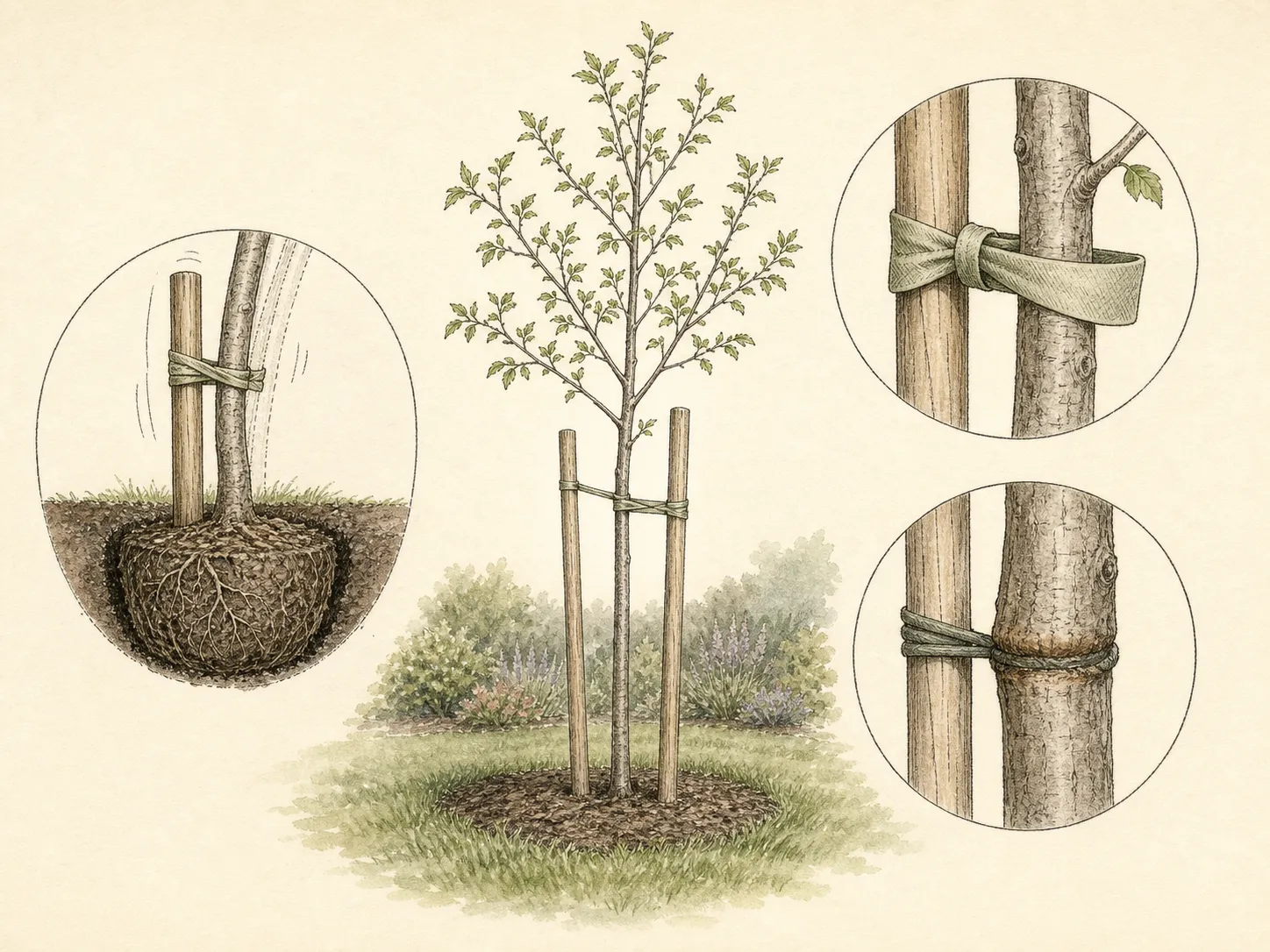
Use movement to separate three problems. Soil that rises at the ball edge indicates anchorage failure. A stable ball beneath a flexible young stem may be normal movement. A sharp bend, split union, hanging leader, or lean that persists while the ball stays fixed points to a structural issue outside routine staking. Test from two directions because a root ball can hold against one wind axis and rock along the other.
Inspect bark under every contact point. Swelling above a tie, a flattened strip of bark, polishing, torn tissue, or a strap trapped in new wood calls for immediate release. Wire, cable, and rope require a broad smooth buffer and clearance from the stem. Nursery canes and labels tied around the trunk belong in the same inspection; their small diameter can girdle a tree even when the landscape stakes are correctly loose.
Read the whole hardware footprint as part of the planting. Tall stakes can rub branches, low anchors hidden in turf can trip a visitor, and guy lines can catch maintenance equipment. Keep anchors visible inside the mulched area and leave an open route to the trunk for watering and inspection. The future increase in trunk diameter makes today's generous clearance temporary, which is why a dated return visit is part of the installation.
Set a visible finish line before beginning
Define the finished condition before loosening a tensioned line: the root flare remains at grade, the root ball stays seated during a gentle trunk test, the stem can move in wind, and no attachment touches bark through wire or cable. Every retained stake needs a legible removal date. Photograph the trunk contact and the entire anchor layout so the next inspection can detect a creeping tie or a shifted stake.
Classify the result immediately after release. Stable ball plus normal stem flex means removal. Moving ball plus an intact stem means a minimal temporary reset and a dated retest. Stable ball plus a pronounced lean, kink, split, or damaged union means staking is not solving the controlling defect. That last class needs qualified tree assessment before stronger tension is applied.
End the inspection when wind makes the trunk hard to control, saturated soil collapses around the ball, a buried utility is uncertain, or the tree is large enough to require winching. A recently wind-thrown tree with heaved roots is a separate operation: Minnesota guidance calls for excavation beneath the lifted root mass before straightening, and larger specimens require specialist equipment. Routine tie adjustment must not become improvised tree recovery.
Prepare the work while every part is still identifiable
Gather broad flexible tree ties, compatible stakes, hand protection, eye protection, a soft measuring tape, and a permanent weatherproof label. Bring a second person for any tree whose crown catches enough wind to move during release. Cutters should match the old wire or strap; a crushing or sawing motion beside living bark is a sign that the hardware needs controlled professional removal.
Expose the root flare and enough of the root-ball edge to see movement while leaving fine roots covered. Mark irrigation tubing and request utility location before a stake changes position. Set tools on the path, not against the trunk. One person controls the lower stem while the other releases attachments individually, which preserves a known support point until the tree's response is understood.
Copy the installation date, tree identity, and original reason for staking into the new record before discarding tags. A reason such as 'west edge of ball lifts in wind' can be retested; 'tree still young' cannot. If the first growing season has elapsed, make removal the default test. An extra season is reserved for movement observed with ties slack, not for uncertainty created by skipping the test.
Carry out the central operation in a controlled sequence
Release the existing ties completely while the lower trunk is controlled, then observe the ball before deciding to rebuild anything. Remove canes, labels, hose-and-wire loops, and redundant stakes from a stable tree. If the ball moves, identify the wind axis and retain the fewest anchors that stop that movement. One stake may serve a small tree; Minnesota guidance adds a second parallel to prevailing wind when one is insufficient.
Drive a replacement stake at the outer edge of the planting hole, clear of the root system and known utilities, and keep it within the mulched bed. Choose the lowest attachment height that controls root-ball lift while leaving the upper stem free. University of Minnesota describes attachment around one-third or two-thirds of the distance to the first branches according to the staking arrangement; contact directly beneath the first branch set concentrates wind load at a vulnerable point.
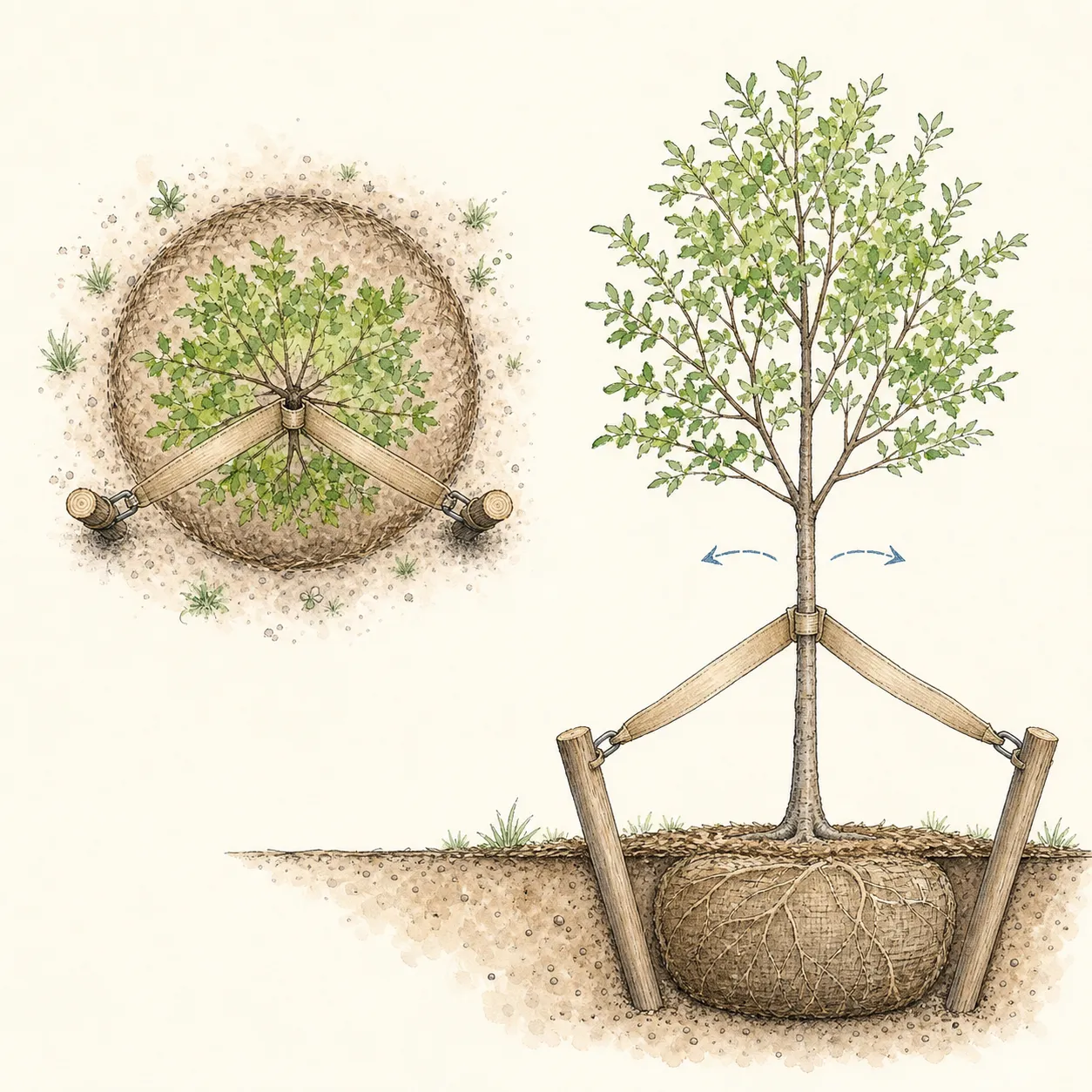
Wrap the trunk only with a broad smooth tie, isolate any wire or cable from bark, and leave visible slack. Push the trunk gently after fastening. The ball should remain seated while the stem still describes a small arc. A strap that goes taut under hand pressure, a trunk held like a rigid post, or a stake that rubs the canopy needs immediate repositioning.
Finish by cutting excess line, covering sharp ends, and confirming that every anchor can be seen from the path. Keep the root flare uncovered and the tree at its planted grade. Tension cannot be used to raise a buried tree or force a damaged stem straight. Those conditions belong to planting correction or structural diagnosis, not routine support adjustment.
Protect roots, crowns, and new growth after the work
Water the original root ball according to weather and soil moisture, keeping the flare visible and mulch clear of the trunk. Support hardware cannot compensate for a dry root ball, saturated planting hole, or settling soil. If watering exposes a void beside the ball, firm loose backfill gently from the surface and repeat the stability test after drainage; pulling harder on the tie would shift the symptom above ground.
Return after the first strong wind and after rain saturates the planting hole. Slack the tie before testing so the hardware does not hide root movement. Compare the same ball edge and wind axis recorded at installation. Fresh abrasion means the contact point is moving across bark; soil heave means the anchorage is still weak. Each finding has a different correction.
Inspect monthly during active growth for swelling, strap indentation, stake lean, and branch contact. Expand a broad adjustable tie before it becomes snug, and remove the whole system as soon as release no longer changes stability. The planned removal date is an upper checkpoint, not permission to leave an unnecessary strap until that day.
Diagnose a weak response before adding another treatment
Persistent rocking after one season deserves a planting diagnosis. Check whether the root flare is at grade, the ball was set on firm soil, water is draining, and new roots are entering surrounding soil. A strap can suppress visible motion during inspection while roots remain confined or the ball settles. Extending support makes sense only when a released test still shows movement and the underlying site can support establishment.
A trunk that leans over a stable ball needs a different assessment. Look for a kink below the soil line, a split leader, included bark at a union, or a crown permanently weighted to one side. Increasing guy tension can add load to damaged wood and distort the planting grade. Large, split, recently wind-thrown, or structurally compromised trees belong with a qualified arborist.
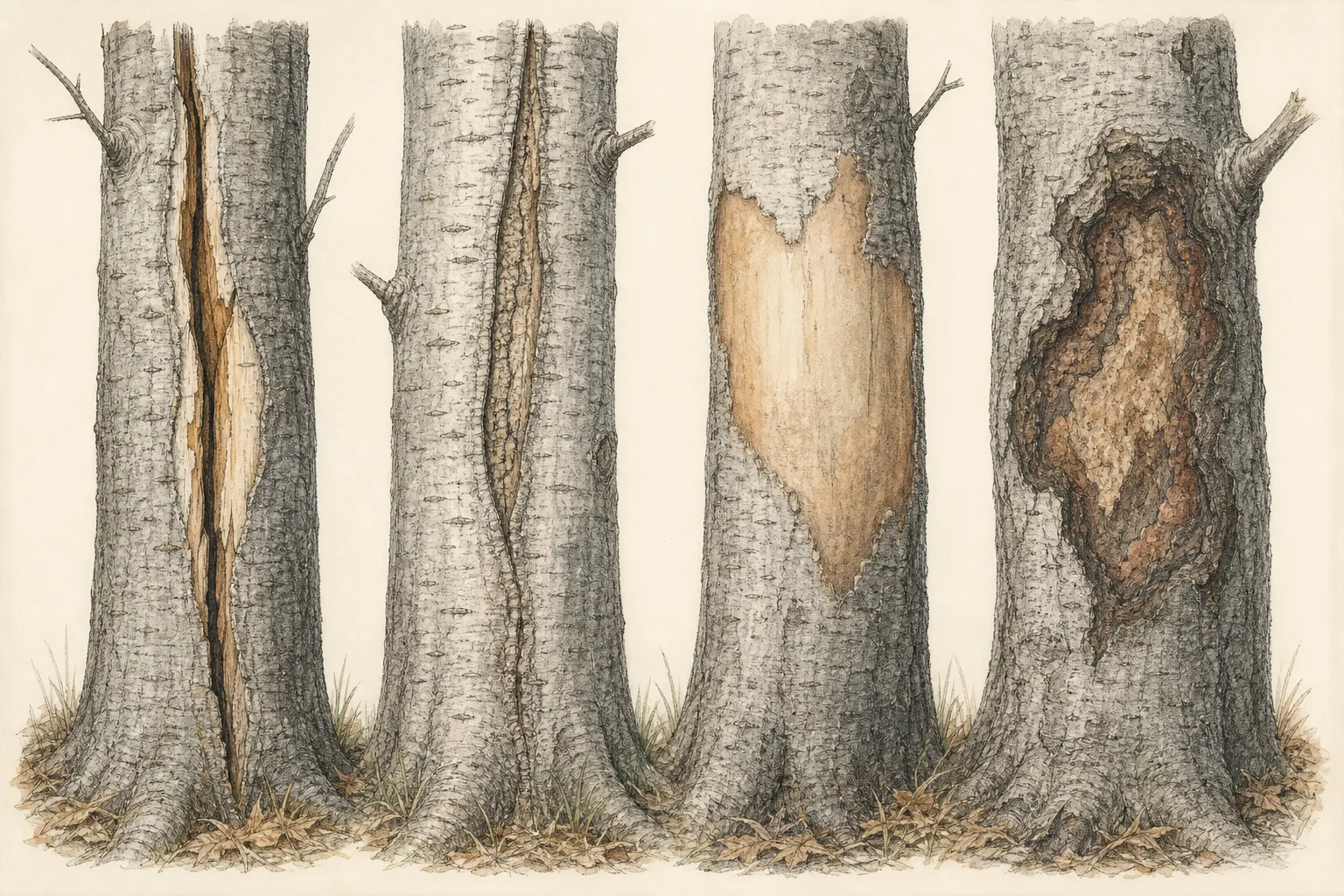
Treat bark symptoms as hardware evidence. A shallow polished patch suggests rubbing; a narrow depression with swelling above it suggests compression or girdling; reverse taper above the attachment suggests prolonged rigid support. Release the contact, photograph the injury, and keep further attachments away from damaged tissue. Wounds, decay, or expanding cracks require professional diagnosis, while a clean shallow abrasion can be monitored after the cause is removed.
Leave a record for the next seasonal decision
Log every stability check with ties slack. Record the weather, soil moisture, direction of hand pressure, and whether the ball edge lifted. Pair a close photograph of trunk contact with a wider image showing the anchor triangle. Those two views reveal strap creep, trunk expansion, a shifted stake, or a new obstruction that a single portrait of the upright crown would miss.
Name each retained component and its measured purpose: west-side ball lift, excessive stem flex, protection from mower traffic, or temporary support after planting. List canes, loops, and redundant anchors removed at the same visit. This inventory prevents a helper from reinstalling discarded hardware simply because an old hole or tag remains visible.
Finish with one dated choice. Remove all hardware when the root ball holds; retain a minimal loose system through one additional growing season when release still changes stability; arrange qualified assessment for windthrow, structural damage, or instability that persists beyond the extension. Put the date on the tie and the garden calendar.
At final removal, extract or cut stakes safely, fill holes, restore the mulch surface, and recheck the root flare. Photograph the unsupported tree and close the record with its current planting grade and ball stability. Future leaning can then be compared with a documented unsupported baseline instead of being attributed automatically to missing stakes.
Steps
- Level
- moderate
- Time
- One focused session, followed by scheduled checks
- Tools
- Gloves, Pliers or cutters, Soft measuring tape, Mallet when new stakes are justified
- Materials
- Broad flexible tree ties, Appropriate stakes or anchors, Removal-date label
- 1Release ties and test the root ball
Choose thawed, stable footing and control the lower trunk before slackening each attachment. Push the stem gently along both wind axes while watching the root-ball edge. A seated ball with continuous trunk flex passes the removal test. Soil lifting with the ball, or excessive folding of an intact young stem, supports a temporary reset and a dated second test.
- 2Inspect bark, grade, and anchors
Expose the root flare, trace the full circumference beneath every tie, and note abrasion, dents, swelling, embedded labels, or reverse taper. Confirm the ball remains at planting grade. Map prevailing wind, slope, irrigation, utilities, mower access, and pedestrian routes. Keep every anchor visible inside the mulched area and clear of roots and buried services.
- 3Remove obsolete nursery hardware
With the stem controlled, remove bamboo canes, trunk-loop labels, hose-and-wire assemblies, broken straps, branch-rubbing stakes, and redundant anchors. Work one attachment at a time so the tree's response stays readable. If the released ball moves, prepare broad flexible ties and the fewest suitable stakes before the last useful support point is taken away.
- 4Reset a loose flexible system
Place a stake at the planting-hole edge, clear of the root system and marked utilities. Start with one for a small tree; add a second along the prevailing-wind axis only when the first leaves the ball unstable. Fit broad smooth contact at the lowest effective height, isolate cable from bark, avoid the first branch union, and leave enough slack for visible trunk movement.
- 5Label the removal date
Write the installation date, observed instability, and next release-test date on a weatherproof tag fixed to the system and in the garden record. Treat one growing season as the normal checkpoint. A further season requires observed root-ball movement or excessive stem bend with ties slack. Keep mulch off the trunk and anchors exposed for inspection.
- 6Retest after wind and rain
Return after strong wind and again after saturated soil drains. Inspect bark contact, slacken the system, and repeat pressure along the recorded axes. Remove hardware when release no longer changes ball movement. Persistent rocking after the defined extension calls for planting-depth, drainage, and root-establishment diagnosis or qualified tree care.
Related reading
Sources
- Staking and guying trees. University of Minnesota Extension. Source record · Accessed 2026-08-30.
- Tree staking. Royal Horticultural Society. Source record · Accessed 2026-08-30.
- Tree Staking and Underground Stabilization. Colorado State University Extension. Source record · Accessed 2026-08-30.