Plant problems · ice storm ornamental tree triage
Triage Ice-Damaged Ornamental Trees After a Storm
Sort ice-storm tree damage by immediate target risk, root-plate movement, trunk or union failure, and the amount of attached structure that remains before you cut, stake, or remove anything.
Published Last updated
In this guide
- Secure the scene before naming the damage
- Read the root plate and trunk first
- Separate suspended failure from attached damage
- Decide what a homeowner can cut immediately
- Reset only small newly planted trees
- Support recovery through the next growing season
- Choose removal when structure or targets make recovery unrealistic
- Diagnosis
Secure the scene before naming the damage
Ice damage is often mismanaged because the first view of the tree is emotional rather than structural. An ornamental maple split over a walk or a flowering crabapple bent into the drive can make the whole tree seem lost even when only one major section failed. Reverse that instinct. Start by asking what can fall, what can strike, and whether the site is electrically or mechanically dangerous. The first goal is not a diagnosis. It is keeping people out of a failure zone until the tree can be read accurately.
Purdue's storm-damage guidance is blunt on the essential first check: inspect from a distance for heaving of the ground, damage to limbs or trunk, hanging branches, and any involvement with utility lines. That distance matters. A brown patch in the canopy may be a broken branch hanging by fibers; a slightly leaning trunk may be carrying a root failure you cannot see from below. A close look too early puts you exactly where a second failure will land. Use binoculars, photographs, or a safer angle before entering the drip line.
Clear the target area around the tree even if the tree itself may recover. Cars can be moved, gates closed, paths taped off, and neighboring containers relocated before a single cut is made. This creates time for better decisions and prevents a recoverable tree from becoming an emergency merely because something remained beneath it. When a tree stands over a house corner, play area, power line, or shared drive, your triage threshold should rise. Target risk changes the correct answer even when the biological injury looks similar.
Note the timing of the storm and what has happened since. Some trees fail under the initial ice load; others hold through the freeze and then split when thaw and wind redistribute the weight. That timeline helps explain whether you are looking at a finished wound or an active one. A branch that is still twisting under a loosening ice sheet is not ready for homeowner pruning. A broken limb on the ground with a clean remaining attachment may be.
Read the root plate and trunk first
A tree with branch loss but a stable root plate is a different case from a tree that tilted in saturated ground. Nebraska Extension points out that wind and saturated soil can push trees to one side while breaking roots that are no longer visible above ground. Ice storms can create the same outcome when a broad crown accumulates weight and then catches wind. Look for mounding or cracking of soil, lifting on one side of the trunk, gaps around structural roots, or a root flare that no longer sits evenly at grade.
Treat root-plate movement as more serious than crown mess. A mature ornamental with lifted roots, churned soil, or a trunk that changed position is usually not a staking project. Nebraska states that mature trees rarely survive attempts to pull them back into place. Even if the canopy looks moderate, the anchoring system has already failed. Homeowners often misread this because the branches are what they can see. In triage, the underground failure outranks the visible branch breakage.
Then inspect the trunk and major unions. Vertical trunk cracks, scaffold unions opening under their own weight, or codominant stems separating under ice indicate structural damage that cannot be solved with a cosmetic cleanup cut. The more weight that remains beyond that split, the less time you have to decide. If the union is actively open, do not stand beneath it and do not wrap it with rope as a temporary home repair. A tied split is still a split, and the tie hides movement rather than correcting it.
Small newly planted trees are the exception, not the rule. Minnesota guidance allows immediate straightening and guying for minor uprooting of smaller trees when roots can be re-covered and correction happens right away. That means the tree is recently planted, manageable from the ground, and not carrying a torn, mature root plate. The presence of this narrow rescue category is exactly why the first question must be age and scale. What is appropriate for a new ornamental cherry is wrong for a thirty-foot magnolia.
Separate suspended failure from attached damage
Hanging branches, torn but attached limbs, and cleanly broken branches on the ground each imply different urgency. A branch suspended by fibers over a path is an immediate hazard even if the trunk is sound. A clean break already on the ground may leave a repairable wound on the tree. A torn limb with bark ripped down the stem often looks minor from below because foliage still masks the wound. It is not minor. That torn attachment becomes a long entry point for decay and often drops further before the gardener returns with tools.
Classify every major defect into one of four buckets: suspended and ready to fall, split but still bearing load, broken and detached, or bent but attached. This prevents the common mistake of treating the whole canopy as one problem. Iowa's storm-damage guidance emphasizes careful evaluation because different storm injuries ask for different action. The only category that routinely invites immediate homeowner work is a reachable detached or clearly hanging piece that can be removed with proper cuts from stable ground. Everything carrying trunk-scale load deserves a more conservative threshold.
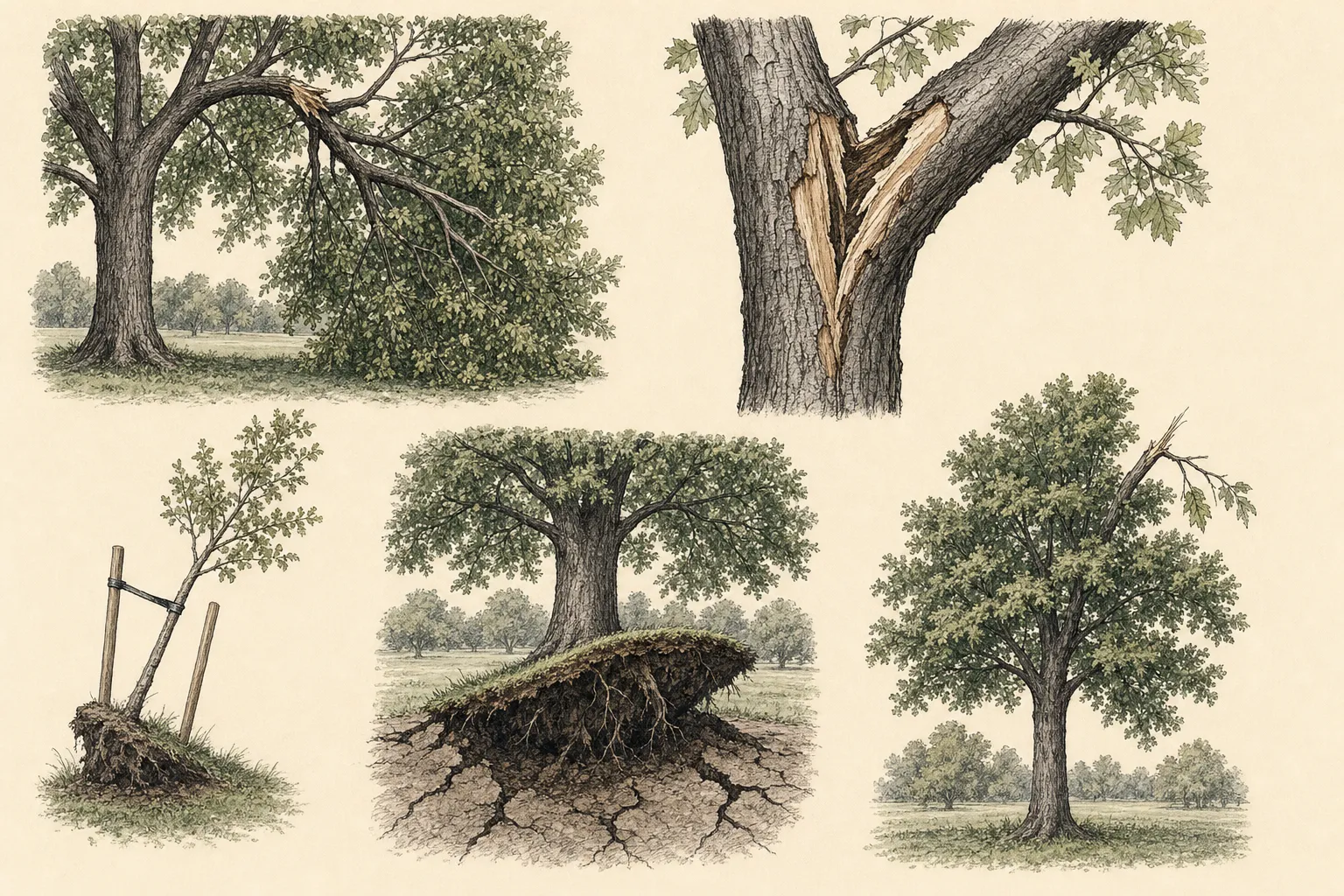
Do not confuse apparent symmetry with attachment soundness. Ice can strip one side of the canopy, leaving the opposite side to look balanced enough that the tree seems stable. Yet the remaining load may now be offset onto a split union or damaged trunk. Step around the tree and compare branch architecture from more than one side. A view from the house may hide the very split that will determine whether the tree is kept or removed.
Use color change as a delayed clue, not a first test. Purdue notes that a patch of brown foliage in the canopy often signals a broken branch that may be hard to spot immediately after a storm. This is helpful several days later, when hanging hidden damage begins to reveal itself. It is not a reason to shake branches or poke into the canopy looking for a weak section. Let symptoms come to you where hazard is uncertain. Triage works by reading evidence already present, not by manufacturing new movement.
Decide what a homeowner can cut immediately
Homeowner cutting begins and ends with safe-reach wood that no longer carries meaningful structural load. That usually means small damaged branches, fully detached pieces, or a hanging branch that can be controlled from stable ground with proper hand tools. Minnesota's storm-damage guidance and Nebraska's storm-pruning notes align here: remove damaged smaller branches to a proper lateral or branch collar, eliminate jagged stubs, and use the three-cut method on wood too heavy to support with one hand. The cut should solve a specific safety or wound problem, not launch a full restoration campaign.
The cut matters because storm damage tempts people into fast stub removal. Nebraska stresses that branch stubs should be given a clean cut so only branch wood is removed and trunk tissue is not injured. This is more than tidiness. Smaller, correctly placed wounds close more effectively and are less likely to invite secondary decay. If you cannot clearly identify the branch bark ridge and collar because the branch is twisted, split, or too large to control, you are outside the homeowner zone.
Do not use wound paint, cavity filler, rope wraps, or heavy hardware as emergency first aid. None of these turns broken wood back into continuous structure, and some make later professional assessment harder. The immediate tasks after a manageable branch failure are to remove the hazard cleanly, keep the wound readable, and prevent further tearing. If a branch is too large for a controlled three-cut sequence from the ground, that alone is enough reason to stop.
Pruning is also not triage when it requires the tree to be climbed, a ladder to be leaned into the canopy, or a chain saw to be used among hanging ice-laden parts. The line between urgent and unsafe is where many homeowner injuries happen. A tree with a split trunk does not become a do-it-yourself job because the gardener owns sharp tools. In winter storms, restraint is one of the most professional decisions available to an amateur.
Reset only small newly planted trees
Recently planted ornamental trees sometimes lean or partially lift after ice and wind without losing most of the root plate. This is the narrow situation where resetting may be worthwhile. The tree should be small enough to move without machinery, the soil disturbance limited, and the correction immediate. Minnesota recommends keeping the roots covered and moist, staking evenly around the tree, and avoiding thin rope or wire against the trunk. Those specifics matter because a reset tree fails not only from the storm injury but from the quality of the correction.
Pull the tree back only until it stands naturally upright, then press out air pockets with existing soil around the roots. Do not excavate a giant bowl or import rich loose soil that behaves differently from the surrounding ground. The point is to restore firm contact, not to repot the tree in place. A mulch ring outside the trunk flare helps conserve moisture and protect the base from mower damage, but it is not a mound over disturbed roots. Keep the flare visible.
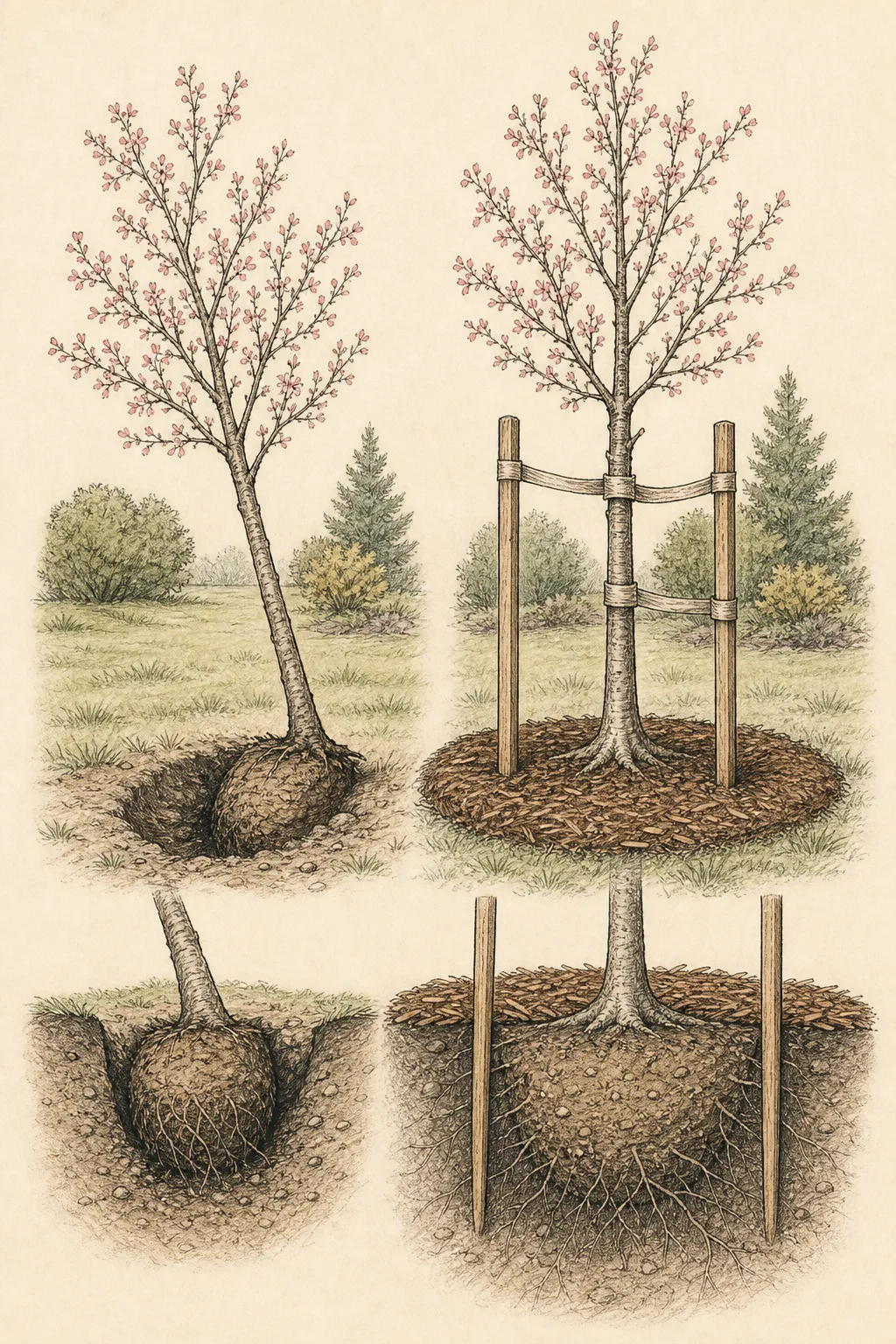
Stakes and ties are temporary structural aids, not permanent braces. Use broad materials, attach them low enough to stabilize but high enough to allow some natural movement, and set a clear removal date. Thin wire, hose over wire, or forgotten nursery straps create a second injury that may outlast the storm damage. Resetting is successful only when the tree can return to independent anchorage after the immediate recovery period.
Do not extend this method to mature trees, heavy multi-stem ornamentals, or any tree with a plate of exposed roots. Nebraska is explicit that mature trees rarely survive being pulled back upright. Trying anyway often breaks more roots, destabilizes the soil further, and leaves a tree that looks saved but fails in a later wind. A reset is a small-tree exception. It is not a general answer to ice damage.
Support recovery through the next growing season
Trees kept after ice damage recover by reallocating energy, sealing wounds, and rebalancing canopy function over time. They do not recover because a gardener demanded symmetry in one weekend. Nebraska advises a wait-and-see attitude in many storm cases, paired with good watering and mulch rather than automatic fertilization. That patience is especially important after partial crown loss. A sound tree may leaf out unevenly, push sprouts near breaks, or hold some browned sections longer than the gardener expects. These are observations to record, not reasons to begin repeated corrective cutting.
Water by condition, not panic. Storm-damaged trees can benefit from reduced drought stress during the following growing season, but saturated roots and reflex fertilization create their own problems. Nebraska specifically warns against automatically fertilizing to help a tree recover, because fast lush growth can come at the expense of root and wound response. Use mulch to reduce mower injury and conserve moisture, then let actual soil dryness, weather, and tree vigor determine irrigation.
Expect delayed consequences. Hidden branch failures may turn brown later; weakened tissue may invite opportunistic pests; and a tree that kept enough canopy to look hopeful in February may struggle during the first hot dry spell of summer. Purdue's emphasis on early inspection remains relevant months later: continue looking for trunk damage, hanging deadwood, and soil movement after the obvious ice is gone. The storm event is over before the biology is.
Reprune only when the next stage is clear. Some broken areas should be cleaned once dead margins are obvious. Some epicormic sprouts should be retained temporarily to help restore photosynthetic capacity before later structural selection. Some flowering ornamentals will lose bloom if winter cuts are made aggressively. Triage and restoration are related but different tasks. The first answers whether the tree can safely remain. The second decides how it will be shaped, monitored, and managed over years.
Choose removal when structure or targets make recovery unrealistic
Some trees can recover biologically and still be poor candidates to keep. An ornamental pear with chronic weak unions, a magnolia over a narrow drive with a lifted root plate, or a conifer split down the center beside a play area may all be recoverable in the abstract and unacceptable in place. Nebraska notes that trees split down the middle are very difficult to brace adequately and should be removed by a professional arborist. That judgment is not pessimism. It is a recognition that structure, target, and species habit all belong in the same decision.
Removal is also the prudent answer when the correction would itself be unmaintainable. A tree that needs repeated cabling, permanent exclusion around a major target, or constant corrective pruning to offset storm weakness is announcing that the site and the structure no longer suit each other. Home landscapes are not arboretum intervention projects by default. If the labor and risk required to keep the tree sound exceed the landscape value it returns, replacement is often the more rigorous choice.
Use removal as a design lesson. Ice exposes weak-wooded species, included bark, broad horizontal branch habits, and poor placement under utility corridors or over pavement. When a tree comes out, replace with a species and form better matched to local winter loads, mature space, and target pattern. Iowa's storm-susceptibility guidance is useful here: broad crowns, included bark, and old internal decay all increase failure risk. The next tree should be chosen with those failure patterns in mind, not simply as the same flower color in a new root ball.
Keep a record of what decided the case: exposed roots, hanging branch over a target, split trunk, only minor crown damage, or successful young-tree reset. Triage improves when the gardener can compare real outcomes rather than memory of one frightening storm day. Over time, that record becomes a better pruning and planting guide than any single dramatic before-and-after image.
Diagnosis
A branch or major limb is hanging, suspended, or visibly cracked above a path, driveway, car, or seating area. The canopy may still look leafy because fibers, bark, or a smaller attached branch are carrying the piece, but the damaged section can drop without warning as ice melts or wind shifts the weight.
- Check
- Inspect from outside the drip line for utility conflicts, ground heaving, trunk cracks, and the exact attachment still holding the limb. Determine whether the branch can be removed from stable ground with a controlled cut or whether any attempt to reach it would place a person beneath suspended load.
- Cause
- Ice accumulated on exposed branches until weight exceeded the strength of the attachment, often where a long horizontal limb, old wound, or narrow union was already weak. Melting and wind can then finish the failure, which is why a leafy limb may remain suspended after the main break has already happened.
- Action
- Exclude people from the target area immediately and remove the hazard only if the wood is within safe reach from stable ground. Use correct pruning cuts and a three-cut sequence on heavy branches. If the branch is overhead, entangled, electrically involved, or too heavy to control, call a qualified arborist instead of improvising beneath it.
A scaffold union or trunk shows an open split, a deep crack, or a seam widening under the remaining load. The canopy beyond that point may still be attached and green, which can make the defect look less urgent than it is. Any movement at the split raises the hazard level immediately.
- Check
- Walk the tree from several angles, photograph the split, and look for included bark, widening movement, or load still borne beyond the crack. Check whether the trunk or union is carrying canopy weight that would be released only by professional reduction or removal rather than by simple cleanup pruning.
- Cause
- A codominant union, included bark seam, preexisting crack, or old structural defect failed under the concentrated ice load. The remaining crown now continues to lever against the split, so the defect is not only a wound but an active structural problem.
- Action
- Do not wrap, cable, or bolt the split as a homeowner fix. Keep the area closed and obtain professional assessment for reduction, bracing, or removal. If the split involves the trunk or a main scaffold over a target, assume the decision is beyond ordinary cleanup pruning until proven otherwise.
A recently planted young tree leans or partially lifts, but the tree is still small, the exposed root area is limited, and the trunk has not fractured. Soil may have opened on one side of the planting hole, yet the root flare and most of the root zone remain close to grade.
- Check
- Confirm the tree is small enough to reset by hand, recently planted enough that roots have not fully spread into the site, and still has a mostly covered root system. Inspect the trunk for abrasion or breakage and decide whether roots can be re-covered immediately without forcing the tree from a major root-plate failure back into position.
- Cause
- The planting had not fully anchored yet, and the combination of wet soil, wind, and ice shifted the small root system without destroying it. Damage is still serious, but it may remain within the narrow range where immediate resetting and staking can restore the tree if most roots remain covered and intact.
- Action
- Re-cover roots at once, straighten the tree only to a natural vertical, press out air spaces with native soil, mulch outside the flare, and stake evenly with broad ties. Schedule tie removal and monitor moisture through the next growing season. If major roots are exposed or the trunk is damaged, move this case into the removal category instead.
A mature tree or older ornamental tilts and the soil mounds, cracks, or lifts around the root plate. Structural roots are exposed, the trunk position has changed, or the tree rocks in wind. The canopy may not look badly broken even though the anchoring system has already failed.
- Check
- Treat the root plate as the primary defect. Look for exposed structural roots, soil cracking, mound lift, a shifted trunk line, and movement when wind pushes the canopy. Compare the target risk around the tree with the biological value of the plant, because a mature uprooted ornamental is often a removal decision rather than a restoration project.
- Cause
- The root system lost anchorage in saturated or shallow soil under the weight and leverage of the canopy. Once a mature plate lifts, large roots break and the tree rarely returns to sound long-term stability even if it is pulled upright for a time.
- Action
- Arrange professional removal and replacement. Mature trees with lifted root plates are poor candidates for resetting, and attempts to save them often create a hidden future hazard. Keep exposed roots moist only until removal can occur and do not allow repeated rocking to enlarge the root failure.
The crown lost twigs and some branches, but the trunk is intact, the root plate is stable, and no large structural union opened. The tree looks ragged, with torn branch ends and possibly a brown patch later in the canopy, yet most scaffold attachments remain sound and the failure is not concentrated over a high-value target.
- Check
- Differentiate minor breakage from hidden structural loss. Check torn branch stubs, branch collars, late-browning foliage patches, and any offset load caused by the missing canopy. Confirm that the root plate is stable and that corrective pruning can be done without climbing, large hardware, or cuts into trunk tissue.
- Cause
- Small and medium branches failed under load while the main structure remained intact. Trees with sound trunks and stable roots often survive this kind of damage, especially if pruning is conservative and secondary drought, pest, and mower stress are limited during recovery.
- Action
- Prune torn and broken branches back to proper laterals or collars, leave the trunk unwounded, mulch the root zone, and water during genuine dry periods rather than fertilizing reflexively. Photograph the tree, recheck later-browning sections, and plan structural follow-up only after the growing season reveals what living framework remains useful.
Related reading
Sources
- How to Manage Storm-Damaged Trees. Iowa State University Extension and Outreach. Source record · Accessed 2026-08-19.
- Tips for Storm-Damaged Trees, Purdue Landscape Report. Purdue University Extension. Source record · Accessed 2026-08-19.
- Managing Storm Damage in Trees and Landscape Plants. Nebraska Extension Lancaster County. Source record · Accessed 2026-08-19.