Grow · winter watering dormant container perennials
Water Dormant Container Perennials in Winter Storage
Check winter-stored container perennials by storage method, temperature, drainage, and thawed root-zone moisture so dormant crowns stay alive without being forced into wet rot or early growth.
Published Last updated
In this guide
- Know which storage system you are watering
- Check thawed medium before adding winter water
- Build a winter moisture reference before everything freezes
- Water only when roots can actually use it
- Read dry cores, wet rims, and frozen pots correctly
- Keep drainage open and containers out of standing water
- Monitor evergreen and semi-evergreen tops without forcing growth
- Hand off gradually to late winter and spring
- Steps
Know which storage system you are watering
Winter watering decisions begin with the storage method, not with the calendar. A buried pot, a grouped pot set outside against a wall, and a dormant perennial stored in an unheated garage do not warm, drain, or lose water in the same way. If you treat them as one category because all three are dormant, you will overwater at least one and ignore a drying risk in another. The first job is to identify the exact storage environment and how quickly it changes after a thaw.
Iowa State's overwintering guidance separates the two main holding methods clearly. Buried or heeled-in containers benefit from the insulating effect of surrounding soil, and once that soil freezes, supplemental irrigation is not necessary until thaw. Containers in an unheated structure, by contrast, can need moisture checks through winter because their potting mix may thaw and dry even while the plant stays dormant. One method stores the root ball inside a slow outdoor temperature mass. The other stores it in protected cold air.
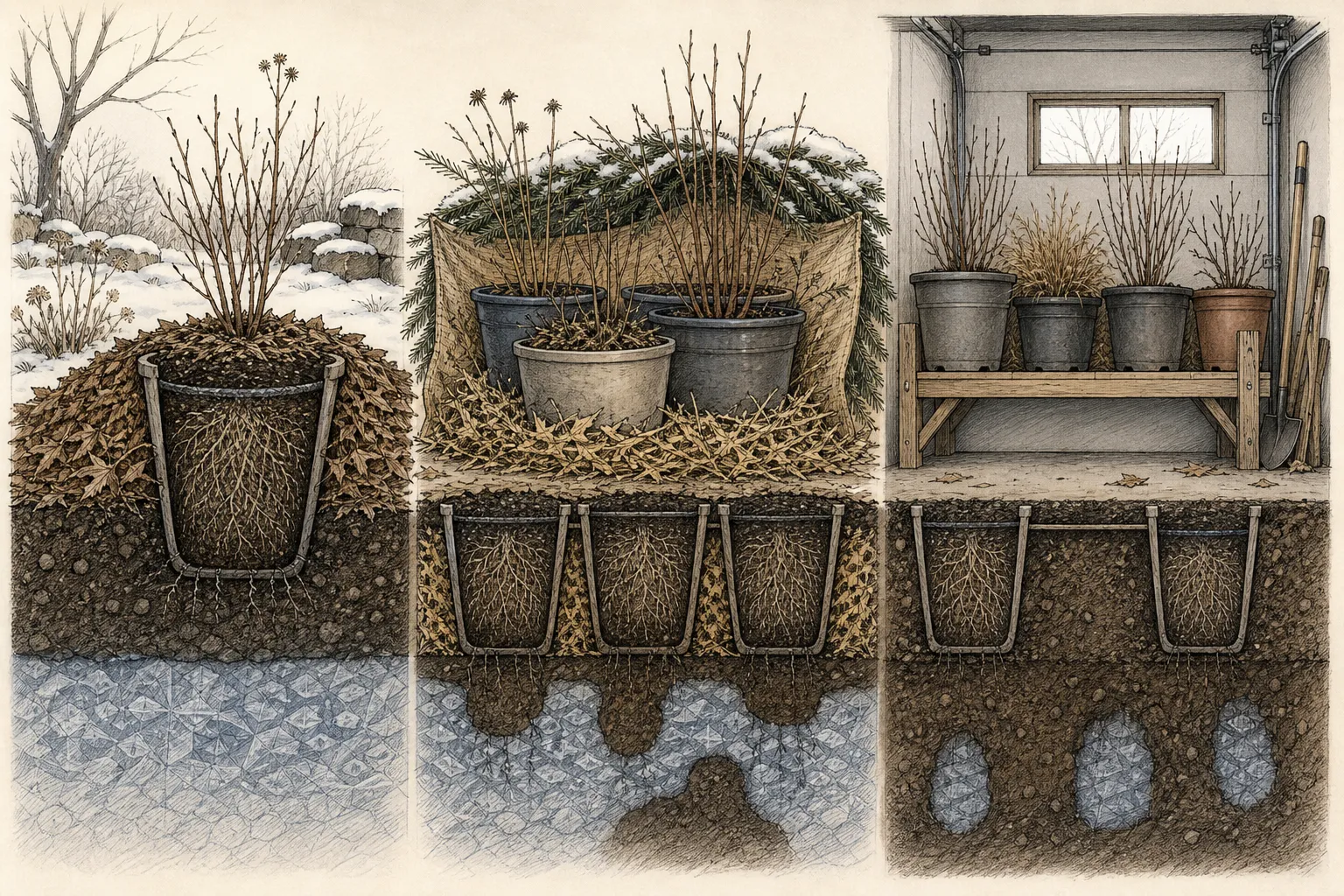
University of New Hampshire adds a third common home reality: grouped containers left outside in a protected place. Those need watering until the soil freezes and then again whenever temperatures rise above about 40 degrees and the pots show actual drying. That is different from watering every mild spell. The source is describing a check-and-confirm routine, not an automatic chore tied to the first warm afternoon.
The system you chose in autumn therefore controls the winter question. Buried pots are mostly a thaw-edge and spring-wake problem. Unheated garage pots are a dormant-but-thawed problem. Grouped outdoor pots are a weather-window problem. Once that difference is clear, the rest of the watering method becomes much easier to read.
Check thawed medium before adding winter water
Identify the storage method, wait for a usable inspection window, and establish whether the root ball is genuinely dry. Frozen medium cannot be read as ordinary dryness. When watering is needed, confirm that excess leaves the container; trapped runoff requires correction first. Increase inspections as thawing and bud movement change the pot from dormant storage to active growth.
Build a winter moisture reference before everything freezes
A dormant perennial should enter storage evenly moist and fully drained, not already drought stressed and not sitting in a saucer of water. This is the baseline from which every later winter decision is made. Water thoroughly before the holding system freezes in, then allow the container to drain completely. That one event creates a useful comparison: what the pot weighs, how the upper medium looks, and how the root ball feels when it is hydrated and cold rather than waterlogged.
Iowa points out that drainage changes when a pot is buried in soil. Water moves out more slowly than it does from a pot sitting above ground. This is exactly why you need a baseline before winter settles. A gardener who remembers only summer watering behavior will misread a heeled-in pot in January. What felt dry quickly in July can remain adequately moist for a long time in cold buffered storage.
Do the same preparation in an unheated structure. Iowa recommends monitoring soil moisture carefully in these moderately cold locations, often in the 20 to 45 F range. That monitoring is only meaningful if you know what an acceptably moist dormant pot felt like on the day you stored it. A pot that goes in already dry invites panic watering later because every check starts from an unhealthy baseline.
This is also the moment to remove saucers, clear blocked drainage holes, and label the most vulnerable pots. A dormant perennial can survive being quiet for weeks. It survives much less well being sealed into standing water or misidentified so long that the wrong plant gets the scarce protected shelf space. Winter watering works best when storage began with accurate setup.
Water only when roots can actually use it
Dormant roots do not benefit from water they cannot absorb. A frozen pot does not need irrigation simply because the air temperature reached a pleasant number for an hour. UNH's rule is more useful: dormant plants brought into a cold indoor shelter should be watered periodically whenever the temperature is above 40 degrees. The key words are dormant, periodically, and above 40. This is a condition under which roots may actually use water, not a requirement to water every time the thermometer crosses that threshold.
Iowa adds a similar principle for unheated structures, noting that water may be needed every two to three weeks if temperatures are above freezing. The phrasing matters. It may be needed. That means you check the pot. You do not pour a fixed amount on a fixed date because the garage happened to stay at 36 F last week. Winter storage favors confirmation over habit.
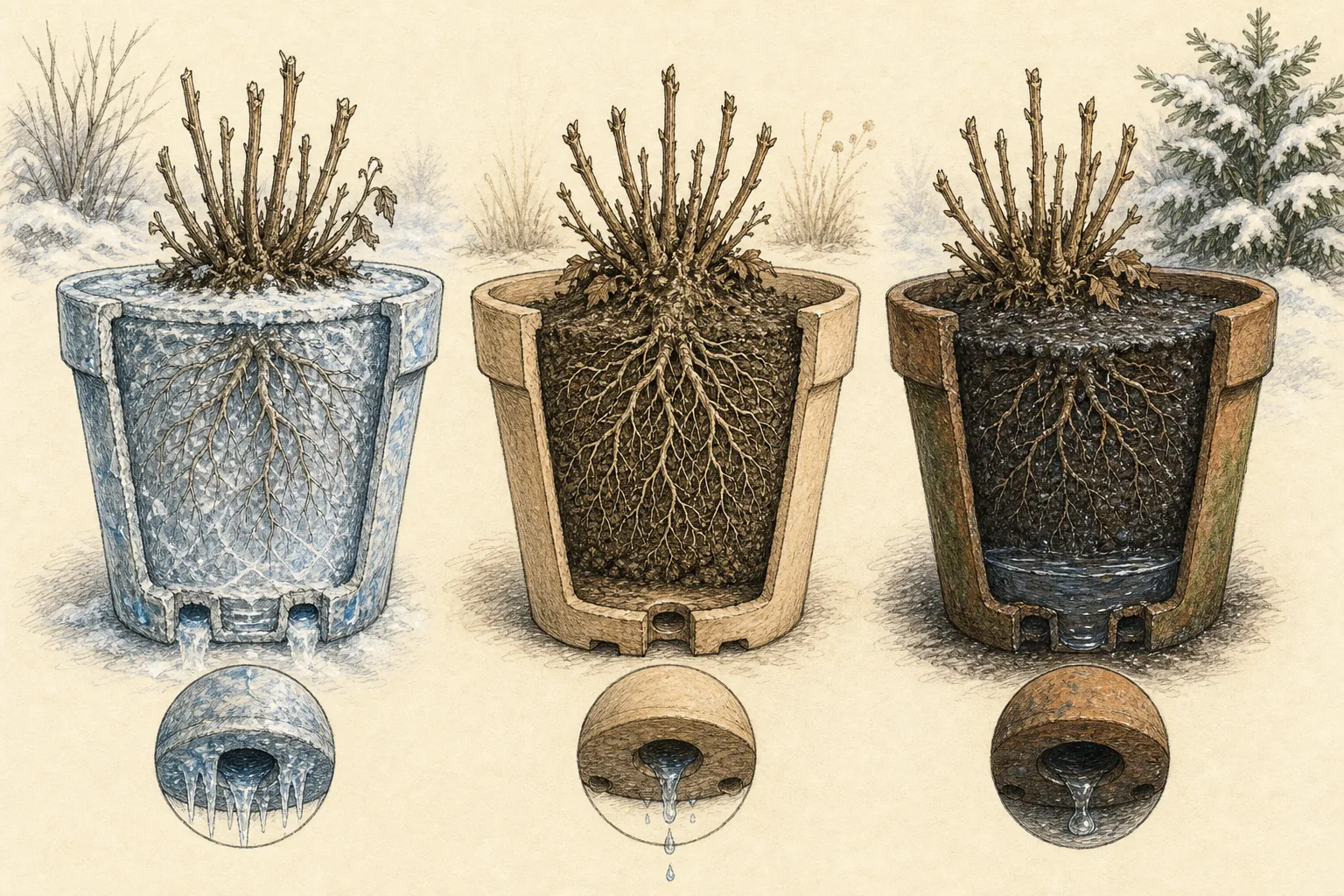
The UMass principle completes the decision: the goal of overwintering container-grown ornamentals is to keep them cold and alive, not actively growing. Watering that pushes a dormant root ball toward constant warmth and wetness defeats the whole strategy. If the pot is still cold, heavy, and damp, leave it alone. If the pot has thawed enough to be assessed, the medium is dry through the root ball, and the storage temperature allows uptake, then water and let it drain again.
In practice, winter watering is a yes-or-no decision made in a narrow biological window. If the roots are locked in ice, no. If the roots are thawed but the pot is still moist, no. If the roots are thawed, the medium has dried, and the plant remains in a dormant storage range, yes. The decision is simpler and safer when written that way.
Read dry cores, wet rims, and frozen pots correctly
A dormant winter pot can mislead you if you judge only the surface. The top inch may look dusty while the center of the root ball remains cold and moist. Or the outer rim may feel wet where condensation and minor thawing collect, while the interior root ball has dried more than you expect in an airy garage. This is why winter watering should never be based on a quick glance from above. Use the weight of the pot, the feel below the surface where accessible, and the storage history together.
Buried or tightly grouped pots often dry from the crown outward much more slowly than isolated pots on open shelves. Outdoor grouped containers may develop a crust of frozen surface medium while deeper layers remain usable once temperatures rise. Unheated indoor storage can create the opposite pattern: the surface thaws and looks workable while the pot interior is still cold enough that added water simply sits. The root ball has to be read as a three-dimensional object, not as a top dressing.
Do not thaw a pot on purpose just to make a winter watering easier. Bringing one dry-looking container into a warm room encourages premature growth and complicates the condition you were trying to assess. Let the storage environment deliver the check window naturally. If the pot has not thawed there, it is not ready for a meaningful water decision.
When you do water, water through the root ball and stop. Dribbling small rescue sips onto the surface can leave the center dry and the crown overly wet. Dormant perennials are not thirsty houseplants. They need an occasional complete correction when the check shows real dryness, followed by a return to cold drained storage.
Keep drainage open and containers out of standing water
Winter storage kills as many container perennials by trapped water as by dryness. Iowa warns that buried containers drain less readily and that overwatering promotes root, crown, and foliar diseases. UNH warns that grouped outside containers still need water only as long as temperatures and drying conditions justify it. Both sources point to the same practical rule: every winter watering has to end with a way for excess water to leave the container.
This matters most in unheated structures where a saucer, sleeve, or tray can quietly hold water against the base for weeks. A plant that is dormant and apparently resting can be rotting below the crown simply because the pot never stopped standing in runoff. The colder the storage, the slower that damage may declare itself. By the time spring growth fails, the winter mistake feels invisible. It was actually mechanical: nowhere for water to go.
Check drainage holes during every winter inspection and after every thaw cycle. Ice can block them, buried soil can press against them, and grouped pots can settle enough that one container creates a puddle against another. Correct the drainage path before you add more water. This is often the most important winter action you take.
Remember that dormant perennials can also be killed when accumulated water freezes in the pot. That is why outside grouped containers and above-ground pots need drainage as urgently as indoor-stored ones. A wet pot that refreezes hard is not hydrated. It is physically more dangerous to the root system.
Monitor evergreen and semi-evergreen tops without forcing growth
Not every container perennial disappears neatly to the soil line. Some carry evergreen rosettes, semi-evergreen foliage, or persistent crowns that continue to lose a little moisture through winter. These plants deserve observation, but not a warm-room rescue. If the storage method keeps them within their intended dormant range, the top growth should be read as part of the moisture and exposure story, not as a cue to wake the plant indoors.
A bit of winter bronzing or weather wear on evergreen foliage does not automatically mean the root ball needs immediate water. Check the medium first. If the pot is frozen or still evenly moist, more water will not help the exposed leaves. Protection from drying wind or midday winter glare may be more useful, especially for grouped outdoor containers. UMass emphasizes the need to keep stored plants cold and alive rather than encouraging active growth, and that distinction is crucial here.
If one semi-evergreen pot repeatedly dries while others of the same storage batch remain stable, ask why. Is it smaller, more exposed, set closer to a vent, or carrying more foliage mass than the rest? Winter watering should be adjusted for the actual plant and its micro-position, not averaged across the whole lot for convenience. A dormant collection becomes much easier to keep when outliers are identified early.
Delay hard pruning of winter-worn tops until spring response clarifies what is alive. Dormant storage is not a beauty contest. A rough-looking crown may recover fully once roots resume normal function, while a neatly trimmed crown may have lost the last living tissues you needed to judge. Watering and pruning should both wait for real biological cues.
Hand off gradually to late winter and spring
The watering routine changes again when winter loosens. Buried pots that needed little or nothing through freeze may need attention once the surrounding soil thaws. Unheated structure pots may dry more quickly as daylight and air movement increase. Grouped outdoor pots may experience repeated freeze-thaw cycles that make drainage and moisture checks more frequent. This is the transition season in which an old winter rule can suddenly become wrong.
Iowa recommends pulling buried containers once extreme winter temperatures have passed and the soil thaws, and removing insulating straw before plants break dormancy. The reason is not only temperature. Once the root zone becomes active, the plant moves out of dormancy management and back into growth management. If you keep watering as though the plant were still fully asleep, you may miss the moment when it needs regular spring care. If you keep it buried and saturated too long, you may hold it in a condition it no longer wants.
Use the first real signs of wake-up as a new reference point. Swelling buds, fresh crown growth, and longer thaw periods mean you are no longer simply preserving the plant. You are preparing it to resume growth. Watering can then move from dormant correction to active support, still with drainage and weather in mind. One of the biggest late-winter mistakes is treating the plant as either fully asleep or fully awake when it is actually crossing the border.
Record what happened in storage: which pots dried sooner, which never needed a midwinter drink, which sat too wet, and which method kept crowns safest. That record turns one winter's guesswork into next winter's setup. Container perennials survive better when the gardener remembers the storage system they actually had, not the one that sounded right in autumn.
Steps
- Level
- moderate
- Time
- 5 to 15 minutes per check, with longer reviews after thaws
- Tools
- Waterproof labels, Watering can, Gloves, Thermometer for storage area
- Materials
- Free-draining storage setup, Mulch or straw only where the storage method calls for it, Stable trays or shelves that allow drainage to leave the pot
- 1Identify the storage method
Sort the collection into buried pots, grouped outdoor pots, and pots stored in an unheated structure. Each one thaws, dries, and drains differently, so the correct winter watering decision begins with where the pot is being held.
- 2Start from an evenly moist baseline
Before the storage system freezes in, water thoroughly and let the container drain completely. Remove saucers or sleeves that trap runoff so the winter checks begin from a healthy dormant root ball rather than from hidden standing water.
- 3Wait for a usable check window
Do not water frozen containers. Check only when the storage method has thawed enough that roots could actually use moisture: above-freezing conditions in a cold structure or outdoor windows when temperatures rise and the pot is no longer locked solid.
- 4Confirm real dryness
Use pot weight, below-surface feel where possible, and storage history to decide whether the root ball has actually dried. A dusty surface or a single mild afternoon is not enough evidence on its own.
- 5Water through and drain
When the dormant root ball is thawed and dry, water evenly through it and allow complete drainage. Empty any collected runoff and return the pot to cold storage. Do not keep adding small sips to the surface.
- 6Adjust for foliage and exposure
Watch evergreen or semi-evergreen pots, smaller containers, and the most exposed positions more closely, but still confirm moisture before watering. A rough-looking crown can reflect exposure without needing immediate irrigation.
- 7Shift the routine as spring approaches
As soil thaws and buds begin to move, transition from dormant preservation to active spring support. Recheck more often, remove storage materials as the method requires, and update your record of which storage pattern stayed too wet, too dry, or most stable.
Related reading
Sources
- Overwintering Unplanted Trees, Shrubs and Perennials. Iowa State University Extension and Outreach. Source record · Accessed 2026-08-19.
- How Can I Overwinter Perennials Still In Containers?. University of New Hampshire Extension. Source record · Accessed 2026-08-19.
- Overwintering Container-Grown Ornamentals. University of Massachusetts Amherst Extension. Source record · Accessed 2026-08-19.