Grow · store bare root roses delayed autumn planting
Store Bare-Root Roses When Autumn Planting Is Delayed
Keep dormant bare-root roses cool and their roots moist during an autumn planting delay, then choose heeling-in or a draining pot when a brief packaged hold is insufficient.
Published Last updated
In this guide
- Keep the roots protected while the bed waits
- Read the stock and its growth stage on arrival
- Choose a short hold by temperature and packaging
- Find a temporary site that actually drains
- Heel the dormant roses in with every root covered
- Use a pot when workable ground is unavailable
- Watch for changes that end the dormant holding routine
- Lift carefully when the permanent bed is ready
- Steps
Keep the roots protected while the bed waits
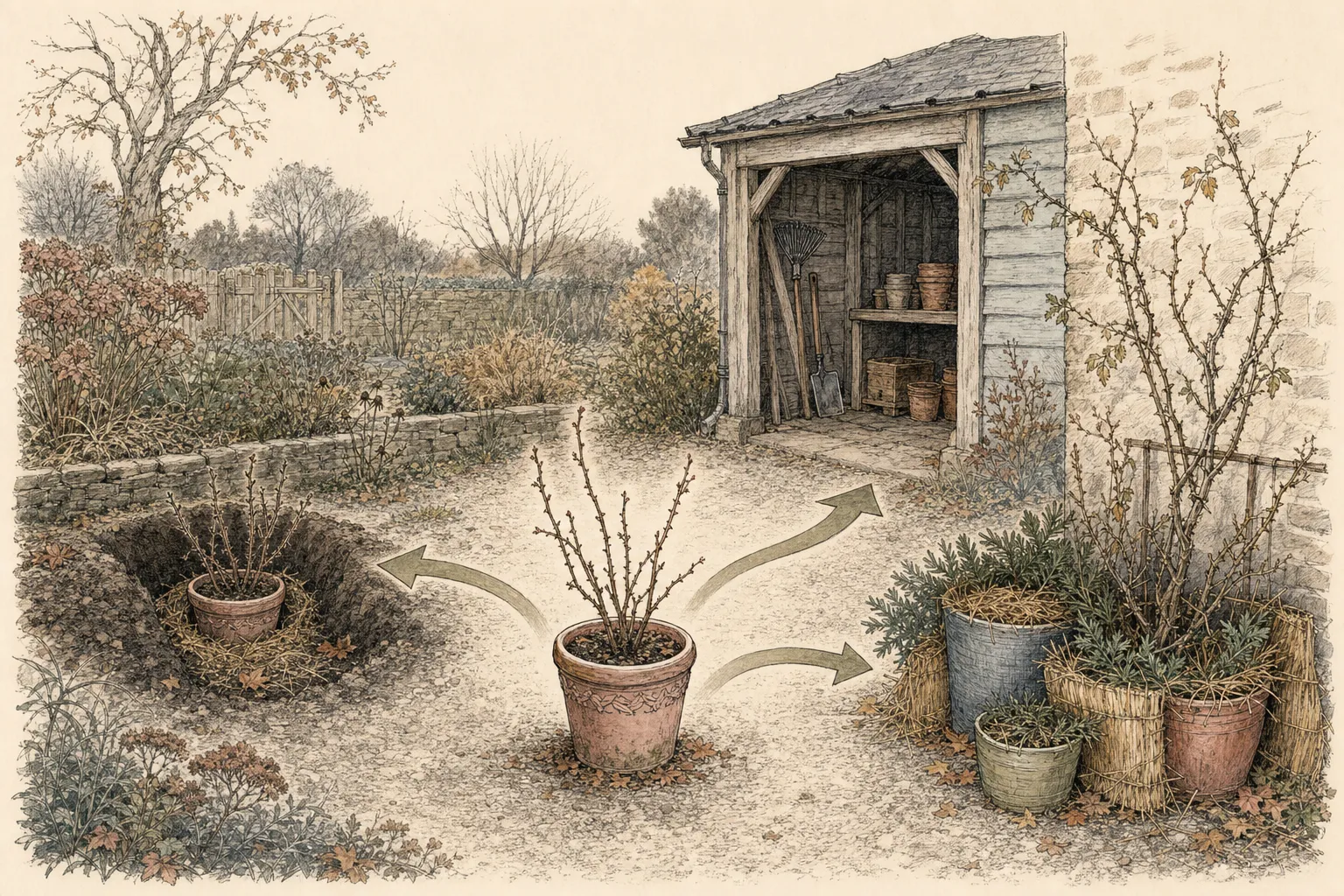
If bare-root roses arrive while the planting bed is frozen, saturated or unfinished, keep their roots protected immediately. For a brief delay, retain suitable moist packing and use a cool, frost-free place. For a longer delay, temporarily heel the dormant plants into workable, well-drained ground or put them into suitable draining containers. Check their condition during the wait and plant permanently as soon as the site and local season allow. A bucket of water is a short preparation step, not a storage place for several weeks.
This is a common decision around the start of the UK bare-root season, when an early-November delivery may meet persistent rain. The season is regional: RHS guidance includes late-autumn planting at leaf fall, whereas the US Extension accounts mainly describe spring deliveries. Their moisture and cool-storage principles are useful here; their spring planting calendar should stay attached to its own climate. In a severely cold region, arrange a locally suitable delivery and holding plan before ordering autumn stock.
Deal with the rose and the bed as two separate tasks. First prevent exposed roots drying in wind or a warm room. Then decide whether the planned delay is short enough for the package and storage conditions you actually have. Repeatedly opening the parcel on the kitchen table while waiting for better weather adds exposure but supplies no protection. Set aside a cool working area, a label for each cultivar and the supplier's instructions before handling the roots.
Read the stock and its growth stage on arrival
Confirm that the plants are dormant bare-root roses with exposed roots and woody canes, not established container plants. Inspect for firm roots and sound, plump canes, retaining the cultivar labels. Iowa State identifies brittle or dried roots, mushy tissue, foul odors and extensive breakage as reasons for concern. Photograph significant damage while the packing and order details are available, then contact the supplier. A temporary trench protects sound stock during a delay; it cannot reverse tissue that has already decayed.
Look closely at the buds. Tight buds on firm canes fit a dormant holding plan. A little bud movement is not proof of failure: David Austin notes that some delivered roses show new growth, especially later in its shipping season. Long, pale, extending shoots tell a different story, particularly after a warm stay indoors. Illinois warns that retail warmth can produce premature weak growth. Reassess that plant promptly and arrange planting or supported pot culture; prolonged dark packaged storage is unsuitable for extending shoots.
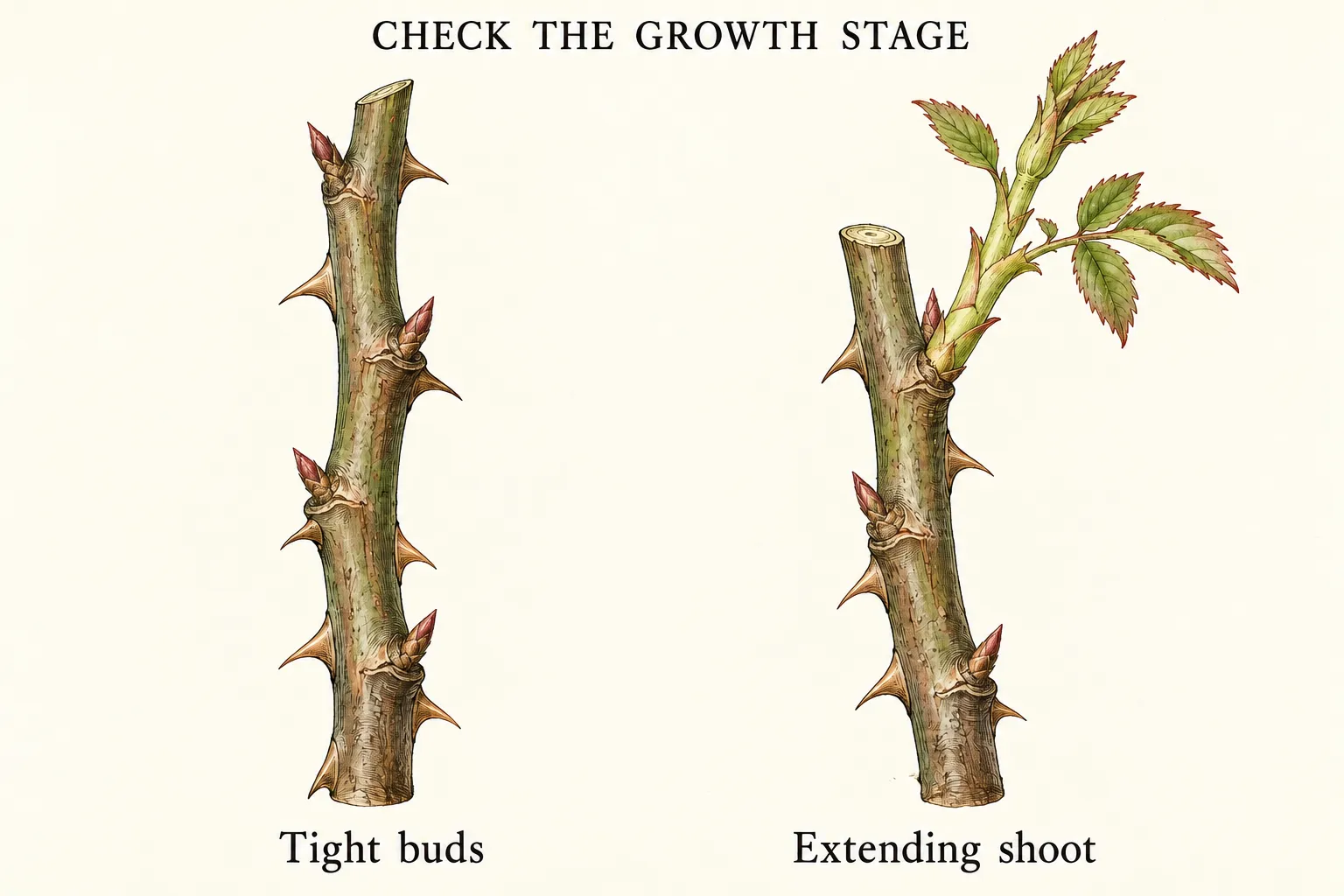
Keep grafted and own-root plants identified. A grafted bush usually has a thickened union near the base of its canes; an own-root rose lacks that graft junction. Standard or tree roses carry a graft high on a stem and need handling and winter protection specific to that form, so set them aside for supplier advice. Canes sometimes arrive coated with wax. Illinois explains that this coating reduces drying and can be left to break down naturally; peeling it away is unnecessary handling.
Choose a short hold by temperature and packaging
Use a cool location that remains above freezing, and measure it beside the package. Iowa State suggests around 40°F, approximately 4°C; Purdue gives 35–40°F, about 2–4°C, for a brief packaged hold. An unheated garage may provide those conditions, but a sunny glazed porch can become much warmer and a detached shed can freeze. The building's name does not establish its temperature. Check the thermometer after a cold night and after afternoon sunshine, then move the package if the location falls outside the intended conditions.
Follow the packaging instructions for the stock received. David Austin's UK advice permits its roses to remain tightly sealed in their original paper sack and potato-starch bag for a short hold in cool, frost-free conditions. Extension guidance for moisture-packed roots calls for checking and maintaining the packing. These instructions describe different packages. Preserve an intact purpose-designed package as directed; for unpacked or damaged stock, ask the supplier how to re-cover the roots and inspect their moisture. A loose cardboard box alone supplies little protection.
Where the packing is accessible, use Iowa State's wrung-out-sponge comparison: damp enough to protect the roots, with no dripping water. Re-moisten drying material and keep it around the entire root system. Inspect on arrival and again during the hold; Purdue's advice to moisten every two or three days is a useful reminder to check, not an instruction to add water to already wet packing. Keep the package away from a heater and preserve access so a leaking bag or drying edge is noticed.
Treat published holding times as conditional limits. Purdue describes several days; Illinois and David Austin's UK guidance allow roughly two weeks under their stated cool, moist conditions. Those figures cannot be combined into a guaranteed shelf life for every shipment. If the bed will remain unavailable beyond a brief hold, arrange the next method now. Keep the arrival date on the label and count all time already spent waiting, including days in a warm delivery area before the package reached its cool position.
Find a temporary site that actually drains
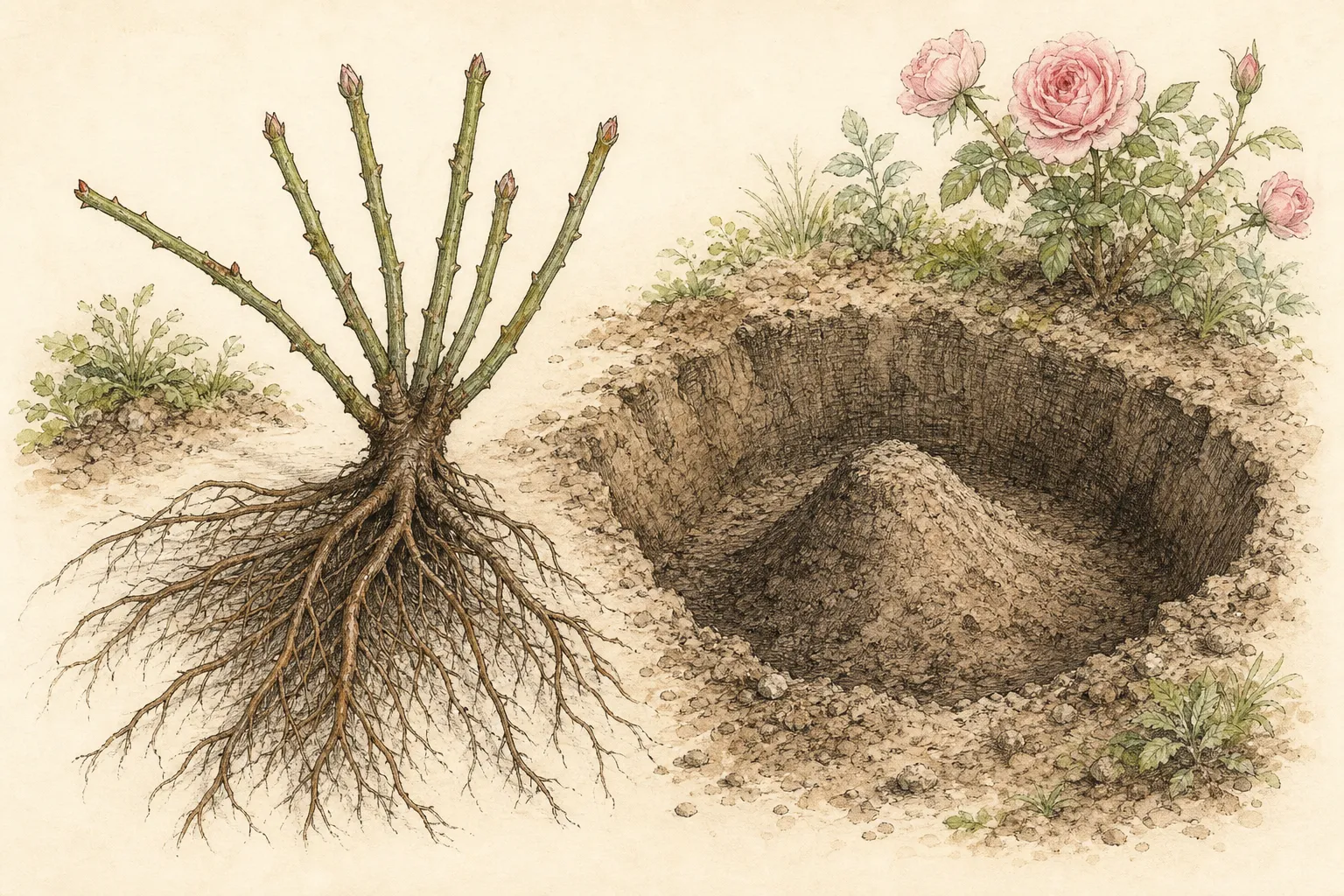
Heeling-in means temporarily covering roots with soil until their permanent position is ready. It works when another patch of ground is workable and drains well. Select an accessible sheltered area where the plants can remain labeled and later be lifted with room around the roots. A low corner receiving roof runoff is a poor nursery bed. Temporary use still requires root contact with moist, aerated soil; the fact that the roses will leave later does not make a wet trench suitable.
Test the proposed patch before opening the parcel. If the soil is frozen, full of standing water or smears into a sticky mass when worked, choose a different holding arrangement. Moving roses from a waterlogged permanent bed into a waterlogged temporary bed merely relocates the same difficulty. Where the whole garden is unsuitable, continue a valid brief packaged hold while arranging proper pots or assistance from the nursery. A hole hacked through frozen ground is not the same as a workable root zone. When a delay becomes a whole-winter hold, have the nursery match protection to the cultivar and local minimum temperatures; a short delivery-storage method gives no assurance of survival through prolonged freezing.
Plan the eventual lift as well as the initial placement. Leave a working side for a fork or spade, space to handle prickly canes, and a route back to the permanent bed. Keep separate batches identifiable if several cultivars share a trench. For example, three labeled shrub roses waiting for a new border can occupy one short temporary row; an already leafing rose and a top-grafted standard belong to separate decisions. The label should describe the plant, arrival date and temporary location.
Heel the dormant roses in with every root covered
Make a trench long and deep enough for the actual roots, with a sloping side against which the canes can rest. Purdue describes a slanted holding trench with roots in its deepest part; Illinois likewise places the roots under soil in a shallow trench. The word shallow describes a temporary arrangement, not permission to leave long roots sticking out. Enlarge the trench to accommodate the sound root system. Keep the plants nearby with their roots covered until you are ready to position them.
Lay the dormant plants along the slope and work loose soil around all the roots, closing gaps gently. In Purdue's temporary method the graft union is also covered. Keep that protective covering distinct from the permanent planting depth, which must later match the rose and local guidance. The completed trench should contain covered roots and supported canes, with labels still readable above the soil. An exposed tip at the end of a root can dry even when most of the bundle is safely buried.
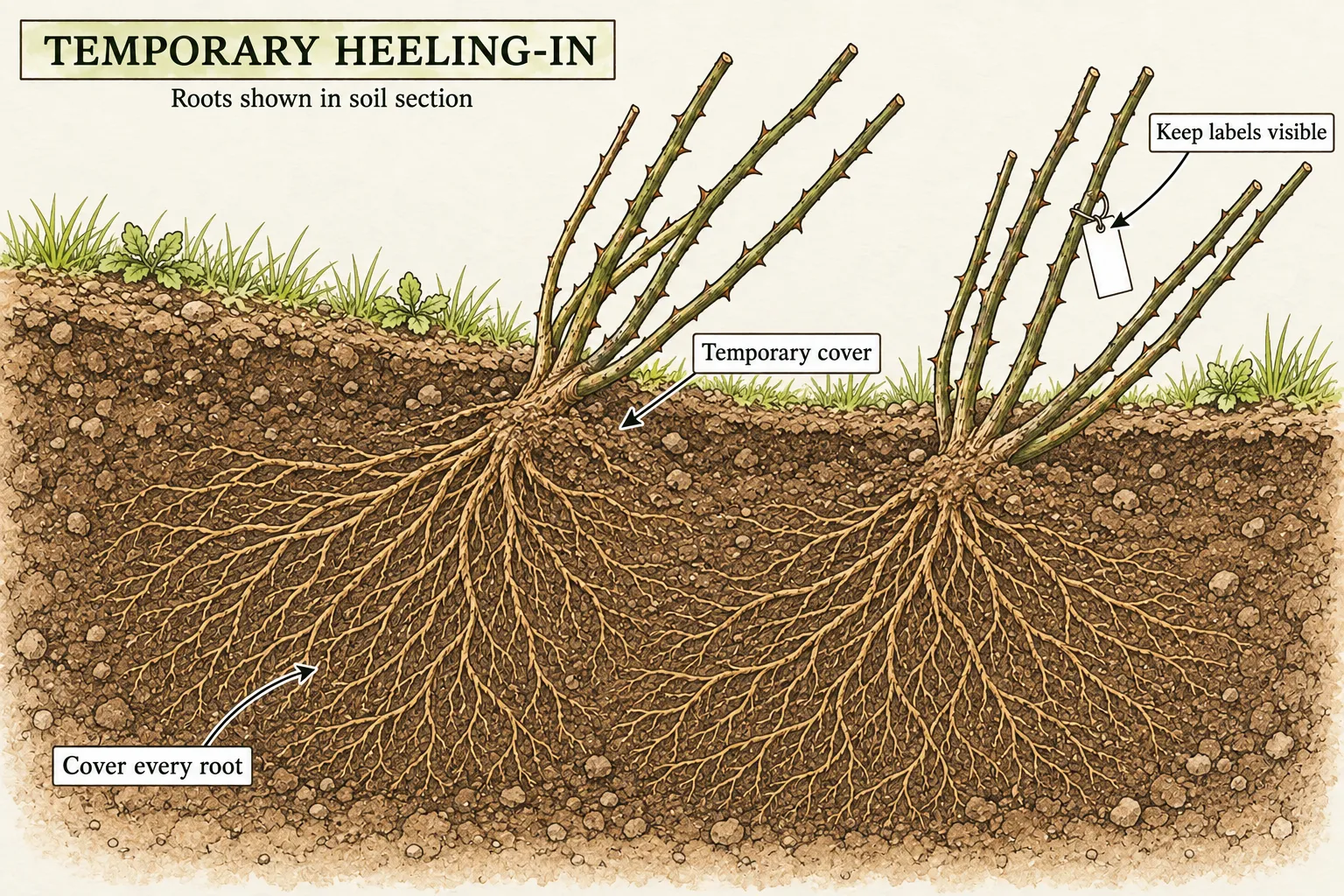
David Austin permits its roses to remain tied together while heeled in. That is convenient for a dormant bundle lifted soon as one group. If you expect to remove cultivars separately, keep loose, identifiable groups and enough access to work around them. Remove packaging from the roots before soil covers them, while preserving nursery labels. Retain healthy root length and the delivered cane framework; cutting everything shorter simply to fit a small trench defeats the purpose of temporary care.
Water as needed to settle soil around the roots, allowing it to drain. Purdue specifies a watered but unsoggy trench; David Austin calls for water when weather is dry. After rain or watering, check for washed-away soil and exposed root tips, restoring cover where necessary. If the trench collects standing water, the site needs reassessment. Heeling-in is a monitored temporary planting, so leave it accessible and set a reminder to review the roses and the permanent bed together.
Use a pot when workable ground is unavailable
A large draining pot is an alternative where a temporary trench is impractical. David Austin describes potting a bare-root rose into compost and keeping it in a sheltered outdoor position. The RHS also advises slightly moist peat-free compost for roses held while ground conditions are unsuitable. Choose a container that accommodates the roots in a natural arrangement and has usable drainage openings. A watertight bucket may look like convenient storage, but retained water creates a different root environment. Fit the container to the roots before removing the last protective packing.
Potting requires an actual rose planting decision, including the crown or graft-union position appropriate to the supplied plant and region. Follow the grower's container directions and use a suitable potting medium. Keep the cultivar label attached, water to establish contact and let excess escape. In a mild UK setting, sheltered outdoor holding may be appropriate; in a severe freeze, an exposed new pot needs a locally supported protection plan. The trench's surrounding ground and the pot's exposed walls provide different winter conditions.
A newly potted bare-root rose is not yet an established container-grown rose. The RHS and Illinois distinguish containerised plants from plants whose roots have developed in the pot. Treat the new container as a growing unit that needs careful moisture checks and gentle handling. If roots begin binding the medium, preserve that developing ball when planting out. Pulling the rose from its canes or shaking all the compost away would undo the advantage gained during its temporary stay.
Watch for changes that end the dormant holding routine
Check accessible packing or soil moisture, cane condition and bud development during the wait. Inspect again after unusually warm weather, a cold spell, heavy rain or a change of storage location. A still-dormant rose with moist covered roots may simply need more time for the bed to become workable. A drying package, flooded trench or softening root system needs a correction now. Use the actual observations to decide, keeping enough notes to explain a deterioration to the supplier.
Where shoots extend noticeably, shorten the delay and ask for stock-specific advice if permanent planting is still impossible. Small healthy bud movement can be normal, but a growing plant is progressively less suited to prolonged package storage. Pot it appropriately when that is the supported option and provide suitable light and protection for its new growth. Keep such plants distinct from the dormant batch. Chilling an actively growing rose harder to make it look dormant again is not a useful storage strategy.
Separate plants with spreading soft tissue, foul odor or extensive mold entering damaged roots from sound stock while seeking assessment. A photograph of discolored tissue alone cannot identify the cause, and extra fertilizer or an improvised treatment does not correct every failure. Check temperature, moisture, package integrity and time in storage first. Preserve order details and clear photographs before trimming away the evidence or putting a doubtful plant into a shared holding trench.
Lift carefully when the permanent bed is ready
Prepare the permanent position before lifting heeled-in plants. Confirm workable, drained soil and the correct planting season for the named rose. Loosen the temporary soil from outside the root area and support the roots as you lift. Keep the canes under control while working; pulling them upward to extract a buried bundle can break roots. If fine new roots have formed, retain as much surrounding soil as practical and minimize the interval between lifting and replanting.
Rehydration belongs immediately before planting when the plant's condition and supplier instructions call for it. Iowa State uses a one- to two-hour root soak in its bare-root shrub and rose method; other rose suppliers specify their own intervals. A rose that has remained evenly moist in a trench is a different starting point from a dry package. Follow the applicable instruction and let excess water drain, keeping the planting hole ready. Extended immersion throughout a weather delay is unnecessary.
Reset the crown or union position from the permanent planting instructions; the temporary soil mark may reflect protective covering. For a potted rose, preserve a newly rooted ball and handle it by the container or supported root mass. After planting, water as needed and check settlement, drainage and bud progress. Keep the holding dates with the cultivar record. If establishment disappoints, those details help distinguish a storage problem from a poor planting site or an unsuitable seasonal transfer.
Steps
- Level
- moderate
- Time
- About 30–60 minutes for a small delivery, followed by condition checks
- Tools
- Spade or garden fork, Minimum–maximum thermometer, Plant labels and pencil, Watering can, Gloves for handling prickly canes
- Materials
- Original root-protecting packaging or supplier-approved damp packing, Workable well-drained soil for heeling-in, if available, A suitable draining pot and potting medium if potting is needed
- 1Inspect and identify the delivery
Move the parcel into a cool sheltered working area. Confirm each cultivar, stock type and root condition; photograph substantial damage with its label. Distinguish dormant bush or climbing roses from standards, established potted plants and roses carrying long new shoots. Keep roots covered while choosing the appropriate holding method.
- 2Set up the short packaged hold
Measure the temperature at the storage position, using roughly 35–40°F (2–4°C) as the Extension reference for a cool non-freezing hold. Follow the supplier’s original-packaging directions. For accessible moisture-packed roots, check that material is damp like a wrung-out sponge and covers the roots. Add the arrival date to the package.
- 3Choose the longer-delay route
If the bed will stay unavailable, examine a separate temporary patch for drainage and workability. Reserve space to lift the roses later. When the garden is frozen or saturated throughout, arrange suitable draining pots and a protected position with the nursery’s advice. Keep the existing short hold functional while preparing that next location.
- 4Complete the temporary planting
For heeling-in, open a sloping trench to fit the roots, lay the dormant plants against it and cover the entire root system with loose soil. Retain readable labels and water as conditions require, allowing drainage. For potting, use the grower’s container planting depth and a pot that accepts the roots naturally.
- 5Separate roses that begin extending shoots
Distinguish a slightly swelling bud from a long extending shoot. Give a noticeably growing rose its own planting or potting decision, using supplier advice when the permanent site remains unsuitable. Keep any new roots protected during the move and arrange appropriate light and frost protection. Leave the sound dormant batch on its monitored holding plan.
- 6Inspect and move on when conditions change
Recheck moisture, canes and buds after weather changes and during the wait. Respond to drying, trapped water or deterioration promptly. Once the permanent site is ready, loosen soil around heeled roots and lift with support. Preserve any developing root ball, rehydrate only as directed, and set the permanent crown or union level afresh.
Related reading
Sources
- How to Plant Bare Root Shrubs and Roses. Iowa State University Extension. Source record · Accessed 2026-10-20.
- Roses (HO-128). Purdue University Extension. Source record · Accessed 2026-10-20.
- Roses: Planting. Royal Horticultural Society. Source record · Accessed 2026-10-20.
- Selecting Rose Plants. University of Illinois Extension. Source record · Accessed 2026-10-20.
- How to Keep English Roses at Their Best Until They Can Be Planted. David Austin Roses. Source record · Accessed 2026-10-20.
- Help & FAQs. David Austin Roses. Source record · Accessed 2026-10-20.