Grow · container rose winter protection
Protect Container Roses Through Winter
Choose a winter route for a dormant container rose by hardiness, graft position, pot durability, drainage, and the coldest exposure its roots will actually face.
Published Last updated
In this guide
- Begin with the roots, not the top
- Protect the pot without closing its drain
- Wait for dormancy but finish before deep cold
- Audit the pot and graft before choosing a route
- Choose one coherent winter route
- Build insulation without trapping water
- Manage a dormant rose with very little water
- Recognize when the chosen route is failing
- Release protection gradually in spring
- Steps
Begin with the roots, not the top
A rose in the ground borrows thermal stability from a large soil volume. The same rose in a pot has roots close to exposed walls that cool from every side and can cycle rapidly between frozen and thawed. Penn State Extension identifies container roots as especially vulnerable and recommends protecting them even when the top is a hardy rose. Winterizing therefore begins with the root ball, pot, and placement. Wrapping canes while leaving a thin root ball exposed solves the less important half of the problem.
The right protection level is not determined by the label “rose” alone. Record the cultivar and its hardiness, whether the plant is grafted or own-root, where the graft union sits, the pot material, container diameter, local winter lows, wind exposure, and whether the site stays wet. A marginal cultivar in a small terracotta pot on an elevated balcony carries more risk than an own-root hardy shrub rose in a large insulated container beside a sheltered wall.
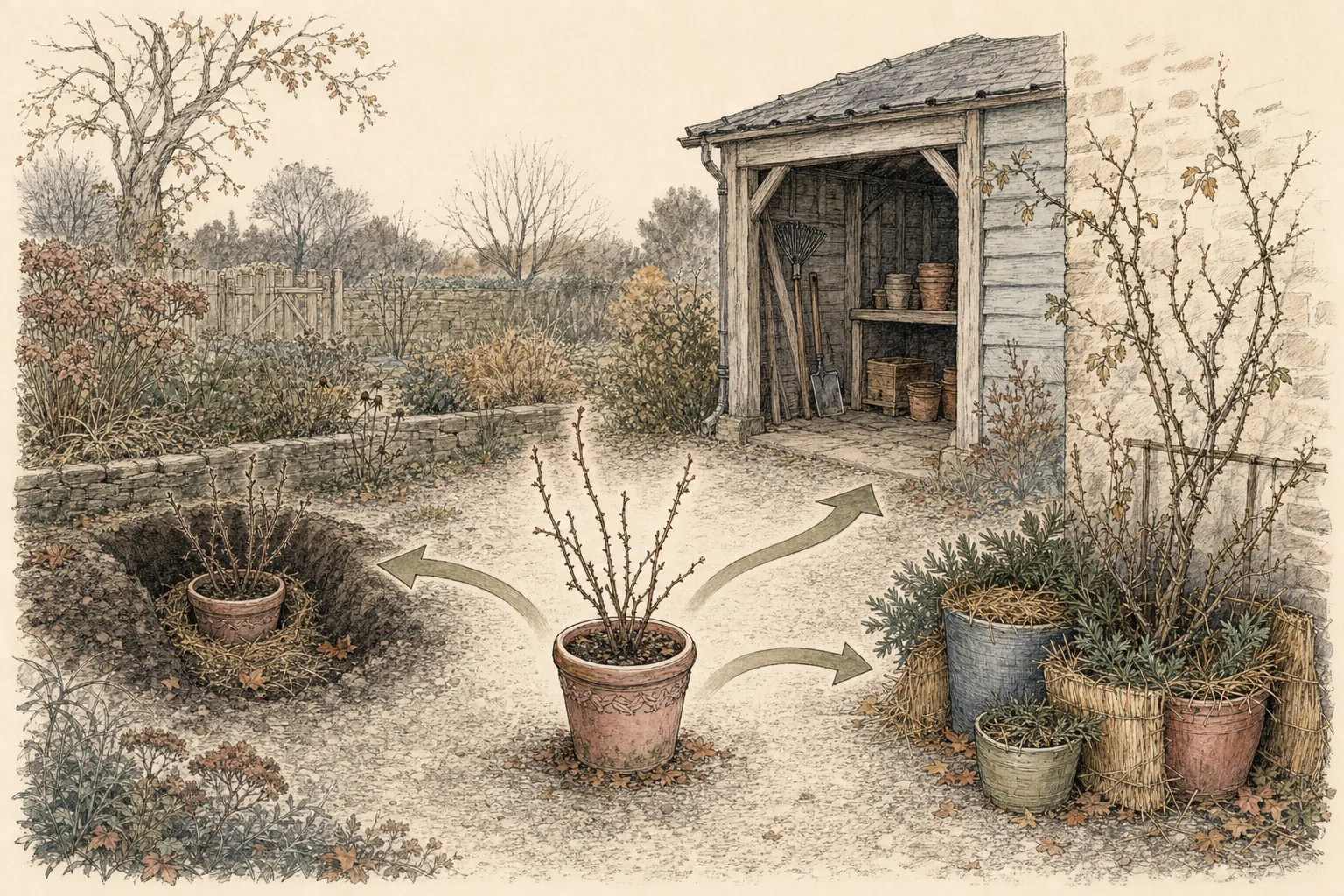
This guide keeps the rose dormant. Iowa State describes an active indoor option for miniature roses in a bright cool window, but that is a miniature-rose alternative requiring houseplant conditions and pest management, not the default for every patio rose. Most full-size hardy roses are better protected in dormancy than encouraged into weak warm-room growth. Choose between a sheltered dormant location, heeling the pot into soil, or insulating it outdoors according to the real constraints.
Protect the pot without closing its drain
Choose one winter route from the rose's hardiness, root type, container and exposure. Check insulation and drainage as separate requirements: a protected pot must still release excess water. During a mild inspection window, correct displaced protection or trapped runoff. Keep the route's release trigger with the plant so spring uncovering follows conditions instead of a forgotten wrapping date.
Wait for dormancy but finish before deep cold
Do not bundle a leafy, actively growing rose during the first cool night. Penn State places substantial winter protection after several killing freezes have brought roses into dormancy. Before that point, continue ordinary autumn care: stop late feeding that pushes soft growth, let flowers wind down, and water when the root ball is dry. Remove fallen diseased leaves so they are not enclosed around the crown, but healthy hips can remain if they do not obstruct handling.
Dormancy is not a reason to wait until the pot has frozen solid. Plan the move while paths are safe and the soil for any heel-in trench is workable. In severe climates, a short interval may separate a killing frost from a damaging freeze around an exposed container. Read forecasts and prepare insulation in advance; install it when the plant is dormant rather than improvising after cold has penetrated the whole root ball.
Avoid hard autumn pruning. Remove only broken, dead, or diseased wood and shorten a wildly whipping cane enough to handle safely. A severe cut creates fresh wounds and may remove wood that reveals the true winter dieback line in spring. Tie long canes loosely together with soft material for transport, never cinching them into a moisture-trapping bundle. Final shaping waits until the rose resumes its seasonal cycle and cold damage is visible.
Audit the pot and graft before choosing a route
Empty any saucer and verify that the drain hole is open. The RHS advises removing saucers in winter and keeping containers moist but not soggy. Probe from below with a blunt stick if roots or compacted mix have sealed the outlet, and raise the pot on feet or battens so meltwater can escape. Do not create a decorative wrap that folds under the base and turns the container into a basin. Drainage remains essential in a garage as well as outdoors.
Inspect the pot itself. Saturated terracotta can spall in freeze-thaw cycles; thin ceramic may crack; a brittle plastic rim may fail when lifted. A valuable rose should not depend on an already fractured vessel. If repotting would severely disturb dormant roots at the wrong season, place the existing container within a sound outer box and insulate the gap. The outer structure carries and buffers the pot without pretending to repair it.
Find the graft union on a grafted rose—the swollen junction between rootstock and named cultivar. Protection that saves roots but leaves a high graft exposed may allow the top cultivar to die back and the rootstock to dominate. Penn State’s winter guidance treats the bud union as a key protection point. An own-root rose lacks that junction but still needs crown and root protection. Mark the union now so the insulation height is deliberate rather than estimated after the plant is wrapped.
Choose one coherent winter route
An unheated attached garage, cold cellar, or frost-free shed is often the simplest route when it stays cold enough for dormancy but above the damaging lows faced outside. Penn State specifically recommends an unheated garage or shed for container roses. Verify the microclimate with a thermometer before relying on it. A metal shed that follows outdoor air below zero is not frost-free; a heated basement that remains warm and dark is not a dormant store. Stability matters more than the room’s name.
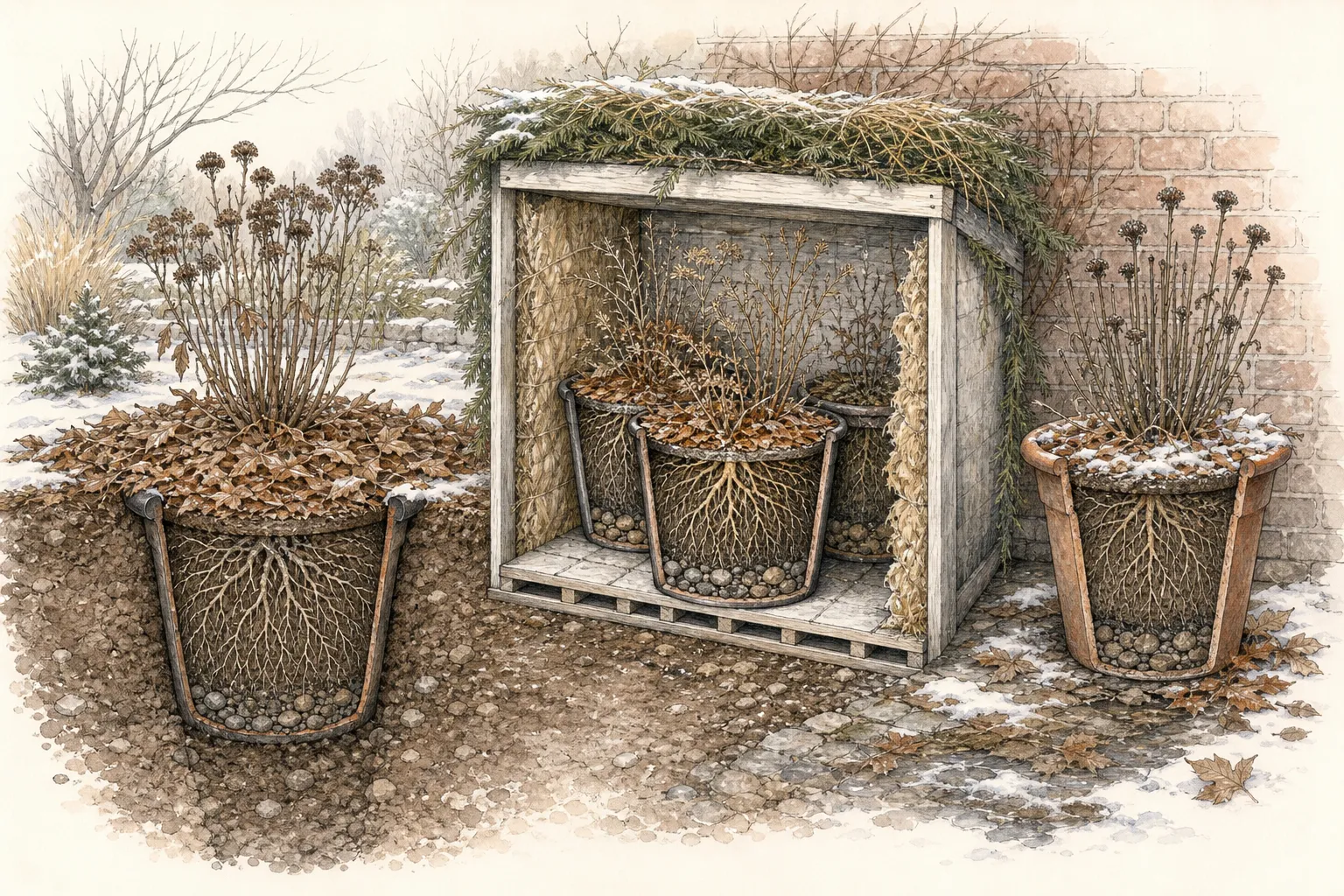
Where a suitable shelter is unavailable, heel the pot into well-drained garden soil. Iowa State’s miniature-rose guidance describes burying the container and mounding soil around the lower rose, an approach that borrows the ground’s thermal mass. Choose a place without winter waterlogging, set the pot with its rim near grade, backfill firmly around the sides, and protect the union according to local rose guidance. Mark the site so it is not struck by a shovel or buried under plowed snow.
A third route is outdoor insulation in place: group containers against a sheltered wall, put the rose inside a larger box or enclosure, and fill the side gap with dry leaves or loose straw. The RHS recommends grouping containers near a wall to reduce exposure. This is a risk-reduction method, not a guarantee in climates colder than the plant and container can tolerate. If the rose is truly marginal or the balcony is wind-scoured, choose a better sheltered route rather than adding endless wrapping.
Build insulation without trapping water
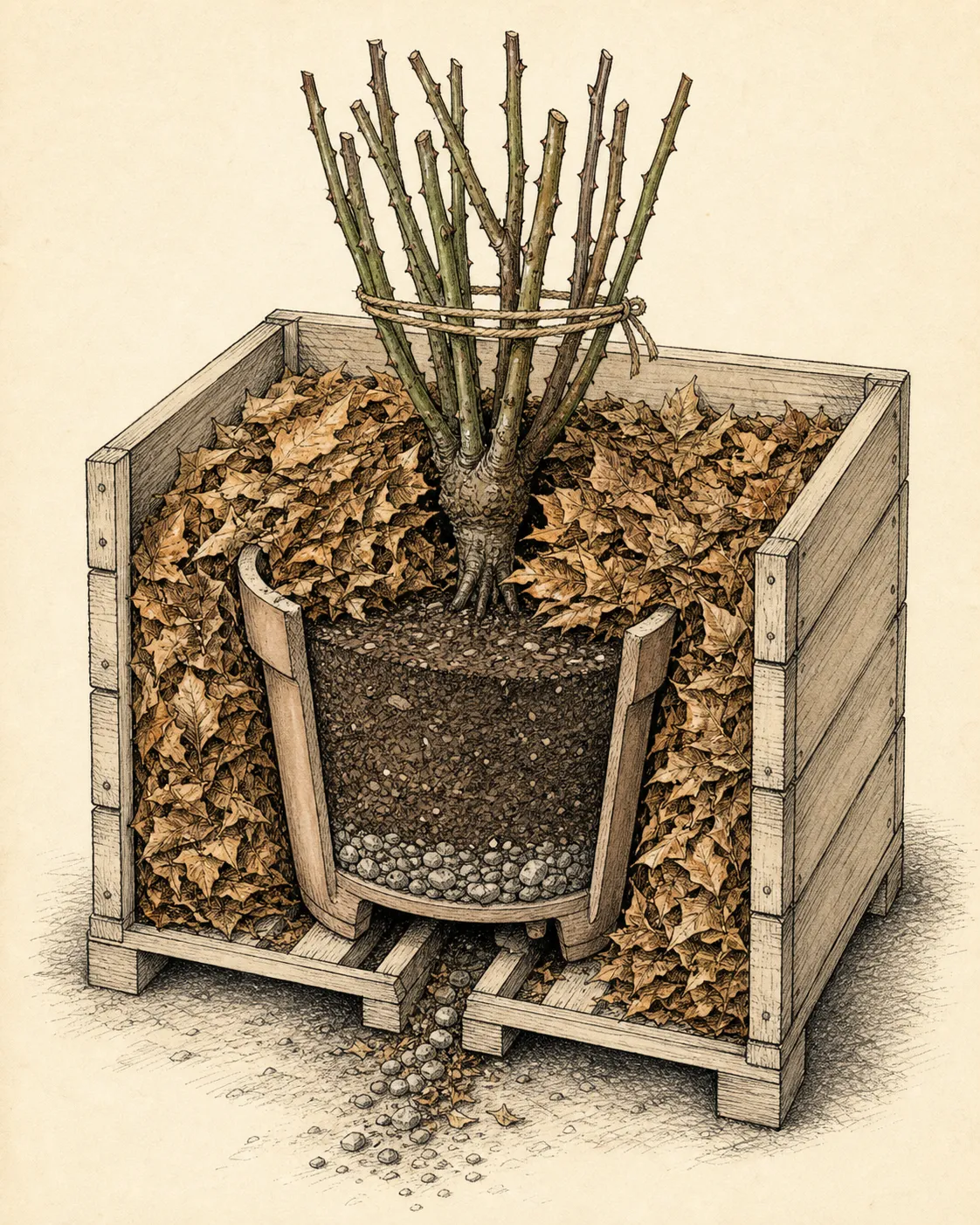
Set the pot on a firm drained base. For a box system, center it with room on all sides, then place dry leaves or clean straw loosely around the container walls. Do not ram organic material into a wet solid mass. Extend insulation to protect the root-ball height and, where necessary, the graft union, but keep a small air space around the cane bases. A breathable burlap outer layer can hold material in place while allowing vapor to escape.
Keep the top surface readable. Mulch can cover the root zone, yet it should not be packed tightly against canes or buried over the crown in a wet collar. Confirm that water applied at the soil surface can pass through and leave at the base. The insulation cutaway for this section shows the critical separation: dry buffering material belongs outside the pot, drainage remains open below, and the rose crown is not sealed inside plastic.
Do not wrap the entire plant in impermeable film. Sun can heat a clear or dark enclosure on a cold day, then the temperature plunges after sunset; trapped condensation keeps tissues wet. A breathable wind screen is useful on an exposed side, but it should be secured independently so it cannot rub bark or pull the pot over. Snow that accumulates naturally around a stable outdoor enclosure can add insulation, provided drains and weak canes are not loaded or blocked.
Manage a dormant rose with very little water
Water thoroughly before moving or enclosing the rose if the root ball is dry, then allow excess to drain. During winter, check the actual mix rather than watering by date. The RHS notes that dormant deciduous container plants seldom need water, but they should not be allowed to remain completely dry for a prolonged period. In a frost-free garage, feel several inches into the mix on milder days and add a small amount only when dryness is evident.
Outdoors, rainfall and meltwater may provide more than enough. A pot under an eave can be surprisingly dry, while one in a decorative cachepot can remain saturated. Do not water a frozen root ball; the water cannot distribute normally and may accumulate around the crown. Wait for a thaw when the drainage path is open. Do not feed during dormancy. Fertilizer cannot compensate for cold or poor drainage and may contribute salts to a root system that is barely active.
Inspect after wind, heavy rain, and major thaws. Reset shifted insulation, remove material that has become a wet mat, and make sure pot feet have not sunk into soft soil. Look for rodent disturbance and cane abrasion. Avoid repeatedly opening and closing a sheltered store during severe cold, which creates temperature swings. The useful winter check is brief and physical: stable temperature, firm canes, no standing water, and a root ball that is neither saturated nor dust-dry.
Recognize when the chosen route is failing
A sheltered rose that begins producing long pale shoots is too warm or is receiving a strong growth signal before it can be returned safely outdoors. Move it to a cooler suitable dormant location if one is available, without exposing tender growth to an abrupt freeze. Do not compensate by watering and feeding. If active growth is already substantial, treat the plant as an acclimation problem and protect the new tissue rather than pretending dormancy can be restored overnight.
An outdoor enclosure is failing when insulation repeatedly becomes waterlogged, the pot rocks after thaw, drains stay blocked, or bark is rubbed by a moving screen. Correct the construction during a mild interval: replace wet fill, reset the base, open the outlet, and support the wind screen independently. Adding another tight wrap over the defect hides the symptom and increases moisture. A cracked pot leaking mix also requires a sound outer support before the next freeze.
Cane blackening alone is not a reason to unpot the rose in midwinter. Mark the visible boundary and wait for spring growth to confirm living wood, unless tissue is soft, foul, or clearly diseased. The root zone remains the priority. If the crown or graft union is exposed by settling insulation, restore loose protection around it while preserving air at the cane bases. Small timely corrections are safer than relocating a frozen container through a large temperature change.
Release protection gradually in spring
Do not move a protected rose directly from a dim shelter into full sun during the first warm spell. Penn State recommends gradual spring removal of protection. Begin when severe cold is passing and the plant can be monitored, vent an enclosure first, and expose the pot in stages. A dormant garage rose can spend several days in bright shade before receiving its normal sun. If another hard freeze is forecast, temporary overnight protection is easier than rebuilding the entire winter system.
For a heeled-in pot, remove the mound and lift the container while soil is workable but before vigorous new shoots make handling difficult. Iowa State’s dates are specific to its regional calendar, so translate the principle—not the exact week—to local frost conditions. Check that roots have not grown through the drain or that the pot has not cracked. Restore normal grade around the garden site and remove all synthetic ties or wraps.
Once buds swell, assess winter dieback and prune to living tissue with clean cuts. Resume watering according to growth and only then restart feeding. If the grafted top died while rootstock shoots emerge below the union, identify the shoots before deciding whether the named rose remains. This spring handoff closes the winter job: the success measure is not merely a green cane in storage, but a correctly identified rose returning to balanced growth from an intact root system and protected crown.
Steps
- Level
- moderate
- Time
- One planning session and 30 to 60 minutes of protection work
- Tools
- Watering can, Hand pruners for dead or broken wood only, Pot feet or sturdy battens, Weatherproof thermometer for sheltered storage
- Materials
- Dry leaves or clean loose straw, Burlap or breathable wind screen, Insulating box or larger outer container, Soil and mulch for a heel-in trench when that route is suitable
- 1Record hardiness, root type, and exposure
Identify the cultivar if possible, locate any graft union, note the pot material and size, and compare the rose’s hardiness with the cold, wind, and wetness the container will face.
- 2Prepare after dormancy begins
After several killing freezes, clear diseased debris and remove only damaged wood. Keep sound canes largely intact and complete the move before deep cold freezes the root ball.
- 3Open the drainage path
Discard saucer water, clear the drain, and raise the pot on feet or battens. Stabilize or over-box any container likely to crack or fail during winter.
- 4Select a single winter route
Use a verified cold frost-free shelter, heel the pot into well-drained soil, or group and insulate it outdoors. Do not treat a freezing shed or warm dark room as equivalent.
- 5Insulate the root zone and graft
Place loose dry leaves or straw around the pot in a breathable enclosure, protect a vulnerable graft union, keep cane bases open, and never cover the drain with wrapping.
- 6Check moisture and stability
Water only when the unfrozen root ball is genuinely dry, never feed during dormancy, and reset insulation after wind or thaws while removing any wet compacted material.
- 7Uncover in stages
Vent and remove protection as severe cold passes, acclimate a sheltered rose to light, then prune confirmed dieback and resume normal watering when buds begin active growth.
- 8Tag the route and release trigger
Attach a visible note naming the cultivar, graft status, winter location, and the local condition that will begin spring venting. This prevents a dormant pot from being forgotten in a dark shelter.
- 9Correct route failures during a mild interval
Replace waterlogged insulation, reopen drains, reset a rocking pot, or move an independently supported wind screen. Avoid relocating a frozen root ball abruptly or sealing the defect beneath another wrap.
- 10Separate shoot problems from root protection
If warm storage produces pale growth, move to a cooler suitable location without freezing new shoots and withhold fertilizer. Keep the root system stable while planning a gradual light and temperature transition.
- 11Close with a root-zone check
Before severe weather, confirm that the protected root ball is stable, the graft or crown has appropriate cover, and the drain releases water freely. Photograph or note the arrangement so shifted insulation and spring removal points are easy to recognize.
Related reading
Sources
- Protecting Your Roses through Pennsylvania Winters. Penn State Extension. Source record · Accessed 2026-08-20.
- I have a miniature rose growing in a pot outdoors on my patio. How do I over-winter it?. Iowa State University Extension and Outreach. Source record · Accessed 2026-08-20.
- Container maintenance: Expert Guide. Royal Horticultural Society. Source record · Accessed 2026-08-20.