Grow · snow removal shrub branch protection
Remove Heavy Snow from Shrubs Without Breaking Branches
Clear loose snow from ornamental shrubs by reading the load first, supporting branches from below, leaving ice to melt, and checking attachments only after the weight is gone.
Published Last updated
In this guide
- Read the load before touching the shrub
- Use the right approach for loose snow
- Stop when snow has frozen into place
- Free branches without forcing the whole shrub
- Check for hidden breaks after the load is gone
- Reset the site instead of corseting the shrub
- Build the next storm plan from the plant's habit
- Steps
Read the load before touching the shrub
Heavy snow on a shrub is not one problem. Dry powder, fresh wet snow, roof-slide debris, and clear ice load branches differently and call for different responses. Start from several feet away and look for what is actually resting on the plant, how the weight entered the canopy, and whether the shrub is simply bent low or already cracked at a union. The first job is interpretation, not action. A broom moved too early can add force to a branch that was only flexed by the weather a moment before.
Check the site before you step into the branch radius. A shrub tucked below an eave, under a bent tree limb, or beside a shoveled driveway may be in the path of a second load. Roof avalanches, falling icicles, and refrozen footing are often more dangerous than the shrub itself. If the only route to the plant is across slick steps, under a loaded limb, or beneath utility lines, stop. The plant can wait for thaw or daylight. The branch structure will not be improved by a rushed rescue carried out in the wrong weather or from the wrong position.
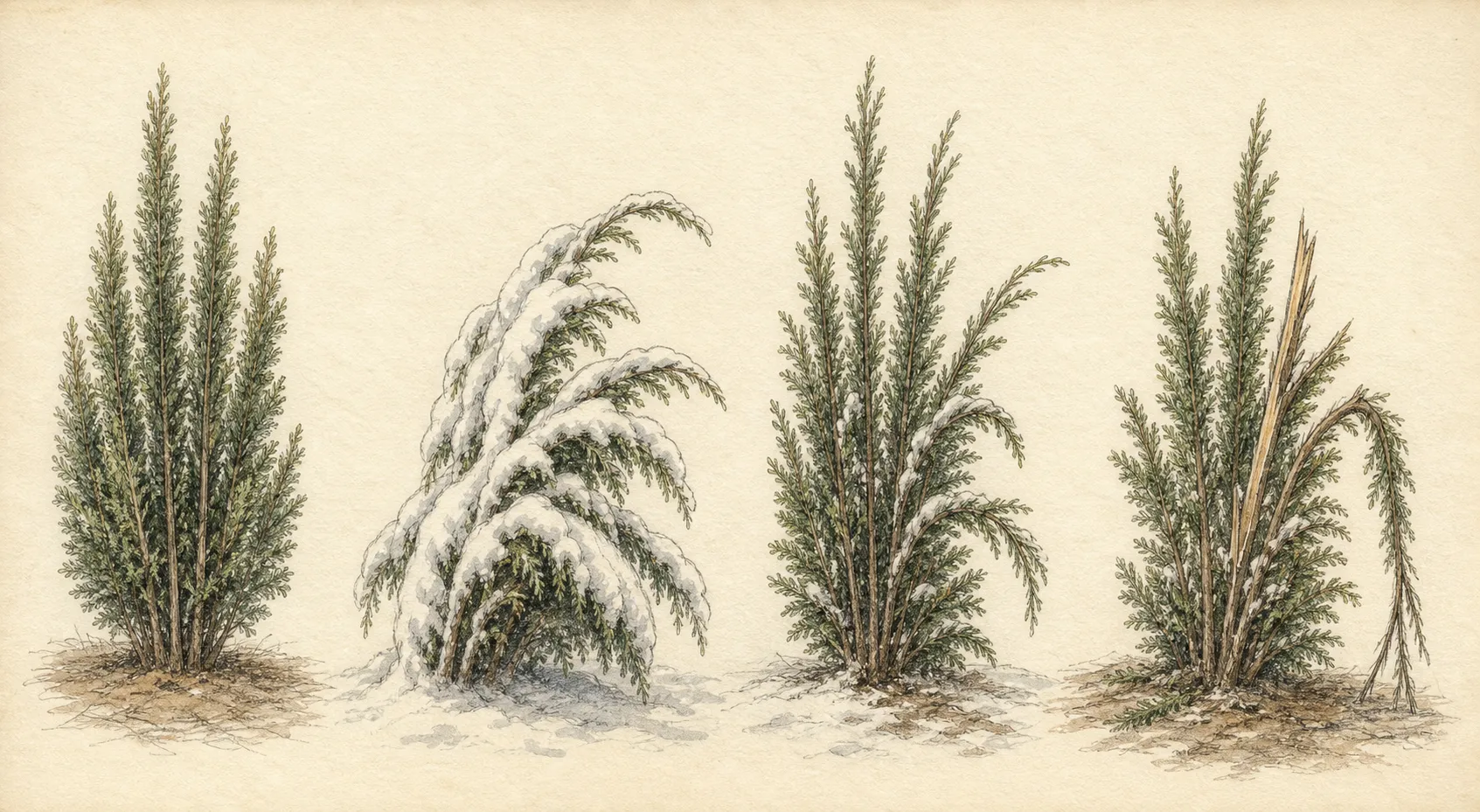
Notice the shrub's habit before you decide how much intervention it can take. A dense rounded boxwood, a layered yew, a narrow arborvitae, and a loose multi-stem hydrangea do not store snow in the same way. Upright evergreens often trap snow between leaders and splay downward under a column of weight, while broad deciduous shrubs may catch snow on many smaller branch forks. That difference matters because it tells you where the branch attachments are carrying the load and whether clearing one section will suddenly transfer stress somewhere else.
Treat ice and frozen crust as a different category from loose snow. Iowa State and K-State both warn that knocking at ice or frozen snow can break branches and strip foliage. NC State likewise notes that if snow is frozen onto branches and will not come off easily, the safe answer is to let it melt. The practical line is simple: if the material moves in light sweeps, you can manage it; if it clings, rings, or resists, your next useful action is patience.
Use the right approach for loose snow
For removable snow, the aim is to release weight without shoving a bent branch farther down. Use a soft broom, not a shovel, rake, or beating stick. Come in from the outside of the plant, support the branch from below with the broom head or your gloved free hand when practical, and move small amounts of snow off at a time. Iowa State describes carefully brushing loose snow upward, while NC State stresses beginning at the lower portion of the plant so the branches beneath do not receive the full load from above. Those instructions meet at the same principle: do not dump more weight onto the branches already carrying it.
Work the canopy in small zones instead of trying to clear the whole outline with one dramatic pass. Remove the easiest loose snow first from outer sections that can shed it cleanly. Then reassess how the branch is sitting before touching the next section. A branch may spring partway back after one light release, which changes the angle and tension in the rest of the snow. That is why repeated small passes are safer than one broad sweep that assumes the branch will behave the same way from beginning to end.
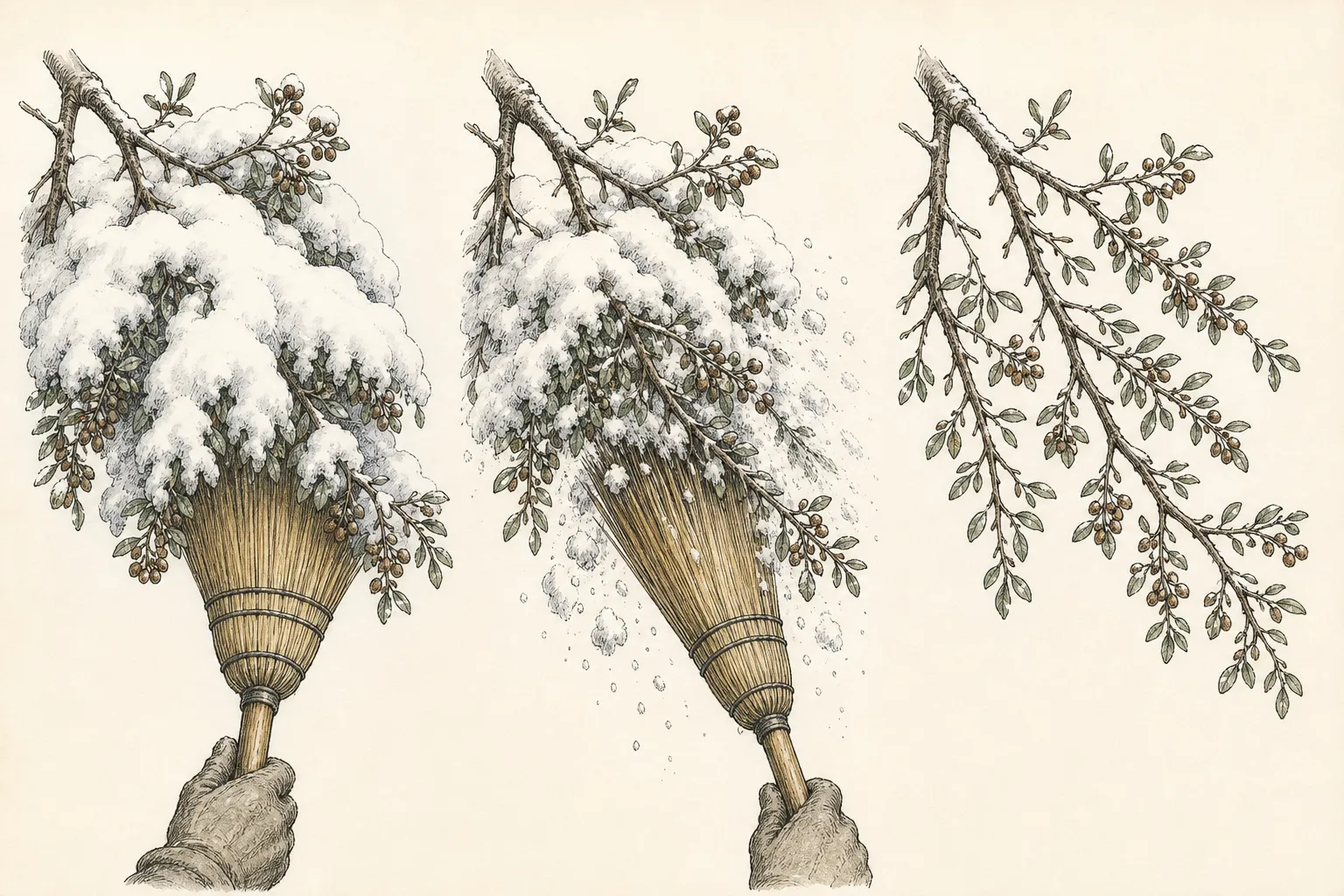
Keep the broom moving with the branch rather than against it. If you feel the limb pushing back, hear cracking, or see bark opening at a union, stop immediately. The branch is telling you that the stored force is no longer being relieved by the method you are using. Do not correct that by pushing harder. Move to another branch, wait for warming, or accept that the remaining load belongs in the no-go category. Saved structure is worth more than a perfectly restored winter silhouette.
Do not shake the shrub or slap at the snow to make it fall. K-State notes that vigorous movement can cause already stressed limbs to bounce and break. The same is true when a gardener grabs the main stem and tries to whip the whole canopy free. A shrub that would have held together under a slow thaw can split because the human movement creates a new force path. Snow removal works best when it is quiet, slow, and mechanical enough to be repeated branch by branch.
Stop when snow has frozen into place
A shrub covered in stiff crust or clear ice is no longer a snow-removal task. It is a wait-and-monitor task. Iowa State explicitly advises letting most ice melt naturally, and K-State says brushing or knocking at frozen snow adhered to limbs can pull off needles and break branches. The reason is structural as much as practical: once snow and ice have become one rigid shell, your motion on one point is transmitted across the whole form. You are no longer easing off a layer. You are levering against frozen wood.
Wet snow that refroze overnight can also behave like ice even if it still looks like snow. Test only the outermost loose material. If it resists the first light pass, stop. Do not begin chiseling channels into it with the broom edge or poking at it with handles. That kind of improvised scraping usually injures buds and twig bark while leaving the main load in place. Waiting for a slightly warmer interval often changes the entire job. What was destructive in the morning can become easy to release in late afternoon.
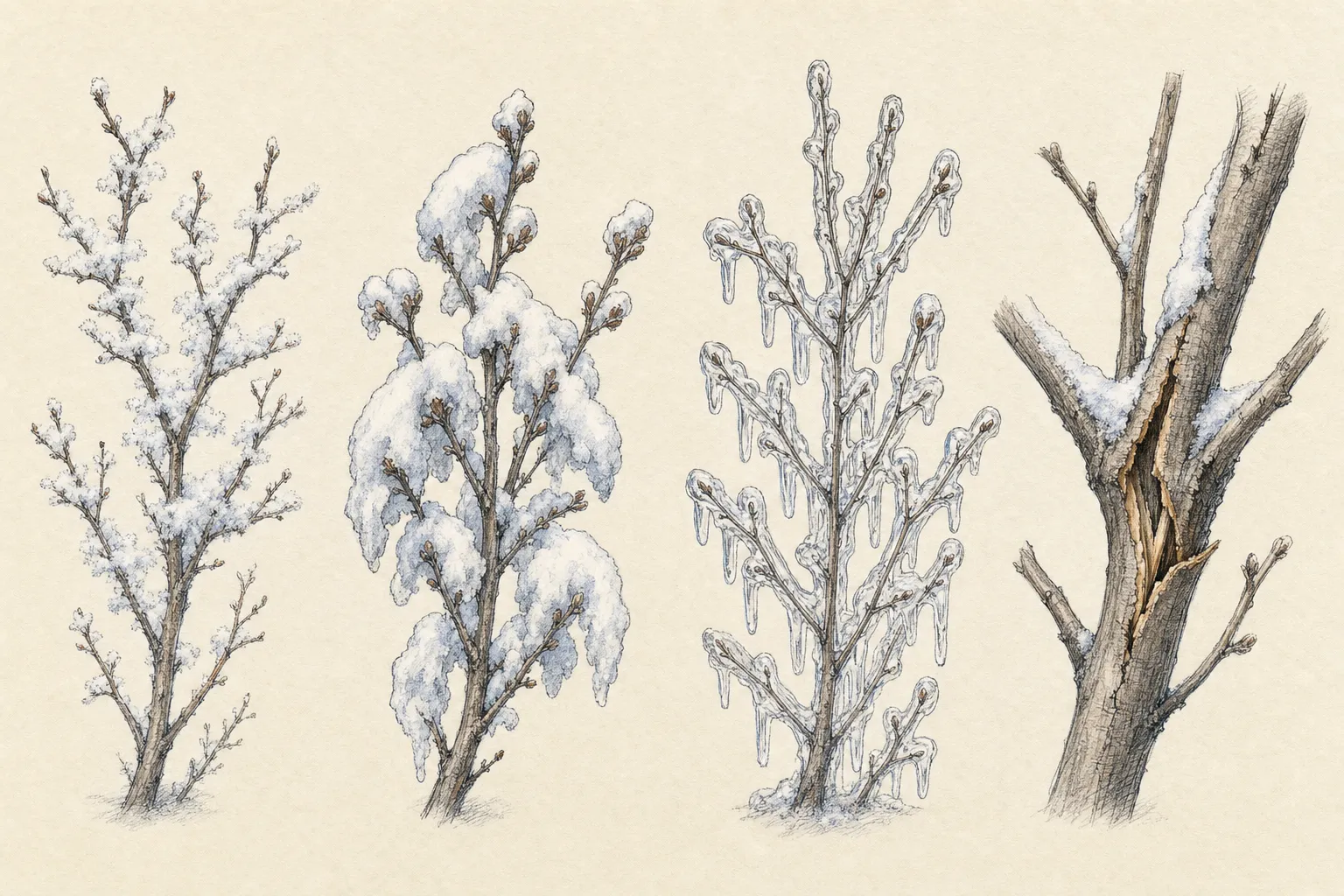
Accept partial success. If you removed the top loose layer and the crust beneath remains, you already reduced some weight. You do not need to finish the picture. The shrub may look uneven for days. That is not failure. Branches bend under winter loads and often recover their position gradually after the load disappears. Trying to make the plant look instantly upright is where many branch losses occur. The correct finish for a frozen plant is often a marked note to return, not a cosmetically complete outline.
Be especially conservative where snow came from a roof edge or plow pile. Those loads may include refrozen chunks, grit, and compacted layers that do not behave like snow resting from the sky. If a roof continues shedding onto the same shrub, removing the first fall only exposes it to the next. In that case, the real task is site control after the storm, not repeated heroics during it. Move future snow routes, add a guard structure where appropriate, or relocate the plant after the season if the site keeps turning it into a catch basin.
Free branches without forcing the whole shrub
After the removable load is gone, step back before touching the branch again. Many bent shrubs look worse in the minute after clearing because the wood has not had time to relax. K-State's guidance is useful here: give the plant time, and resist pulling, staking, or tying limbs back into place immediately. Flexible branches often right themselves over weeks or months. A branch that is still alive but bent does not benefit from being dragged upright to satisfy the eye of the gardener that same day.
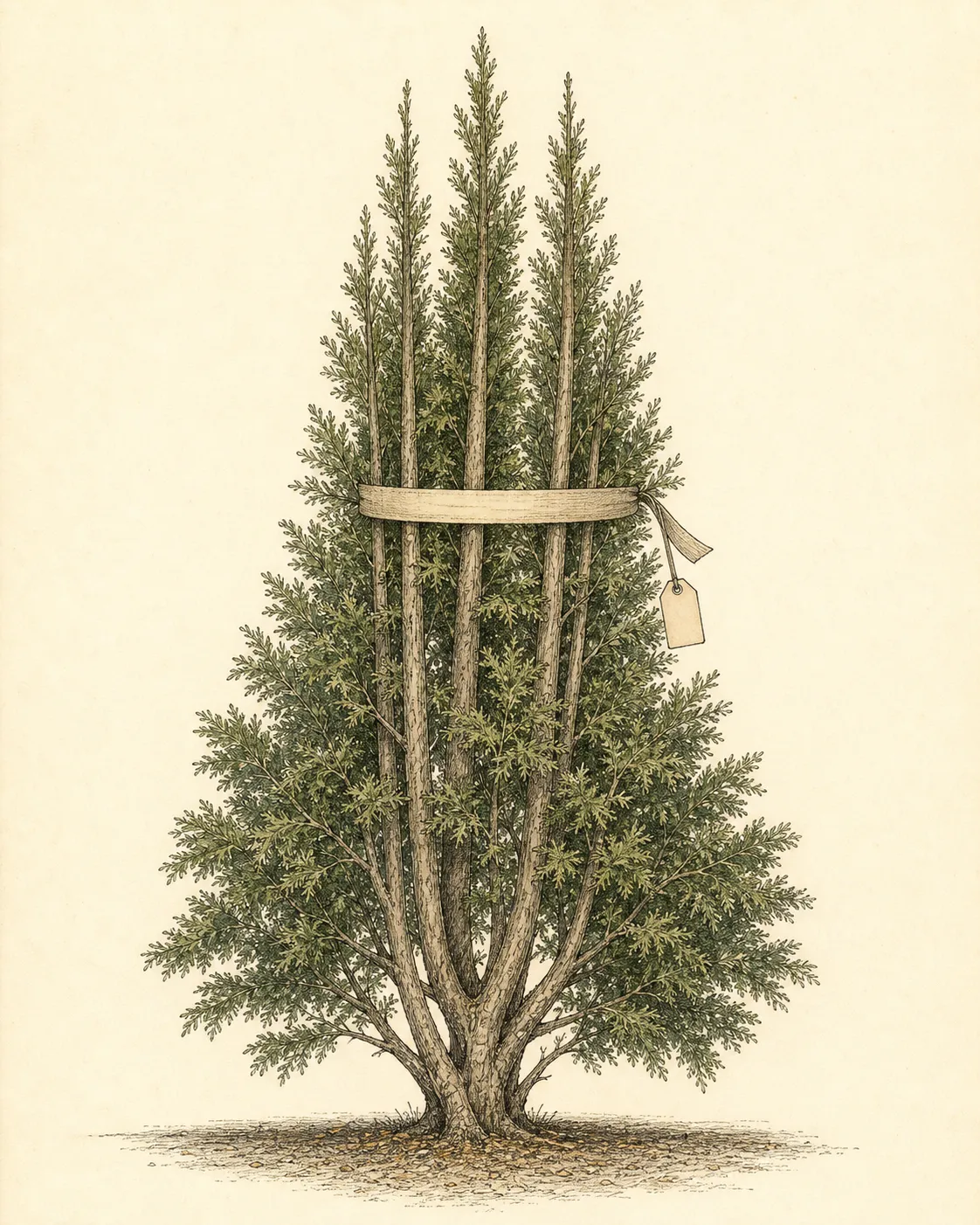
If several leaders of an upright shrub remain splayed outward, do not gather them into one tight bundle as a reflex. Tight post-storm binding traps moisture, rubs bark, and hides splits at the base of the leaders. It also makes later diagnosis harder because every branch seems supported whether it is sound or not. If a branch must be prevented from dropping into a path before thaw, use a broad temporary restraint on the individual section and schedule a quick removal review. The goal is short-term hazard reduction, not permanent corseting.
Release debris from the canopy before you decide a branch is deformed. Twine from holiday decor, bird-feeder wire, and roof-grit-packed leaves can hold a branch in a false position after the snow is gone. Remove those first and look again. Many winter distortions are partly mechanical hang-ups. Once the trapped material is gone, the branch may settle into a far less alarming shape without any further help from you.
Where the plant was tied in advance of the storm, check that the preventive ties did not cut in and that they can be removed once the heavy-snow period passes. Both Iowa State and K-State recommend soft materials and timely spring removal. A support that prevents one storm but remains forgotten through growth becomes a different injury. Prevention and recovery meet at the same rule: temporary support must stay visible, broad, and scheduled for removal.
Check for hidden breaks after the load is gone
Once the branch line is visible, inspect attachments from the stem outward. Look for bark tearing on the underside of bends, a widened crotch where two stems meet, twigs hanging by a strip of bark, and needles or leaves stripped from one side of a branch. These signals matter more than whether the plant's outline still looks crooked. A shrub can appear misshapen and still be structurally sound, or look almost normal while carrying a hidden split that will fail in the next wind.
Do not prune during the storm unless a broken section poses an immediate safe-reach hazard. Branches bent but not broken should be given time. If a branch is clearly split, detached, or hanging into a walkway and can be removed safely with hand tools, make the smallest correct cut back to a lateral or base after the event, not an emergency cosmetic stub. Large cuts, ladder work, or any cut made beneath a remaining load belong to a qualified arborist or to a safer weather window.
Expect some delayed change. Browned foliage, dropped leaves, and wilted shoot tips can appear later, especially where bark was stretched but not torn outright. Mark questionable branches with removable tape and recheck them after a mild spell. This keeps you from over-pruning on the first day and from forgetting an attachment that seemed fine until it dried. Winter damage often reveals itself in stages, and patient observation is part of competent aftercare.
Photograph the plant from two or three useful angles now. A picture taken after the load is gone becomes the reference for deciding whether a branch is actually recovering. Memory is poor at this stage because the gardener is comparing the shrub with the shock of the storm image rather than with the plant's real pre-storm structure. A documented baseline makes spring decisions calmer and more precise.
Reset the site instead of corseting the shrub
If the same shrub catches every heavy snow because it sits below a roof valley, at the end of a plow run, or in a narrow funnel between walls, the site is teaching you something. Repeat damage is often more about where the plant stands than about the species itself. A resilient shrub forced into the wrong snow route will eventually lose form or structure no matter how carefully you brush it out each winter. Long-term success comes from redirecting the snow, not from repeating a rescue routine.
Change the catch points you can control. Keep shoveled piles off shrub crowns. Redirect downspouts and roof-shed where practical. Add seasonal markers so plowed snow is not tossed onto small woody plants. If a temporary protective frame is justified, build it so it sheds snow away from the shrub rather than compressing the canopy from above. A good winter intervention reduces future load before it reaches the branches.
Review whether the shrub's habit suits the exposure. Narrow multi-leader forms can be excellent plants, but they are not forgiving in every snow pocket. A broader, lower, or differently branched plant may handle the same space more gracefully. Replacement is not an admission that the last cleanup failed. It is a design decision made from repeated evidence. Good gardens learn from mechanical weather, not only from color and bloom.
Use the coming spring to separate real structural loss from temporary distortion. If the shrub leafs out evenly, holds new growth, and gradually resumes a workable outline, let it recover at its own pace. If large openings, chronic splay, or repeated split leaders remain, plan selective training or replacement in the proper season. Winter cleanup should move the shrub toward a healthier future, not merely toward a neater afternoon.
Build the next storm plan from the plant's habit
Preventive tying is a fall job, not a panic job during snowfall. On shrubs known to splay under load, use broad soft ties or flexible cord arranged to support the natural column before snow begins. Leave enough room that the foliage is not compressed into a damp sleeve. Remove the ties after the season's heavy-snow risk passes. A preventive system should help the shrub shed snow, keep branches together, and disappear before growth expands into it.
Pair prevention with autumn plant health. Conifers and broadleaf evergreens going into winter already dry or weak are more likely to show winter browning and delayed dieback after snow events. Water newly planted shrubs as needed through fall until the ground freezes, then stop treating every winter symptom as a simple snow problem. Mechanical injury, drought stress, and winter desiccation often travel together. The branch line may be the first place you notice what the root zone has already been telling you.
Keep tools appropriate to the job. A soft broom, clear footing, and knowledge of when not to continue will save more shrubs than a larger toolkit. Gardeners often reach for harder tools because the snow looks heavy. In reality, the harder the tool, the easier it becomes to strike bark, snap buds, and force branches. Winter shrub care is one of the clearest examples of restraint as a real skill. The best tool is often the decision to stop at the safe point.
Make a brief record after each damaging storm: snow type, whether it adhered or brushed free, which branches were marked, and what recovered by spring. After a few winters, that record shows whether you need a stronger preventive tie, a different site strategy, or a different shrub. It also prevents you from relearning the same branch geometry every January. A publication-ready winter routine is not one dramatic rescue. It is a repeatable method that protects the plant, the gardener, and the site.
Steps
- Level
- moderate
- Time
- 10 to 30 minutes for loose snow, plus later recheck after thaw
- Tools
- Soft broom, Gloves with grip, Eye protection, Stable ground access only
- Materials
- Broad soft tie for future prevention if the shrub is habitually snow loaded, Removable branch-marking tape
- 1Read the load from a distance
Identify loose snow, refrozen crust, clear ice, roof-slide debris, and the direction of the load before touching the shrub. If access requires walking under a hanging limb, roof edge, or utility line, stop and wait for a safer window.
- 2Choose the safe category
Proceed only if the material moves as loose snow under a light pass. If snow is frozen onto the branches or ice has glazed the canopy, let it melt naturally. Clearing a partial loose layer is useful; forcing off frozen material is destructive.
- 3Support the branch from below
Use a soft broom or gloved hand to hold the branch under its bend while removing small amounts of snow. Work from the outside of the shrub and release weight gradually instead of trying to restore the whole outline in one motion.
- 4Clear the lower exterior in small passes
Brush the easiest loose snow from the lower outer portions first so the branches beneath are not suddenly asked to carry everything that falls from above. Reassess the branch after each pass because its tension changes as the load lightens.
- 5Stop at resistance or cracking
If snow clings, a branch pushes back, bark begins to open, or the broom motion starts to drive the branch farther down, stop immediately. Waiting for a warmer interval is part of the method, not a failure to finish the job.
- 6Inspect attachments after release
When the weight is gone, look for torn bark, widened unions, hanging twigs, and delayed springback. Mark questionable branches and recheck after thaw rather than pruning every bent stem on the same day.
- 7Correct the site before the next storm
Move shoveled piles, study roof-shed routes, and decide whether the shrub needs fall tying, a guard frame, or a different location. Repeated snow rescue usually points to a site pattern that should be changed before another winter load arrives.
Related reading
Sources
- How to Prevent Ice and Snow Damage on Trees and Shrubs. Iowa State University Extension and Outreach. Source record · Accessed 2026-08-19.
- Preventing and Managing Ice and Snow Damage to Landscape Plants. NC State Extension. Source record · Accessed 2026-08-19.
- Helping Evergreens Recover From Heavy Snow. K-State Research and Extension Johnson County. Source record · Accessed 2026-08-19.