Grow · multi stem evergreen snow tying
Tie Multi-Stem Evergreens Before Heavy Snow
Use broad temporary ties to gather small upright multi-stem evergreens before snow, without girdling bark, crushing foliage, or disguising a structural defect.
Published Last updated
In this guide
- Use tying only for the right plant
- Inspect stems and forecast before touching the plant
- Choose material that spreads pressure
- Find the useful support height
- Use an open spiral only when one band is insufficient
- Observe storms without escalating into removal work
- Keep temporary tying distinct from structural support
- Remove support before growth resumes
- Steps
Use tying only for the right plant
This preventive method suits a relatively small, accessible, upright evergreen with several leaders or stems that can splay under wet snow—forms commonly seen in arborvitae and upright junipers. Iowa State Extension identifies multi-stemmed junipers and arborvitae as susceptible, and Minnesota Extension similarly notes upright evergreens and trees with multiple leaders. The work happens before a storm while branches are flexible and unloaded. It is not a technique for forcing an ordinary spreading shrub into a narrow decorative bundle.
Stand back and identify the plant’s natural outline. The goal is to reduce the open forks and flat ledges that catch heavy snow while preserving a tapered, conical form from which snow can shed. If bringing the stems together requires strong force, the plant is too broad, too rigid, or structurally compromised for temporary wrapping. Stop rather than converting flexible support into a permanent cable installed without diagnosis.
Keep the scope at ground level. Minnesota distinguishes relatively small trees that can have leaders tied from large, wide-spreading multi-stem trees that may require professional cabling. A tall evergreen, a plant near wires, a split union, dead top, hanging limb, or old storm wound needs a qualified arborist. A household strap cannot repair included bark or a failing junction, and hiding a crack inside foliage makes later inspection harder.
Inspect stems and forecast before touching the plant
Work in dry, above-freezing conditions before snow accumulates. Brush your hands through the outer foliage to find the principal leaders and trace them toward their junctions. Look for cracks, dark seams, cavities, loose bark, previous constriction marks, and branches already pulled out of line. If a weak union moves independently or opens under light hand pressure, do not cinch it closed. Isolate the area from foot traffic and seek professional assessment.
Confirm that the expected hazard is snow loading, not merely cold. A routine light snowfall may not justify installing support months early on a plant with no history of splaying. Repeated heavy wet snow, a narrow multi-leader habit, or previous opening under load makes the case stronger. Temporary tying has its own cost: forgotten material can abrade foliage, trap debris, and constrict expanding stems. Use it for a defined winter exposure and attach a removal reminder at installation.
Check the base and soil. A leaning root plate, heaved soil, or saturated footing cannot be corrected by tying the crown. Also look for nesting wildlife and avoid disturbing occupied shelter. Choose a calm work period so loose strap cannot whip into the face and so the plant’s resting form is visible. Measure the circumference with the branches held only lightly inward; that prevents cutting material too short and then tightening it to make the ends meet.
Choose material that spreads pressure
Use broad, soft, flexible material: woven tree-support strap, nylon webbing, or folded cloth strips that remain strong when wet. Iowa State recommends broad fabric, nylon, or flexible cord that will not cut into bark; Illinois describes cloth strips or coated twine used loosely. A wider contact surface spreads load across foliage and reduces the wire-like pressure of thin twine. Avoid bare wire, fishing line, monofilament, zip ties, and narrow plastic cord.
Test the material by wrapping it around a gloved finger and pulling. A sharp edge, stiff buckle, abrasive seam, or wire core will be worse against a moving branch. Remove hooks and hardware that can strike bark. Natural fiber may soften and decay outdoors, so inspect it during winter; synthetic webbing persists reliably but becomes especially dangerous if forgotten. Either choice requires an explicit removal date, not an assumption that weather will dispose of it.
Cut enough length for a relaxed pass and a simple releasable knot or approved flat connector outside the densest foliage. Do not improvise a tourniquet knot that tightens under load. If a spiral method is needed, use one continuous open route with generous vertical spacing instead of numerous hidden loops around individual stems. The body illustrations show a broad contact band and an open upward path, both of which remain visible for inspection.
Find the useful support height
Bring the leaders inward with both forearms or with a helper holding opposite sides, using only enough pressure to restore the plant’s natural narrow outline. Minnesota places a leader tie roughly two-thirds of the distance above the weak crotch for a small multiple-leader tree. On a dense shrub where the exact crotch is obscured, identify the zone where stems begin to diverge and place the principal support well above it, around the upper-middle mass, rather than directly across the tender tips.
The tie must catch structural stems through their foliage, not compress only a soft outer shell. Slide a flat hand under the strap at several points and make sure no single twig is sharply bent beneath an edge. Keep the material off the trunk base and away from a narrow branch collar. One broad support at the correct height may be enough for a compact plant. Extra loops are not automatically safer; every contact is another place for abrasion and hidden pressure.
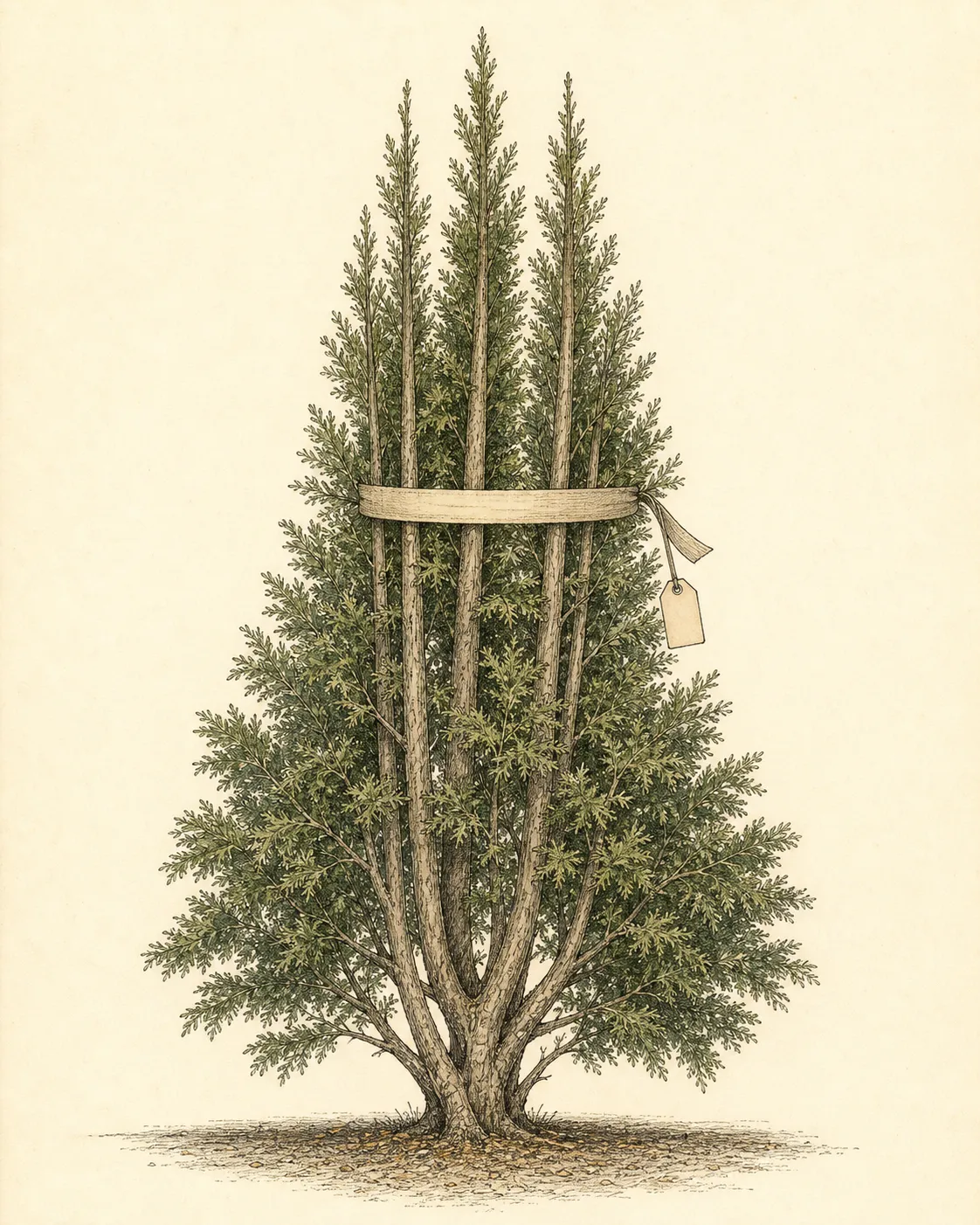
Release your hands slowly. The stems should remain gathered but still show slight independent movement. If the strap slides downward immediately, catches on foliage, or requires a very tight knot to stay up, choose a different height or method. If the top becomes a clenched cylinder with no taper, loosen it. Iowa State’s conical-form objective means retaining the silhouette that sheds snow, not turning the evergreen into a rigid post.
Use an open spiral only when one band is insufficient
For a tall narrow shrub that opens at several levels, begin low enough to gather the outer branches without encircling the trunk base, then guide broad material upward in a widely spaced spiral. Nebraska Extension describes a bottom-up spiral that draws branches into a pyramidal form without enough tension to break them. Finish around the upper-middle crown while leaving the leader tips free. Each turn should rest on sturdy foliage and share load; none should cinch a separate stem.
Keep gaps large enough to see into the plant and for loose snow to filter through. A mummy-like wrap with touching coils catches moisture, compresses foliage, and makes inspection impossible. Tie off with a flat, releasable connection on the sheltered side where it will not flap. Tuck the free end securely but leave it visible. A bright weatherproof tag can state “remove in spring” without putting a tight label around a stem.
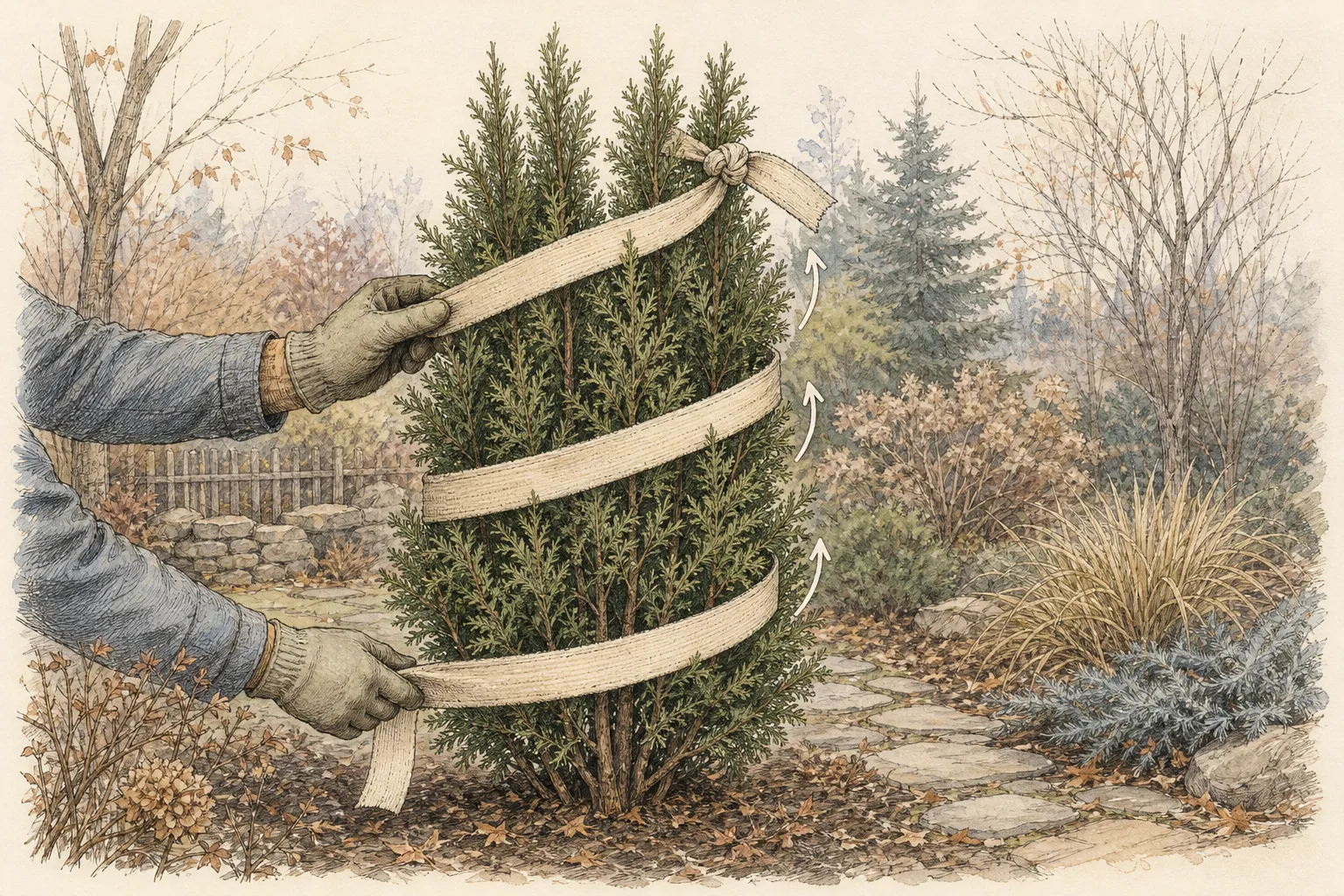
Walk around the plant after tying. It should still look like the same evergreen, just gently gathered. Check that branches are not pulled across a path, that the base remains ventilated, and that the root flare is unobstructed. Photographing the knot location for your own record can help find it after snow, but the physical tag is more reliable in the garden. Do not add a tarp or impermeable cover over the tied crown; this method relies on form, not enclosure.
Observe storms without escalating into removal work
After a snowfall, inspect from a safe distance. A tied plant should retain its general outline without the material cutting inward or sliding. Do not walk under ice-loaded limbs, strike branches, or pour hot water onto them. Iowa State warns against knocking ice from branches because brittle frozen wood can break. If the plant is dangerously loaded, keep people away and consult an arborist rather than pulling harder on the pre-storm tie.
This article intentionally stops short of a snow-removal procedure. Light loose snow on a small shrub and heavy adhered ice present different risks, and the separate snow-removal guidance addresses direction, temperature, and technique. Likewise, stems already splayed after a storm need recovery assessment, not an increasingly tight wrap. Preventive support is successful when it limits opening without becoming a rescue cable under load.
During a midwinter thaw, check exposed contact points. Loosen or reposition any strap that has twisted to an edge, abraded foliage, or shifted onto a narrow stem. Replace degraded material before the next forecast, maintaining the same gentle outline. Remove debris caught in the wrap by hand only when branches are unloaded and flexible. Never cut a hidden line with powered tools; locate every turn first so bark and live shoots are not severed.
Keep temporary tying distinct from structural support
A wrap gathers neighboring leaders so their existing flexibility and tapered outline resist snow opening. A guy line to a stake introduces a different force path through the root plate and can pull a shrub off balance. Do not add ground anchors, overhead lines, or a central rigid pole to this method without a design appropriate to the plant and site. Hidden trip lines are particularly hazardous once snow covers the ground.
Permanent cabling also serves a different purpose. It is specified for particular unions, hardware positions, loads, and inspection intervals, generally by an arborist. Broad winter webbing around foliage should never be left in place as a cheap substitute. If removing the seasonal tie immediately reveals a hazardous split or extreme splay, restrict access and obtain an assessment rather than reinstalling the same wrap more tightly for another year.
Likewise, pruning is not part of the pre-storm tying session beyond removing a small already-detached twig that can be reached safely. Cutting healthy outer branches to make a strap fit changes the plant and may expose interior foliage to winter injury. Schedule structural pruning for the correct species and season after diagnosis. The discipline of one temporary intervention makes later cause and effect readable: you know whether gathering alone reduced snow deformation.
Where snow repeatedly slides from a roof or is thrown by a plow, address the source and impact zone rather than tightening the plant. A properly located snow fence or a change in snow placement may require separate site planning, but it should not be attached to the evergreen. Concentrated moving snow can overwhelm a gently gathered crown, and no reasonable foliage strap makes an unsuitable high-impact location safe.
Remove support before growth resumes
Temporary ties must come off. Iowa State, Minnesota, and Illinois all direct removal in spring, with Iowa offering a regional mid- to late-April reference rather than a universal calendar date. Choose the local point when the main risk of heavy snow has passed and before active expansion can grow around the material. Untie or cut the connector while supporting the strap, then unwind it completely; do not leave hidden lower turns inside the foliage.
Inspect every contact line for flattened foliage, discolored bark, abrasions, or stem deformation. Most gently gathered branches should relax toward their natural positions. If a union opens, a leader remains displaced, or bark has split, avoid immediately reinstalling a tighter permanent tie. Those signs call for structural evaluation and possibly selective pruning or professional cabling appropriate to the plant’s size and value.
Clean, dry, and store reusable webbing with the removal tag, then record whether the plant actually needed support. A small upright evergreen that repeatedly requires forceful tying may have a form or structural problem better addressed through informed pruning or replacement. The durable method is modest: select only an eligible plant, use broad material, place it above the divergence, retain a conical outline, observe without manipulating loaded branches, and remove every tie on time.
Steps
- Level
- moderate
- Time
- 20 to 40 minutes for one small accessible shrub
- Tools
- Work gloves, Eye protection, Stable step stool only for low reachable work, Weatherproof removal tag
- Materials
- Broad woven tree-support strap, soft cloth strips, or flexible nylon webbing, A short separate tie for a loose spiral when the plant form requires it
- 1Confirm that the shrub is an eligible size and form
Proceed only with a small accessible upright multi-stem evergreen whose flexible leaders can be gathered gently. Refer tall, wide, split, leaning, or utility-line-adjacent plants to an arborist.
- 2Inspect before the forecasted storm
Trace leaders and check unions, bark, roots, and soil in unloaded above-freezing conditions. Stop if any crack, cavity, root-plate movement, or unstable dead wood is present.
- 3Select broad soft support
Use woven tree strap, nylon webbing, or folded cloth without sharp hardware. Reject wire, monofilament, zip ties, and narrow cord that concentrates pressure.
- 4Gather to the natural outline
With a helper if needed, ease leaders inward only until the normal tapered silhouette returns. Do not force a broad plant into a narrow cylinder.
- 5Place support above the divergence
Set a broad band around the upper-middle crown, roughly two-thirds above the weak crotch where it can be identified, and keep it off tips, trunk base, and narrow collars.
- 6Add only an open spiral if needed
For a taller narrow form, route one widely spaced spiral upward, keep the foliage visible, finish with a releasable connection, and attach a weatherproof spring-removal tag.
- 7Inspect safely and remove in spring
Observe loaded plants from a distance, adjust only during an unloaded thaw, and unwind every band after heavy-snow risk passes but before active expansion begins.
- 8Tag every connection at installation
Put a visible weatherproof removal tag beside the releasable knot and record how many turns were installed. Hidden lower loops are easy to miss once dense foliage regains its shape.
- 9Keep anchors and permanent hardware out of scope
Do not add ground guys, stakes, trunk wires, or improvised cables to seasonal foliage wrapping. A plant that needs those forces requires a separate structural design and often professional assessment.
- 10Reassess the plant after removal
Check every contact line and watch whether leaders return naturally. Restrict access and seek structural advice if a union opens, a split appears, or the shrub cannot stand without the temporary wrap.
- 11Count and expose every turn before cutting
During an unloaded thaw or spring removal, trace the whole strap from knot to end and compare it with the recorded turn count. Use hand tools only at a fully visible section so live bark and concealed branch tips are not severed.
- 12Store reusable material separately
Clean and dry sound webbing after removal, discard material with sharp edges or damaged fibers, and keep the dated removal tag attached for next season. Never leave a loose length hidden in the crown where it can constrict new growth.
- 13Record whether support changed the outcome
Note storm type, visible splay, strap movement, and any abrasion before deciding to repeat the method. Recurrent severe opening despite gentle support indicates a structural or plant-form issue that deserves pruning guidance, professional assessment, or replacement.
Related reading
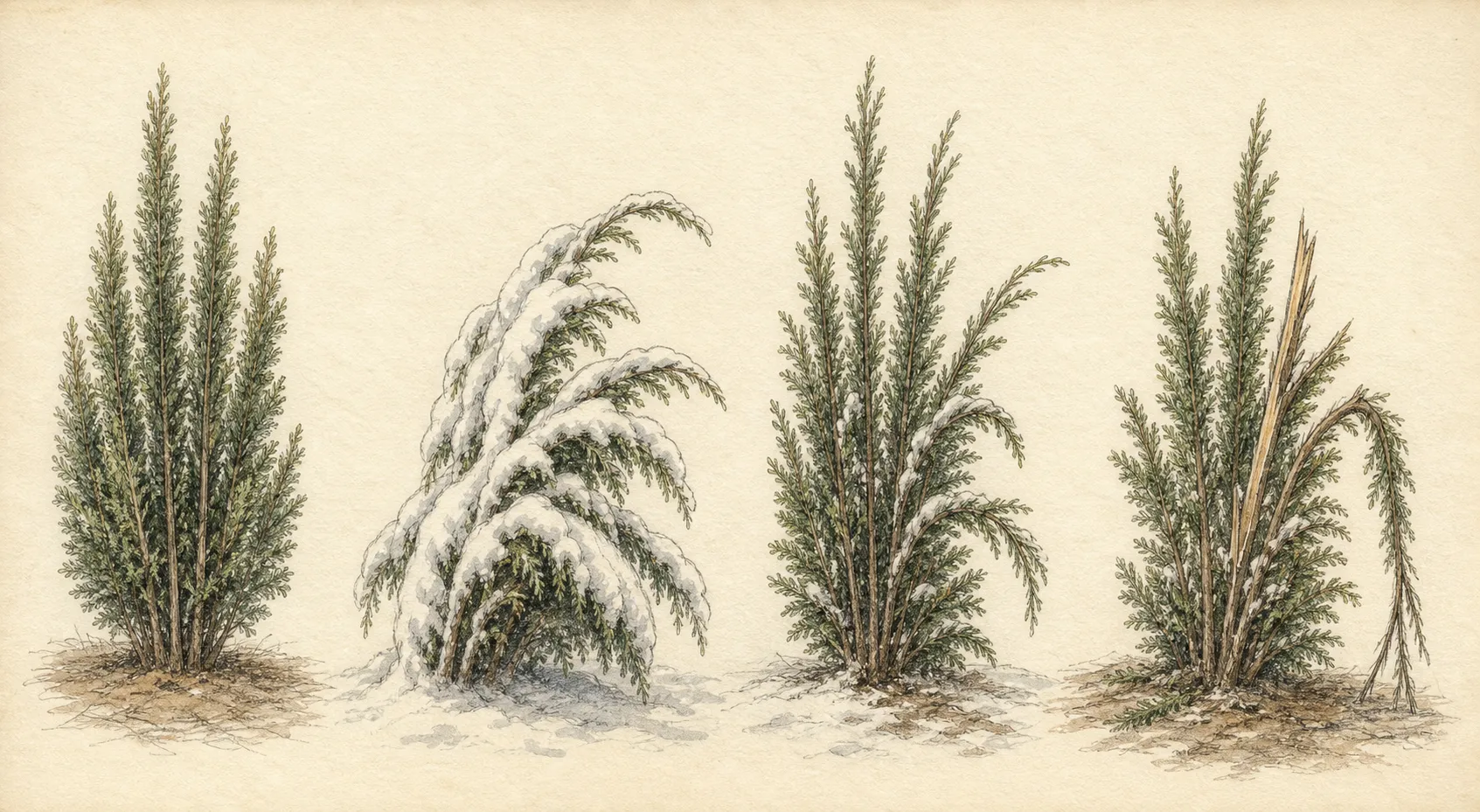
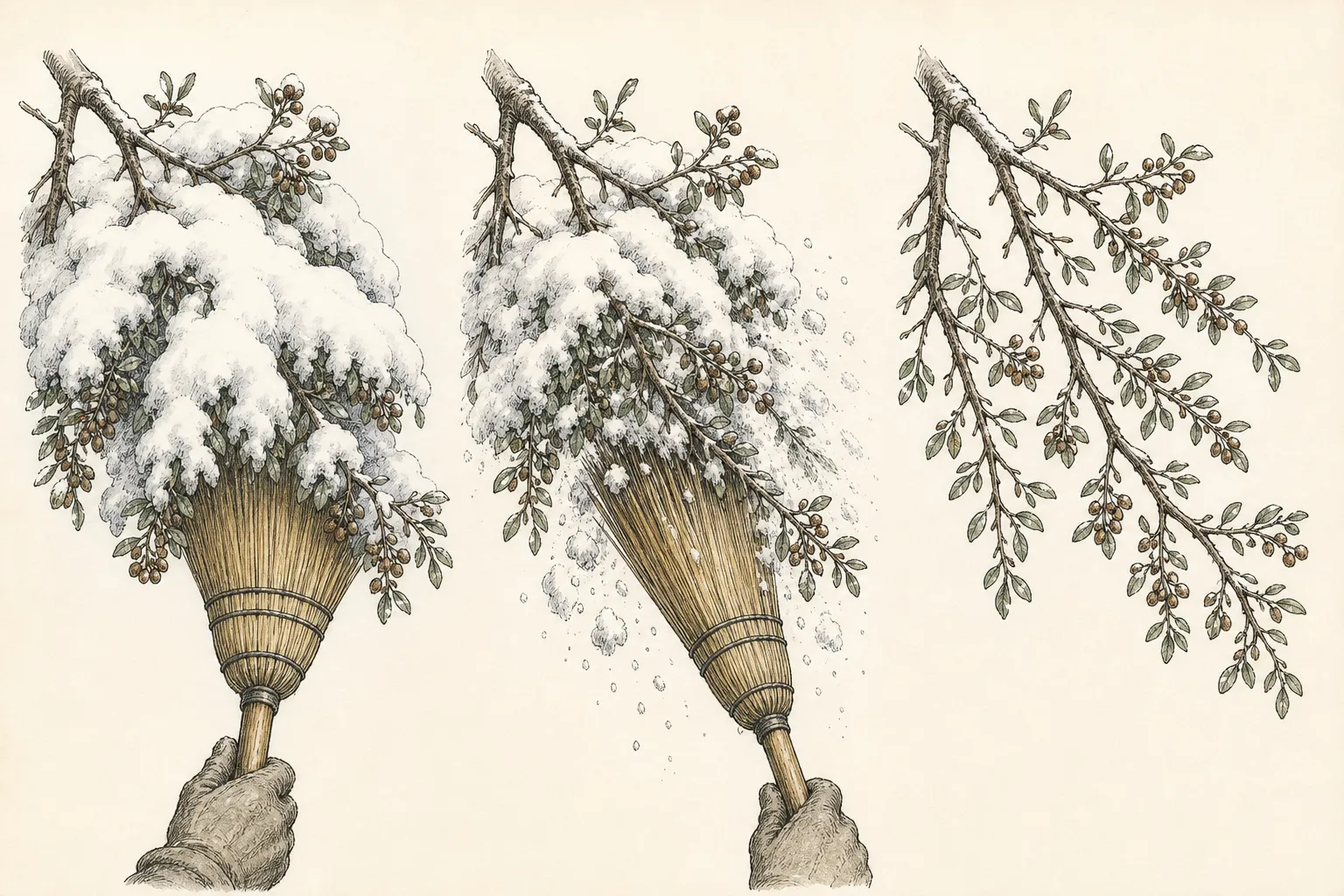
Sources
- How to Prevent Ice and Snow Damage on Trees and Shrubs. Iowa State University Extension and Outreach. Source record · Accessed 2026-08-20.
- Protecting trees and shrubs in winter. University of Minnesota Extension. Source record · Accessed 2026-08-20.
- Winter Snow and Ice Damage to Trees. University of Illinois Extension. Source record · Accessed 2026-08-20.
- Winter Protection for Sensitive Plants. Nebraska Extension in Lancaster County. Source record · Accessed 2026-08-20.