Grow · protect musa basjoo stems winter uk
Protect Musa basjoo Stems Through a UK Winter
Prepare established outdoor Musa basjoo for winter by protecting its retained stems with breathable wraps, an insulating cage and a rain-shedding top.
Published Last updated
In this guide
- Protect retained stems before the first hard frost
- Separate leaves, pseudostems and the underground plant
- Choose a protection level that fits the site and clump
- Remove the leaves while preserving the stem sheaths
- Wrap the stems and build room for insulating material
- Fill the enclosure and shed rain from its top
- Inspect during mild spells and respond to the actual problem
- Release the enclosure as spring growth resumes
- Steps
Protect retained stems before the first hard frost
Prepare established outdoor Musa basjoo by removing frost-damaged leaves, wrapping the retained stems with fleece and hessian, and adding a straw-filled cage where exposure calls for more insulation. Finish with a secure rain-shedding cover over the top. The purpose is to preserve useful stem height for the next growing season. A banana that survives underground and starts again from the base has achieved a different result.
Use the weather forecast to time the job. The RHS's dedicated banana guidance allows a few minor frosts and describes removing leaves after the first light frost has blackened them, but it requires the plant to be wrapped before hard frosts arrive. Have materials and help ready in advance: the interval between those conditions can be short. Early November is a planning point in many UK gardens, not a compulsory date or permission to wait through a severe forecast. Complete protection ahead of a forecast hard frost even if some leaves are still green.
This method is for an established clump rooted in a suitable garden position. Check that it is Musa basjoo, the hardy Japanese banana, before choosing outdoor stem protection. A tender Ensete or another banana species may require a different overwintering arrangement. Newly acquired small plants and pots also need separate decisions. The name banana on a sales label does not establish that the plant can spend winter in this outdoor enclosure.
Separate leaves, pseudostems and the underground plant
The apparent trunk is a pseudostem formed from overlapping leaf sheaths. NC State describes Musa basjoo as an herbaceous perennial, not a woody tree. Its broad leaves can be lost to frost while some of the thick stem remains viable. Leave sound lower sheaths intact when removing the leaves. Peeling the cylinder back to make it look clean removes part of the structure you intend to preserve.
Below ground, the rhizome and roots can support new shoots even when exposed top growth is killed. NC State's discussion of cold hardiness is specifically conditional on pruning and mulching the underground plant; it also describes above-ground dieback in colder zones. That information cannot be read as a guaranteed temperature limit for an unwrapped tall pseudostem. Keeping the clump alive and keeping its existing height require attention to different plant parts.
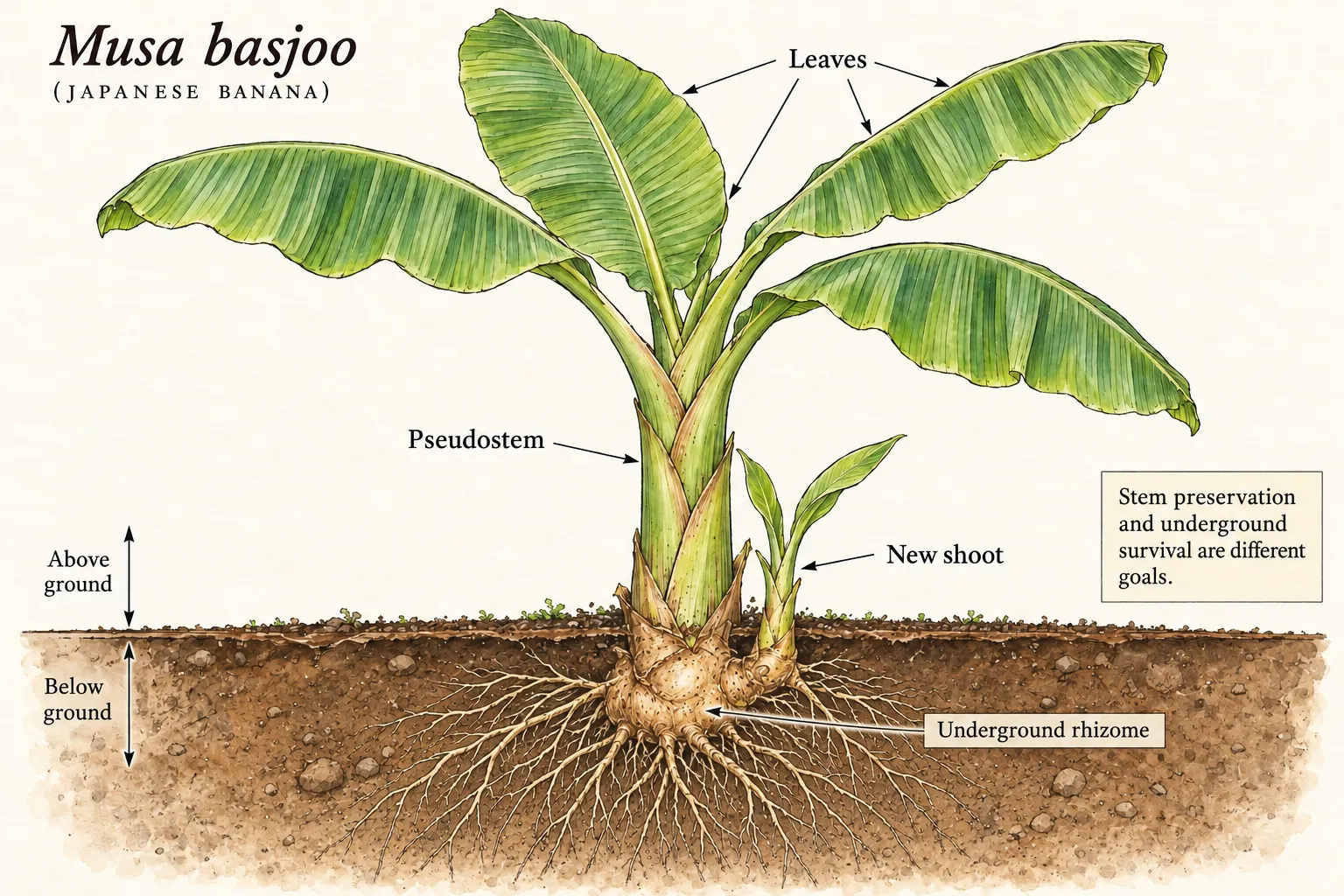
Choose the result you want before cutting. Retained stems can give the next season a taller starting structure, while regrowth after loss to ground level must rebuild that height. RHS horticulturists at Harlow Carr reported good recovery from both protected and unprotected clumps in one observed winter, including a clump cut back by frost. Their experience shows that recovery is possible, but it does not establish a reliable no-protection rule for another garden or a harsher winter.
Stem age also matters. NC State notes that a pseudostem dies after flowering and fruiting, while new shoots arise from the underground plant. Wrapping cannot make that spent stem permanent. Identify the living stems and developing offsets you are trying to carry through winter, and keep a record of any stem that has already flowered. This is ornamental foliage care; flowering or fruit production next year is not the measure of success.
Choose a protection level that fits the site and clump
The RHS starts with a complete fleece wrap followed by hessian. For a sheltered position, those layers may be sufficient. Colder or more exposed sites call for the extra frame and dry insulating fill described below. Cambridge University Botanic Garden likewise includes Musa basjoo among plants that benefit from full wrapping in harsher winters, sometimes supported by a framework. Treat the level of protection as a response to the actual site.
Check where rain, wind and winter runoff reach the clump. Shelter from wind is useful in the growing season too, because Musa has large leaves that tear easily, and NC State recommends a sheltered position. For winter construction, the practical questions are whether stakes can be secured, whether the top can shed water away from the base, and whether you can reach the retained stem tops. A narrow passage beside a leaning tall stem may be a poor place to improvise a cage.
A young or movable container plant can use a protected indoor route. RHS guidance offers a frost-free greenhouse or conservatory for small plants, while NC State describes bringing container bananas into a sunny room before frost. That is separate from the leafless outdoor wrapping method. Resolve the pot's light, temperature and watering requirements as one arrangement; a warm, dark corner is not interchangeable with a bright indoor growing position.
Decide on an attainable enclosure height. The dedicated RHS method removes leaves while retaining the main stem; another RHS illustrated routine reduces top growth to stumps, and NC State gives a two-foot cutback in its colder-region overwintering description. These are different approaches. For this stem-preservation method, keep sound height that can be covered and inspected safely. There is no universal two-foot cut to add merely because it appears in another set of instructions.
Remove the leaves while preserving the stem sheaths
Once the chosen frost window arrives, assess the foliage and clear working space around the clump. The dedicated RHS routine cuts off the leaves just above the top of the stem with sharp secateurs. Make the leaf-stalk cuts slope away from the centre so water is directed outward. Support a large leaf while cutting, then lower it clear of neighboring stems. Keep the work on the leaf stalks and preserve the sound pseudostem below.
Remove detached leaves and wet debris from around the base. RHS wrapping guidance identifies retained damp debris as a potential source of rot beneath protection. Clearing it also makes the edge of the clump visible for placing the support frame. Keep healthy offsets visible while doing this; a small shoot close to a larger stem can disappear beneath a folded leaf. Leave the underground clump rooted in place for this method.
Inspect the remaining stems before they are concealed. A firm retained cylinder is different from tissue that has already collapsed or become soft and decaying. Photograph a questionable area and obtain local advice if extensive damage makes the plant's condition unclear. Packing insulation over deterioration cannot restore the missing tissue. Equally, blackened leaves alone are an expected trigger for this routine and are not proof that every stem has failed.
Wrap the stems and build room for insulating material
Apply fleece around the retained plant with continuous coverage, then secure it with twine. The RHS specifies enough tension to keep the fleece in place while keeping the ties from cutting into the stem. Add hessian over it and fasten that layer as well. Work upward deliberately, checking the back of the clump and the spaces between stems. A tidy front face can conceal a gap where an offset stands apart from the main stem.
For the additional cold-area protection, form a cylinder of chicken wire or suitable stock fencing around the plant. The RHS calls for approximately 15 cm, or 6 inches, between the trunk and the wire, secured with two stakes on opposite sides. That is space for insulation on each side, not the overall cage diameter. Position supports carefully to minimize disturbance to the existing roots and give the wire its own stable structure.
Measure around the widest part of the retained clump. A frame that clears one central stem may press against an offset on the far side. As a simple planning example, one 20 cm-wide stem plus 15 cm on either side needs roughly 50 cm of internal cage width before allowing for its wraps. A multi-stemmed clump requires a larger outline based on its outermost stems. Check the remaining space after wrapping, because that is where the straw must fit.
Take care with cut wire. Use sturdy gloves and eye protection for constructing the frame, as the RHS advises, and turn or secure protruding ends away from the working route and plant. Attach the mesh to the stakes so a gust cannot rub it repeatedly against the pseudostem. Arrange an accessible join or fastening for spring removal. Building the cage in sections is useful only if each join remains secure under the weight of the fill and cover.
Fill the enclosure and shed rain from its top
Fill the space with dry straw or dry bracken, working around every retained stem. The dedicated RHS method calls for fairly firm packing so the trunks are fully surrounded by a substantial insulating layer. Fill pockets between stems as well as the outer ring, and continue above the retained tops. Keep the stems upright and supported as you work. Firm filling means continuous insulation, not using force that bends or crushes the plant.
Check the fill from several sides before closing the top. A hollow beside a stem or a thin layer at one edge reduces the protection exactly where the plant is nearest the outside. The 15 cm spacing is useful only when the gap actually contains insulating material. Keep a reserve of dry fill for settling or replacement later. Adding a decorative outer cloth cannot compensate for an empty section inside the cage.
Secure a reused waterproof sheet over the top, following the RHS banana method. Support or shape it so rain and melting snow run off beyond the insulating column. Fasten it to the structure so it stays in place in wind, while keeping it removable for inspection. The waterproof element is a rain cap over the top; the surrounding fleece, hessian and mesh remain distinct layers. A sagging lid that collects water is a construction fault to correct.
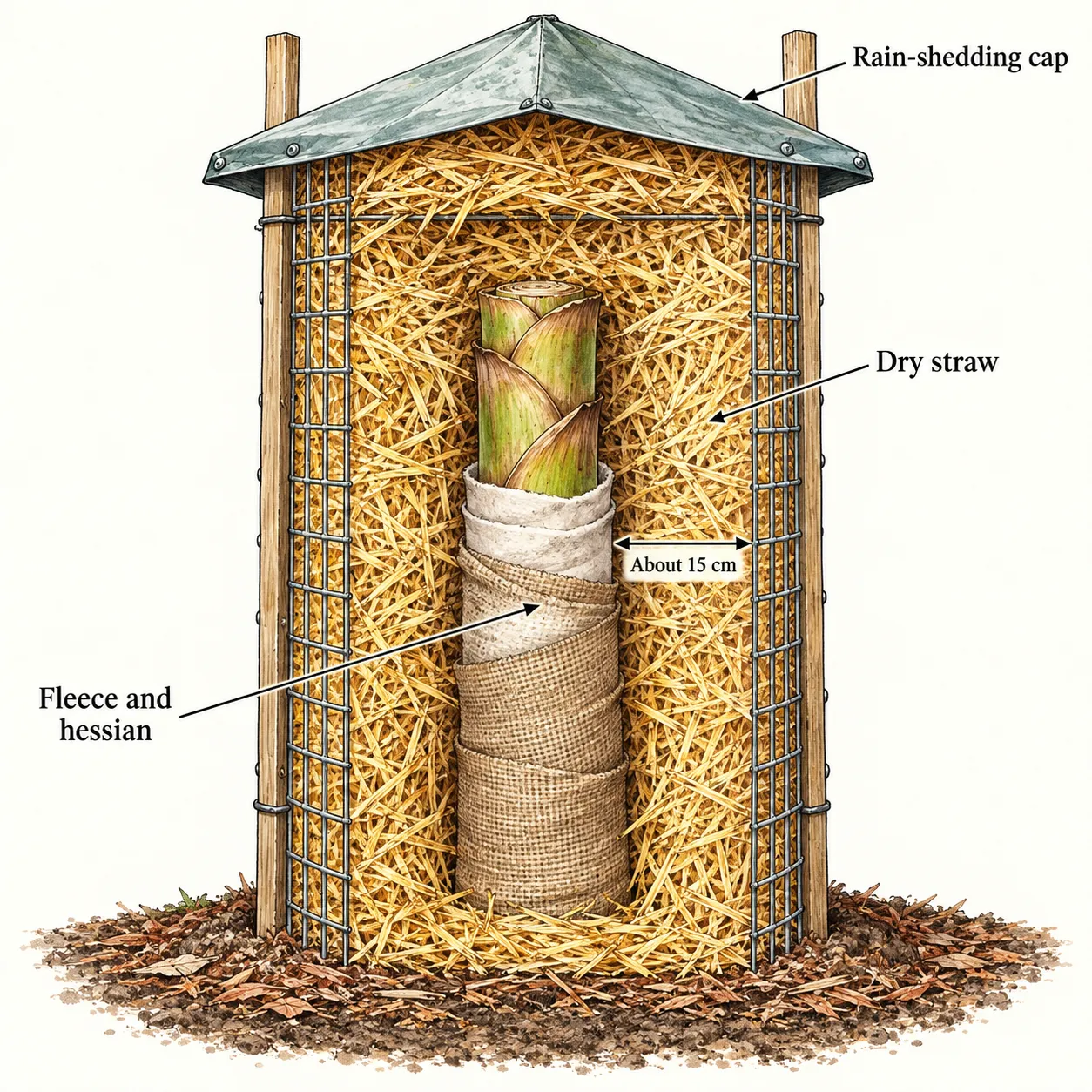
Consider the ground beneath the enclosure too. NC State recommends a substantial mulch around the base to protect the underground part, but drainage must continue to function. Keep runoff from the cap out of any low pocket at the clump's base. This rooted plant is not being lifted and dried like a stored tuber. Its soil needs assessment separately from the dry insulating straw, especially where the cover prevents normal rainfall from reaching it.
Inspect during mild spells and respond to the actual problem
After wind or prolonged rain, inspect the rain cap, mesh fixings and exposed edges. Look for displaced straw, a torn covering or water being directed into the centre. Open a manageable section in suitable weather and check that the fill remains reasonably dry and the retained stem is still sound. Replace sodden insulation and correct the leak or runoff route. Covering a wet interior with another layer leaves the original problem in place.
Cambridge and the RHS advise removing or opening protective covers during extended mild spells to limit sweating and rot, then replacing them as cold returns. Build that access into the package from the outset. A permanently sealed sleeve makes it difficult to distinguish dry insulation from trapped moisture. Use the forecast to choose an inspection window and restore the enclosure before the next cold period, keeping the retained tops protected when needed.
Check the root-zone moisture during mild, unfrozen conditions. NC State describes Musa basjoo as needing consistently moist, draining soil during growth, and the winter roof changes the water arriving at its base. Water only in response to an observed need, letting excess drain; saturated soil calls for drainage attention. Leave fertilizer for the growing season. A winter stem that is not extending leaves has no need to be pushed into a summer feeding routine.
Record stem condition and the location of damage across the clump. Loose dead material and an extensively soft stem are different observations. Keep any investigation gentle and seek a diagnosis for progressive decay. At the end of winter, compare the retained cylinders and emerging basal shoots with the autumn record. That comparison will show whether the method preserved stem height, underground growth, or both.
Release the enclosure as spring growth resumes
Use local weather and growth to plan removal. The RHS's general banana wrapping guidance says to unwrap by May in its UK context, while its broader advice calls for staged removal after severe frost danger has passed and new growth has begun. Treat May as a regional checkpoint, not a reason to leave fresh leaves trapped inside a warm cover or expose them early in a colder garden. Keep a temporary protection option available for a renewed cold forecast.
Remove the cap and outer materials in a sequence that lets you see the plant before pulling straw away from it. Undo ties, open the cage and lift the fill out gently around emerging growth. Release any fastening that has become tight as the plant changes. A dull day or gradual exposure follows the RHS acclimation advice. Give unfolding leaves room to open, and watch the wind conditions as the large new blades become exposed.
Resume watering and growing-season feeding as active growth and weather require, using the product directions. NC State supports regular feeding during growth and a moist, well-drained root environment. Assess the old pseudostems separately from new pups. If a retained stem has failed but basal shoots are developing, the clump may still rebuild; that is a different outcome from preserving its original height. Keep the record so next autumn's protection is based on this plant's response.
Steps
- Level
- moderate
- Time
- About an hour for a manageable established clump, plus winter checks
- Tools
- Sharp secateurs, Measuring tape, Sturdy gloves and eye protection for wire work, Wire cutters, Twine and suitable fastenings
- Materials
- Horticultural fleece, Hessian, Chicken wire or suitable stock fencing, Two suitable supporting stakes for a small enclosure, Dry straw or bracken, Reusable waterproof sheet for the top, Suitable organic mulch for the root area
- 1Identify the plant and set the objective
Confirm established in-ground Musa basjoo and decide which sound stems you intend to retain. Record the clump's current height and any stems that have flowered. Prepare a different shelter route for tender species or small container plants. Assemble materials before light frosts leave only a short interval ahead of harder cold.
- 2Remove leaves and expose the base
In the chosen frost window, cut the leaves just above the stem using sharp secateurs, with leaf-stalk cuts sloping away from the centre. Support each leaf as it comes away. Retain sound lower sheaths and clear detached wet foliage from around the base. Inspect the remaining cylinders and keep smaller offsets visible while preparing the enclosure.
- 3Wrap and size the supporting cage
Cover retained stems with fleece, fasten it gently and add hessian. Where extra insulation is needed, measure the full clump and form a wire cylinder leaving about 15 cm from the stems to the wire. Allow for the wraps and outermost offsets. Secure the frame to supports positioned carefully around the established root area.
- 4Fill the space and attach the rain cap
Work dry straw or bracken around and between the retained stems so the insulating layer is continuous. Fill above the stem tops while keeping the plant upright. Attach a removable waterproof top that sheds rain beyond the cage. Check that the cap cannot sag into a water basin or direct runoff into the clump's base.
- 5Maintain access through changing weather
Inspect fixings and the cap after storms. Open protection during suitable extended mild spells, check the fill and replace material that has become sodden. Repair the water-entry route before reclosing. Assess root-zone moisture separately from the dry insulation and restore the covering before cold returns. Leave routine fertilizer for renewed growing-season activity.
- 6Unpack and judge the spring result
Follow local frost conditions and emerging growth to remove the covering in stages. Undo ties and open the frame before lifting straw from around new leaves. Retain temporary protection for late cold and resume normal care as growth develops. Compare preserved stem height with new basal shoots, recording which parts of the plant carried through winter.
Related reading
Sources
- Protecting bananas over winter. Royal Horticultural Society. Source record · Accessed 2026-10-27.
- Overwintering tender plants: wrapping. Royal Horticultural Society. Source record · Accessed 2026-10-27.
- Musa basjoo. NC State Extension Gardener Plant Toolbox. Source record · Accessed 2026-10-27.
- The garden in frost and snow. Cambridge University Botanic Garden. Source record · Accessed 2026-10-27.