Grow · summer flowering hanging basket build
Plant a Summer Flowering Hanging Basket That Stays Serviceable
Build a flowering hanging basket around compatible plants, durable root volume, open drainage, verified wet load and a watering route that remains reachable after the display fills out.
Published Last updated
In this guide
- Write the site brief before buying flowers
- Choose the basket and support as one system
- Reserve root volume instead of planting for opening day
- Build the Iowa three-plant sunny recipe
- Build drainage and watering access into the empty basket
- Plant on a stable work surface and preserve balance
- Verify the wet assembly before it goes overhead
- Water by evidence without moving the mature basket
- Reset the display before roots and weather take control
- Steps
Write the site brief before buying flowers
A hanging basket is a suspended root zone, a flowering composition and a recurring maintenance job. Begin at the intended hanging point, not at the bedding bench. Record the hours and direction of direct sun, reflected heat, wind, shelter from rain and the cool-season end of the local display. A porch that looks bright may still be deep shade for much of the day, while a west wall can expose roots and foliage to heat long after the sun leaves an open border.
Define the viewing and working sides. A basket centered in a window may be seen from outside but watered from inside; one beside a path may be approached from only one direction. Keep the mature canopy away from doors, lights, house numbers, vents and opening windows. Reserve a position where runoff can fall harmlessly and where a hose, wand or can can reach the potting surface without the gardener standing beneath an unstable load.
Choose a summer lifespan. Seasonal annuals can fill a basket for one display and be removed before cold weather; longer-lived plants need different root volume, nutrition and overwintering decisions. The RHS notes that summer bedding should go outside only after frost risk has passed in its context. Use local frost guidance and plant labels for your region. Do not let a calendar headline overrule a cold night, an unacclimated plant or a tender cultivar.
Set a maintenance ceiling now. If daily inspection in hot weather is unrealistic, reject a small exposed basket, choose a larger workable container within the support limit, move the display to gentler light or use plants with compatible lower water demand. Iowa State notes that larger and deeper baskets dry more slowly but are heavier. That is the central tradeoff: root and water stability must be solved together with structural capacity, not after planting.
Choose the basket and support as one system
Inventory every load-bearing part: the building or freestanding frame, anchor, bracket, hook, swivel if present, chain or hanger, basket frame and liner. Each component needs a manufacturer rating and a compatible installation method for the actual substrate. A strong chain does not rescue an unknown screw in decayed timber, and a sound bracket does not rescue a cracked basket rim. Where the structure or fixing cannot be verified, have a qualified person specify or install it.
Compare basket materials by behavior rather than appearance alone. A plastic container is less porous and usually dries more slowly; a wire frame needs a sound liner that holds mix while allowing drainage. Iowa State describes coir, moss, burlap and compressed-fiber liners and warns that larger baskets add weight. Reject rusted frames, ultraviolet-brittle plastic, torn liners and hangers that no longer share the load evenly across all attachment points.
Select enough internal depth and width for the named plants to build roots through the whole display. A shallow decorative shell can look full at planting but give roots little buffer between saturation and drought. Conversely, the largest basket is not automatically safest or easiest: wet mix, mature foliage and retained water all add mass. Choose the largest useful root volume that the verified support system and your maintenance method can safely carry.
Place the empty basket temporarily at the proposed point without planting. Check that it hangs level, cannot strike glazing or a wall in ordinary movement and does not intrude into headroom or a route. Confirm the hanger cannot jump off an open hook. Do not add a second safety tether unless it is a rated, correctly installed part of the system; improvised cords can create new tangles while giving false confidence.
Reserve root volume instead of planting for opening day
Plan the mature roots before arranging flowers. List each plant's labeled spread, habit, light and moisture need, then reduce the list until every component has a plausible share of potting mix. Iowa State cautions that overplanting can make a basket overgrown and increase watering demand. Nursery starts will expand. Empty mix between small root balls is not wasted space; it is the reservoir of air, moisture and new rooting room that lets the composition remain stable beyond its first photograph.
Use one moisture regime. The next section supplies one bounded sunny Iowa-context recipe whose three current supplier labels agree on part sun to sun, average water, mature height and spread. It is an example, not a universal formula: cultivars and labels change, and regional heat changes performance. Reject the recipe or any substitution if one component needs consistently wetter or drier mix than its neighbors, regardless of how pleasing the colors look together.
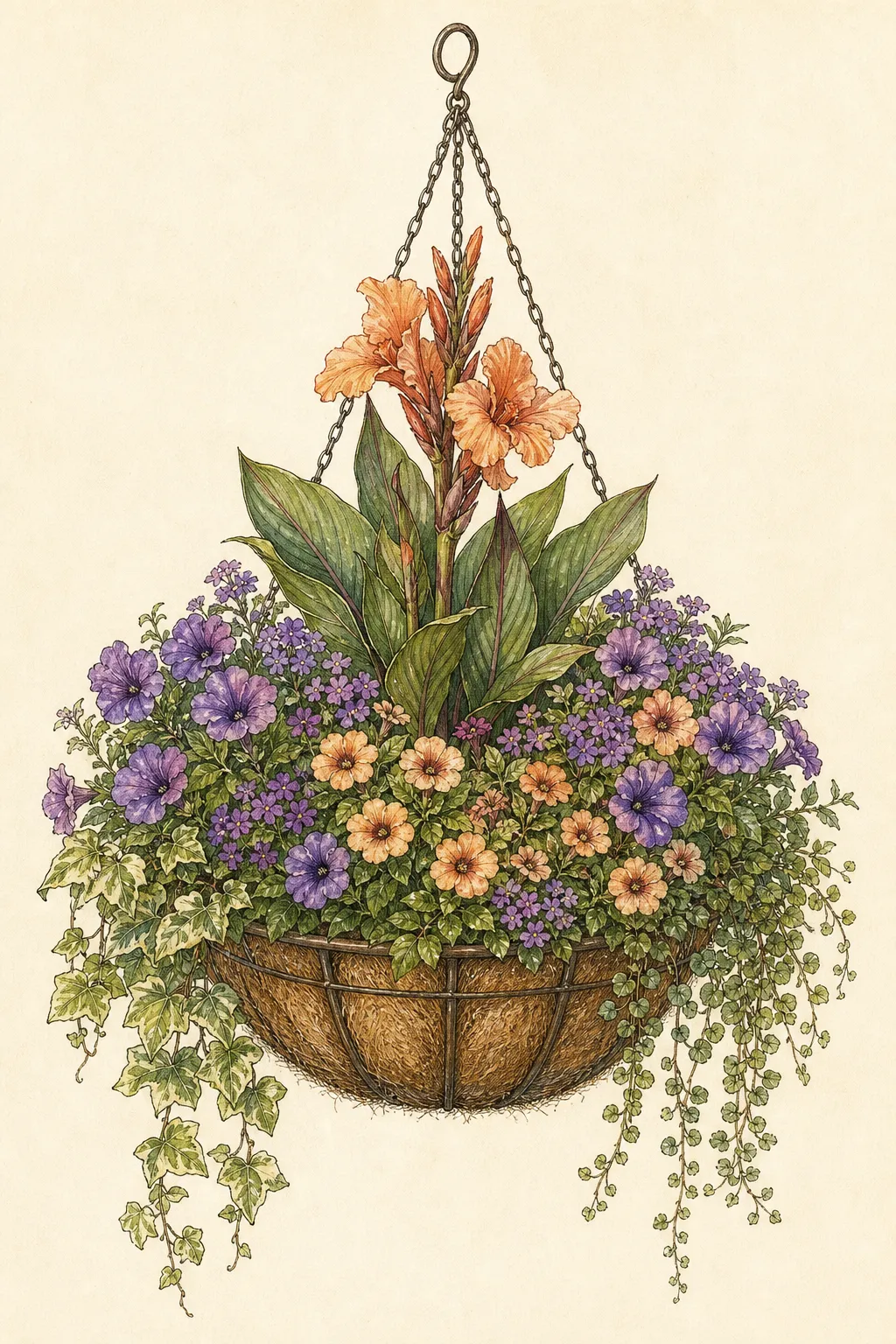
Balance vigor as well as shape. A restrained upright accent, a medium filler and a trailing edge can create a readable silhouette, but the familiar design roles do not predict growth rate. A vigorous trailer may root through the whole basket and suppress a slower partner. Read mature size, use fewer plants where vigor is high and distribute root balls evenly. A centered top-heavy plant can shift the basket's balance as stems lean toward light, so plan the full canopy in three dimensions.
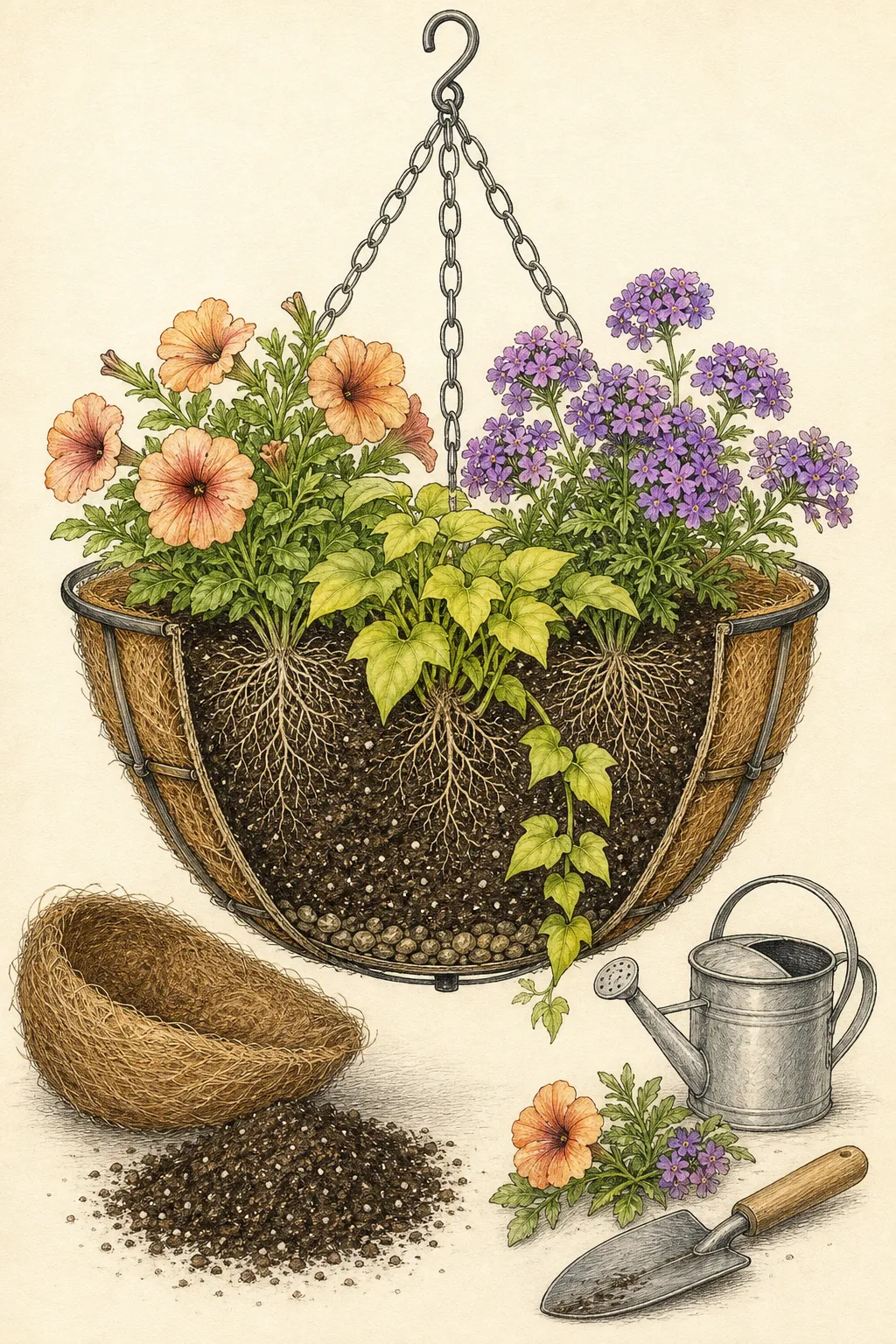
Treat side planting as optional. The RHS notes that side holes can make a basket look full sooner, but every extra plant occupies root volume and every cut can weaken a liner or leak mix. If the container and liner are designed for side planting, place openings above the base and keep them clear of hanger points and drainage paths. Otherwise, plant the top only and let suitable trailing growth soften the edge over time.
Build the Iowa three-plant sunny recipe
Use one top-planted basket 12–14 in (30–36 cm) in diameter. Iowa State says a basket in this size band accommodates three to five plants and that side plants count within the total; this recipe deliberately uses the minimum three and no side openings. Fill with well-drained soilless container mix while preserving the Iowa State watering headspace of ½–1 in (1.3–2.5 cm) below the rim. Do not fill the apparent gaps with two more starts after planting—the three named plants are vigorous spreaders, not placeholders.
Buy exactly one Supertunia Mini Vista White petunia, one Superbena Royale Romance verbena and one Superbena Royale Plum Wine verbena, retaining each complete label. Their current Proven Winners pages all list part sun to sun, average water, 6–12 in (15–30 cm) height and 18–24 in (46–61 cm) spread. The petunia is described as vigorous and trailing; both Royale verbenas are mounding trailers that can spill over container edges. If any live label differs at purchase, stop and reassess rather than treating the online receipt as permanent.
For a repeatable top view, stand over the supported basket with the hanger junction pointing to twelve o'clock. Place the petunia root ball at twelve, Romance at four and Plum Wine at eight, each the same distance from the center and with its strongest outward shoots aimed toward its own third of the rim. Keep the center between root balls filled with mix but visibly open as the primary watering target. Rotate the still-supported basket and correct crown depth or mass imbalance before the hanger carries weight.
Treat this as an Iowa summer annual display, not a hardiness promise. Install outdoors only when local guidance says frost risk has passed; the supplier labels describe bloom from planting to frost, so frost closes the season. During hot sunny or windy weather, Iowa State says established hanging baskets may need checking daily and sometimes watering more than once in a day. That is a moisture-check trigger, not a fixed schedule: probe the mix, water until drainage appears and lower the basket if safe access is lost. In a hotter region, a colder start or a harsher reflected site, reselect plants with local Extension guidance.
Build drainage and watering access into the empty basket
Confirm that excess water can leave the root zone before adding mix. Plastic baskets need open drainage holes; lined wire baskets need a liner arrangement that retains mix without sealing the base. Hold the empty assembly over a safe surface and run water through it. Clear manufacturing plugs, folds or liner material that block outlets. Do not assume a reservoir, saucer or decorative outer shell drains; identify exactly where retained and excess water will go.
Use a fresh, lightweight, well-drained container mix rather than garden soil. Iowa State describes soilless mixes as providing drainage while holding useful moisture, and Purdue emphasizes aeration and drainage in suspended containers. Choose a product labeled for outdoor containers and the selected plants. Pre-moisten it so dry material does not blow away or shrink dramatically after planting, but let it drain rather than starting with a saturated, heavy mass.
Preserve a watering lip below the rim. Iowa State and Purdue both leave roughly an inch of headspace in their examples, while the RHS describes the finished compost level as slightly below the rim. Treat that as a functional principle, not a compulsory measurement for every vessel: the final surface must accept a slow application without mix and water spilling immediately over the edge. Keep central foliage from sealing the only approach to that surface.
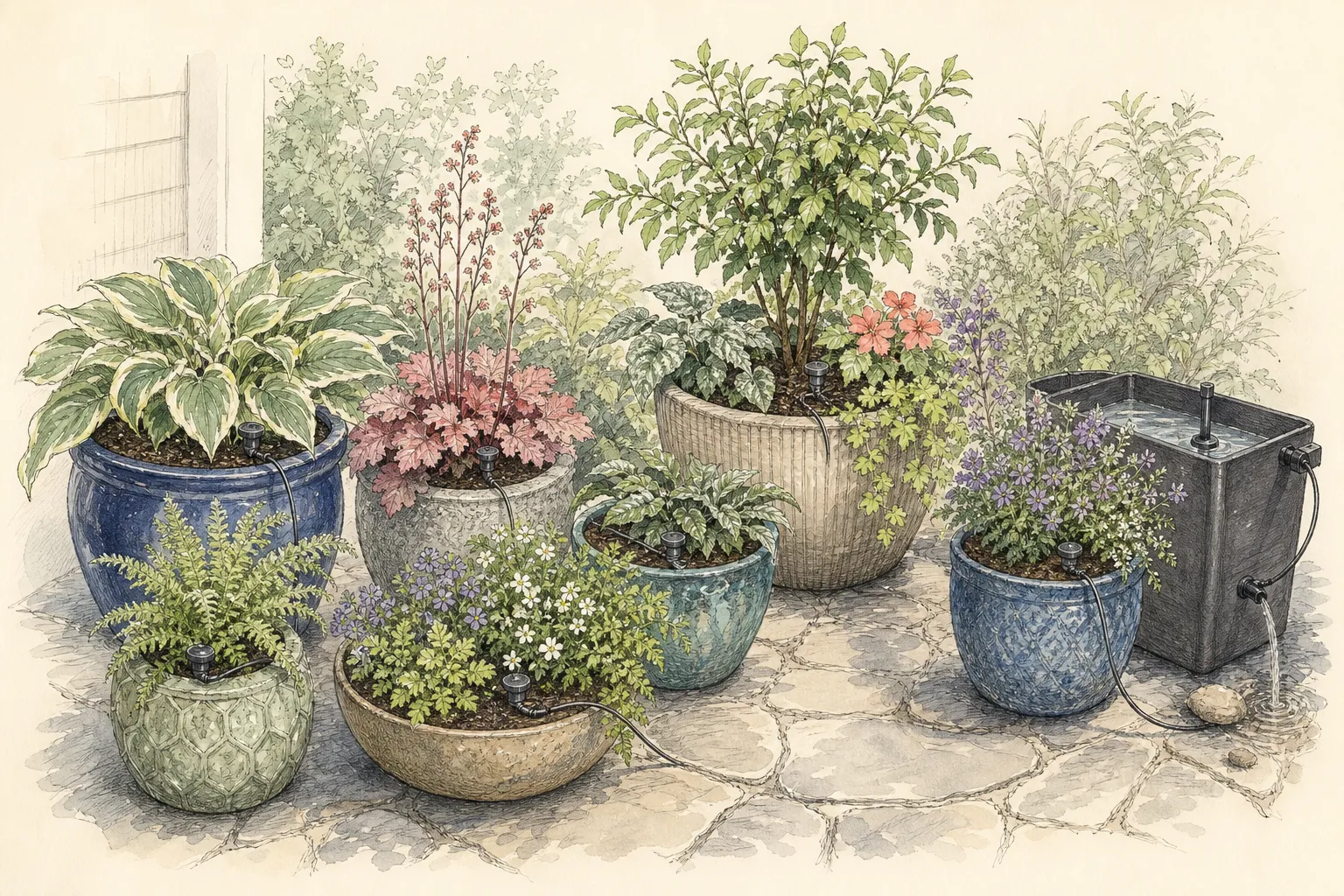
Decide how water will reach the basket at mature size. If it cannot be lowered safely, use a fine-spray hose or long watering wand from stable ground, as the RHS suggests for baskets too heavy to lift. Test the angle now. The stream must reach several points on the mix rather than bounce from foliage, and drainage must not fall onto electrical equipment, seating, neighboring property or a path that becomes slippery.
Plant on a stable work surface and preserve balance
Set the basket on a low, wide stand that supports the base without crushing drainage outlets. The RHS uses a short pot to steady the frame during planting. Work at a comfortable height with the hanger laid aside, not dangling where it can catch tools. Add pre-moistened mix in stages, settling it lightly rather than compressing air from the root zone. Recheck the liner continuously because it is easier to close a gap before roots and wet mix apply pressure.
Arrange still-potted plants first. For the Iowa recipe, use the fixed twelve-four-eight clock positions: Mini Vista White petunia at twelve, Romance verbena at four and Plum Wine verbena at eight, all at equal radius with an open watering target between them. Rotate the group and view every visible side, keeping growth clear of chains. Check root-ball mass as well as flower color; adjust the equal-radius positions without changing the three-plant count if the basket leans before growth begins.
Plant at the depth each start occupied in its nursery container unless its label directs otherwise. Tease only correctable circling roots, place crowns above the final wet surface and work mix around root balls without leaving large air pockets. Stagger trailing plants around the rim rather than forcing all stems through one gap. If using designed side openings, wrap or guide root balls gently so the liner closes around them without stripping roots.
Finish with continuous mix between root balls and a clear top surface. Do not mound mix against stems to make the basket look fuller. Install the hanger exactly as designed and confirm that all chains or straps carry evenly while the basket is still supported from below. Labels can be tucked inside the rim where they remain retrievable; record cultivar names separately before foliage hides them.
Verify the wet assembly before it goes overhead
Water the planted basket slowly on its stand with a fine rose or gentle stream. Move around the surface so every root ball and the surrounding mix receive water. Continue until the profile is evenly wetted and excess leaves through the intended outlets, then allow it to drain fully. Immediate runoff down one liner gap is not proof that the center is wet. Probe the mix and repeat gently if a dry pocket remains.
Observe how the assembly changes. Purdue notes that basket weight increases as plants grow and especially after watering. Look for a stretching liner, distorted rim, uneven chain, clogged outlet or tilt. Correct those faults on the ground. If the basket cannot remain level with evenly arranged wet mix, do not hope that hanging will straighten it. Reduce or rebuild the planting and replace any component that deforms.
Determine the drained wet mass only with a safe ground-level method and equipment suited to the load. Compare the complete assembly with the documented ratings and installation requirements for the structure, anchor, bracket, hook, hanger and basket. Any additional margin for wind, growth or dynamic movement must come from the manufacturer or a qualified installer, not an invented gardening rule. If one component or the supporting substrate is unknown, do not hang the basket overhead.
Lift and attach the basket using a method appropriate to its mass and height, with another person or lifting equipment when required. Never stand directly beneath it during the first suspension. Confirm that every hanger is seated, the basket is level and the hook closure works as designed. Keep the area below clear of seating, sleeping, play and routine foot traffic; a verified support still deserves a consequence-aware location.
Water by evidence without moving the mature basket
Check moisture at the mix, not by the appearance of flowers alone. Hanging baskets contain limited volume, exposed sides and closely growing roots, so Iowa State advises daily checks once plants establish and notes that hot sunny weather can raise demand further. That is an inspection frequency, not an automatic watering order. Feel below the surface with a finger or probe and learn the safely observed difference between freshly drained and approaching-dry mix.
Water slowly across the accessible surface until the root zone is rewetted and excess can leave. If dry mix has pulled from the liner, a first application may escape down the gap; pause and repeat in stages. Do not leave an ordinary basket soaking indefinitely. Confirm that runoff stops, the hanger remains even and no reservoir has become stagnant. Keep the ground route and hose free of trip loops while attention is directed overhead.
Feed only from plant and product guidance. Summer annuals in containers may need replenished nutrients, but formula and frequency depend on whether the mix already contains controlled-release fertilizer, the species, water quality and growth. Follow the fertilizer label and never strengthen a dose to correct wilt, weak roots or poor light. Leach or drainage decisions must also respect the site so nutrient-rich runoff does not enter a pond or sensitive planting.
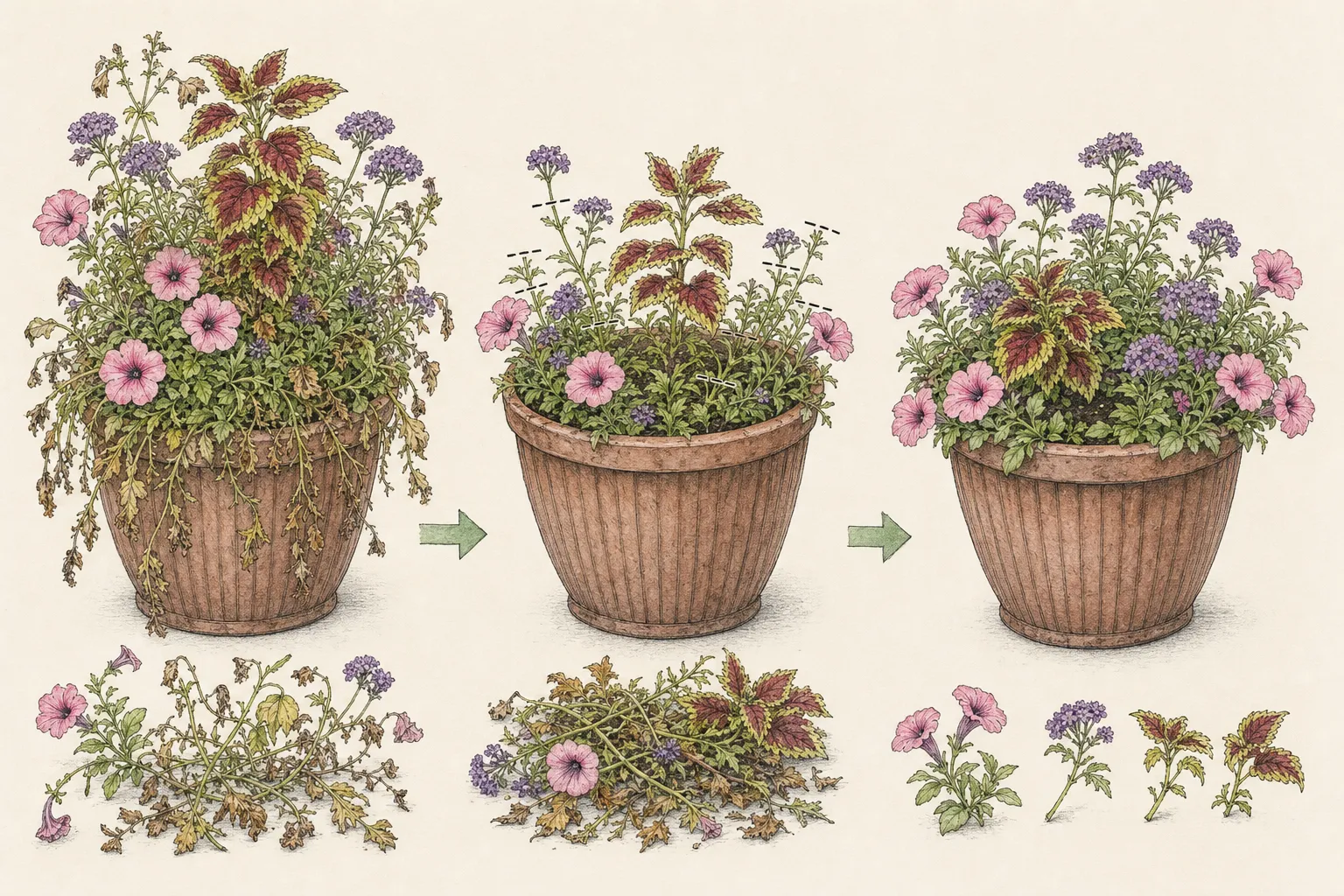
Inspect the whole system during each watering round. Remove spent flowers where the cultivar benefits, trim only enough to restore balance, loosen foliage caught in chains and check the bracket, hook, hanger, rim, liner and outlets. Midseason root fill can shorten the interval between waterings; leggy growth can increase wind movement. If maintenance becomes unsafe or structurally doubtful, lower the basket with an appropriate method and rebuild rather than nursing a failing suspended display in place.
Reset the display before roots and weather take control
A successful basket should remain serviceable, not merely alive. When one plant begins to dominate, trace it to the crown and prune according to its label, preserving the balanced canopy and the open watering route. If incompatible moisture needs become obvious, do not alternate between drought and saturation. Remove the weaker component at an appropriate time or accept an early redesign. Root volume cannot be restored by adding fertilizer to an overfilled basket.
After strong wind or unusually heavy rain, keep people away from beneath the basket and inspect from a safe position. Look for a shifted hook, tilted hanger, saturated liner or bracket movement. Lower the assembly if a close inspection is required. Do not tighten building fasteners under load unless the hardware instructions specifically allow it. Structural movement belongs to a qualified repair, not a cosmetic adjustment hidden by trailing stems.
At the seasonal finish, water only as the remaining plants require and remove the basket before severe weather or frost makes handling hazardous. Lower it with the same attention used at installation. Compost healthy plant material only where accepted, dispose of failed or diseased material according to local guidance and keep reusable plants only if they have enough root space and a realistic overwintering site.
Clean the basket, liner if reusable, hanger and hardware, then inspect for corrosion, ultraviolet damage, cracking and stretched attachment points. Record the wet mass, plant list, exposure, watering pattern and any balance or access failure. Next year's design should begin with that evidence. The best summer hanging basket is a measured suspended container whose roots, drainage, load and care route remain coherent from planting day to removal.
Steps
- Level
- moderate
- Time
- Two to three hours for planning, planting, wet-load verification and hanging
- Tools
- Tape measure and site notebook, Low wide planting stand, Hand trowel, Watering can with a fine rose or fine-spray hose, Moisture probe or narrow wooden probe, Ground-level scale suitable for the load, if safe to use, Tools specified by the support manufacturer
- Materials
- Rated basket, hanger, bracket, hook, anchors and fasteners, Sound liner matched to the basket, Fresh outdoor container potting mix, Summer flowering plants with compatible light and moisture needs, Plant labels, Fertilizer only if required by the mix and plant labels
- 1Write a site and maintenance brief
Record direct sun, reflected heat, wind, rain shelter, runoff destination, viewing sides and the route for a wand or hose. Keep the mature basket clear of doors, glazing, vents, electrical equipment and active paths. Decide whether daily moisture inspection is realistic; if not, choose a gentler exposure, fewer plants or a larger verified container rather than accepting an inaccessible thirsty display.
- 2Verify the complete support chain
Match the supporting structure, anchors, bracket, hook, hanger and basket to the actual substrate and manufacturer instructions. Reject corroded, cracked, brittle or unbalanced parts. Test the empty position for headroom, wall contact and watering reach. If the substrate or any load rating is unknown, stop and obtain a qualified installation instead of relying on one visibly strong component.
- 3Edit plants to the available root volume
For the Iowa sunny recipe, use one 12–14 in basket and exactly three top-planted starts: Supertunia Mini Vista White at twelve o'clock, Superbena Royale Romance at four and Superbena Royale Plum Wine at eight. Their current labels agree on part sun to sun, average water, 6–12 in height and 18–24 in spread. Keep all three at equal radius, retain the center watering target and use no side plants; recheck live labels before buying.
- 4Prepare drainage and a watering lip
Run water through the empty basket to locate outlets and correct blocked holes or liner folds. Fill with pre-moistened, well-drained outdoor container mix while the basket rests on a low stable stand, leaving Iowa State's ½–1 in watering headspace below the rim. Keep the drainage path and central watering target open, then test that a fine stream reaches the mix without striking foliage or spilling immediately.
- 5Plant level and balanced
Arrange plants in their pots first, keeping taller growth away from chains. Set each root ball at its nursery depth, work mix around roots without burying crowns and distribute trailers around the edge. Preserve continuous root volume and the watering route. Install the hanger as designed and confirm equal load on every strap or chain while the basket remains supported from below.
- 6Wet, drain and verify before hanging
Water the whole profile gently, correct dry channels and allow excess to drain. Inspect the liner, rim, hanger and level under the drained wet load. Determine mass only with a safe ground-level method, then compare it with every documented component and installation requirement. Use manufacturer or qualified advice for safety margins; do not suspend an assembly with unknown capacity or visible deformation.
- 7Hang, inspect and maintain from stable ground
Attach the basket with appropriate help or lifting equipment, keep everyone out from beneath it and confirm secure seating. Check mix moisture frequently as roots fill the container, water by evidence with a wand or fine spray and monitor runoff. During each round inspect hardware, balance, chains, foliage and outlets; lower the basket safely whenever close repair or redesign is needed.
Related reading
Sources
- Creating and Growing Hanging Baskets. Iowa State University Extension and Outreach. Source record · Accessed 2026-08-19.
- Hanging Baskets. Purdue University Cooperative Extension Service. Source record · Accessed 2026-08-19.
- How to Plant a Hanging Basket. Royal Horticultural Society. Source record · Accessed 2026-08-19.
- Supertunia Mini Vista White Petunia. Proven Winners. Source record · Accessed 2026-08-19.
- Superbena Royale Romance Verbena. Proven Winners. Source record · Accessed 2026-08-19.
- Superbena Royale Plum Wine Verbena. Proven Winners. Source record · Accessed 2026-08-19.