Grow · cyclamen coum winter woodland edge
Plant Cyclamen coum Tubers for a Winter Woodland Edge
Distinguish hardy Cyclamen coum from florist cyclamen, choose a visible woodland edge with summer drainage, and set tubers shallowly for a winter colony.
Published Last updated
In this guide
- Confirm Cyclamen coum before choosing the ground
- Choose a woodland edge seen in winter
- Test cool-season moisture and summer drainage
- Choose rooted, readable tubers when possible
- Set the tuber shallowly and keep its surface legible
- Build a low drift with room to become a colony
- Manage leaf fall without burying the planting
- Water with the active season and wait through dormancy
- Steps
Confirm Cyclamen coum before choosing the ground
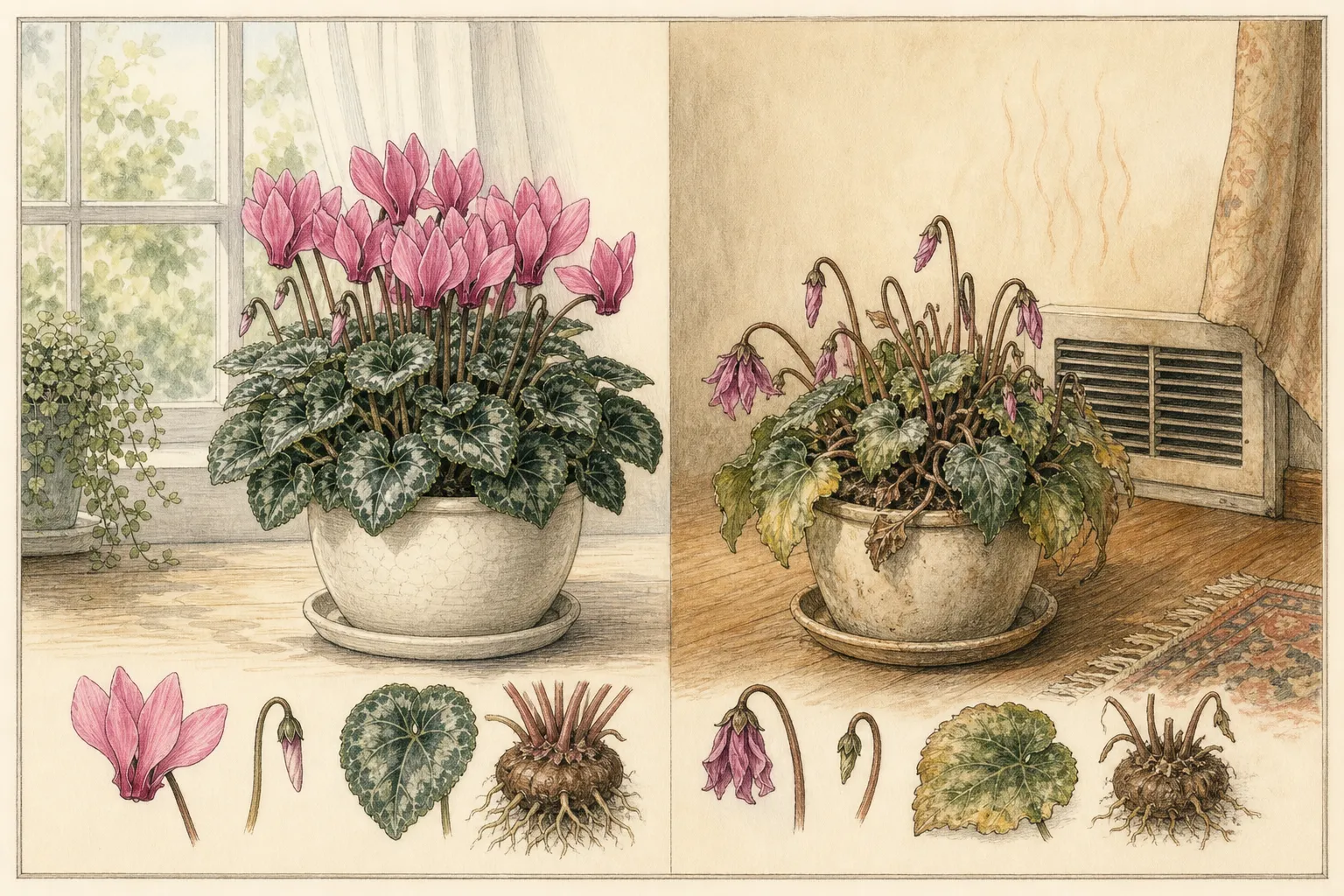
Cyclamen coum is a hardy, low tuberous perennial that carries rounded or kidney-shaped leaves and small reflexed flowers through the winter-to-early-spring season. The RHS places its main flowering from January to March under UK conditions, while Kew uses it for the depths of winter at Wakehurst. This is not the large florist cyclamen, Cyclamen persicum, sold for cool indoor color, and it is not the autumn-flowering hardy species C. hederifolium. The name on the label changes outdoor hardiness, bloom timing, leaf sequence, and tuber handling.
Buy nursery-propagated plants or tubers from a source that gives the full botanical name and regional hardiness information. Penn State Extension notes that wild collection has reduced some cyclamen populations, making reputable cultivated stock the responsible starting point. Keep the label with the individual lot; a generic 'hardy cyclamen' tag can mix species that flower in different seasons and can leave an unrooted tuber difficult to orient.
This method is for establishing C. coum outdoors in a temperate garden where a regional authority considers it hardy. It does not convert a florist cyclamen into an outdoor perennial and does not promise winter survival outside the plant's tested climate. If the supplier's zone range conflicts with local Extension or botanic-garden experience, choose the more conservative local guidance or grow the plant under protected conditions until its identity and hardiness are resolved.
Choose a woodland edge seen in winter
Place this small plant where winter visitors will actually see it. Kew recommends shaded sites and specifically suggests positions near a doorway or path because cyclamen flowers are easily lost at a distance. A woodland edge is more useful than the dark center beneath evergreen foliage: deciduous shrubs or trees can admit cool-season light, provide partial shade as summer arrives, and supply a natural setting for the low leaves and flowers.
Observe the edge while the canopy is both leafless and full. The RHS favors partial shade and warns against sites that are overly dry or sunny. Deep shade can reduce the visual effect and allow larger neighbors to dominate; a hot exposed bank may dry active autumn roots before the plant establishes. Aim for bright filtered winter light and shelter from harsh afternoon sun in the warmer part of the year, then confirm that the same position is not buried beneath summer irrigation or dense perennial growth.
Use the path side, front of a shrub border, or upper face of a low bank as the viewing line. Keep tubers beyond the reach of routine edging and away from places where feet compact wet soil. Map a narrow maintenance route so leaves, seed capsules, and new seedlings can be inspected without raking through the colony. The edge should feel quiet below ground and visually accessible above it.
Test cool-season moisture and summer drainage
Hardy cyclamen need a soil pattern, not simply a shade label. The RHS specifies moderately fertile, humus-rich, well-drained ground for C. coum and warns against excessive summer moisture. Penn State describes a similar cycle: adequate moisture through fall, winter, and spring followed by drier conditions while the tubers are dormant in summer. Check the site after autumn rain, during a dry spell, and along the route of any irrigation line before treating a woodland edge as suitable.
Dig a small inspection hole to the intended shallow depth and look below it. Water must be able to leave the tuber zone; standing water on or around a tuber can lead to rot. At the same time, a tree-rooted bank that turns to dust as growth resumes can interrupt establishment. Humus from mature leaf mold can help a suitable mineral soil hold moisture while preserving pore space, but a small pocket of soft compost inside compacted clay does not create drainage. Improve the broader edge or choose a naturally better grade.
Trace summer water separately. Lawn sprinklers, a drip line serving thirsty shrubs, and roof discharge can keep a dormant cyclamen site much wetter than its winter appearance suggests. Kew's cultivation guidance supports watering during dry periods while plants are growing in autumn, winter, and spring; that active-season instruction should not become automatic summer saturation. Mark the cyclamen zone on the irrigation plan so its seasonal rhythm survives later changes to the border.
Choose rooted, readable tubers when possible
The easiest stock to orient is a labeled C. coum tuber already in root growth or a small container-grown plant. The RHS recommends planting tubers while roots are active because they establish quickly and the growth helps distinguish top from bottom. Open the package promptly in shade. A useful dormant tuber should be plump and coherent rather than badly shriveled, wet, or collapsing. Document serious damage before removing packing or altering the tissue.
Read actual growth rather than relying on a generic concave-side rule. Cyclamen species differ in where roots emerge, and an anonymous dry disc can be genuinely confusing. Preserve visible roots, leaf buds, and the supplier's orientation mark. If the tuber has no reliable cues, contact the grower or pot it according to their instructions until growth identifies the working surfaces. Cutting or scraping the tuber to search for hidden buds creates injury without supplying dependable orientation.
Keep roots from drying while the hole is prepared, but do not soak a questionable tuber in an attempt to make it look plump. Separate species and color strains on the tray, retain all labels, and handle broad older tubers with two hands. The planting plan should be ready before packages are opened so readable, actively rooting stock can move into the soil with minimal delay.
Set the tuber shallowly and keep its surface legible
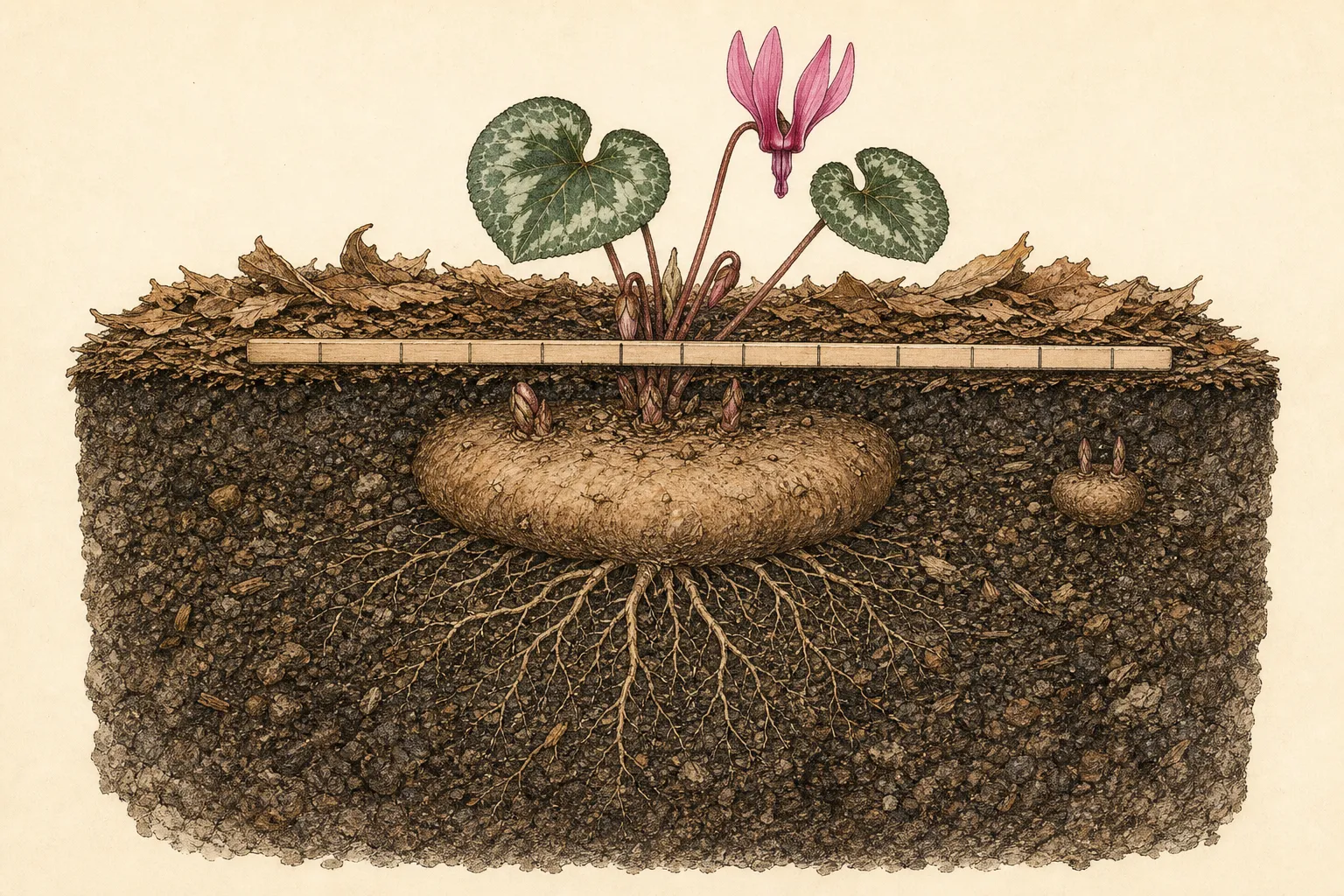
Make a broad shallow hole rather than a narrow vertical shaft. The RHS species profile says to plant C. coum five centimetres deep; its general hardy-cyclamen guide gives a range of three to five centimetres and warns that excessive depth can prevent flowering. Penn State's Pennsylvania guidance for hardy cyclamen is shallower, about one inch or less. These differences reflect source scope and practice. Follow the named stock and closest regional authority, and record whether the number describes soil over the tuber or total hole depth.
Set a rooted tuber with its verified growing surface upward and its roots spreading into loose, continuous soil. Support the disc evenly so no edge hangs over a void. Return fine soil around and above it, maintaining the chosen shallow cover from finished mineral grade. Leaf mold or winter mulch is a separate surface layer and should not silently double the planting depth. The aim is a tuber protected within the soil while remaining close enough to the surface to grow and flower normally.
Firm with fingertips and water gently when the surrounding soil is dry enough to need settling. Watch for exposed edges, sinking, or a depression that collects water over the center. Correct the grade immediately while roots are still minimally disturbed. Place a small marker outside the tuber, not through its center, and take an overhead photograph that includes a fixed path stone or shrub stem.
Build a low drift with room to become a colony
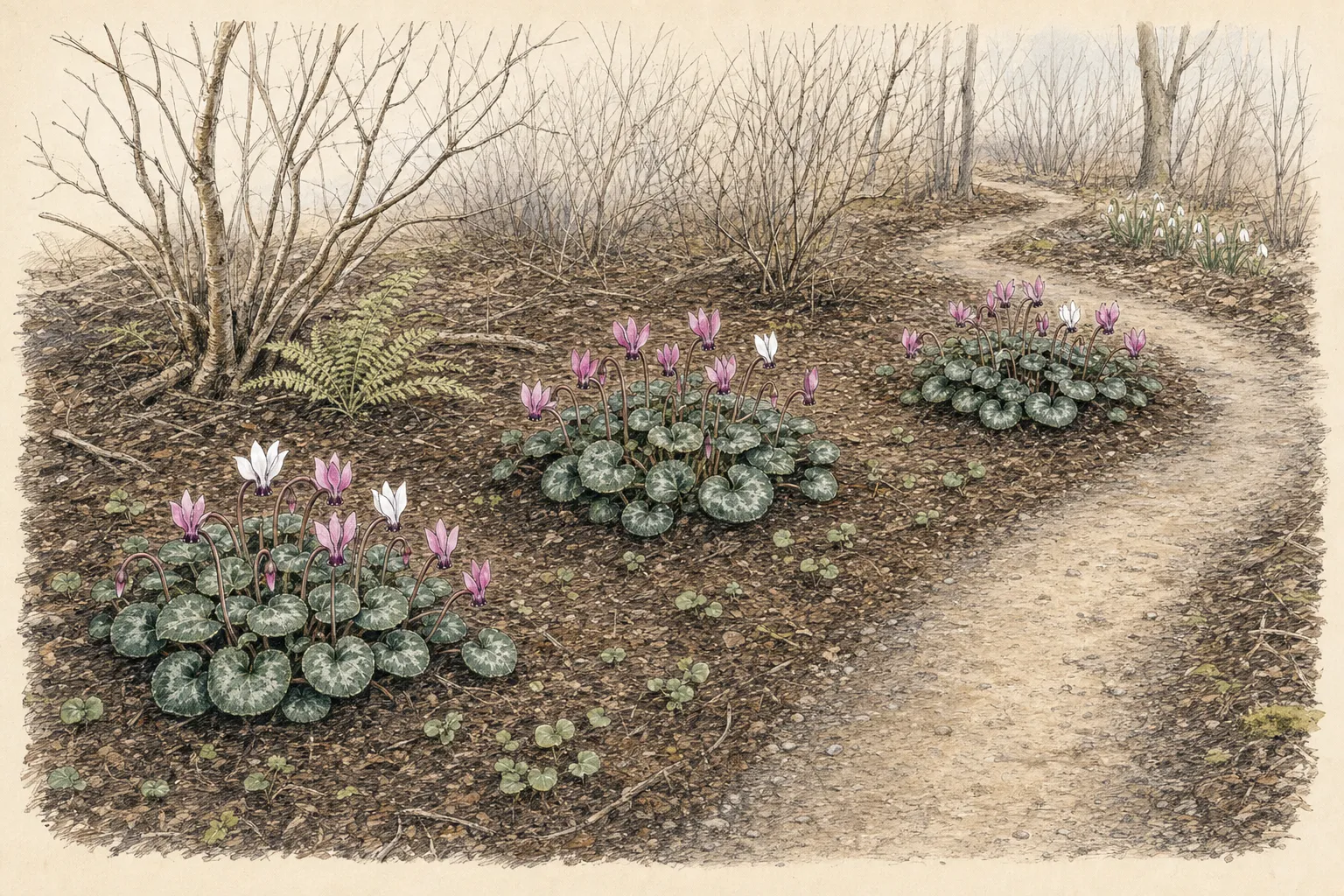
Plant several tubers as an irregular drift, allowing the path or lower bank to define one edge. The University of Arkansas gives six to ten inches between hardy cyclamen tubers in its regional guidance. Treat that as a starting range where local stock and mature size agree. Distribute plants in two or three loose threads instead of a tight ring, leaving small open pockets where seedlings can appear and fallen leaves can be removed by hand.
Choose modest neighbors. Penn State warns that the low, summer-dormant plants can be smothered by larger fast-growing perennials or annuals that also demand regular summer water. Small ferns, restrained sedges, snowdrops, winter aconites, and other locally suitable woodland plants can share the visual layer if their crowns and irrigation needs leave cyclamen space. Keep vigorous groundcovers and dense hosta crowns outside the immediate drift, even when the bed looks bare on planting day.
Plan for patience and gradual spread. Hardy cyclamen can live for many years in a stable site, and self-sown seedlings make the most convincing transition from path to woodland. The Arkansas account notes that a mature display can take years. Preserve open soil, avoid routine cultivation, and let seed capsules complete their cycle before editing the colony. The first winter's job is to establish readable plants, not to imitate a decades-old carpet with crowded tubers.
Manage leaf fall without burying the planting
Apply a thin layer of fine leaf mold where it suits the soil, keeping the original depth record clear. The RHS recommends annual leaf-mold mulch as foliage dies down, and Penn State likewise favors only a thin surface layer around hardy cyclamen. A deep mat of whole wet leaves can block light, trap moisture over shallow tubers, and hide flowers. Use the material as a breathable soil surface, not as a permanent blanket.
Remove heavy autumn leaf fall gently before it compresses. Kew advises clearing excess leaves to admit light and specifically cautions against using a rake that can damage tuber tops. Lift leaves by hand or with a small soft tool from outside the mapped tuber centers. Leave enough fine organic material to maintain woodland character, while opening windows over emerging leaves and the spaces intended for seedlings.
Winter protection is regional. In colder gardens where C. coum is locally recommended, a loose insulating cover may be useful, especially during establishment, but it must not hold standing water or become extra soil depth. Follow local Extension guidance and remove temporary coarse protection when conditions moderate. A reliable snow layer can insulate, yet it should not be assumed. The durable protection is a correctly chosen microclimate, well-drained soil, and a colony left undisturbed.
Water with the active season and wait through dormancy
During autumn establishment, keep the soil evenly moist when rainfall is insufficient and let excess drain. Continue checking during winter dry spells and spring growth, using the soil beneath the surface rather than a fixed weekly schedule. Water at the ground outside the crown of leaves so moisture reaches the root zone without repeatedly pooling over the tuber. Kew's seasonal advice supports water during active autumn, winter, and spring growth.
As leaves fade toward early summer, reduce supplemental water and allow the tuber a drier dormant period. Dormancy is not evidence that the plant has died. Keep the marker and resist exploratory digging, which can wound the shallow tuber and destroy seedlings. Maintain only the moisture pattern supported by the site and regional guidance; the goal is to prevent both prolonged saturation and extreme desiccation, not to force visible growth year-round.
Review the planting over several seasons. Record leaf emergence, winter flower count, standing water, heavy leaf accumulation, animal disturbance, and new seedlings. A sparse first display can still be establishing successfully. Correct one observed constraint at a time—light, smothering leaves, drainage, or competition—while preserving sound tubers in place. The woodland edge becomes convincing as its low drift repeats and seeds into suitable gaps, a process helped more by continuity than by annual rearrangement.
Steps
- Level
- moderate
- Time
- 60–90 minutes for a small drift, plus seasonal site checks
- Tools
- Hand trowel, Ruler or marked planting stick, Shallow tray, Durable labels and pencil, Watering can with a fine rose
- Materials
- Nursery-propagated, labeled Cyclamen coum tubers or small plants, Mature leaf mold for a thin surface layer, Loose regional winter protection only if locally advised
- 1Verify the species and hardiness
Confirm the full name Cyclamen coum, retain the nursery label, and compare the supplier's hardiness claim with a local authority. Keep florist cyclamen and autumn-flowering C. hederifolium outside this winter-flowering outdoor planting method. Photograph the label beside the unopened stock so identity survives planting.
- 2Choose a visible edge
Select bright partial shade beside a path, doorway, shrub border, or low bank where the small flowers can be seen. Check the position under both bare and leafy canopy and protect the mapped drift from feet and routine edging. Mark the normal winter viewing direction before arranging individual tubers.
- 3Test the seasonal water pattern
Inspect after autumn rain and trace summer irrigation. Keep the humus-rich planting zone evenly moist during active cool-season growth, freely drained at all times, and drier during summer dormancy; improve the broad edge when water has no outlet. Compare an upper and lower pocket before choosing the final line of the drift.
- 4Read the tuber
Prefer labeled stock already in root growth, retain visible roots and buds, and document shriveling or collapse. Use the grower's orientation cue when surfaces are unclear; never cut a dry anonymous disc simply to search for a top. Keep exposed roots shaded and protected while the shallow holes are prepared.
- 5Set a regional shallow depth
Follow the named C. coum and closest regional guidance, recording whether depth means soil cover or total hole depth. Support the tuber evenly with its verified growing side upward and measure from finished mineral soil, excluding leaf mulch. Recheck the reference after watering has settled the loose surface.
- 6Space an open drift
Arrange several tubers in irregular threads with room for leaves and seedlings, using six to ten inches only where the retained Arkansas scope and local mature dimensions agree. Keep vigorous crowns and summer-thirsty companions outside the immediate planting pockets. Leave hand-width access gaps for gentle leaf removal.
- 7Settle and clear the surface
Water gently as soil conditions require, correct sinking or ponding, label outside each tuber, and apply only a thin layer of fine leaf mold. Lift heavy autumn leaves by hand so emerging foliage receives light without a rake crossing the shallow colony. Save an overhead photograph with fixed path stones visible.
- 8Protect the seasonal rhythm
Water through dry active-season periods, reduce irrigation as foliage enters summer dormancy, and leave marked tubers undisturbed. Record flowers, leaves, drainage, and seedlings for several seasons before expanding or editing the drift. Treat a quiet first year as establishment unless a specific sign shows failure.
Related reading
Sources
- Cyclamen coum | Eastern Cyclamen. Royal Horticultural Society. Source record · Accessed 2026-08-20.
- Cyclamen: Hardy. Royal Horticultural Society. Source record · Accessed 2026-08-20.
- Hardy Cyclamen for the Home Garden. Penn State Extension. Source record · Accessed 2026-08-20.
- Cyclamen Are Seasonal Treasures. Royal Botanic Gardens, Kew. Source record · Accessed 2026-08-20.
- Plant of the Week: Hardy Cyclamen. University of Arkansas System Division of Agriculture. Source record · Accessed 2026-08-20.