Gardens · spring woodland ephemeral layer
Design a Spring Woodland-Ephemeral Layer That Does Not Vanish in Summer
Use deciduous-canopy light, named spring ephemerals, persistent foliage, and protected tree roots to build a woodland border with a credible summer structure.
Published Last updated
In this guide
- Read the canopy as a moving light source
- Fit the spring groups around roots and persistent crowns
- Protect the existing tree system
- Draw two calendars on one plan
- Use a bounded worked composition
- Control visual density through repetition
- Source plants without stripping wild places
- Establish through small interventions
- Design ideas
Read the canopy as a moving light source
Map direct light before and after leaf-out. A bright April floor may become deep dry shade by June. Schedule the work when ephemerals are visible enough to map and later layers are just emerging. Confirm the choice by inspecting canopy leaf-out, spring soil moisture, the exact dormancy window, persistent companion spread and tree-root distribution. The safe finish is reached when spring drifts read clearly while a separate summer layer retains soil cover and access.
Photograph the same view at monthly intervals. Reflected light and neighboring evergreen shade alter the woodland edge.
Choose plants for the conditions during active growth and dormancy. Spring appearance alone is incomplete site matching. In this case, success means spring drifts read clearly while a separate summer layer retains soil cover and access. Let the next inspection test whether spring drifts read clearly while a separate summer layer retains soil cover and access; the workday shows only the starting condition.
A same-angle photograph makes read the canopy as a moving light source measurable. Record canopy leaf-out, spring soil moisture, the exact dormancy window, persistent companion spread and tree-root distribution now, then repeat the view after weather or active growth shows whether spring drifts read clearly while a separate summer layer retains soil cover and access.
Deciduous canopy creates two different gardens in one place. Before leaf-out, direct sun reaches the soil and supports rapid emergence, flowering, and seed set. Weeks later, shade deepens and the same surface cools. Map both light states, not just the spring visit. University of Wisconsin notes that true ephemerals complete their annual growth as the canopy closes, while other woodland plants keep foliage into summer. Choose each plant for the full sequence of light, soil moisture, and dormancy.
A fixed spring light photograph taken before and after canopy closure helps distinguish a truly shaded pocket from one that receives a useful early window.
Fit the spring groups around roots and persistent crowns
Use the worked woodland edge only where its spring light, summer shade and moisture assumptions hold. Place the ephemeral groups without excavating major tree roots, and keep the persistent fern and ground-layer crowns outside their emergence space. If a proposed pocket is already occupied below ground, reduce or shift the planting. Summer disappearance does not release that pocket for another plant.
Protect the existing tree system
Locate trunk flares and major surface roots before drawing beds. Keep added soil and mulch away from woody bases.
Plant small nursery stock into pockets between roots with hand tools. Create the drift with small hand-dug pockets between major roots. Map canopy leaf-out, spring moisture, dormancy dates, companion spread, and major tree roots across both seasonal layers. Use propagated plants and shallow hand-dug pockets while keeping tree flares, drainage, and incompatible moisture zones undisturbed.
Preserve leaf litter where it does not bury small crowns. Organic surface continuity supports the woodland character. The finished work must allow spring drifts read clearly while a separate summer layer retains soil cover and access. Weather and new growth can clarify canopy leaf-out, spring soil moisture, the exact dormancy window, persistent companion spread and tree-root distribution during a measured pause.
Existing trees are the primary structure. Keep trunk flares and large surface roots exposed, avoid grade changes, and dig small pockets by hand between roots. A thin layer of leaf mold can conserve moisture and imitate woodland litter, but deep mulch over crowns or against bark damages the system. Route foot traffic before planting so wet soil is not compacted. If the desired pattern requires cutting major roots or building a raised pocket over them, move the planting, and treat the tree as primary infrastructure.
Moist woodland soil is not synonymous with a wet planting hole. Observe whether the edge is an upland slope, a floodplain pocket, or a compacted basin, then match species to that hydrology. Virginia bluebells accept moister conditions than many dry-woodland sedges. Keep downspout flow and path runoff from concentrating over dormant crowns. Leaf litter should remain loose enough for small shoots to emerge; shred or redistribute heavy mats, not digging them into soil among tree roots.
Draw two calendars on one plan
Map ephemeral emergence, flower, seed and dormancy beside companion expansion. The handoff is temporal as well as spatial. Separate seasonal timing from cosmetic urgency. The useful window is when ephemerals are visible enough to map and later layers are just emerging.
Place ferns, sedges and persistent woodland perennials near gaps without covering ephemeral crowns. Mature spread controls the overlap. Compare that setting with canopy leaf-out, spring soil moisture, the exact dormancy window, persistent companion spread and tree-root distribution.
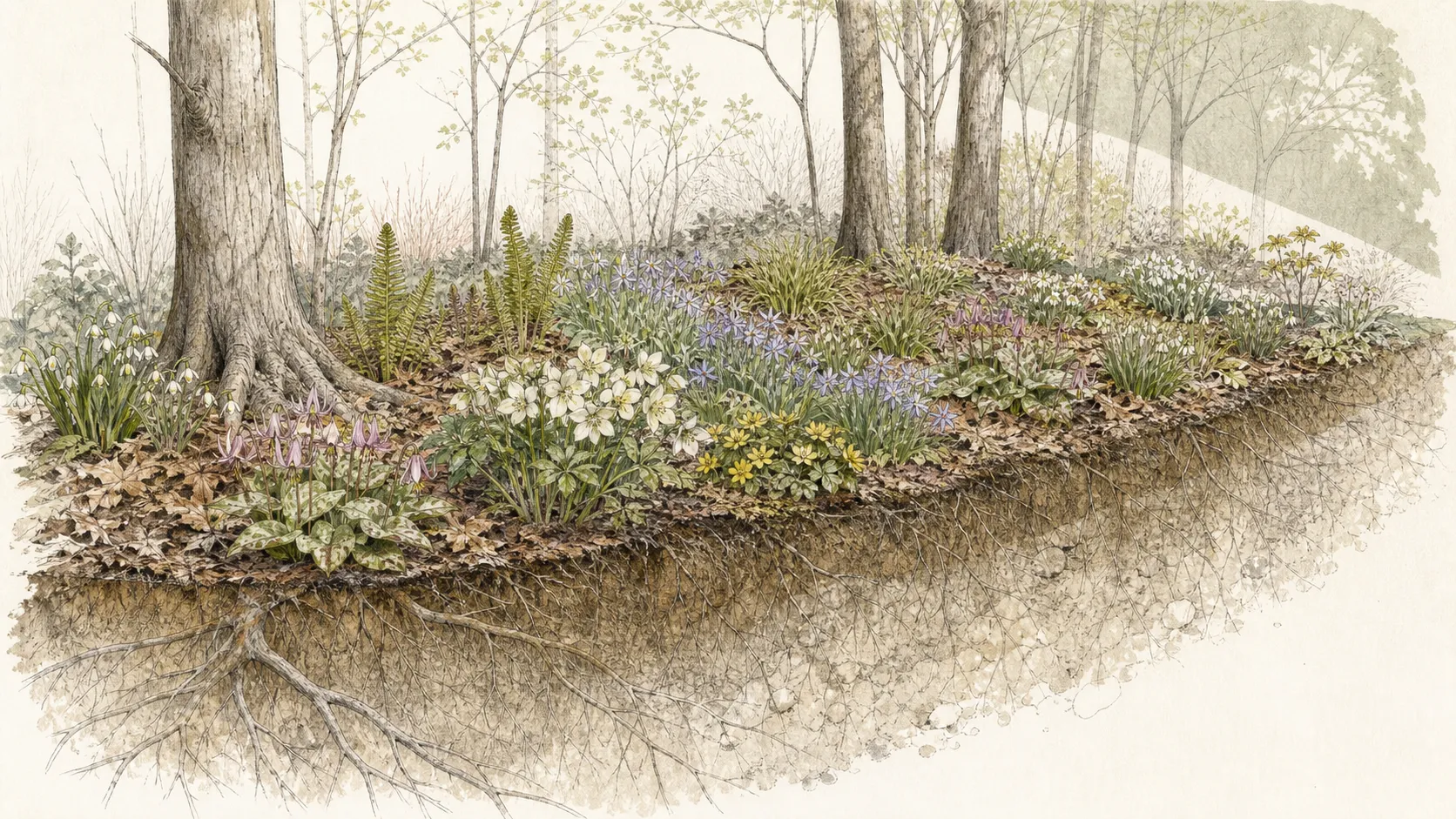
Include autumn and winter structure from evergreen fronds, seedheads or low shrubs. Empty summer ground invites weeds and disturbance. Stop once spring drifts read clearly while a separate summer layer retains soil cover and access.
Draw one calendar for ephemeral emergence, bloom, seed, yellowing, and dormancy, then a second for persistent companions. Virginia bluebells and spring beauty may disappear as summer arrives; Christmas fern, Pennsylvania sedge, foamflower, and a woodland aster can retain cover or appear later. The overlap must preserve enough light for green ephemeral leaves to replenish underground storage. Mark dormant positions and reserve access, because an apparently open July patch may contain roots, bulbs, corms, or rhizomes waiting for spring.
Include seed maturation on the spring calendar. Removing faded stems too soon prevents natural increase even when leaves remain. Where seedlings are desired, keep the surface free of thick mulch and learn their first leaves before routine weeding begins.
Use a bounded worked composition
For a 12-by-6-foot Pennsylvania-style edge, repeat three small Virginia bluebell groups behind lower foamflower and spring beauty pockets. Confirm local suitability. Use nursery-propagated plants that are native or otherwise suitable to the local region. Keep major tree roots, trunk flares, drainage, and summer moisture intact while arranging spring groups and a separate persistent layer.
Set five Christmas ferns and a loose Pennsylvania-sedge edge as the persistent layer. Keep mature fern crowns off bulb and rhizome clusters. Record canopy leaf-out, spring soil moisture, the exact dormancy window, persistent companion spread and tree-root distribution before the work begins.
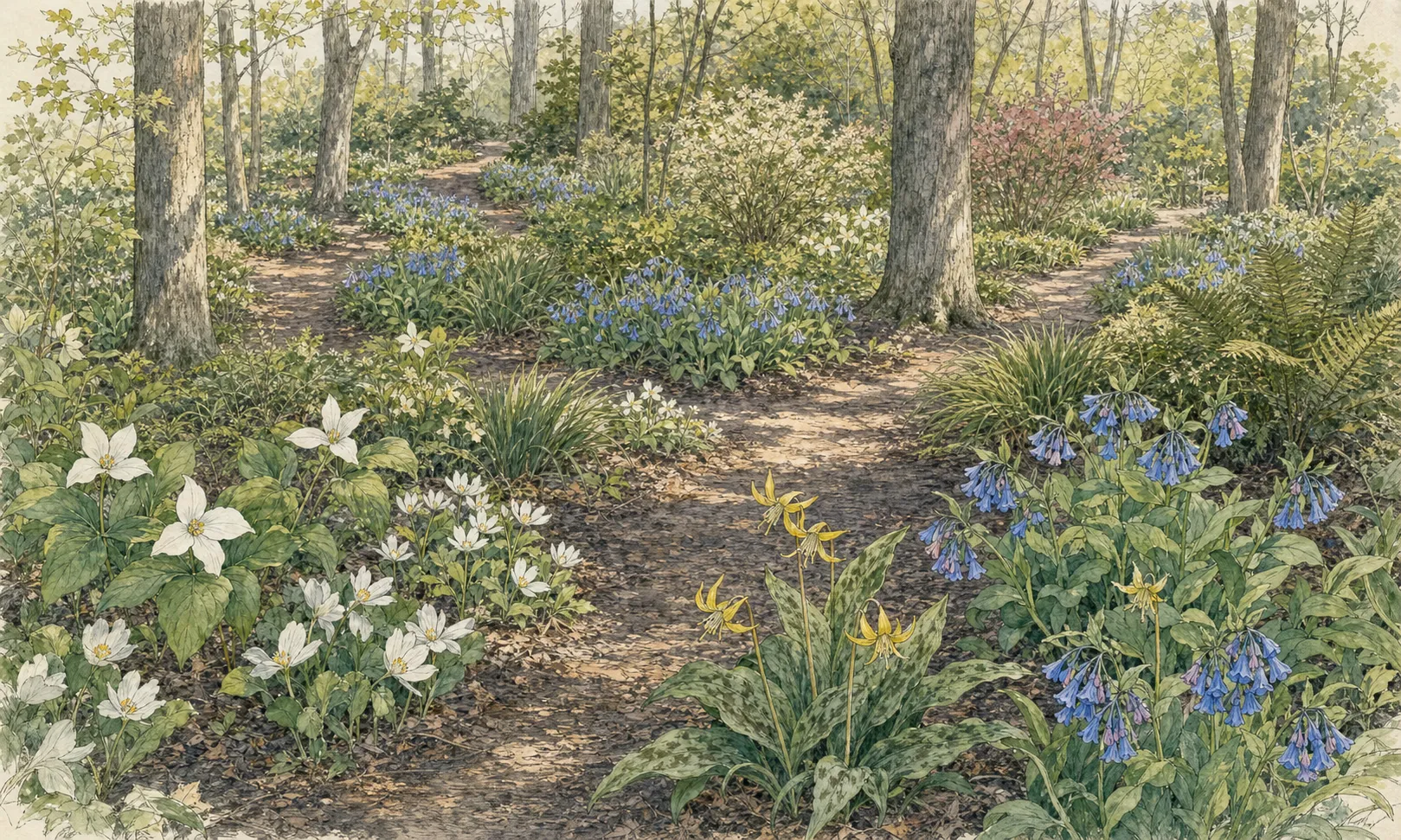
Add one white wood aster group for late-season flower where summer moisture supports it. Substitute from local authoritative lists elsewhere. Account for deciduous light, root competition, slope, drainage and regional native flora define the palette.
In a 12-by-6-foot eastern woodland-edge example, repeat three small Virginia bluebell groups behind lower spring beauty and foamflower pockets. Use five Christmas fern crowns and a loose Pennsylvania-sedge edge as the persistent layer, then add one bounded white wood aster group for late bloom where summer moisture fits. All plants must be nursery propagated and regionally suitable. Set every crown at its own mature spread and keep a hand-width observation gap around ephemeral centers until the pattern is established.
The 72-square-foot example can begin with three bluebell groups of three plants, six to nine lower spring-beauty or equivalent pockets, five Christmas ferns, and a loose sedge edge set by mature width. One small woodland-aster group occupies the late-season corner. These counts leave visible soil and access during establishment; they are not density targets for every cultivar. Recalculate when local substitutions differ in spread, and keep fern crowns and sedge rhizomes outside every marked ephemeral root system.
Control visual density through repetition
Repeat two or three species in irregular groups, not displaying one specimen of every ephemeral. Restraint makes brief flowers legible. Repeat a small set of ephemerals in irregular drifts so their short display reads clearly. Persistent sedges, ferns, and summer woodland flowers occupy different pockets and maintain cover after ephemeral foliage disappears.
Vary group size while keeping recognizable intervals. Straight rows and perfect spacing feel imposed beneath tree canopies. Use canopy leaf-out, spring soil moisture, the exact dormancy window, persistent companion spread and tree-root distribution to decide whether the task is corrective, preventive, or unnecessary. That distinction controls timing and scale.
Let foliage texture connect flower windows. Fern fronds, sedge blades and foamflower leaves carry the border between blooms. Leaf form links the seasonal layers: fine sedges, arching fern fronds, and foamflower or another persistent ground layer remain visible between bloom periods. Leave marked openings around dormant crowns for observation and division.
Repetition makes fleeting flowers visible. Use two or three species in irregular drifts, not one specimen of every woodland wildflower. Fine sedge leaves can connect the spring groups, while fern fronds carry larger form after leaf-out. Keep aggressive rhizomes and self-sowing species at an inspectable edge. The goal is seasonal relay, not continuous equal density: brief spring openings are acceptable when the dormant plants are mapped and the persistent layer still covers enough soil to limit weeds.
Summer companions must emerge late enough or remain open enough that ephemeral leaves receive spring light. Track the bluebell, spring beauty, or substitute until its foliage yellows, then compare that date with fern and sedge expansion. If a companion covers green leaves early, move the companion during its own suitable window, and retain the ephemeral's green foliage. Where bare summer soil remains, use a compatible persistent plant at measured distance, and keep mulch shallow enough to reveal the dormant crown. This keeps the relay legible and protects the underground plant from accidental excavation.
Source plants without stripping wild places
Buy nursery-propagated plants with botanical names and regional provenance information. Use nursery-propagated stock or material moved with explicit lawful authority.
Verify that a showy species is native and appropriate to the specific region. Native to a continent is not a local site prescription.
Keep labels and receipts for slow or dormant plants. Accurate identity prevents accidental cultivation and inappropriate sharing. Include canopy leaf-out, spring soil moisture, the exact dormancy window, persistent companion spread and tree-root distribution.
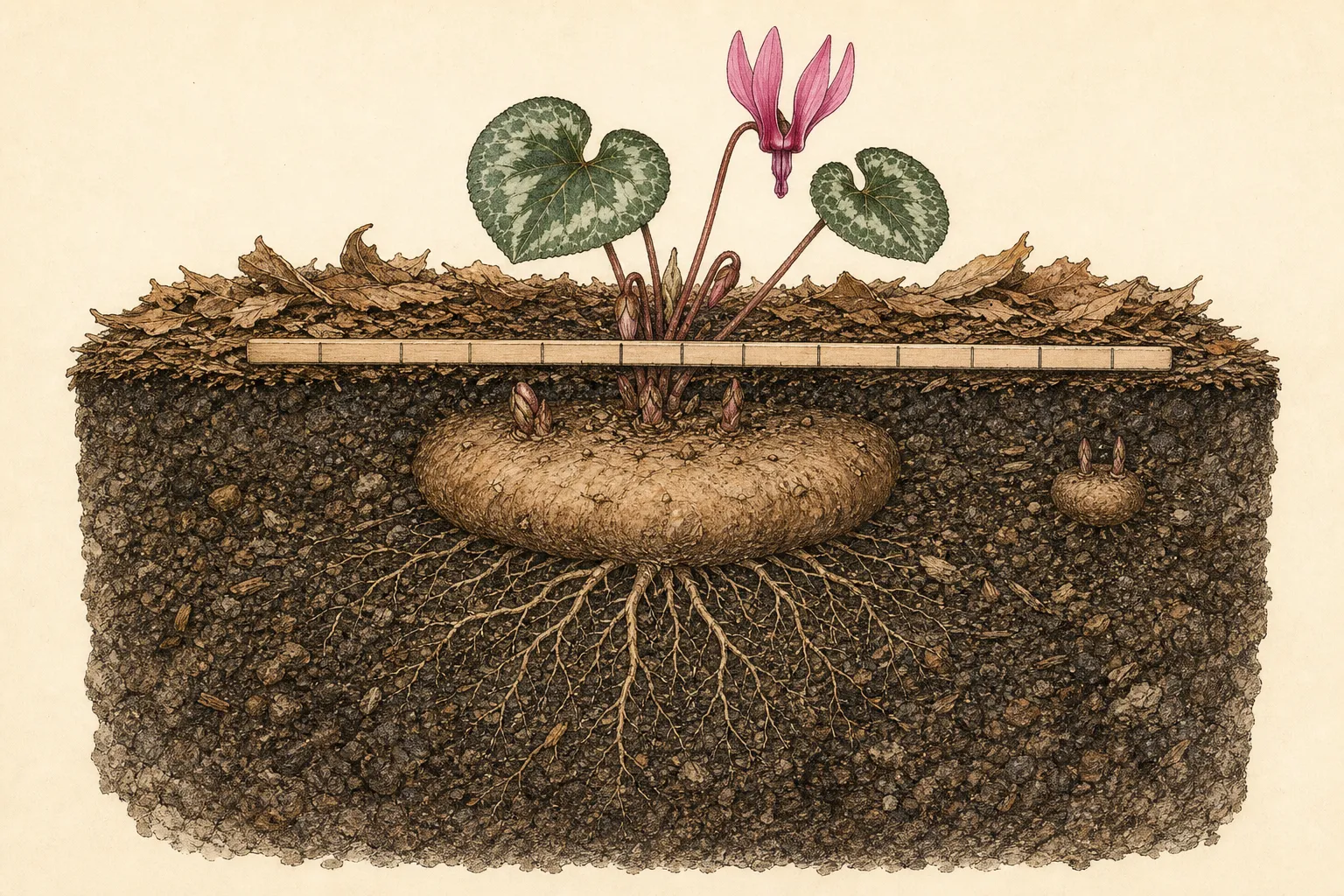
Wild collection is not a shortcut. Many spring ephemerals spread slowly, occur in sensitive populations, or are protected locally. Purchase propagated stock from a nursery that gives a botanical name and, for native-garden work, an appropriate regional origin. Reject unlabeled roots and plants represented only by a common name. Illinois Extension emphasizes that leaf dieback is normal, so a dormant nursery plant may still be viable; plant its intact root ball at the original surface and mark the position.
Inspect nursery labels for botanical name, propagation method, and origin. Plants dug from development sites or offered without provenance can carry legal, conservation, weed, or disease concerns. A regionally native species is not automatically suitable to every woodland soil, and a cultivar may alter sterility or spread. Keep new plants quarantined long enough to identify hitchhiking weeds where practical. Collect divisions, seed, or leaf mold only with explicit lawful authorization.
Quarantine purchased pots long enough to remove nursery weeds and inspect soil-borne hitchhikers where practical. Keep source labels with dormant plants, because foliage may disappear before the first full identity check.
Establish through small interventions
Plant while soil is workable and root balls can stay intact. Water each pocket without saturating the whole tree root zone. Track canopy leaf-out, spring soil moisture, the exact dormancy window, persistent companion spread and tree-root distribution.
Mark dormant locations and weed by identification. Summer cultivation can destroy the invisible spring layer.
Allow seedheads and foliage to complete their cycle where the design accepts natural increase. Edit seedlings beyond the boundary.
Establish the border through small interventions. Water new root balls when the surrounding soil begins to dry, keep leaf mulch light, and weed by positive identification. Keep self-sowing ephemeral and dormant areas free from pre-emergent treatment and cultivation. Review spread once while spring plants are visible and again in late summer when the persistent layer is mature. Remove invasive seedlings immediately, but delay division of desired plants until a source-supported time. Same-location photographs help map the seasonal handoff without substituting for plant labels.
The annual care calendar has two inspection peaks. In spring, map emergence, remove invasive seedlings, and let green ephemeral leaves complete seed set and storage. In late summer, assess sedge, fern, and aster spread while dormant crowns remain marked. Add leaf mulch after deciduous fall, keeping it shallow over small crowns. Hand-place displaced leaves in early spring while emerging crowns remain visible. Hand-place displaced leaves so new shoots and the tree's flare stay visible.
Keep the spring and summer maps together. In April or the local equivalent, mark every emerging ephemeral and photograph its overlap with persistent companions. After canopy closure, confirm that dormant marks remain uncovered and that ferns, sedges, or asters still allow a narrow access route. Move only the companion that caused an evidenced conflict, using its own suitable season. A missing ephemeral should be observed through its normal emergence window before replacement. This paired review protects invisible underground plants and keeps the border from becoming either bare after spring or so dense that the next spring layer cannot return.
Design ideas
- Style
- naturalistic woodland edge
- Space
- deciduous shade border
- Climate
- The worked example is a temperate eastern North American woodland edge with bright early-spring light, deciduous summer shade, humus-rich soil that drains, and no excavation through major tree roots. Plant sources must be nursery-propagated; local native ranges, conservation status, deer pressure and summer moisture vary. The eastern North American taxa are a worked example, not a collecting list. Match plants to the local woodland community, buy propagated stock, and protect established tree roots from grade changes, trenching, and deep cultivation.
- 1Spring opening
Use three small Mertensia virginica groups behind lower Claytonia virginica and Tiarella cordifolia pockets, adapting names to local native guidance. Place bluebells behind lower spring beauty and foamflower so later bluebell foliage can decline out of the main sightline. Adjust group counts to mature spread and the site's summer moisture.
- 2Persistent floor
Repeat Carex pensylvanica in loose edge bands and leave open leaf-mold gaps so ephemeral crowns remain visible and accessible. Pennsylvania sedge supplies a fine persistent matrix, but its rhizomes need room and an edge. Leave light leaf mold between groups and mark ephemeral crowns before sedge growth begins to connect.
- 3Fern structure
Place five Polystichum acrostichoides crowns as evergreen or persistent anchors, respecting mature spread and existing woody roots. Christmas fern remains visible beyond spring and gives the border height after ephemeral leaves fade. Set crowns between woody roots at nursery depth and allow their full mature spread.
- 4Late-season bridge
Add one bounded Eurybia divaricata group where the summer site remains compatible, or substitute a locally documented woodland aster. A bounded white wood aster group carries bloom into late summer. Substitute only with a locally appropriate woodland species that accepts the same shade and moisture and can be edited at the chosen edge.
- 5Root-safe installation
Use small nursery plugs and hand-dug pockets between tree roots. Keep trunk flares, major roots and natural drainage uncovered. Use a hand trowel to find spaces between woody roots and choose smaller plugs when a pocket is tight. Keep the tree's flare and major surface roots exposed and return a light leaf mulch after planting.
- 6Dormancy map
Mark each ephemeral group on the plan and in the bed so summer weeding, division and companion planting miss dormant crowns. Mark the exact center and outline of every disappearing group on a plan. Keep the marked dormant space free from digging, pre-emergent herbicide, and new summer companions.
- 7Regional substitutions
Preserve the jobs—spring flower, persistent fine floor, fern structure and late bloom—while changing species to verified local flora. Regional substitutions retain four roles: early flower, persistent fine ground layer, fern structure, and later bloom. Verify local conservation status and mature spread, not importing the Pennsylvania species list unchanged.
- 8Annual edit
Review spread after flowering and again in late summer, removing only seedlings or runners that cross the designed boundary. Review spring colonization before foliage yellows, then inspect summer cover and weeds separately. Remove invasive seedlings promptly and thin only the named plants that have crossed a measured boundary.
Related reading
Sources
- Welcoming Spring Ephemerals to Your Garden. University of Illinois Extension. Source record · Accessed 2026-08-30.
- Gardening with Native Plants: Woodland Plants for Shaded Gardens. University of Wisconsin–Madison Arboretum. Source record · Accessed 2026-08-30.
- Which Spring Ephemerals Are Best for New Hampshire Gardens?. University of New Hampshire Extension. Source record · Accessed 2026-08-30.
- Native Plants for Shade. University of Maryland Extension. Source record · Accessed 2026-08-30.