Grow · eucomis dormant pot overwintering
Overwinter Pineapple Lilies in Pots Through Their Dormant Season
Move summer-growing Eucomis pots into frost-free shelter, manage autumn dieback, keep dormant bulbs dry, and restart watering when spring growth returns.
Published Last updated
In this guide
- Bring the pot under cover before winter wet and frost
- Check that this is a summer-growing Eucomis
- Choose protection by the pot and the actual shelter
- Let the leaves finish before treating the bulb as dormant
- Dry the mix while keeping a route for water to escape
- Keep the bulb in its pot unless a different method is needed
- Inspect during rest and respond to a change
- Restart in spring before returning to the patio
- Steps
Bring the pot under cover before winter wet and frost
Move an established, summer-growing pineapple lily into a frost-free place as autumn cold approaches. Keep the bulb in its pot, let the foliage yellow and die back, and allow the potting mix to dry. Once fully dormant, it can remain dry through winter. Begin the return to watering as spring growth resumes. This method suits mature Eucomis grown for their summer display; it starts with identifying the plant and its stage, because a green plant and a leafless bulb need different handling.
Late October is a useful planning point in many Northern Hemisphere gardens, not a deadline that overrides the weather. The RHS specifically describes moving Eucomis containers into frost-free shelter in October. Colder gardens may need to act earlier, while mild sites may still have leafy plants or attractive seed heads. Bring the whole container under protection when necessary and finish the seasonal transition there. Waiting for every leaf to disappear outdoors can leave the bulb in a soaked or frozen pot.
The pot does not have to be emptied as part of ordinary winter preparation. Keeping a sound bulb in its established mix makes the move simpler and preserves its position and label. Reserve lifting for a chosen bare-bulb storage method or an actual problem that needs inspection. A loose bulb lying on a shelf and a bulb resting in a dry pot are two different arrangements; decide which one you are using before removing soil or cutting roots.
Check that this is a summer-growing Eucomis
Look for Eucomis on the original label. Pineapple lily refers to the tuft of bracts above its dense flower spike, not to an edible pineapple or a true Lilium lily. The familiar garden forms include E. comosa and its cultivars, E. bicolor and E. autumnalis. They form basal rosettes of broad, straplike leaves around a separate flower stalk. Keep the species or cultivar name attached after the visible growth disappears, when similar-looking stored pots become easy to confuse.
There is an important exception to a genus-wide winter routine. The Pacific Bulb Society places E. regia in South Africa's winter-rainfall region, distinct from most cultivated Eucomis. Its seasonal care needs its own species guidance. Exclude a labeled E. regia from the summer-growing batch described here. For an unidentified collector's plant, recover its name or growing history before deliberately withholding water for an entire season; the common name alone is too broad to settle that decision.
Young bulblets raised from leaf cuttings are another separate case. RHS guidance keeps these protected for their first two winters and reduces their winter watering, with good water supply during active growth. The dry-storage method below is for established bulbs that have entered rest. Keep newly propagated plants in a clearly labeled group where you can follow their development. A small green youngster beside a large dormant bulb should not inherit its neighbor's care merely because both pots say Eucomis.
Choose protection by the pot and the actual shelter
Published hardiness descriptions refer to particular plants and settings. NC State says Eucomis may survive Zone 7 winters with protection, while colder sites require indoor winter care. The RHS describes outdoor possibilities in southern UK gardens. Neither statement establishes that an exposed container on your patio is protected. For this movable-pot method, a reliably frost-free location removes the need to test the lower outdoor limit of a valuable bulb.
Research experience also cautions against treating the genus as uniform. In their account of Eucomis cut-flower trials at NC State, Alicain Carlson and John Dole reported that E. bicolor failed to overwinter at their Zone 7b site, although other cultivars performed well. That is a report from a particular trial, not proof that every E. bicolor will fail in that zone. It is a sound reason to preserve the cultivar label and use sheltered storage when a pot can readily be moved.
Place a minimum–maximum thermometer at the intended storage position and read it after cold nights. A shed, garage or greenhouse is only suitable if that actual location remains frost-free. Above freezing means above 0°C or 32°F; it does not mean that a single mild-night reading gives enough margin for January. Keep the pot away from an exterior doorway that repeatedly admits freezing air. If a cold forecast exceeds what the space can handle, relocate the container before that night.
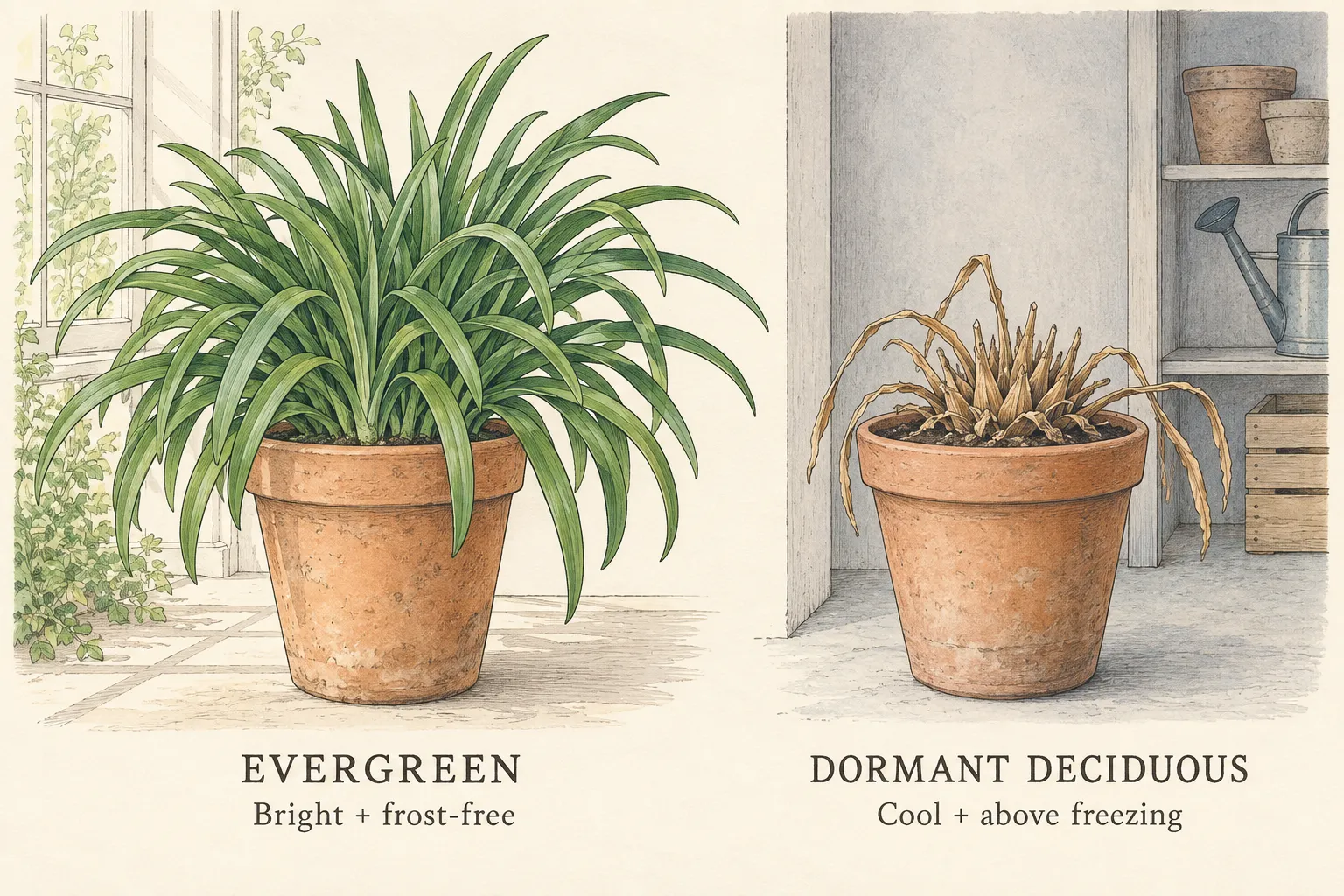
For a numerical reference, Carlson and Dole describe dry overwintering of dormant bulbs in production crates at 40–55°F, about 4–13°C. That range provides context for choosing a cool protected space; it is not a trial establishing an exact optimum for every household pot or species. A heated living-room display is unnecessary for a resting bulb. Use a thermometer to assess the proposed cool room, and keep remaining green foliage in a bright protected position until it finishes.
Let the leaves finish before treating the bulb as dormant
A spent flower spike and a dormant plant are different observations. After the florets fade, the stalk may retain ornamental seed capsules while the basal leaves remain functional. Farmer Gracy advises allowing the foliage and faded stems to yellow before removal, helping the bulb prepare for the following season. Keep healthy foliage attached during this transition. A tidy pot of cut green stubs is not evidence that the bulb has completed its seasonal work.
Reduce watering as the plant declines and stop replenishing moisture once it is dormant. Move the container away from rain so that this reduction is real: skipping the watering can achieves little if autumn storms keep refilling the pot. A still-green plant in bright shelter may take longer to finish than another pot whose leaves are already yellow. Assess each separately. The useful sequence is a protected leafy plant, then natural dieback, then a dry resting pot.
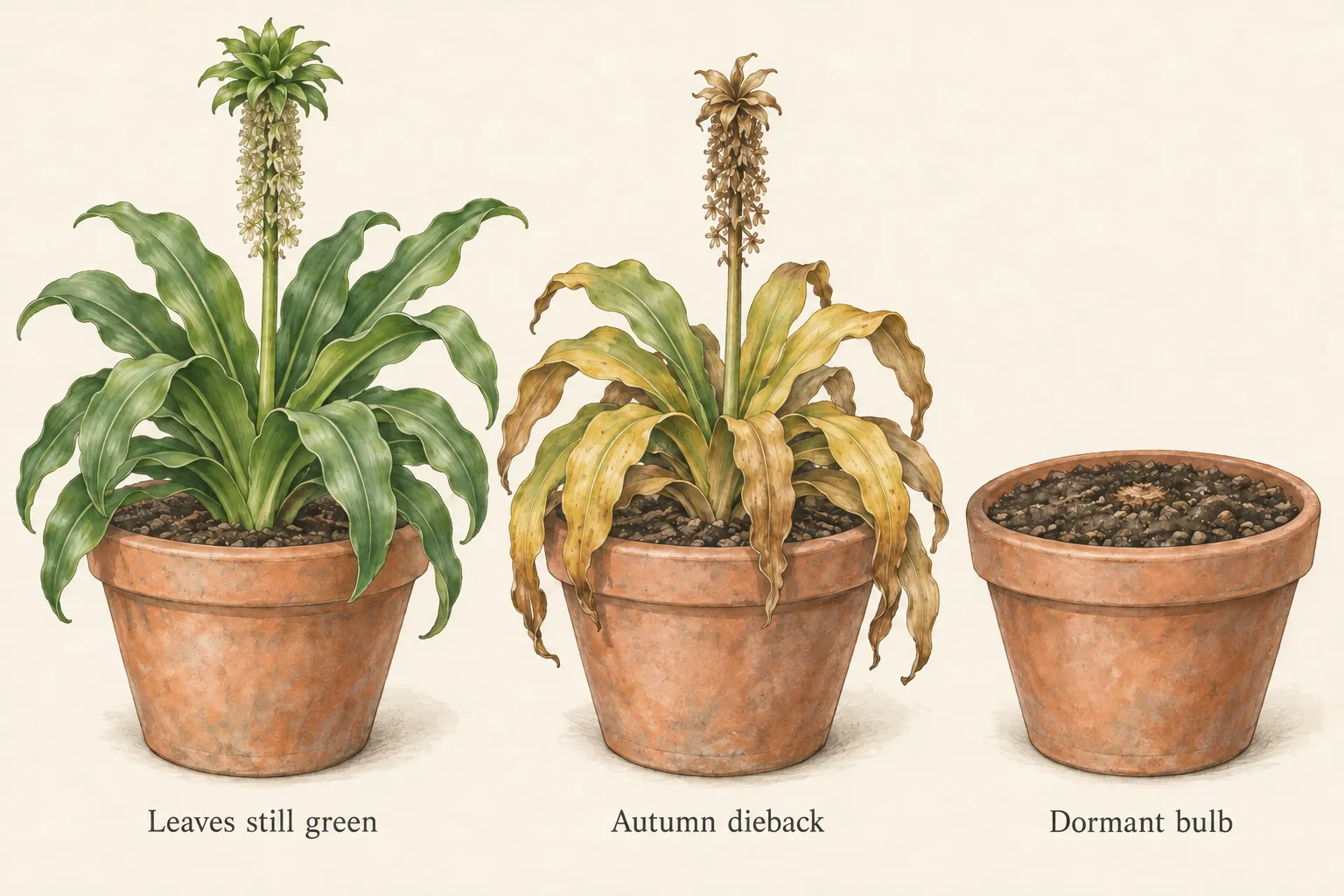
Remove dry and yellowed leaves and cut away an untidy old flower stalk, keeping the tool clear of the bulb neck and any living growth. Gather loose material from the mix so the surface remains visible for inspection. If a leaf is still firmly attached and partly green, give it more time. Pulling a bundle of leaves to lift the container can damage the plant; move the pot by its base or a suitable trolley.
Use the appearance and history together. Gradual yellowing across an established plant in autumn fits the expected transition. Sudden collapse while the mix is saturated, a soft neck or an unpleasant smell calls for investigation. These signs cannot identify a particular pathogen from a photograph, but they are enough to interrupt routine storage. Keep that pot apart from the sound dormant group while examining its condition or seeking local diagnostic advice.
Dry the mix while keeping a route for water to escape
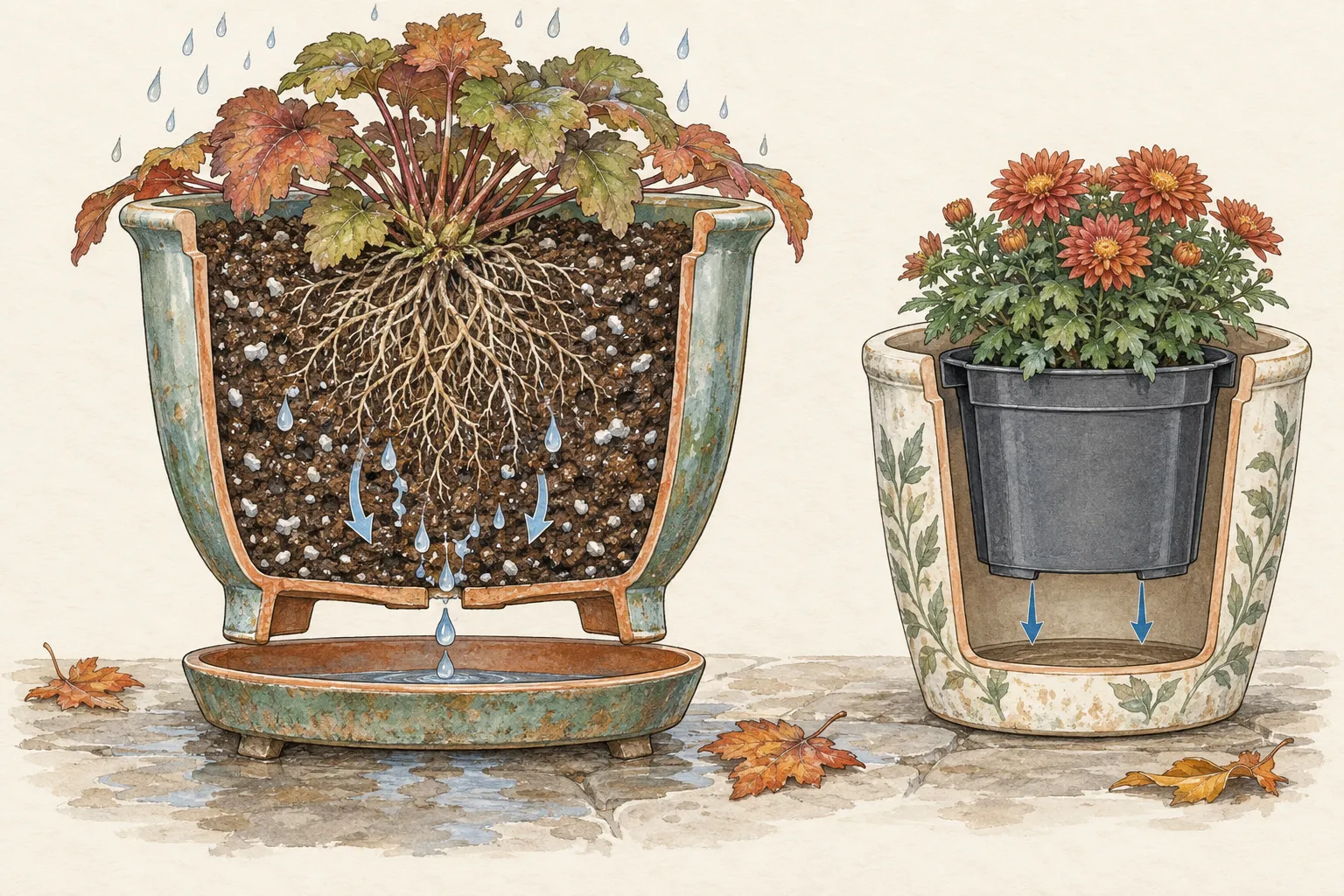
Remove the nursery pot from any watertight decorative cover and empty accumulated runoff. Confirm that the drainage openings remain clear after the move. A container can drain on pot feet outside and then lose that outlet when set flat against a shelf or into a lined box. A draining pot under a roof has two advantages here: new rain is excluded, and the water already present has a way to leave.
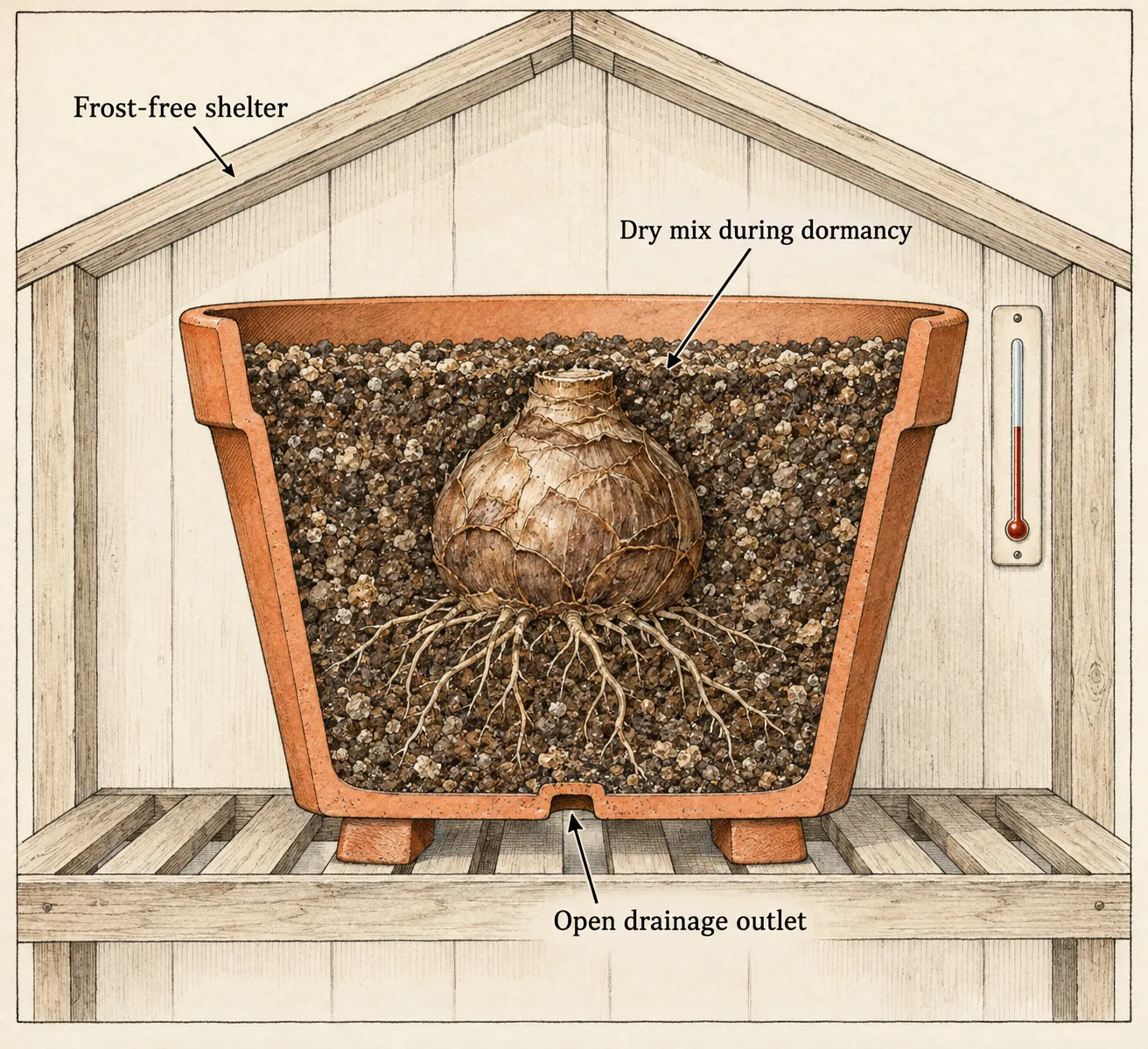
Let an already wet pot dry gradually in a sheltered, ventilated place. The surface color alone is a poor indicator of what surrounds the bulb farther down. Feel an accessible area of mix away from the bulb neck, or compare the pot's weight if it is small enough to lift safely. Keep the label visible while doing this. The objective is to confirm that drying is progressing, not to disturb the bulb repeatedly just to satisfy a daily inspection.
For example, two matching pots brought in after the same rain can reach dormancy at different times. One may hold a single bulb with open space around it; the other may be crowded with offsets and dead leaves. Mark the first as dry only when its mix has actually dried, and leave the second in the transition area while checking its drainage. This small separation prevents the entire collection being watered or packed away on the evidence of one representative pot.
Once an established summer-growing bulb is dormant, follow its dry winter regime. Farmer Gracy explicitly advises no winter watering for containers of dormant Eucomis. A dry surface at this stage is expected. Keep these pots apart from evergreen agapanthus, actively growing houseplants and other containers receiving regular water, with a label such as 'Eucomis—dormant; inspect before watering.' The label communicates a plant state, so update it when shoots begin to grow.
Keep the bulb in its pot unless a different method is needed
The RHS and Harts Nursery container guidance allows the compost to dry around the bulb. That is the straightforward choice when the pot is sound, the mix drains and storage space is available. Retain the current planting level through winter. There is no need to add a deep layer of soil over the neck simply because winter has arrived, and no benefit in burying the plant label under protective material where it can no longer identify the pot.
White Flower Farm describes another valid approach: remove potted bulbs in autumn, dry them, remove old leaves and store them in dry peat moss or sand in a cool place above freezing. That method reduces the number of containers occupying winter space, but it requires handling and a clearly labeled storage container. It does not mean that bulbs must be lifted to make the RHS dry-pot method work. Choose one complete approach and retain its moisture conditions through storage.
If a container has broken, support the bulb and its surrounding mix while transferring it to a draining replacement. If the mix stays persistently wet or the neck is soft, examine the bulb before treating the change as routine repotting. Keep firm material separate from soft, deteriorating tissue and seek help with an uncertain diagnosis. Moving suspect stock into fresh mix can hide the evidence while leaving the underlying problem unresolved.
Routine propagation can wait until you are ready to manage the resulting plants. Dividing offsets changes one established container into several smaller growing units with their own labels, space requirements and establishment needs. For a first winter with the plant, keep the healthy group intact and record any crowding for spring. That choice is about simplifying this winter's handling; it is not a claim that Eucomis can only ever be divided in spring.
Inspect during rest and respond to a change
Wisconsin Extension recommends labeling stored bulbs and retaining their identity in notes. Keep a simple storage note with the name, date moved inside and date the last leaves were removed. During occasional checks, record the overnight minimum and whether the pot remains dry. Check again after severe cold, a roof leak or a move to another room. These event-based checks are more informative than repeatedly watering a leafless pot to see whether it is alive. A firm, resting bulb can remain visually quiet for a long period.
If moisture returns, find its route: roof drip, condensation falling from glazing, a leaking nearby pot or a well-intended watering. Correct that route and inspect the neck and mix. Habitual overwatering is associated with rots in the Carlson and Dole production account. Softening, wet decay or a foul smell deserves attention; dry papery remains at the neck after ordinary dieback have a different context. A named disease or a treatment product requires a diagnosis beyond these observations.
If a shoot appears during storage, the pot has changed state. Give the new growth a bright, frost-free position and begin reassessing its moisture as growth develops. A pot that starts early cannot simply be left under the same 'dormant' label in a dark corner. Keep it protected even if outdoor weather still looks wintry. Note the temperature history and the date, which will help you choose a more suitable position for the next dormant season.
Restart in spring before returning to the patio
The RHS gives late March or April as its UK reference for restarting water. Use that as a prompt to inspect, then take the plant's growth and local conditions into account. Begin cautiously and let excess water drain. As leaves expand and the bulb becomes actively growing, increase water to meet that change. A calendar date is not a reason to keep a cold, inactive bulb sitting in wet compost.
Spring is also the time to assess the container and refresh or replace tired mix where needed. For container planting, the RHS places the top of the bulb just below the mix surface, distinct from its deeper outdoor-border instructions. White Flower Farm likewise describes bulbs near the surface in pots. Keep that container-specific distinction if repotting. Leave enough room for drainage and for the mature leaf rosette, which can spread well beyond the pot's rim.
Return the container outdoors after local frost danger has passed, introducing it to outdoor exposure gradually. Keep the option of moving it back under cover if cold returns. Resume growing-season watering and feeding as active growth establishes; the summer plant needs a dependable water supply despite its dry winter rest. Judge the result first by sound new leaves and continued growth. Flowering also depends on bulb size and growing conditions, so successful winter storage alone cannot promise a particular bloom date or number of spikes.
Steps
- Level
- easy
- Time
- About 30 minutes per manageable pot, followed by autumn drying and periodic winter checks
- Tools
- Minimum–maximum thermometer, Plant labels and pencil, Clean secateurs, Pot trolley or lifting help for a heavy container
- Materials
- Established summer-growing Eucomis in a draining pot, Cool frost-free storage space, A bright frost-free position for remaining leaves and spring shoots
- 1Identify and label the storage group
Confirm Eucomis and its species or cultivar from the label or purchase record. Select established summer-growing bulbs for this method. Keep E. regia, unidentified specialist plants and newly propagated bulblets on their own care plans. Add the pot location to the label if several cultivars will look identical once their leaves disappear.
- 2Reserve two usable positions
Choose bright frost-free space for a plant retaining leaves and cool frost-free space for its later rest. Test the overnight minimum beside the proposed pots. Check the carrying route, floor or shelf capacity and access to drainage outlets before moving a large container, and arrange lifting help if needed. Leave the thermometer in place through winter.
- 3Move and complete autumn dieback
Bring the whole pot under protection before damaging cold or continued winter rain. Empty its outer cover or saucer and let the mix begin drying as the plant declines. Retain healthy leaves, then remove yellowed or dry growth and the finished flower stalk carefully as each becomes ready.
- 4Confirm the dormant pot is drying
Check accessible mix and, where manageable, the changing container weight. Correct trapped runoff or blocked openings first. Keep a wet pot in the ventilated transition area until drying progresses. Once the mature bulb is dormant, mark it for dry storage and separate it from containers that still receive regular irrigation.
- 5Inspect after meaningful changes
Record cold-night minima and examine the pot after leaks, unusual condensation or relocation. Investigate soft or decaying tissue before returning the plant to the normal group. If fresh growth appears, update its label, provide bright protected space and reassess watering; the dormant-storage instruction no longer describes that growing shoot.
- 6Make the spring handoff
Inspect around the local spring restart period, using late March or April only as a UK reference. Resume water cautiously, increase it with active leaves, and assess whether repotting is needed. Keep the pot frost-free until outdoor conditions permit a gradual return, then manage it as a growing summer plant.
Related reading
Sources
- Eucomis. Royal Horticultural Society. Source record · Accessed 2026-10-11.
- Eucomis (Pineapple Lily). NC State Extension Gardener Plant Toolbox. Source record · Accessed 2026-10-11.
- Eucomis for Specialty Cut Flower Production. Alicain Carlson and John Dole, Cut Flower Quarterly. Source record · Accessed 2026-10-11.
- Eucomis Three. Pacific Bulb Society. Source record · Accessed 2026-10-11.
- Eucomis (Pineapple Lily). White Flower Farm. Source record · Accessed 2026-10-11.
- Eucomis planting instructions. Farmer Gracy. Source record · Accessed 2026-10-11.
- Eucomis. Harts Nursery. Source record · Accessed 2026-10-11.
- Storing Tender Bulbs for Winter. University of Wisconsin–Madison Extension. Source record · Accessed 2026-10-11.