Grow · holiday poinsettia indoor care
Keep a Poinsettia Healthy Through the Holiday Season
Keep a holiday poinsettia attractive for weeks by preventing cold shock, giving bright indirect light, and watering only after the decorative wrapper can drain freely.
Published Last updated
In this guide
- Start at the car, not the coffee table
- Give light and temperature the right kind of calm
- Water by drainage, not by the holiday wrapper
- Do less than you think during the holiday display
- Read wear and warning signs correctly
- Only begin the rebloom project if you want the whole year
- Use a weekly inspection instead of constant intervention
- Steps
Start at the car, not the coffee table
A poinsettia can lose quality before it ever reaches the living room. Illinois Extension warns that even a few minutes of cold exposure can damage the bracts and leaves, and both Minnesota and Utah State place real injury below about 50 degrees Fahrenheit. That means transport is part of care, not a separate shopping errand. Have the plant wrapped if outdoor temperatures are low, move it directly from store to vehicle, and do not leave it sitting in a cold car while you finish other tasks. A holiday plant asked to survive errands often begins its decline before it has even been unwrapped.
The first inspection at home should therefore be about condition, not decoration. Remove or loosen any shipping wrap once you are inside, check whether the pot actually drains, and note whether the plant is sitting in a sleeve designed more for gift presentation than horticulture. If the soil is already sodden in a foil sleeve, do not assume more water is the welcoming gesture it wants. Poinsettias fail from excess water at least as often as from neglect. A handsome red bract canopy can hide the fact that the roots were shipped into a swamp.
This transport-first mindset is also what keeps expectations realistic. Illinois says that with good care a poinsettia may last six to eight weeks indoors, and some cultivars stay attractive even longer. That is already a strong seasonal return for an indoor holiday plant. The goal is not to turn every poinsettia into a permanent shrub in one December. The goal is to protect the display you bought, starting with temperature shock, wrapper drainage, and light placement, so the plant arrives at late winter having looked intentional instead of exhausted.
Give light and temperature the right kind of calm
Poinsettias want abundant light, but not the kind of stress that comes from a blast furnace room and a cold glass pane at the same time. Illinois and Utah State both support about six hours of indirect or bright daylight, while Minnesota suggests bright daylight from a south, east, or west window. Taken together, the useful rule is bright placement without hard exposure to temperature extremes. Keep the plant near a good window, but do not let leaves press against icy glass and do not assume a high, hot south-facing shelf above a radiator is brighter in the way the plant needs.
Temperature guidance is unusually consistent across the sources. Illinois places ideal daytime conditions around 60 to 70 degrees Fahrenheit with nights around 55, Utah State suggests days around 65 to 70 and nights in the 55 to 65 range, and Minnesota summarizes indoor ideals near 65 to 70 while warning against swings. This is not a tropical plant that wants constantly warm air. It stays fresher in a cool stable room. High temperatures shorten the display and increase water stress. Cold drafts from doors or windows are also damaging. The best placement is bright, calm, and moderately cool.
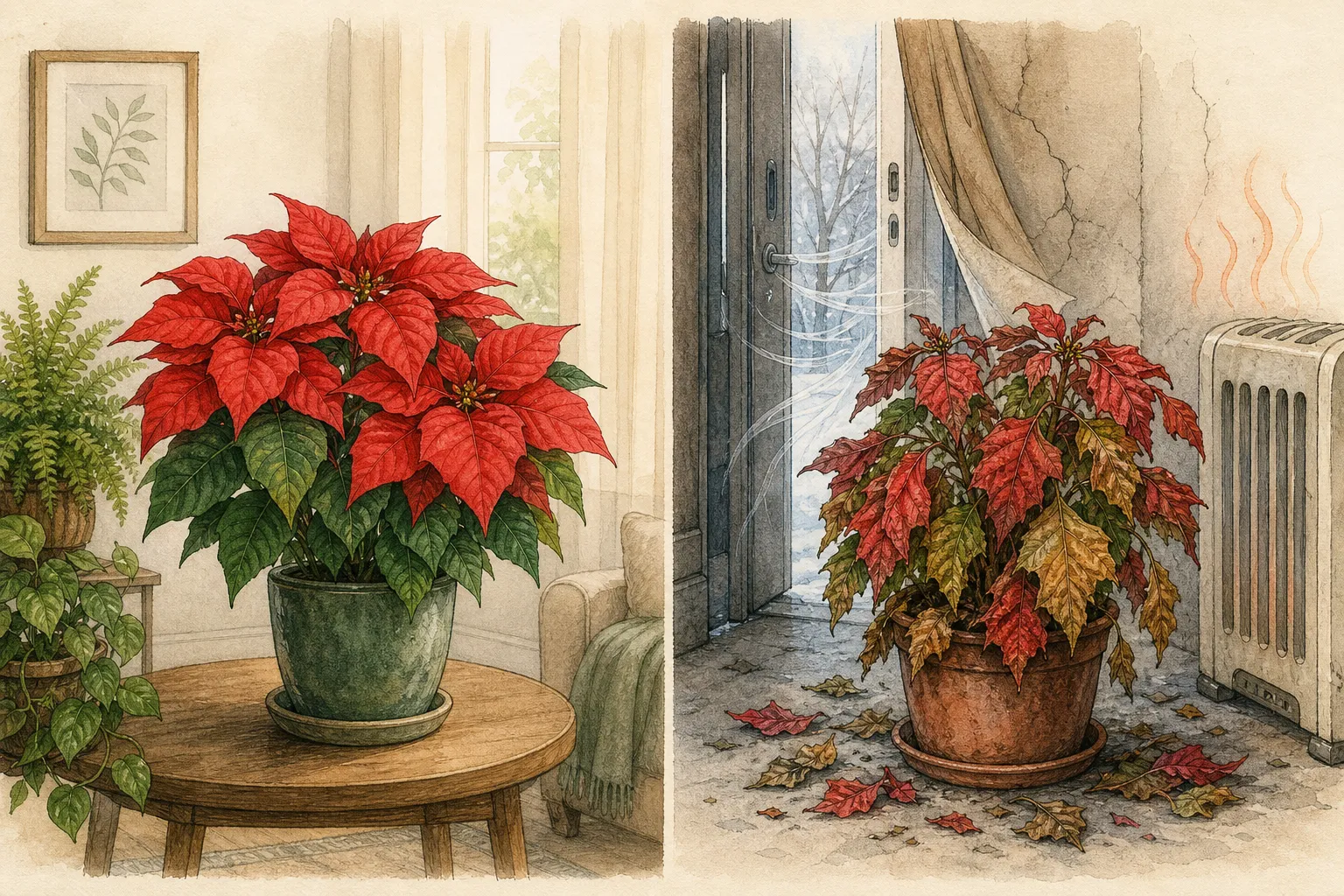
If you need to move the plant for a meal or gathering, move it for the event, not for its whole life. Repeatedly shifting a poinsettia between rooms with different light and temperature conditions adds noise to every other care decision. Stable placement helps you read the soil, bracts, and lower leaves accurately. A plant that stands in one good place tells you something useful when it wilts or yellows. A plant that spends three days by a fireplace, then two days in a dim hall, then a day beside a cold picture window mostly tells you that the house has become the problem.
Water by drainage, not by the holiday wrapper
Most poinsettia failures in December are watering failures disguised as decorative success. The foil sleeve or cachepot that makes the gift look finished is often the thing that prevents the root zone from drying and breathing normally. Illinois says to punch holes in foil so water can drain into a saucer, Minnesota says to remove the decorative foil or outer pot before watering, and Utah State emphasizes thorough drainage after each watering because the plant is highly sensitive to root rot. The recurring message is plain: the wrapper must serve the pot, not trap it.
Use the plant and the mix to decide when to water. Utah State describes watering when the soil is dry two to three inches down; Minnesota says to water when the surface feels dry to a light touch or the pot feels lightweight; Illinois tells gardeners to check the soil daily and water when it is dry. Those are all reasonable variations for different pot sizes and home climates. What they do not support is watering by calendar because the poinsettia happens to sit beside the buffet. Water thoroughly, let the water run all the way through, and then let the plant drain completely before it goes back into any decorative sleeve.
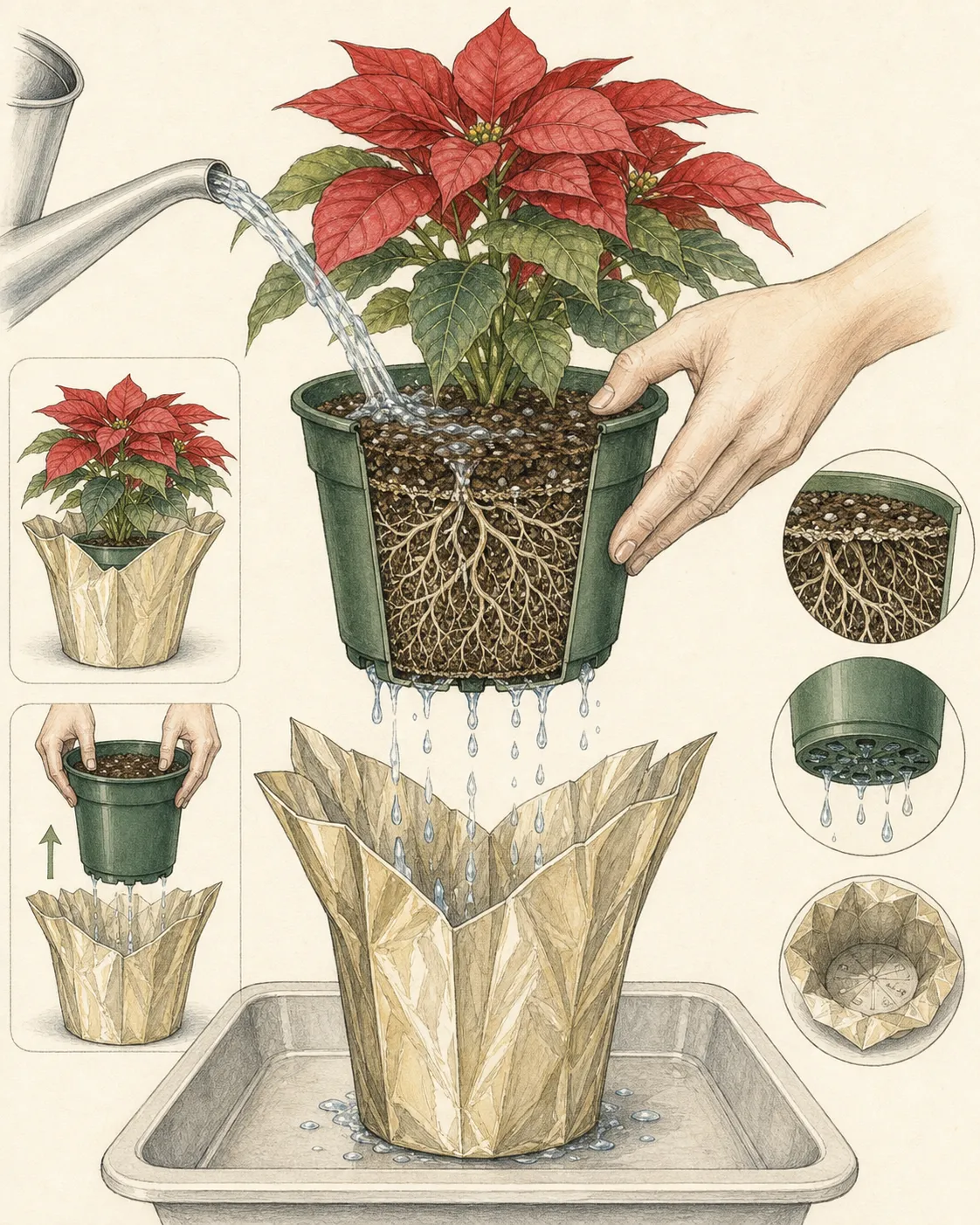
Never let the pot stand in excess water once drainage has finished. Minnesota directly connects constant wetness to root rot, and Illinois notes that wilted plants drop bracts sooner even though overwatering is the more common long-term danger. That combination fools many owners. A poinsettia in oxygen-poor wet mix can wilt and look thirsty because the roots have already stopped functioning. If the pot is heavy, the foil is holding water, and the lower leaves are yellowing, more water is not kindness. It is repetition of the same mistake in a prettier container.
Do less than you think during the holiday display
Holiday poinsettia care is mostly about not overmanaging the plant. Minnesota specifically says you do not need to fertilize during the holiday period and should wait until you see new green growth later. Illinois makes the same distinction, advising fertilizer only if you keep the plant past the holiday season. This matters because gardeners often interpret every leaf drop or bract fade as a nutrient problem. In December and January, the plant's main needs are light, stable temperature, and correct watering. Extra feed during bloom does not compensate for a bad room or a saturated root ball.
The same restraint applies to pruning, repotting, and constant grooming. Remove a damaged leaf or a truly spent bract cluster if necessary, but do not start reshaping the plant while it is being displayed. The structure you bought is the structure you should keep through the holidays. Big interventions belong to the longer rebloom cycle, not to the decorative season. If the plant is leaning slightly toward the window, small rotation is acceptable, but avoid chasing perfect symmetry every day. A poinsettia that stays in one good place is easier to water correctly than one that keeps changing orientation and room climate.
Success during the holiday season therefore looks quieter than many care guides imply. The healthiest poinsettia often seems almost uneventful. The bracts stay colored, the leaves stay attached, the soil dries gradually between waterings, and the plant does not become part of the heating system. When owners are anxious, they tend to add actions. When the conditions are right, there is less to do. The art is recognizing that restraint is active care, not indifference, when the plant is already being held in a short seasonal display window.
Read wear and warning signs correctly
A few aging lower leaves do not automatically mean the plant is failing, especially after transport and the shift into a home environment. What matters is the pattern. If lower leaves yellow slowly while the bracts remain good and the pot is drying normally, the plant may simply be adjusting to lower light than greenhouse conditions. If the bracts fade fast, leaves drop across the whole plant, and the pot sits by a heat source or cold draft, then placement is the more likely cause. Pattern recognition is more useful here than reacting to the first single yellow leaf.
Repeated wilt is also a sign with more than one possible reading. A truly dry poinsettia will wilt and recover after proper watering, but a plant in chronically wet soil may also wilt because the roots are failing. This is why Illinois, Minnesota, and Utah State all insist on checking the potting mix and drainage rather than guessing from foliage alone. Lift the pot, feel the mix, and inspect the sleeve. If the plant keeps wilting even though the container stays heavy, you are not looking at thirst. You are looking at a drainage or root problem that needs less water and better aeration, not more sympathy.
Use the holiday season itself as the benchmark for success. If the plant remains attractive through late December and into January, you have done the essential work correctly. The poinsettia does not need to remain at peak retail perfection until spring to count as healthy. What it does need is freedom from cold injury, enough light to hold color, and roots that are not drowning. A plant that reaches the end of the holiday season with sound leaves and a living root system is far more successful than one that looked hyper-lush for ten days in standing water and then collapsed.
Only begin the rebloom project if you want the whole year
Keeping a poinsettia beyond the holidays is possible, but it becomes a different project with different goals. Minnesota outlines a full year cycle that includes new-growth fertilizing, summer outdoor time, pruning for branching, and controlled dark nights in autumn. Illinois also walks through dormancy, spring pruning, and short-day treatment. This is useful knowledge, but it should not be confused with ordinary holiday maintenance. The plant can be healthy in December without your deciding today whether you are willing to manage a long-day and short-day schedule next September.
If you do choose to keep it, begin only after the holiday display has naturally aged. Once bracts and leaves begin to drop in earnest, water is reduced and the plant may enter a rest period before later pruning and renewed growth. That later cycle includes outdoor acclimation only after frost danger passes and light levels are increased gradually. None of that changes the simple December rule that the plant does not need fertilizer during bloom and does not want to sit in standing water. The holiday stage is the foundation for any rebloom effort, not a separate disposable prelude.
For the reader who only wanted a good plant through the current season, this long aftercare note serves one main purpose: it keeps the holiday advice honest and appropriately limited. A poinsettia held healthy through January was not neglected simply because it was not pushed into a year-long regimen. It was managed for the promise the plant was bought to fulfill. That promise is seasonal color in a bright, cool, stable room. If you later choose to turn it into a rebloom project, start that deliberately. Do not burden the holiday season with work that belongs to another calendar.
Use a weekly inspection instead of constant intervention
Once a week, lift the inner pot from its decorative cover and inspect drainage holes, lower leaves, and stem bases in good light. Remove standing water, turn the plant for balanced exposure, and feel below the mix surface before irrigating. This catches trapped water and uneven light without turning care into daily disturbance.
Keep fallen leaves and faded bracts off the mix surface. If several plants share a display, leave enough space to inspect each pot separately. A dry plant and a saturated plant can both wilt, so diagnose each root zone rather than watering the arrangement as a unit. Record sudden leaf drop so it can be matched to cold exposure, heat, or a watering event.
Steps
- Level
- easy
- Time
- A few minutes of setup, then regular checks through the holiday season
- Tools
- Sink or waterproof tray, Saucer, Finger or moisture check by pot weight
- Materials
- Healthy poinsettia in a draining pot
- 1Protect the plant from cold on the trip home
Have the poinsettia wrapped in low temperatures, move it directly from store to vehicle to house, and do not leave it in a cold car while running other errands. Cold shock can damage bracts within minutes.
- 2Unwrap and inspect the pot immediately
Once indoors, loosen any transport wrap and find out whether the nursery pot truly drains. If the plant sits inside foil or an outer sleeve, make sure there is a way for excess water to escape instead of pooling around the root ball.
- 3Place it in bright indirect daylight
Use a bright east, west, or south exposure with at least several hours of good light, but keep leaves off cold glass and keep the plant away from hot vents, fireplaces, or drafty doors.
- 4Keep the room cool and steady
Aim for a stable cool room with daytime temperatures around 60 to 70 degrees Fahrenheit and nights in the mid-50s to mid-60s. Avoid both temperature spikes and low-temperature exposure below about 50 degrees.
- 5Water only after the mix begins to dry
Check the potting mix daily, then water thoroughly only when it has begun to dry and the pot has lightened. Remove decorative foil before watering if necessary and let all excess water drain away completely.
- 6Do not fertilize during the holiday display
Hold fertilizer until the plant resumes active green growth later. During bloom, the useful work is stable light, correct drainage, and temperature control, not extra feed.
- 7Judge success by the season
A poinsettia that remains attractive through late December and into January has done its job well. If you want to keep it beyond that point, begin the rebloom cycle later as a separate project rather than changing the holiday care rules midstream. Continue bright light and careful drainage while the display lasts, then decide explicitly whether the plant will be composted or carried into long-term culture. That decision prevents an exhausted display plant from lingering in unsuitable conditions without a plan.
Related reading
Sources
- Caring for Poinsettias. Illinois Extension. Source record · Accessed 2026-08-19.
- How Can I Keep My Poinsettia Alive Beyond the Holidays. Utah State University Extension. Source record · Accessed 2026-08-19.
- Growing and caring for poinsettia. University of Minnesota Extension. Source record · Accessed 2026-08-19.