Grow · evergreen bough harvest garden form
Gather Evergreen Boughs Without Disfiguring Garden Plants
Cut holiday greenery from landscape evergreens with hidden regenerative cuts, species-aware restraint, and even distribution so the garden still reads whole after harvest.
Published Last updated
In this guide
- Choose donors, not victims
- Let the donor's remaining outline stop the harvest
- Match the cut to the kind of evergreen
- Plan the silhouette before the first cut
- Use node cuts and collar cuts for different jobs
- Keep the volume low and the materials fresh
- Let the garden still read whole tomorrow
- Stop while the donor still looks untouched
- Steps
Choose donors, not victims
Fresh holiday greenery can come from the home garden without turning prized plants into evidence, but the first decision is which plants can spare growth. UNH says that many evergreen and landscape branches can be gathered for wreaths and swags if pruning is done with care, and Illinois makes the same optimistic case. The missing implication, which the gardener has to supply from the actual border, is that not every plant should be treated as a donor. Skip newly installed plants, weak or drought-stressed evergreens, and any specimen whose form is central to the winter view. The decoration is optional; the plant's structure is not.
Timing matters because both stress and longevity change with season. Illinois and Oregon State both recommend harvesting after hard frost, when the tree or shrub is dormant and the needles or foliage tend to hold better on the cut material. That dormant timing reduces stress on the donor and improves the staying power of the greens indoors or on the porch. It also gives the gardener a clearer view of the branch structure before cutting. Holiday impulse often produces rough cuts because the plant is being harvested while the person is thinking like a decorator. Waiting for a dormant-season view encourages you to think like a pruner first.
The right donor plant is therefore one that is healthy, established, and viewed generously enough that selective removal can disappear into the whole. Gardeners who want absolute symmetry from every specimen all year may be better off buying extra boughs from a grower and using home material only as accent. That is not defeat. It is a correct match between the role of the landscape plant and the role of the arrangement. The strongest wreath in the world is not worth it if the front garden reads as thinned, lopsided, or scalped all winter afterward.
Let the donor's remaining outline stop the harvest
Choose a healthy established donor whose species and visible structure can tolerate the intended cut. Take small concealed amounts from suitable plants and inspect what remains after each removal. Stop while the winter outline still works. If the decoration needs more greenery than those donors can spare, obtain other material instead of expanding the cuts into prominent growth.
Match the cut to the kind of evergreen
UNH offers one of the most useful distinctions in the source set: pine and fir hold well for decorations, but they only grow on new growth, not from old wood in the place where a tip was removed. That means a missing terminal or visible tip cut can stay visible on a valuable landscape plant for a very long time. These genera are generous sources only when you can take interior or less conspicuous branches, or when the donor is a wilder tree whose exact silhouette is not doing a formal garden job. A prized specimen pine beside the front walk is a very different donor from a windbreak edge or a backyard tree mass.
Other evergreens are more forgiving. UNH notes that juniper, cypress or Chamaecyparis, and yew can produce new growth on older wood to some extent, and that conservative clipping may not damage the look while also helping control size. That does not make them inexhaustible. It does, however, make them more useful for small home arrangements when you need a few stems without preserving every tip exactly as it stood. Broadleaf evergreens such as holly, rhododendron, mountain laurel, boxwood, and inkberry also have ornamental value in decorations, though Illinois warns that boxwood and holly can discolor if they freeze after cutting.
Arborvitae deserves special caution. UNH advises skipping it unless you only need a short display because it tends to discolor quickly, which means it can sacrifice plant form without rewarding you with long performance. That is exactly the kind of poor bargain this article tries to avoid. The point is not to memorize a moral ranking of evergreens. It is to understand what kind of regrowth, visibility, and post-cut quality each donor brings. Once you know that, you can harvest from a yew or juniper more freely than from a formal pine, and you can decide in advance which plants should remain fully intact while the grocery-store bundle supplies the missing volume.
Plan the silhouette before the first cut
Illinois says the whole goal is to make it look as though you were never there harvesting. That sentence is really a design rule. Before cutting, walk around the plant and decide which faces matter from the road, the front door, and the key winter windows. Look for branch runs that disappear into the interior, secondary stems that are already slightly crowded, and sections where removal will read as an opening rather than as a missing corner. The basket should stay empty until you can see those places. Harvesting by convenience almost always removes the best-looking outer material first, which is exactly what the plant cannot spare visibly.
Distribute cuts around the donor instead of stripping one side. Illinois says never to take more than 25 percent of the evergreen plant, and Oregon State applies the same upper limit to the live crown of a standing tree. In a home landscape, that number is an absolute stop sign, not an invitation to take a quarter from every donor. Some shrubs will look altered well before that threshold. Let appearance set the earlier limit. Step back every few cuts and ask whether the outline has changed from the view that matters most. If the answer is yes, that donor is finished for the season even if the basket is not full yet.
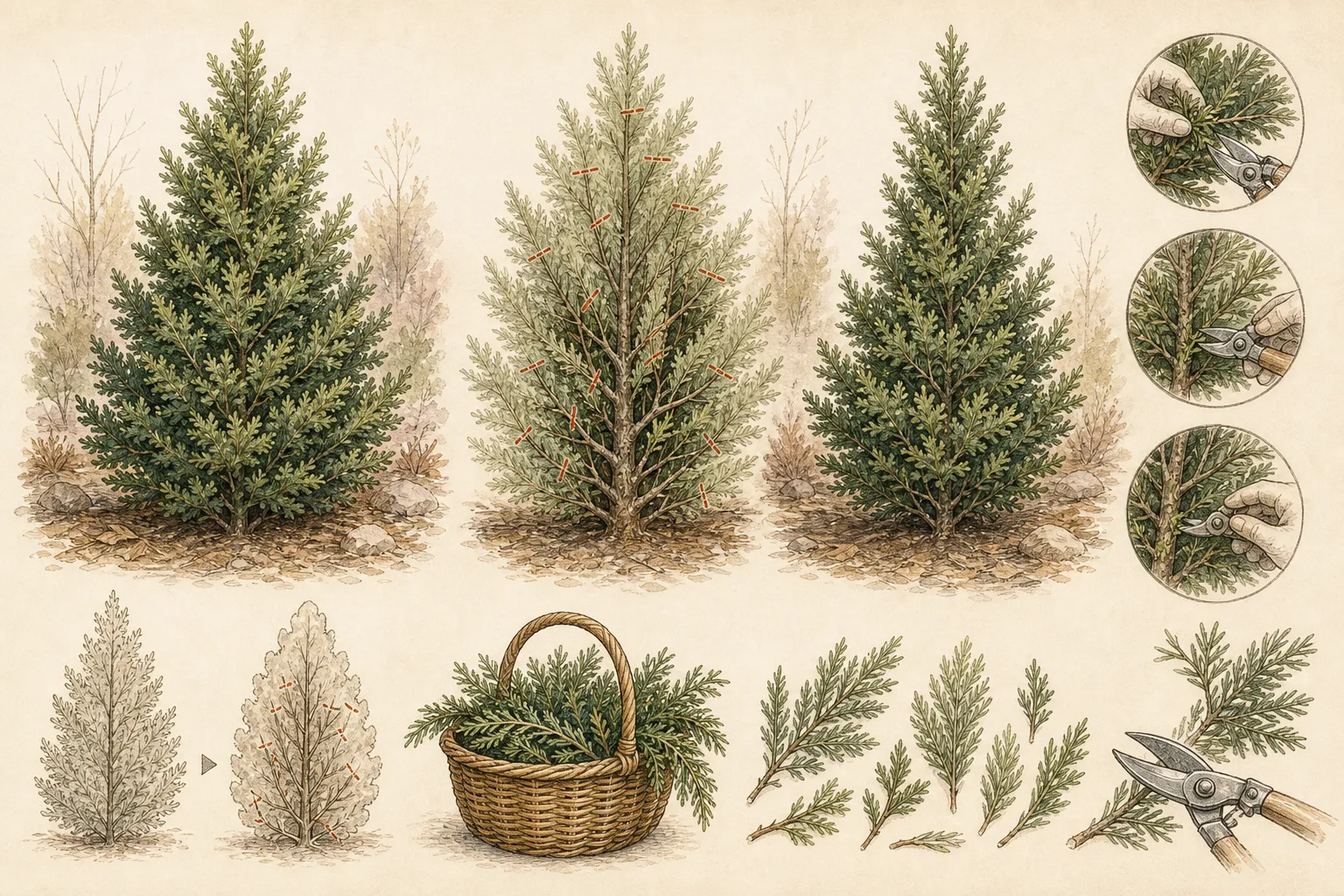
This planning step is what separates gathering from raiding. You are not simply removing biomass. You are editing a winter silhouette that has to remain legible after the greens go indoors. A conifer or broadleaf evergreen often carries more visual weight in December than in June because the surrounding garden is quieter. That means every cut shows more. Planning for invisibility therefore includes scale, viewpoint, and the role of that plant in the winter composition. A donor that anchors the whole entry may yield only a few stems. A background hedge or large informal mass may yield many more. Read the garden, not just the species list.
Use node cuts and collar cuts for different jobs
Illinois and Oregon State are consistent about regenerative bough cuts taken from a longer branch. If you are shortening or taking a length of branch for greenery while leaving the supporting branch in place, cut above a node and leave live foliage behind. Illinois places these cuts about two to four feet back from the tip; Oregon State gives a three- to four-foot range. The exact distance varies with branch size, but the functional rule is stable: do not snip the visible outer tip off a branch and expect the hole to repair itself elegantly. Cut back to a point that still supports regrowth and still leaves the branch alive beyond the cut.
Whole-branch removal is a different operation and needs pruning anatomy, not decorative instinct. Both Illinois and Oregon State say not to leave stubs and not to cut flush into the branch collar. Cut just outside the collar so the wound can close properly. This is appropriate when the branch was a sensible pruning candidate anyway, or when one removal solves a real structural issue and also yields greenery. It is not appropriate because the branch happens to be easy to reach and the wreath still needs another armful. Decorative harvesting should piggyback on sound pruning only when the plant actually benefits from that removal.
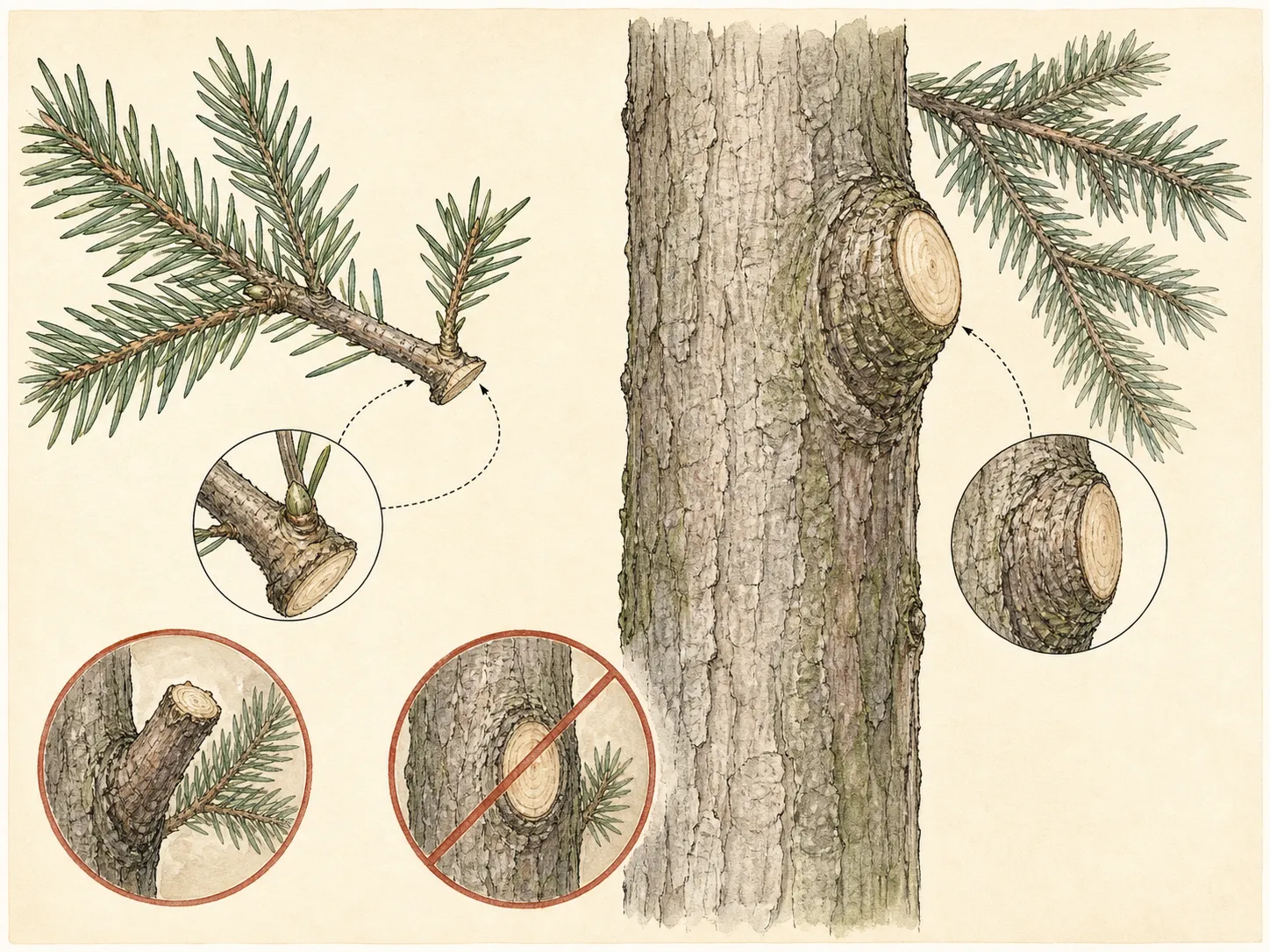
These two cut types should not be blurred together. A node cut on a retained branch aims for regeneration and concealment. A collar cut removes the whole branch cleanly and asks the shrub or tree to seal the wound. Confusing them creates either ugly stubs or dead tipped branches. This is why sharp hand pruners and deliberate cuts outperform twisting, tearing, or clipping at random with household scissors. The garden will reveal the quality of the cut long after the arrangement has browned, so make every harvest cut a real horticultural decision instead of a craft decision disguised as one.
Keep the volume low and the materials fresh
Once the stems are cut, the next quality loss usually comes from storage, not from the arrangement itself. Illinois suggests holding greens in a garage and misting them, while Oregon State gives more specific storage options: loose piles in a refrigerator around 37 degrees Fahrenheit or outside under a cool dense tree canopy with good airflow, with periodic moisture but not constant wetness. The shared principle is cool storage with enough humidity to prevent desiccation and enough air movement to prevent mold. Cut greens do not need a warm staging table while you think about the wreath shape.
Species choice also shapes where the arrangement will live. UNH notes that hemlock and spruce tend to shed needles more quickly, especially indoors, while pine and fir usually hold longer as structural greens. Illinois says boxwood and holly may discolor if they freeze after cutting, which makes them better protected accents than all-weather porch workhorses in some climates. This is where mixed gathering becomes useful. Let the longer-lasting conifer provide the backbone, then add more delicate accent foliage or berry stems where their shorter lifespan or color change will not ruin the whole arrangement. A good donor choice can save storage trouble later.
Freshness in the arrangement therefore begins with restraint in the garden and ends with discipline in storage. If you cut more than you can condition, you have already wasted part of the donor plant. If you need more volume than your landscape can spare invisibly, buy the backbone and reserve home material for distinctive accents. The point of gathering from your own garden is not to prove complete self-sufficiency. It is to use excellent material responsibly. A small amount of perfectly chosen, properly conditioned garden greenery is usually more convincing than a huge bundle cut in haste and stored badly.
Let the garden still read whole tomorrow
The final audit should happen in the landscape, not on the workbench. Go back outside the next day and view each donor plant from the angle that matters most. If the cuts disappear, the donor was chosen and edited correctly. If you can see repeated holes, a thinned front, or a blank section where the outline used to be, you now know that plant's future harvest limit is lower than you thought. This is useful knowledge, not wasted effort. The whole purpose of home-garden gathering is to learn the real carrying capacity of each plant while keeping the winter composition intact.
Rotation across seasons protects both the plants and your options. Oregon State recommends rotating harvest areas and returning only every few years in woodland settings. The home-garden version is simpler but still valuable: do not ask the same visible specimen to supply the same wreath every year. Alternate donors, use bought backbone material when needed, and let one season's cuts become a pruning advantage rather than a pattern of chronic depletion. If a boxwood was due for light shaping anyway, that year's clippings may do real double duty. If a formal pine never hides the loss well, stop treating it as a donor at all.
When done well, evergreen gathering can actually sharpen your understanding of the winter garden. It teaches which plants regenerate gracefully, which silhouettes carry the border in cold weather, and where negative space is worth more than extra greenery. The wreath or swag is temporary. The garden is the longer composition. A successful harvest is one where the arrangement feels local and fresh, while the donor plants still read like garden plants rather than like raw material that happened to be left standing.
Stop while the donor still looks untouched
Step back after every few cuts and inspect the plant from its main garden viewpoint. Stop before the basket looks full: branch tiers should remain balanced, leaders intact, and no pale interior gap should face the path. Supplement a small harvest with purchased or fallen storm material rather than taking the last useful branch from a living specimen.
Steps
- Level
- moderate
- Time
- One careful harvest session plus short-term conditioning before arranging
- Tools
- Sharp hand pruners, Clean bucket or tarp, Cool storage space
- Materials
- Established evergreen donor plants, Optional cones, berries, or twigs for accents
- 1Choose donors after hard frost
Harvest from healthy established plants once winter dormancy has set in and needle retention is likely to be better. Skip stressed, newly planted, or composition-critical specimens that cannot lose growth invisibly. Confirm the species before cutting, because evergreens differ in how readily growth returns from old wood and in whether berries or foliage pose household concerns. Choose several large donors for a few concealed cuts instead of stripping one convenient plant.
- 2Decide which species can spare what
Treat pines and firs cautiously because missing tips stay visible, and favor more forgiving plants such as yew, juniper, or Chamaecyparis when you need small amounts from refined landscape plants.
- 3Map the visible faces first
Walk around the donor and mark the fronts, the window views, and the branch runs that can hide removal. Do not start cutting from the most accessible outer growth just because it looks like the quickest fill for the basket.
- 4Use regenerative cuts on retained branches
For bough lengths taken from a branch that stays on the plant, cut back above a node and leave live foliage behind so the branch can regenerate without a dead visible tip.
- 5Use branch-collar cuts only for true branch removal
If an entire branch is a sensible pruning candidate, remove it just outside the branch collar without leaving a stub or cutting flush. Decorative need alone is not enough reason to remove a whole structural branch.
- 6Stop well before the outline breaks
Never exceed the published 25 percent ceiling and stop much earlier whenever the plant's visible shape starts to change. Distribute cuts around the donor instead of hollowing out one face.
- 7Store greens cool and airy
Keep cut stems in a cool garage, refrigerator, or shaded outdoor holding space with light moisture and good airflow. Build the arrangement only after the material is conditioned and you know the garden donor still reads whole.
Related reading
Sources
- Harvesting evergreens for holiday decorations. Illinois Extension. Source record · Accessed 2026-08-19.
- Harvesting evergreen boughs from your woodland. Oregon State University Extension Service. Source record · Accessed 2026-08-19.
- Which greens can I collect for making holiday decorations?. University of New Hampshire Extension. Source record · Accessed 2026-08-19.