Grow · cool season ornamental grass division
Divide Suitable Cool-Season Ornamental Grasses in Spring
Confirm that spring division fits the exact clumping grass and region, then lift, read and separate substantial crown sections with live shoots and roots.
Published Last updated
In this guide
- Confirm a spring division is suitable
- Select live rooted fans before deciding the number of divisions
- Use plant condition to justify division
- Choose a low-stress spring window
- Prepare destinations and a controlled work area
- Lift the whole crown before deciding cuts
- Read the crown before cutting it
- Reset substantial divisions at their former grade
- Use aftercare to protect the new crown
- Steps
Confirm a spring division is suitable
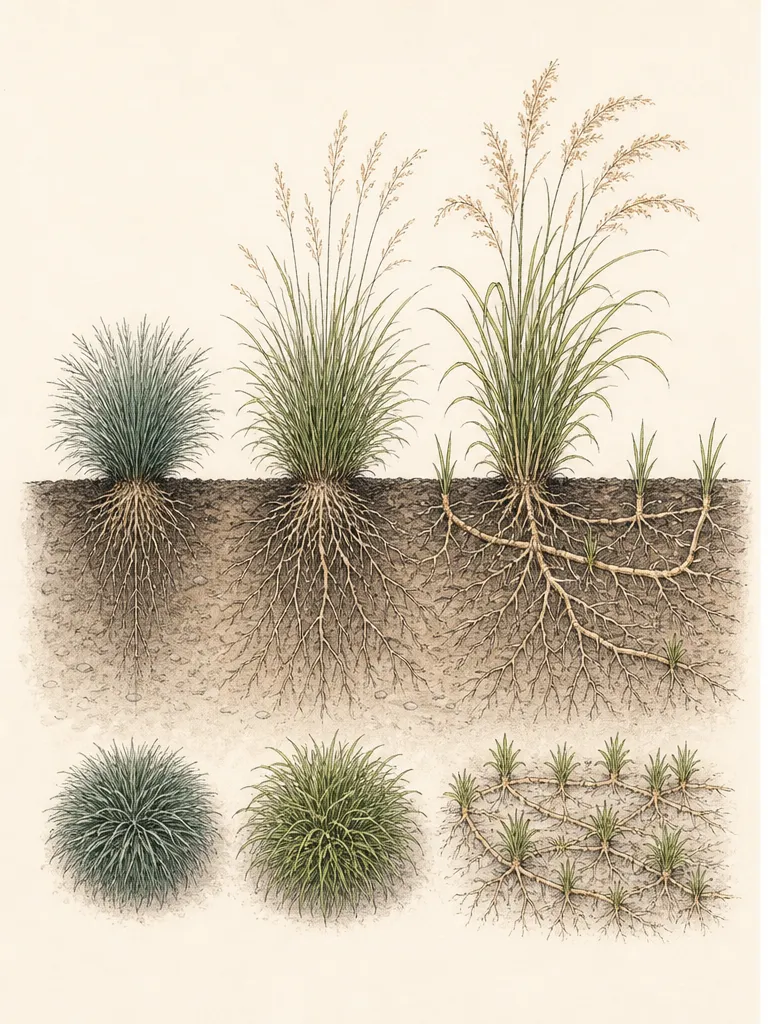
This method is for an identified, crown-forming perennial ornamental grass whose retained regional guidance permits division in spring. It does not apply automatically to every plant sold as a grass. Read the source-bounded regional decisions below before cutting; sedges, rushes, running grasses, grasslike perennials, and any plant without a confirmed botanical name remain outside this procedure.
In Nebraska, the retained UNL guide lists Calamagrostis × acutiflora 'Karl Foerster', C. × acutiflora 'Overdam', and Helictotrichon sempervirens as bunch grasses. Its general ornamental-grass direction makes spring the preferred division period while stems are 4 to 7 inches long or shorter. A Nebraska gardener may therefore proceed with one of those named plants inside that measured window, but only when the crown condition actually justifies division.
Colorado reaches a different seasonal decision for the same cool-season taxa. PlantTalk Colorado places blue oat grass, 'Karl Foerster', and 'Overdam' feather reed grass in late summer or fall because its cold, dry winter conditions shape establishment practice. Defer spring work on those grasses in Colorado. Keep the Nebraska and Colorado windows separate; averaging them produces a date that neither source supports.
Festuca glauca also remains outside this spring procedure in Colorado because PlantTalk assigns blue fescue to late summer or fall. Wisconsin describes it as a dense mound, but that habit evidence supplies no Wisconsin division window. A bounded crown is necessary for this method, yet crown form alone is insufficient authorization for spring cutting. Elsewhere, defer until current local guidance for the exact taxon provides a spring window.
Wisconsin's description of 'Karl Foerster' as a strong clump helps distinguish it from a running colony, while the Nebraska table supplies the bunch habit for 'Overdam' and blue oat grass. Those habit records establish how a crown can be read, not when it should be disturbed. If the taxon is unlisted, the identity is uncertain, the colony runs, or local timing conflicts with this regional decision, stop and obtain taxon-specific guidance.
Select live rooted fans before deciding the number of divisions
Confirm a crown-forming grass with a supported spring-division window, then map living fans and any failed center. Prepare only the destinations that fit its mature size. Keep substantial roots with each accepted piece and replant at the former crown level. Rocking, sinking or exposed roots calls for correction; an arbitrary plant count does not justify weaker divisions.
Use plant condition to justify division
Do not divide a healthy grass by anniversary. Iowa State and Nebraska guidance tie the job to growth rate, spacing and appearance: some clumps remain sound for years, while others form a conspicuous dead center or exceed their allotted space. Look for a ring of live outer growth around an inactive core, declining vigor, repeated flopping caused by crown congestion, or a mature footprint that has crossed its maintenance boundary.
Separate crown decline from a site problem. Uniform weak growth across the whole plant can reflect shade, poor drainage, drought, unsuitable soil or winter injury rather than crowding. Division will not correct the original mismatch and can leave several stressed fragments. Compare the plant with its site record, neighboring clumps and regional expectations before treating an empty center as the only explanation.
Decide whether the job is renovation, size control or propagation. Renovation removes a failed center and returns a smaller number of vigorous outer sections. Size control keeps one substantial portion in the original position and relocates or passes on the rest where moving plants is permitted. Propagation seeks more plants, but maximizing count is the wrong target; every usable division must retain live shoots, crown tissue and a root system.
Mark the mature space each accepted division can occupy. One crowded clump does not create permission to crowd four new positions. Prepare only the number of destinations with matching light, soil, moisture and regional hardiness. If there is no suitable home for surplus material, reduce the number retained rather than leaving divisions exposed while a location is improvised.
Choose a low-stress spring window
Within an approved spring row, use Nebraska's measurable boundary: work while stems are 4–7 inches long or shorter. New shoots should be visible enough to locate but still short enough to handle without crushing. If growth is already beyond that range, seek taxon-specific regional advice rather than cutting it down aggressively simply to recreate an earlier stage.
Choose a cool, still, overcast interval when soil is workable. Heat and wind increase water loss from newly separated roots, while saturated soil compacts and smears. If the spring has turned abruptly hot or the ground remains waterlogged, delay within the locally suitable window or use the alternate recommended season. A date cannot make poor handling conditions safe.
Water dry soil before the work so the root mass holds together without becoming a heavy saturated block. Check the forecast for the establishment period, not only the division day. New sections need accessible moisture but also drainage and root-zone air. Postpone if severe cold, heat or an absence of follow-up care would leave freshly cut crowns without a credible recovery period.
Remove old dry foliage before lifting only as appropriate for the exact grass, keeping emerging shoots visible and intact. Tie bulky dead tops before cutting so blades do not scatter or hide the crown. Do not shear into fresh growth. If live blades and old stems are intermingled, work by hand in small sections or delay until the distinction is clear.
Prepare destinations and a controlled work area
Open every receiving hole before lifting the parent. Match the original suitable light and soil, allow the documented mature spread and leave access for future cleanup. Iowa State guidance resets ornamental grass at the same level it occupied previously. Prepare each hole to accept roots without folding them while keeping the crown at that established relationship to the surrounding soil.
Stage clean, sharp tools according to clump size: a sturdy spade or fork for lifting, hand pruners for old foliage and a sharp spade or knife for readable crown cuts. A large old grass can be unexpectedly dense and heavy. Do not escalate casually to axes or powered tools. If the crown exceeds safe hand-tool capacity, divide in place only with reliable plant-specific guidance or obtain experienced help.
Create a stable cutting area beside, not inside, the border. Use a firm surface that will not let the crown roll and keep hands out of the cutting line. Wear protective clothing appropriate to sharp grass blades and the chosen tools, and follow manufacturer instructions. Plan how the lifted mass will be moved without twisting, dragging across emerging plants or lifting beyond comfortable capacity.
Set out labels, water and damp cover for brief holding. Record which side of the parent faced the principal view if habit matters. The divisions should move from ground to assessment to prepared holes without a long drying interval. If interruptions are likely, divide fewer sections at one time and leave the rest of the crown intact until destinations are ready.
Lift the whole crown before deciding cuts
Dig outside the visible crown, circling it rather than driving a blade through the center at the first attempt. Work from several sides and preserve as many outer roots as practical. The required distance depends on clump size and root structure; use resistance and visible roots rather than a universal radius. Lever gradually and add another cut if the mass remains anchored.
Support the crown as it rises. A dense clump can break under its own weight, tearing live fans away from their roots. Slide it onto a tarp or low board instead of pulling by foliage. Move it into shade and orient it as it grew. If the mass is too heavy to handle safely, stop and reduce it with controlled cuts while it remains supported rather than attempting one lift.
Remove only enough loose soil and old debris to reveal the architecture. Identify living outer fans or tiller groups, firm crown connections, attached roots and any dead hollow center. Do not wash every root bare as a routine or pound the clump until it fragments. The aim is to see where a cut can pass between viable groups with the least loss of crown tissue.
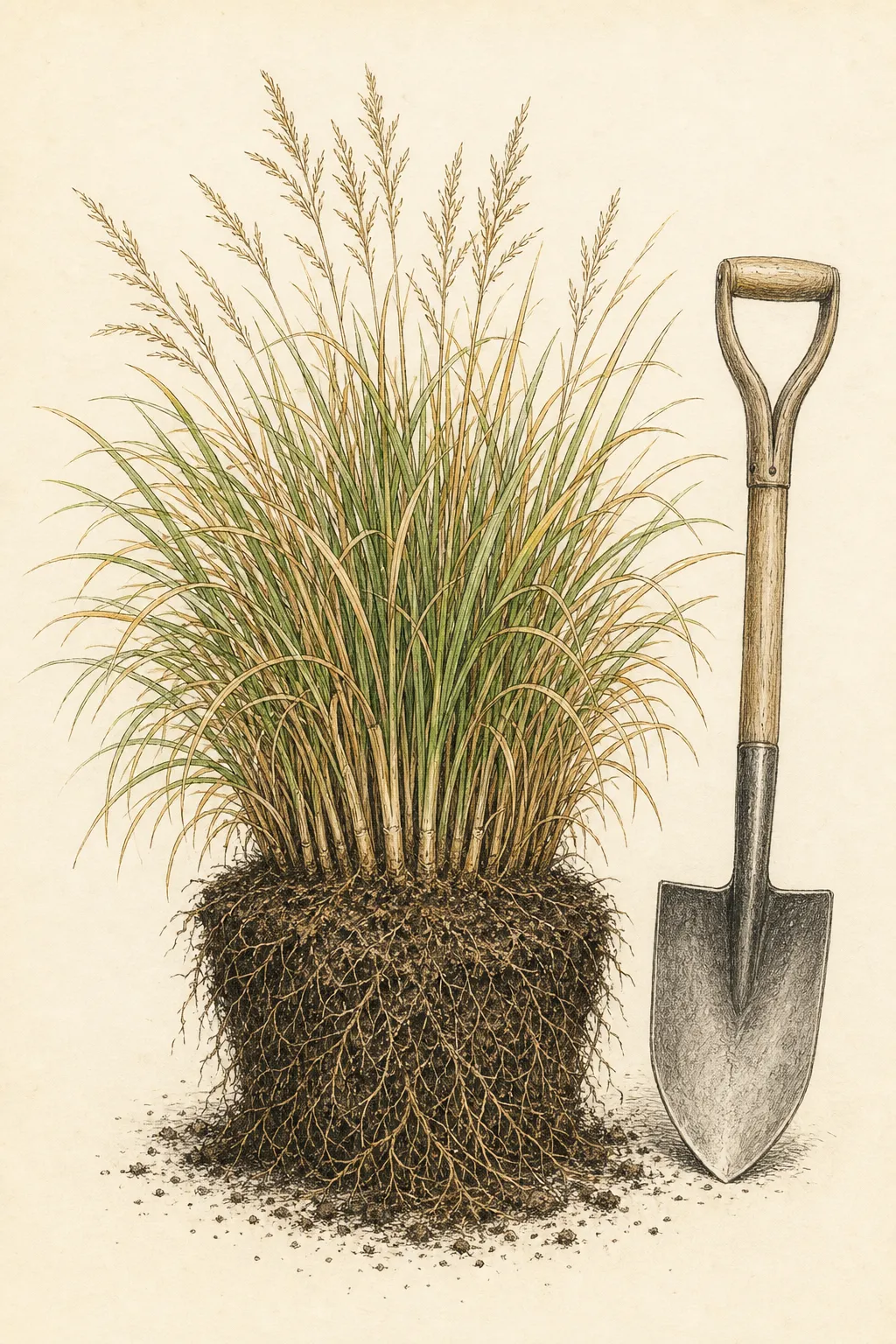
Reassess the diagnosis now that the crown is visible. A sound center and evenly rooted clump may not need the planned renovation. Conversely, soft, discolored or poorly rooted tissue extending beyond the apparent center suggests a problem outside ordinary crowding. Do not distribute suspect sections. Seek regional diagnosis and follow local disposal guidance rather than multiplying uncertainty.
Read the crown before cutting it
Trace each candidate division as a complete unit. It needs a coherent group of live shoots connected to firm crown tissue and useful attached roots. Foliage without crown cannot regenerate a plant, and a crown sliver stripped of roots carries little establishment capacity. Mark natural seams or narrow connections between live fans before positioning a blade.
Remove the failed center from the plan. Iowa State and Colorado guidance both direct gardeners to separate living divisions from dead central material. The inactive core is not included merely to make a section larger. Cut back to firm, visibly living tissue while keeping the accepted outer fans intact. If no clean boundary exists, stop and diagnose rather than chasing sound tissue through the whole crown.
Make the fewest controlled cuts that produce substantial divisions. Start by halving or quartering only where those cuts pass through dead center or between clear live groups, then assess each piece before cutting again. A strong division should read as a small clump, not a handful of detached tillers. Fewer robust plants recover more predictably and preserve named-cultivar identity without relying on seed.
Direct the blade away from hands and emerging shoots. Use steady pressure through the selected line; do not saw randomly around the crown until it falls apart. If a cut starts through the center of a live fan, withdraw and choose another seam. Clean the tool before moving from suspect tissue to accepted sections and keep roots shaded while each division is evaluated.
Reset substantial divisions at their former grade
Move accepted sections immediately to prepared holes. Spread roots naturally without forcing the crown lower to make the plant stand upright. Hold the living crown at the same soil relationship it had before lifting, then backfill with the excavated soil unless a documented site correction calls for another treatment. Burying the crown can hold moisture against shoots; leaving roots exposed creates a different stress.
Firm soil gently around roots to close broad voids while preserving pore space. Water thoroughly and watch how the soil settles. Add soil around exposed roots or lift a sunken crown before the first watering becomes the permanent grade. Do not pack a mound tightly against the crown as a brace. Stability should come from correct root placement and evenly settled soil.
Return one suitable outer division to the original position only after failed center material and the cause of crowding are addressed. Do not fit all sections back into the old footprint. Preserve mature spacing and the maintenance side used for annual cleanup. Label every moved named cultivar; seedlings from a cultivar may not preserve the selected habit, which is one reason division is used.
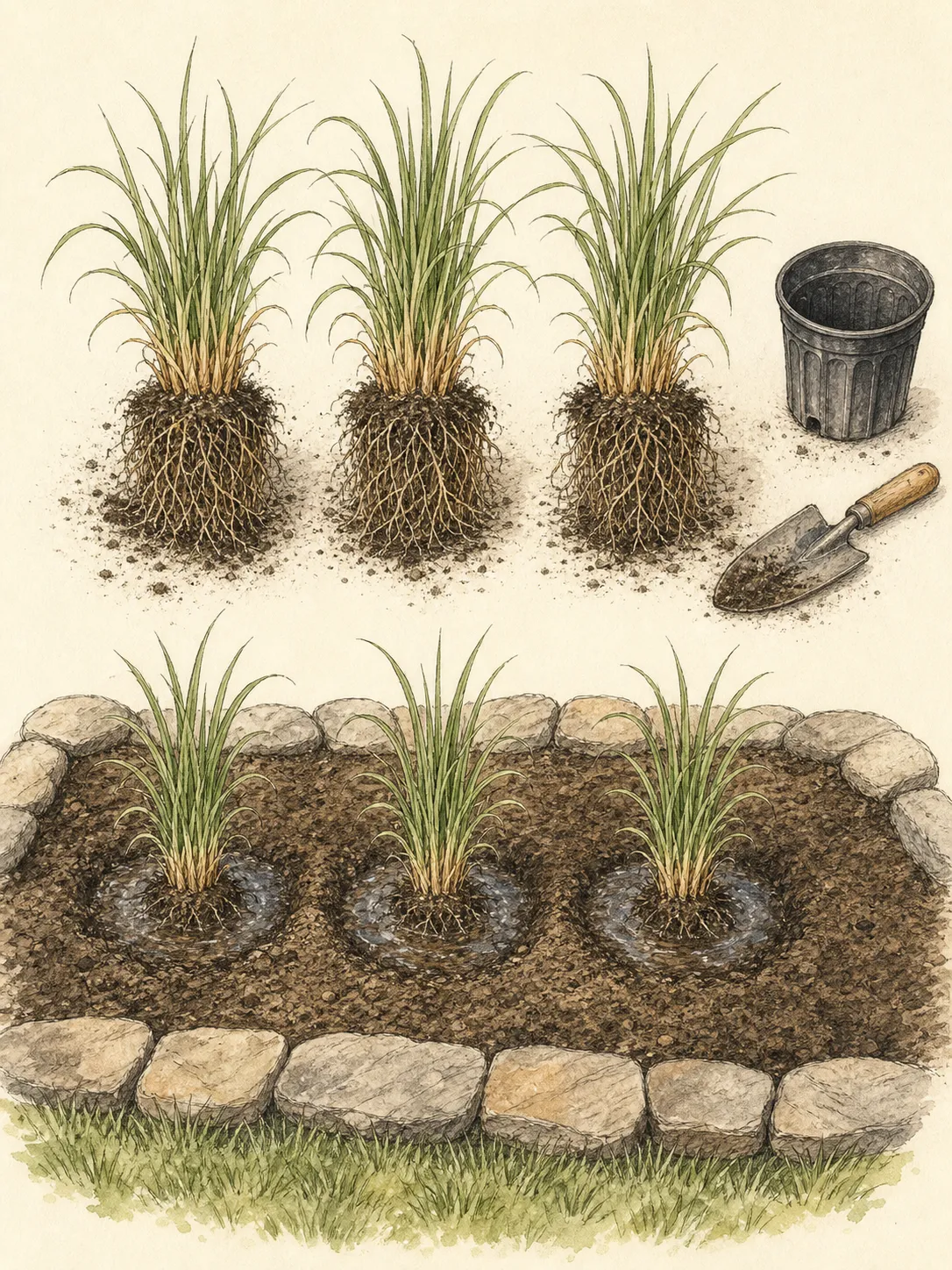
Apply mulch conservatively around, not through, the crown according to local guidance. Keep new shoots visible and avoid material that holds them wet. Colorado's fall-division advice includes winter moisture and mulch because its regional risk is desiccation; that does not become a universal spring depth. Use local establishment and mulching recommendations for the actual season and climate.
Use aftercare to protect the new crown
Check moisture at root depth rather than watering by a fixed interval. Fresh divisions have reduced root systems and should not dry out during establishment, yet saturated soil deprives roots of air. Compare the original and new sites after watering and rain. Correct runoff, a buried crown or a dry root-ball center before simply increasing frequency.
Expect a division to look smaller and less architectural than the parent. Do not force rapid fullness with heavy fertilizer. Fresh upright shoots, stable crown position and roots holding the surrounding soil are more useful signs of recovery. A section that rocks in the hole, sinks after rain or pulls away from soil needs a physical correction before a nutritional one.
Distinguish temporary handling stress from continuing failure. Limited older-leaf browning can follow division, but expanding collapse, soft crown tissue or shoots pulling free with no roots require investigation. Stop sharing material from the parent if an abnormal pattern appears. Photograph the crown and obtain regional diagnostic advice rather than trimming symptoms until the evidence is lost.
Keep the site open through the first season. Do not plant permanent fillers in the reserved mature envelope because the divisions look sparse. Mark each crown so dormant or slow sections are not dug accidentally. Water according to observed need through establishment and review posture, vigor and center growth before deciding whether the division was successful.
In later years, use the same condition-based test. Some grasses can remain undivided for long periods, and regional timing may change which season is safest. Record the cultivar, date, crown condition, weather and response. The objective is a vigorous ornamental clump with an intact center and maintainable spread—not a recurring spring ritual that cuts healthy crowns without cause.
Steps
- Level
- advanced
- Time
- One cool working session after the named grass passes the regional suitability table, followed by moisture and crown checks through establishment
- Tools
- Sturdy garden spade or fork, Clean sharp division spade or knife, Hand pruners or shears for old foliage, Tarp or low board for moving the crown, Watering can or hose with a gentle outlet, Weather-resistant labels
- Materials
- Identified clumping cool-season ornamental grass approved for spring division locally, Prepared receiving soil, Damp cover for brief shaded holding, Locally appropriate mulch if recommended
- 1Confirm identity, season and need
Proceed only with an identified crown-forming ornamental grass whose exact taxon and regional guidance permit spring division. Look for a real reason such as a dead center, declining vigor or an exceeded boundary. Leave a healthy compact crown intact. If local guidance favors late summer or fall for that cool-season grass, use that regional window rather than averaging recommendations.
- 2Prepare every destination first
Choose sites matching the parent's workable light, soil, moisture and hardiness. Draw mature spread and future cleanup access, open each hole to receive natural root depth, stage water and place labels. Retain only the number of divisions that can be replanted promptly. Water dry parent soil in advance, but postpone work if the ground is saturated or severe weather would interrupt establishment.
- 3Expose the crown without cutting new shoots
Remove old dry foliage as appropriate while keeping emerging growth visible. Tie bulky tops before cutting and work by hand where old and new blades mingle. Dig outside the crown from several sides, preserving outer roots. Lift onto a tarp or board with the mass supported; if it is too heavy, stop and obtain help or make controlled supported reductions.
- 4Map live fans and the failed center
Ease away only enough loose soil to identify live shoot groups, firm connecting crown, attached roots and dead central tissue. Mark narrow seams between viable fans. Reassess any soft, discolored or poorly rooted area before proceeding. Do not wash, beat or tear the clump into fragments, and do not move suspect tissue to new garden positions.
- 5Cut substantial rooted divisions
Place a clean sharp blade through a selected seam or failed center, keeping hands and live shoots outside the cutting line. Make a few decisive cuts, then inspect each section. Retain coherent small clumps with several live shoots, firm crown tissue and useful roots. Discard the dead core under local guidance and stop dividing before strong sections become weak slivers.
- 6Replant at the former crown level
Transfer each selected section directly into a prepared destination. Fan the roots over firm soil, align the old soil mark with finished grade, refill in shallow lifts, irrigate to settle, and inspect again after drainage. Keep only one piece in the original position and use the documented mature width at every new site instead of rebuilding the crowded ring.
- 7Monitor roots, moisture and stability
Check root-zone moisture and water before new roots dry while allowing excess to drain. Keep crowns visible, labels in place and permanent fillers outside the mature envelope. Correct rocking, sinking or a dry central root ball promptly. Expanding collapse, soft tissue or shoots releasing without roots ends ordinary aftercare and calls for regional diagnosis before any section is shared.
Related reading
Sources
- Ornamental Grasses for Nebraska Landscapes. University of Nebraska–Lincoln Extension. Source record · Accessed 2026-08-30.
- Ornamental Grasses for the Home Landscape. Iowa State University Extension and Outreach. Source record · Accessed 2026-08-30.
- 1068 – Dividing Ornamental Grasses. Colorado State University Extension PlantTalk. Source record · Accessed 2026-08-30.
- Ornamental Grasses Enhance Landscapes. University of Wisconsin–Madison Division of Extension. Source record · Accessed 2026-08-30.