Grow · small tree bark branching selection
Choose Small Ornamental Trees for Bark and Branching
Choose a small ornamental tree by its mature winter silhouette, bark development, site clearance, and nursery structure instead of judging flowers alone.
Published Last updated
In this guide
- Begin with the leafless job the tree must perform
- Reject mature-size conflicts before scoring winter character
- Draw the mature winter envelope on the actual site
- Compare bark and branching as two separate traits
- Use three candidates to test the brief
- Inspect the nursery tree for the form you intend to keep
- Choose the tree whose winter character can mature without correction
- Steps
Begin with the leafless job the tree must perform
Choose a bark-and-branching tree in the season when those features have to carry the garden. Flowers, fruit, and foliage can still matter, but the November decision begins with a leafless question: what should this space look like when the crown is fully exposed? A tree may need to frame a window, mark a path turn, hold a quiet focal point beyond a border, or add fine branches against a plain wall. Name that job before opening a plant list.
Use small as a site term, not a promise printed on a tag. Oregon State University Extension describes small ornamental trees as those with a mature height below 25 feet in its selection framework, while several familiar ornamentals reach or exceed that threshold under favorable conditions. The useful test is the documented mature height and width of the species or cultivar in conditions comparable to yours. A 20-foot tree that spreads 25 feet is not small beside a six-foot-wide path court.
Separate ornament from fitness. Attractive bark cannot compensate for a site that stays saturated when the tree requires drainage, a crown that will block a window, or a species beyond its suitable climate. Record winter minimums, summer heat, light, drainage, soil limitations, exposure to drying wind, and the available root area. These facts eliminate unsuitable candidates before the subtler comparison between peeling, mottled, smooth, and colored bark begins.
Finish the first pass with a one-sentence brief that contains a form, a view, and a boundary. For example: choose an upright-to-oval deciduous tree whose winter bark can be seen from the kitchen, with a mature crown that clears the main path and does not depend on annual size reduction.
That sentence is specific enough to test each candidate and flexible enough to admit more than one species. Keep it beside the site measurements so attractive bark photographs cannot quietly replace the stated boundary.
Reject mature-size conflicts before scoring winter character
First exclude trees that fail the site's full height, crown, rooting or cultural limits. Compare bark and branching only among the remaining candidates, using the intended winter viewpoint. If a preferred specimen fits only after its natural crown is reduced on paper, reopen the shortlist. Record the accepted mature form so later pruning preserves the feature selected.
Draw the mature winter envelope on the actual site
Measure the open volume, not only the patch of soil. Mark the proposed trunk, then sketch the mature radius toward the house, path, neighboring plants, property line, and important view. Include the lower branch zone as well as the crown edge. A low spreading tree can occupy eye level and walking space even when its top remains modest; an upright tree of similar height may leave the same ground plane much more open.
The University of Florida IFAS tree-form guidance connects form directly to function and future maintenance. It notes that spreading small trees near pavement often require regular pruning when planted too close, while form also affects visibility and clearance. Apply that principle at domestic scale. Test whether a snow-laden lower branch could cross a path, whether a broad crown will crowd a wall, and whether the trunk remains visible from the intended winter viewpoint.
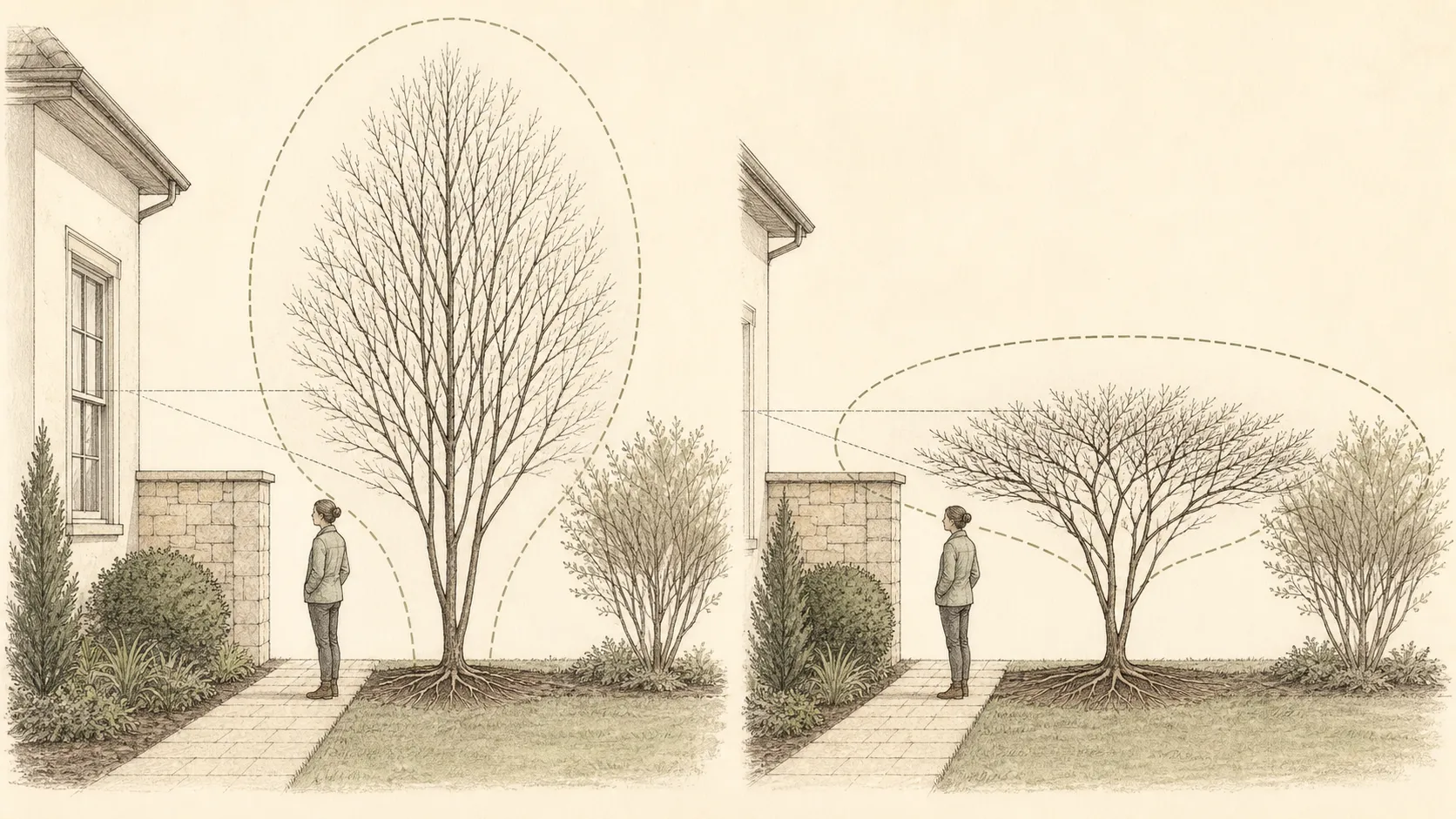
Repeat the drawing from the place where the tree will usually be seen. Bark is a close- to middle-distance feature. A richly mottled trunk hidden behind evergreen shrubs will contribute less than a quieter trunk placed against a calm background. Fine branching reads best against open sky, pale masonry, a fence, or a distant evergreen mass. The view should expose enough trunk and branch pattern to justify making them primary selection traits.
Allow room for the crown to express its natural habit. A tree selected for tiered, vase-shaped, or multistem architecture loses its purpose if a doorway, eave, or path forces continuous corrective pruning. The mature envelope is therefore both a design drawing and a stop rule. If it crosses an immovable boundary, reduce the candidate list or move the planting point before nursery stock makes the decision feel irreversible.
Compare bark and branching as two separate traits
Bark and branching do not mature on the same schedule. Young bark may be smooth and quiet while older trunks begin to peel or mottle; a nursery tree may also carry a temporary training form that changes as the crown broadens. Ask how old the wood must be before the advertised bark appears, which parts of the tree display it, and whether the visible trunk area on your site will reach that stage. A close photograph of mature bark cannot describe the entire winter tree.
Read bark in four ways: color at a useful distance, texture at close range, seasonal persistence, and the amount of trunk that will remain visible. Cinnamon curls catch low light differently from a patchwork of tan and gray. Smooth gray bark can be elegant beside dark evergreens, yet it may disappear against similarly colored stone. Peeling bark also creates small shed pieces, a minor maintenance point worth noticing beside immaculate paving or a pond.
Read branching by origin, direction, density, and change with age. An upright oval may give vertical emphasis without closing a passage. Tiered horizontal limbs create strong winter planes but need lateral room. A multistem base multiplies the bark display and can make a fuller low silhouette; it also occupies more visual and physical width than a single trunk. Decide which architecture serves the site before treating one habit as inherently superior.
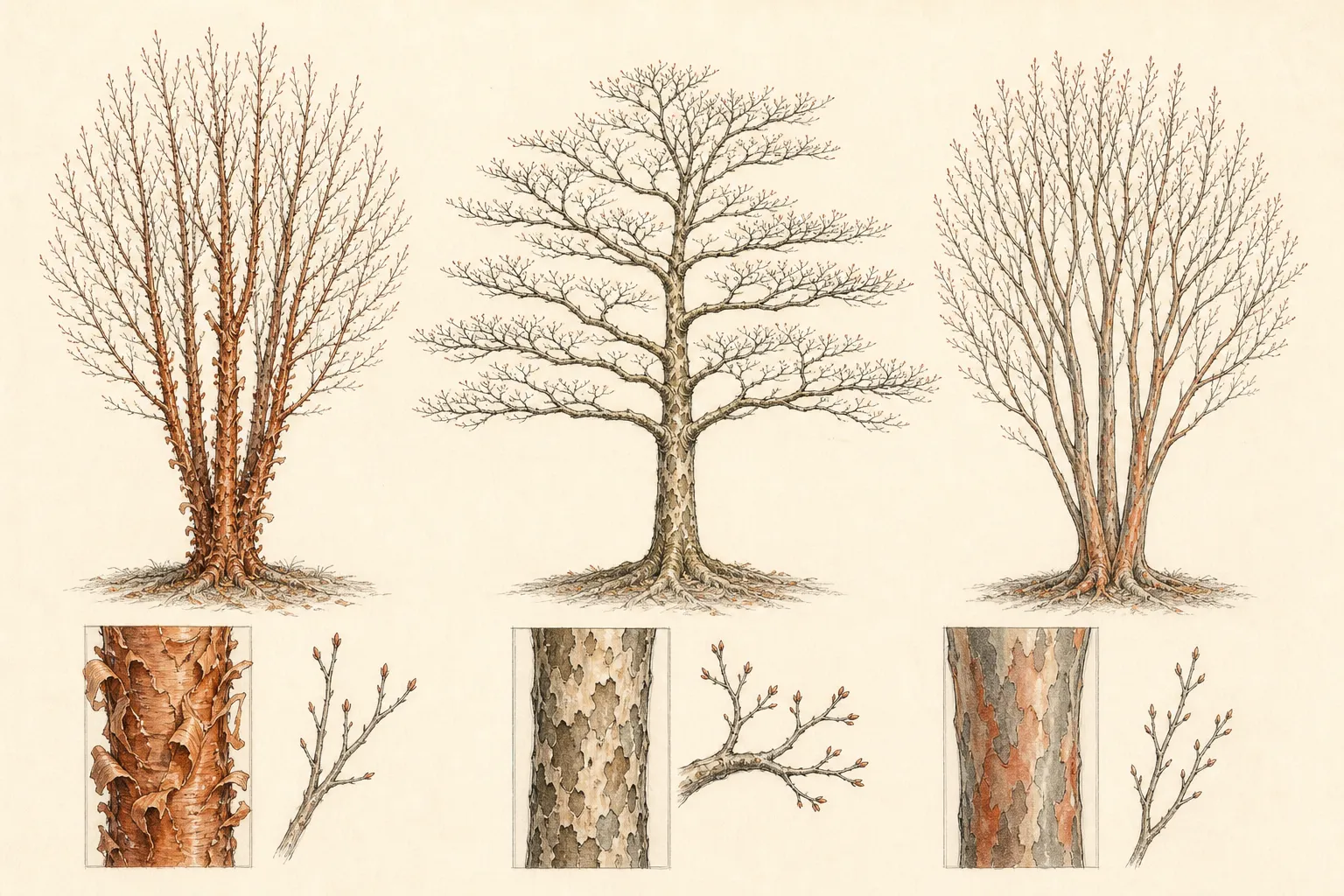
Finally, distinguish natural habit from structural defect. Codominant upright stems with a tight union are not automatically the same thing as an intentional, well-spaced multistem tree. Likewise, a picturesque bend does not excuse damaged bark, an unstable root flare, or crossing branches. The chosen specimen should express the species habit with sound unions and enough space between major parts for the form to remain legible as it grows.
Use three candidates to test the brief
Paperbark maple, Acer griseum, is the clearest candidate when cinnamon-colored exfoliating bark is the leading requirement. The Morton Arboretum lists a mature height of 20 to 30 feet and width of 10 to 30 feet, with an oval, rounded, or upright form, full sun to partial shade, and a preference for moist, well-drained soil. Its width range matters: verify the actual selection and available space instead of assuming every specimen will stay narrow.
Kousa dogwood, Cornus kousa, shifts the balance toward branching character. NC State Extension describes young trees as upright and vase-shaped, then increasingly rounded, wide-spreading, and horizontally branched with age. Mature trunks develop mottled peeling bark, and the species reaches about 30 feet. This is a tree to place where the later horizontal architecture has room; squeezing it beside a path would turn its defining habit into a pruning conflict.
Japanese stewartia, Stewartia pseudocamellia, offers multicolored exfoliating bark and a fine pyramidal-to-oval framework. NC State gives a broad mature range of 12 to 40 feet high and 8 to 25 feet wide, reflecting why local and cultivar information matters. It prefers moist, well-drained, organically rich soil, is drought intolerant, and benefits from protection from winter winds. Its beauty does not make it a substitute for paperbark maple on a dry exposed site.
These three are comparison tools, not a universal shortlist. Paperbark maple foregrounds curled copper-cinnamon bark; kousa dogwood foregrounds age-developed horizontal structure and mottled bark; stewartia combines mottling with an upright oval form but asks more of moisture and shelter. Regional hardiness, heat, pests, invasive status, nursery availability, and cultivar dimensions can change the final answer. Use local Extension or arboretum guidance to replace any candidate that falls outside the site evidence.
Inspect the nursery tree for the form you intend to keep
Take the site brief and mature-size notes to the nursery. First confirm identity, cultivar, and documented dimensions. Then step back far enough to see the complete crown. The trunk should meet the root area without a buried-looking pole effect, the main framework should be balanced around the plant, and branch arrangement should resemble the habit you selected. A dense screen of temporary nursery shoots can conceal the structure, so change viewing angles rather than judging from the front alone.
Look for healthy, continuous bark on the trunk and major branches. Decorative peeling that belongs to the species should not be confused with fresh wounds, abrasion from ties, sunscald, cracks, or missing bark around a union. Oregon State advises selecting nursery trees with good form and no trunk damage. If you cannot tell whether a mark is normal exfoliation, ask the nursery to identify it and compare another specimen of the same taxon.
Trace major unions before admiring twig density. A natural multistem tree should have separate, intentional stems and enough visible architecture to assess. For single-trunk stock, follow the main leader and note competing upright branches, abrupt bends, crossing limbs, or a crown forced into symmetry by tight staking. The aim is not geometric perfection. It is a sound young framework compatible with the mature habit and with the view you planned.
Compare at least two specimens when possible. Bark color varies with age, moisture, light, and the amount of older wood present, while crown form varies with training and growing conditions. A side-by-side comparison exposes whether the first tree is representative or merely convenient. If every available specimen is too large for the root space, damaged, or trained into the wrong architecture, leave without a tree and keep the brief intact.
Choose the tree whose winter character can mature without correction
Return to the site drawing after the nursery visit. Insert the actual candidate's mature height, width, form, and cultural needs, not its current container dimensions. Confirm that its best bark will face or remain visible from the intended view and that its natural branches can clear circulation. A tree that passes only after imagined annual pruning has failed the original brief. Choose the candidate whose ordinary development creates the composition.
Rank the remaining trees with site fitness first, mature form second, bark character third, and secondary seasonal traits after those. This order prevents a photograph of remarkable bark from overriding drainage, exposure, or width. It also keeps winter structure central. Flowers and fall color become welcome additional seasons, while the leafless tree still earns its position for the months when the article's selection promise matters most.
Record what you expect to change. Paperbark maple's strongest bark effect belongs to developing older wood; kousa dogwood broadens and becomes more horizontal; stewartia's mottling and peeling intensify as the trunk matures. A young purchase is the beginning of that sequence. Give it the site conditions and space required for the trait instead of trying to manufacture age with pruning or bark cleaning.
The final test is simple: imagine the tree without bloom, leaves, labels, or a nursery backdrop. Its trunk is larger, its crown has reached the drawn envelope, and winter exposes every decision. If the silhouette strengthens the view, the bark can be seen, the root and crown space remain workable, and the site supports the species, the tree is doing the job you named at the start.
Steps
- Level
- moderate
- Time
- Two site-reading visits plus one careful nursery comparison
- Tools
- tape measure, site sketch or garden plan, camera or phone for winter reference photographs, notebook, straight stake or helper for scale
- Materials
- species and cultivar descriptions from regional sources, nursery availability list, mature height and width notes for each candidate
- 1Name the winter function
Write one sentence describing what the leafless tree must do, where it will be viewed from, and which boundary it must respect. Specify a form such as upright oval, tiered, spreading, or multistem and identify whether bark color, texture, or branching is the leading trait. Keep flowers and fall color as secondary benefits during this first decision.
- 2Measure the three-dimensional site
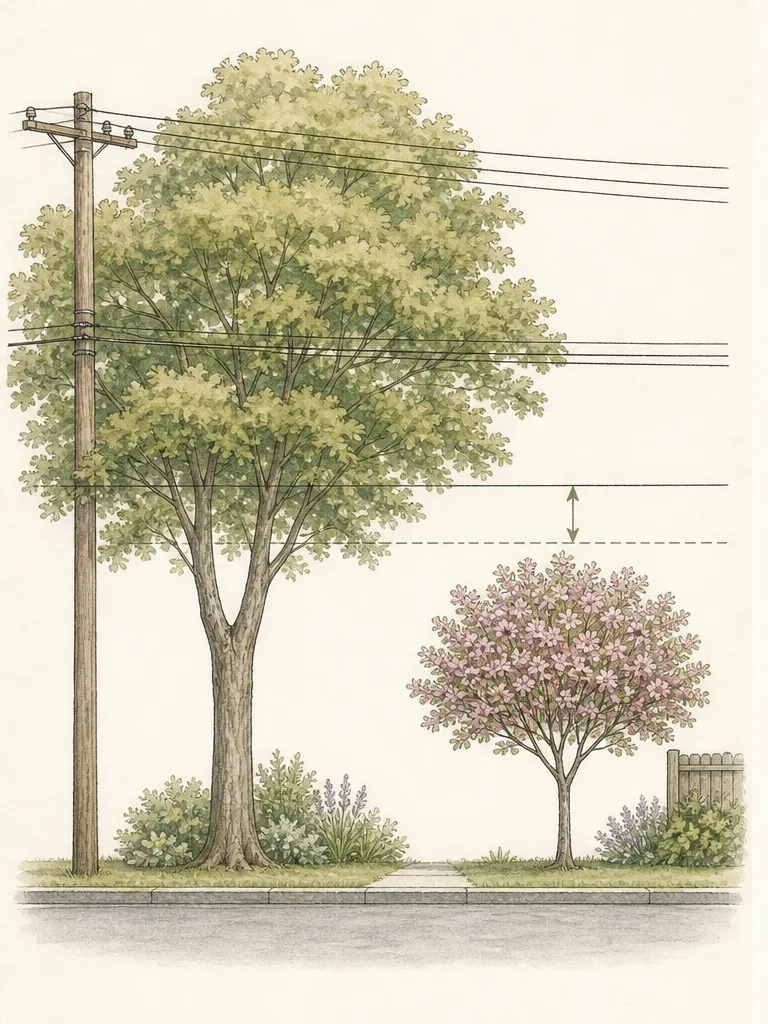
Mark the proposed trunk and measure available height and radius toward structures, paving, property lines, neighboring crowns, and utilities. Include the lower branch zone and the visible trunk area. Photograph the site from the primary winter viewpoint so the background and sightline remain part of the selection, not an afterthought at planting.
- 3Eliminate candidates that fail the site
Compare regional hardiness, summer conditions, light, drainage, soil limits, wind exposure, and root space with direct local guidance for each species or cultivar. Remove any tree whose mature envelope or cultural needs conflict with fixed conditions. This pass should leave only candidates that can grow normally without routine size containment or soil conditions the site cannot provide.
- 4Score bark and branching independently
For every viable candidate, note when mature bark character develops, which wood displays it, and how visible that wood will be. Then note the crown's natural direction, density, stem count, and age-related change. Independent notes keep dramatic bark from hiding an unsuitable spreading habit and keep an elegant silhouette from substituting for the winter texture you wanted.
- 5Compare real specimens from several angles
At the nursery, confirm identity and dimensions, step back to see the full crown, and walk around at least two specimens. Trace the leader or intentional stems, major branch unions, trunk surface, and root-flare area. Ask about any mark that might be damage rather than normal exfoliation. Decline stock whose current structure works against the mature habit in your brief.
- 6Reinsert the candidate into the site drawing
Use the documented mature height, width, and form of the exact taxon to redraw the envelope. Check path clearance, window and doorway views, background contrast, and access for ordinary care. If the drawing requires repeated pruning to preserve circulation or expose the bark, move the planting point or return to the candidate list.
- 7Record the mature promise
Keep a short record with the accepted mature dimensions, natural habit, bark-development expectation, cultural limits, and the source used. Add photographs of the selected specimen and empty site. This becomes the reference for planting and young-tree care, protecting the chosen architecture from later attempts to make the tree smaller or more symmetrical than its natural form.
Related reading
Sources
- Selecting, planting and caring for a new tree. Oregon State University Extension Service. Source record · Accessed 2026-08-20.
- Form: Match tree form to function. University of Florida IFAS. Source record · Accessed 2026-08-20.
- Paper-barked maple. The Morton Arboretum. Source record · Accessed 2026-08-20.
- Cornus kousa. NC State Extension. Source record · Accessed 2026-08-20.
- Common Stewartia: Stewartia pseudocamellia. NC State Extension Plant Toolbox. Source record · Accessed 2026-08-20.