Grow · living tabletop conifer post holiday acclimation
Acclimate a Living Tabletop Conifer After the Holidays
Move a living tabletop conifer out of the house without breaking dormancy: limit indoor display, re-stage it through an unheated shelter, and plant or overwinter it according to hardiness.
Published Last updated
In this guide
Read the tag before you promise the tree a future outdoors
A tabletop conifer sold for holiday decorating is a category, not a species. NC State notes that this market can include hardy plants such as dwarf Alberta spruce as well as Norfolk Island pine, false cypress, Italian stone pine, and even rosemary masquerading as a tiny tree. Some can be planted outdoors in suitable climates. Some cannot. Some may have been greenhouse-grown and therefore possess little immediate winter hardiness at all. Before you decide how to acclimate the plant after the holidays, read the tag for species name, hardiness zone, and any note about greenhouse production. Without that information, you do not yet know whether the next stop should be a cold garage, a spring planting plan, or a sunny indoor window.
Scale matters almost as much as identity. A tabletop plant feels modest because it sat on a sideboard, but species that are sold small are not always truly small in the landscape. Illinois Extension reminds readers that many evergreens eventually occupy a broad footprint, and NC State makes the same point with full-size living trees that outgrow the place where sentiment first planted them. If your plant is a genuine dwarf conifer, you may have a practical garden future for it. If it is simply a juvenile standard tree or a tropical substitute, the after-holiday plan changes. The best acclimation step is the one that fits the plant's real biology, not its holiday role.
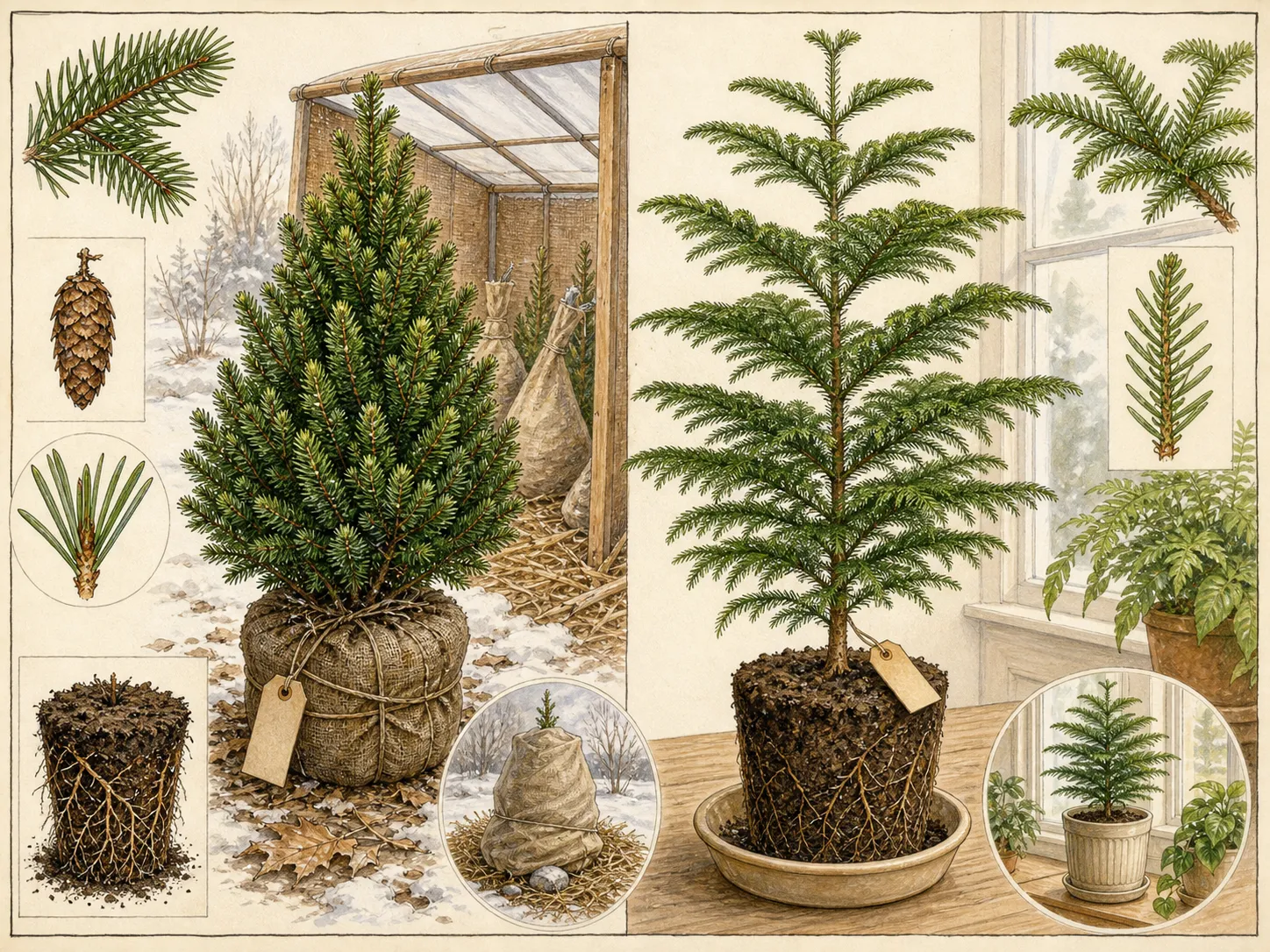
This identification step also protects you from a common mistake: treating all living holiday trees as hardy evergreens that should go back outdoors immediately. UNH is clear that dwarf Alberta spruce can serve as a miniature Christmas tree and later be planted in spring, but the same article treats Norfolk Island pine as a long-term houseplant. That is a completely different fate. The reader value here lies in making the tree legible before it becomes stressful. Once you know what it is and whether it is expected to live in your climate, the rest of the sequence becomes practical instead of hopeful.
Limit the indoor display to the tree’s tolerance
Every source in this set warns that the warm house is the narrowest window in the whole process. Illinois says trees should be indoors only four to five days total. UNH allows roughly seven to ten days. NC State says survival improves if the display lasts no more than about a week to ten days. The exact number varies, but the principle does not. Keep the indoor phase as short as you can. A living conifer is not a cut tree with unlimited holiday duty. The longer it remains in heated air, the more likely it is to lose dormancy and the harder it becomes to send it back into winter conditions safely.
Placement inside the house should therefore be chosen for coolness and stability rather than for theatrical prominence. NC State places living trees in a cool spot away from heat and direct sun, and UNH similarly recommends a cooler area away from heat sources. Use LED or other low-heat lighting. Keep the plant out of the airflow path of vents, fireplaces, and sunny radiator corners. The goal is to hold dormancy, not to wake the tree into a soft flush of new growth. If you see active growth beginning indoors, the acclimation options narrow because the tree has already started to leave winter behind.
This short indoor display can feel severe when the plant was purchased for festive use, but it is what makes the rest of the article possible. Once a living conifer has spent two or three warm weeks in the house, the gardener no longer has a gentle re-entry problem. They have a dormancy-break problem. The smartest response is to keep the celebration brief enough that the plant still behaves like a winter tree afterward. In practical terms, plan the move out before the decorations go on, not after the tree has spent ten nights by the dining room lights.
Water the root mass without drowning it
A living tabletop conifer can be lost by a single drying episode, but it can also be lost by being treated like a cut tree stand. NC State is unusually direct here: container and balled-and-burlapped trees need regular water but should not be flooded, and if a tub is used it should hold only a shallow amount of water rather than a brim-full reservoir. Illinois says container-grown trees drain efficiently and should be checked daily so the soil remains moist. UNH echoes the need to keep the roots moist during the staging period. The shared instruction is daily attention to moisture, not permanent saturation.
This is where the difference between root ball and display vessel matters. Use a saucer, tub, or leak-proof outer container to protect floors, but do not confuse that protection with a standing pond. If water collects beneath the pot, let it be shallow and temporary. Some sources mention stones or support material beneath the ball to keep roots from sitting directly in water, which is a good mental model even for small container-grown trees. Moisture must be available; oxygen must still reach the roots. If the plant is wrapped in plastic or decorative fabric, keep the top open and make sure you can still inspect the medium instead of guessing through presentation materials.
The indoor check should be tactile and specific. Lift the pot. Touch the medium. Look for a root ball that is drying at the outer edge while the center stays wet, or a tiny container that dries faster than its holiday appearance suggests. Tabletop trees are especially vulnerable because the containers are often small and rootbound. The plant may look substantial above the soil and still have very little moisture reserve below it. Daily checking is not overcare here. It is the difference between a living holiday tree and a plant that quietly crossed the point of no recovery while the ornaments still looked perfect.
Use an unheated shelter as the re-entry chamber
After the holiday, the best next location is usually neither the living room nor the open yard. UNH recommends moving the tree to an unheated structure such as a shed, garage, or similar shelter for the rest of the winter when planting is not sensible yet. NC State likewise recommends an unheated protected area if the ground is frozen when the tree must move back out. Illinois emphasizes timing and even suggests preparing the site in advance for larger plantings. For a tabletop tree, the essential concept is the same: transition the plant back into winter through a cool protected holding zone before asking it to face wind, hard freezes, or spring planting.
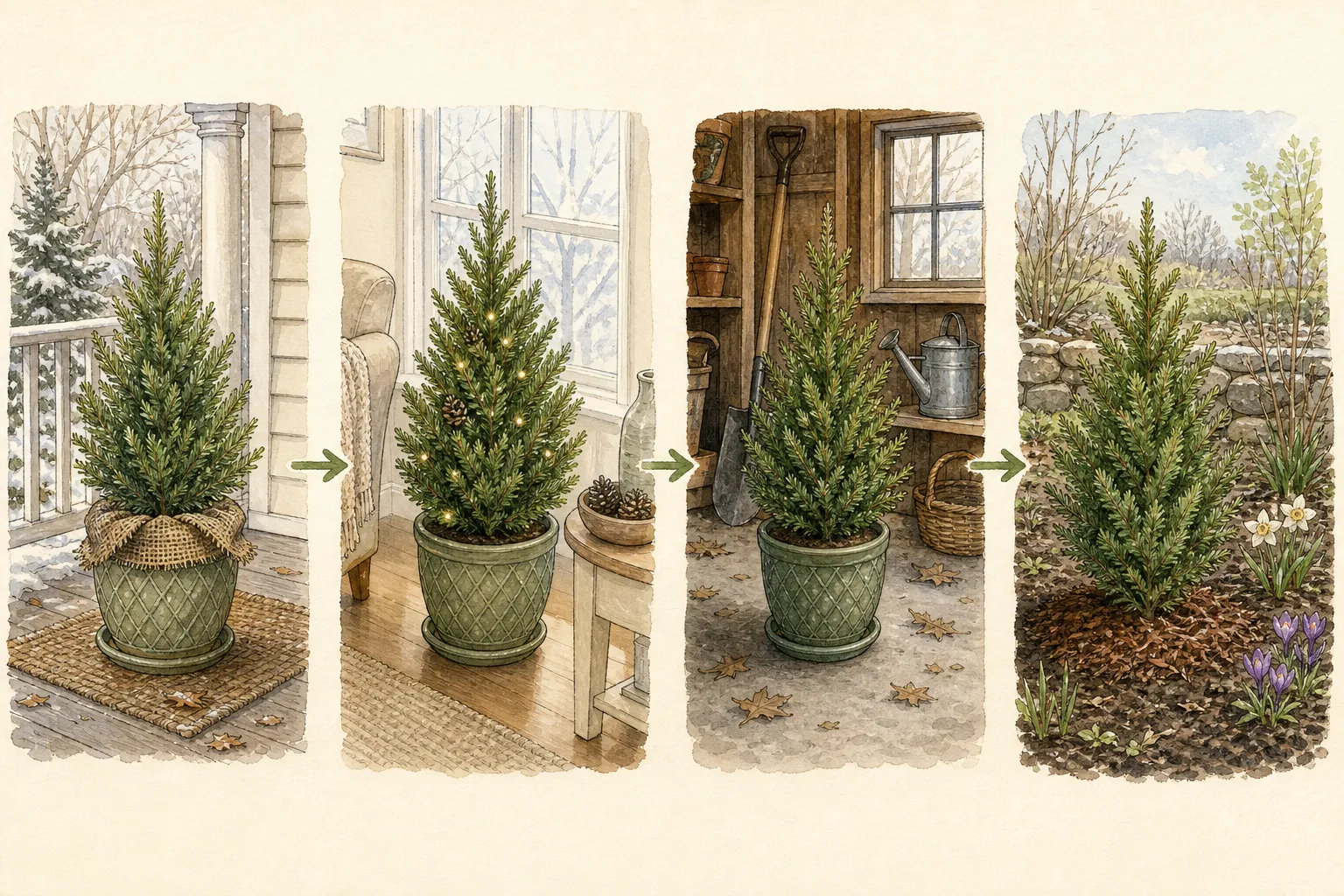
That holding zone serves several purposes at once. It keeps the plant colder than the house, but less exposed than the open landscape. It buffers wind, which can desiccate foliage when roots are not fully functional. It also buys time when the soil is frozen or the date is simply too late in winter to expect immediate planting success. A garage or shed is not glamorous, but it is horticulturally honest. If no structure exists, UNH advises a protected site out of prevailing winds with the root system mulched. That is second-best, but still much better than shuttling the tree directly from a bright room into a freeze.
Keep watering during this holding period, though less heavily than a plant sitting in house heat. Cold roots use less water, but they do not want to become dust dry. Check periodically and maintain slight moisture. If the species is tender or greenhouse-grown and lacks winter hardiness, this is also the stage where you decide whether it must remain protected until spring or whether it is better handled as a permanent indoor plant. Re-entry is not a single dramatic move. It is a protected stage whose whole point is to make the eventual outdoor life possible.
Plant only when the species and season agree
Immediate planting after the holidays is not automatically the most virtuous choice. UNH explicitly warns against assuming a late-season planting is wise just because the tree is available and the hole can technically be dug. Spring planting after the soil has thawed and dried is often the safer path for tabletop evergreens that spent some time indoors. Illinois also describes site preparation and planting depth in terms that are far more realistic once the weather has moderated. If you are looking at a frozen root ball, a frozen planting site, or a species that was greenhouse-grown, waiting in protected cold storage is not failure. It is alignment with the plant's actual chances.
When planting time does come, site by species and mature size, not by sentiment. Hardy dwarf Alberta spruce may fit a formal small planting well. A plant sold as a tiny standard spruce or fir may want far more room than a front bed can honestly give it. Illinois reminds readers that many evergreens ultimately reach significant width and height, while NC State points out that some species widely sold as living holiday trees are poorly adapted outside specific regions. Plant adapted species at grade with the root flare at or slightly above surrounding soil, water them in thoroughly, and use mulch to moderate root conditions rather than piling soil against the trunk.
This is also the point where container versus landscape futures split cleanly. A true hardy dwarf conifer may live outdoors permanently once established. A tender species or a nonhardy novelty may instead need to remain a container plant that goes outside only in frost-free weather. The article's title uses the word acclimate on purpose. The plant does not owe you one destiny because it wore ornaments in December. Good acclimation ends with the right life for the right species, not with a universal rule that every tabletop tree belongs in the ground immediately after the holiday.
Monitor establishment through the first growing season
The tree's real test begins after it is planted or moved into its correct long-term container life. Illinois describes the first season after planting as important to long-term success, with regular watering as needed once spring comes. NC State similarly treats watering, mulching, and establishment care as the work that turns a holiday survivor into a landscape plant. Do not assume that a tree which made it through the holiday transition is ready for neglect. New conifers, especially those that spent time indoors and arrived in small containers, need a steady first season more than they need nostalgia.
Mulch is useful, but mulch is not a substitute for water. Keep it off the trunk and use it to moderate soil temperature and moisture around the root zone. If the plant is in a windy place, secure it in a way that protects the root ball rather than abrading the bark. Delay fertilizing until the plant is actually established and growing, particularly if the root system was stressed. This is another reason not to rush planting into impossible winter conditions. The plant needs to enter establishment season with enough root function left to respond when spring asks it to grow.
If the larger goal is a reusable holiday tree every year, separate that ambition from the biology of a hardy conifer. Repeated indoor display is easier with true houseplant substitutes than with outdoor conifers whose dormancy you keep interrupting. A tabletop dwarf Alberta spruce can make the transition once and become a garden plant. A Norfolk Island pine can remain indoors for years if treated as a houseplant. Trying to make one plant satisfy both roles over and over often produces a stressed compromise. Good acclimation ends when the plant's post-holiday life is clearer, healthier, and less theatrical than its holiday role.
Steps
- Level
- moderate
- Time
- A short indoor display followed by protected re-staging and later planting or spring holdover
- Tools
- Plant tag or label record, Saucer or watertight tub, Mulch, Optional unheated garage or shed
- Materials
- Living tabletop conifer or other tagged living holiday tree
- 1Identify the plant before moving it again
Read the species name and hardiness information on the tag. Separate hardy outdoor conifers from tender or greenhouse-grown substitutes before deciding whether the plant belongs in a cold shelter, a spring planting plan, or ongoing houseplant care.
- 2End the indoor display early
Keep the tree indoors only for a brief holiday display. Extension guidance ranges from about four or five days to roughly a week or ten days, but every source warns against extended warm indoor exposure.
- 3Hold it in the coolest bright indoor spot possible
While it is inside, keep the plant away from heat sources and direct hot sun, and use low-heat lights if it is decorated. The entire point is to preserve dormancy, not to stimulate growth.
- 4Check moisture daily
Keep the root ball evenly moist but never waterlogged. Use a saucer or tub to protect surfaces, but do not let the roots sit in deep standing water or assume a decorative wrap tells you anything about moisture inside the root zone.
- 5Move it to an unheated protected shelter after the holiday
Shift the plant to a garage, shed, enclosed porch, or another cold protected area so it can return to winter gradually. If no shelter exists, place it out of prevailing wind and mulch the root system well.
- 6Plant only when season and species allow
If the tree is hardy, adapted, and the soil is ready, plant at the correct depth with the root flare at grade and water it in well. If the season is too late or the species is tender, hold it protected until spring instead.
- 7Give the first growing season to establishment
Water regularly through the first season, mulch sensibly, and avoid treating the plant like a finished landscape specimen right away. Check the root zone during dry spells rather than watering by calendar alone. A holiday tree becomes a real garden plant only after it survives establishment care.
Related reading
Sources
- Selection and Care of Living Christmas Trees. NC State Extension Publications. Source record · Accessed 2026-08-19.
- Living Christmas Trees. University of New Hampshire Extension. Source record · Accessed 2026-08-19.
- How to care for a living Christmas tree. Illinois Extension. Source record · Accessed 2026-08-19.