Gardens · peony border post bloom structure
Design a Peony Border That Holds Its Shape After Bloom
Build a peony border around permanent foliage, discreet early support, mature crown spacing, working access, and companion plants that carry the composition beyond June.
Published Last updated
In this guide
- Draw the border after the flowers are gone
- Check summer companion growth against the peony service route
- Place crowns for light, drainage, and longevity
- Install support before stems lean
- Build a sequence around peony foliage
- Use one measured central Iowa composition
- Keep water and air moving through the planting
- Protect the foliage that supports next year
- Plan division and the winter outline
- Design ideas
Draw the border after the flowers are gone
Design the border from its July foliage and winter outline as carefully as from its peony week. Mark the main view, path, irrigation, permanent grass, and every long-lived crown. A peony can hold a broad middle layer for months after flowering, but its herbaceous stems disappear after frost. The plan therefore needs a low edge, later flowers, and a durable vertical rhythm that does not depend on peony bloom.
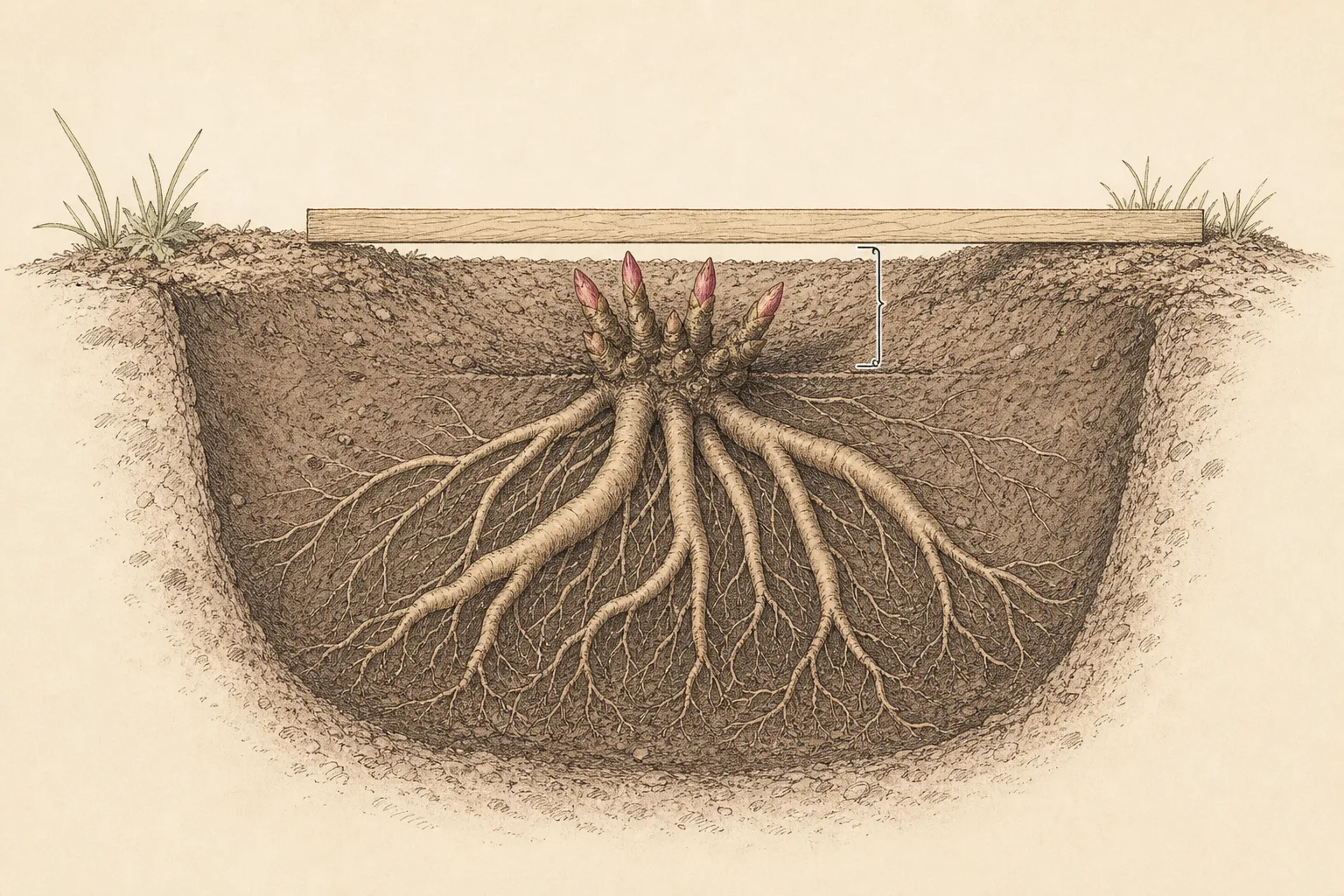
Draw each named peony as a mature circle. RHS advises about 1 metre, or 3¼ feet, between herbaceous peonies, while Iowa guidance commonly places the buds only 1 to 2 inches below the surface. A small bare-root division should not invite a temporary filler into its future canopy. Keep the eventual spread clear of the path and preserve access for a support ring, deadheading, foliage inspection, and autumn sanitation.
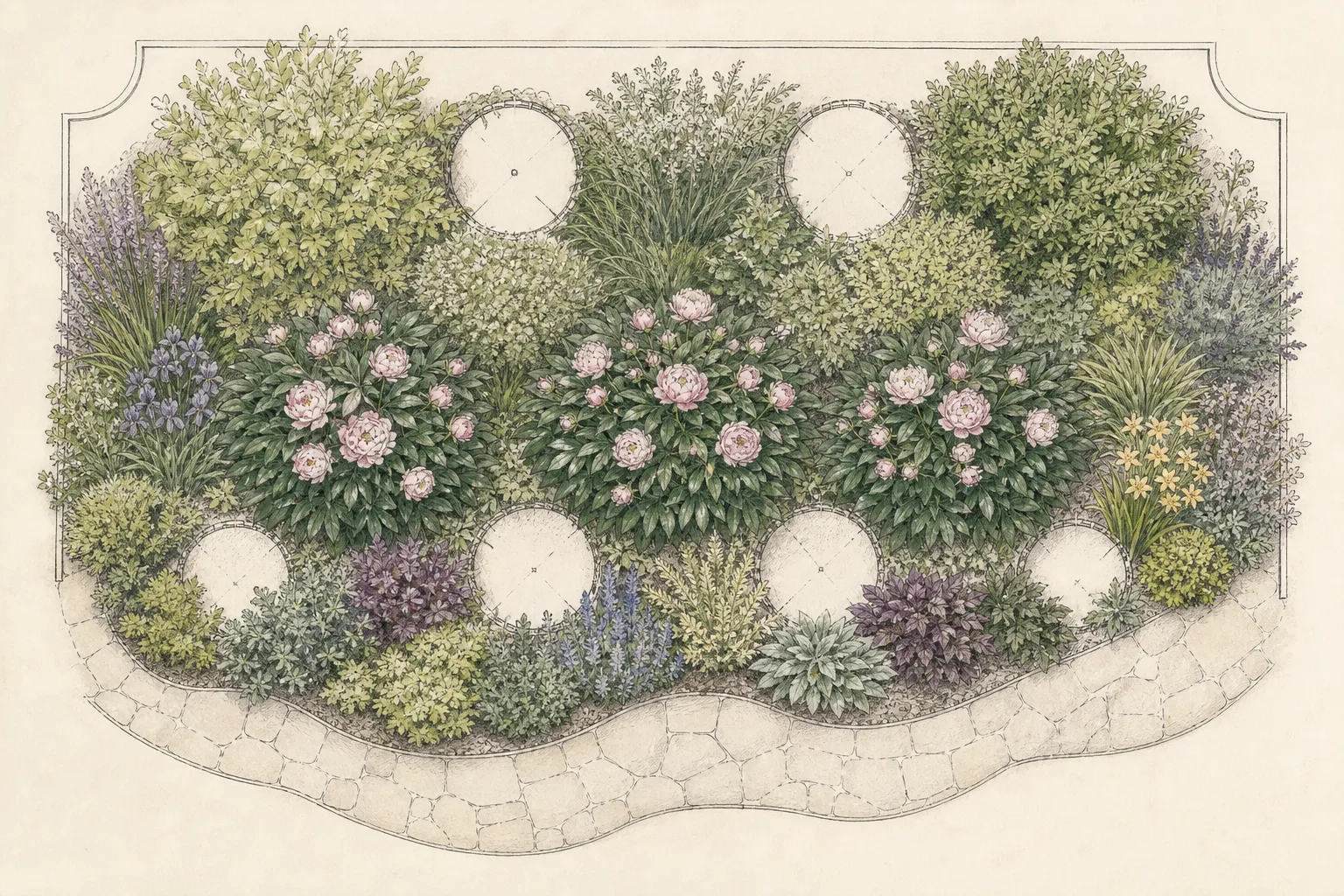
Treat open mulch as useful space. A visible crown edge helps the gardener judge grade, moisture, emergence, and disease. It also keeps companion roots and stems from sealing the center of a long-lived clump. Repeat peonies in a measured rhythm, then use companions beyond those circles. Dense first-season planting usually erases the working spaces the mature border will need.
Check summer companion growth against the peony service route
Use the central Iowa composition's full peony circles and maintenance access before placing companions. Keep foliage and crown space available after flowering, when the peonies still occupy the bed. A later plant can carry the display without covering those bases. If the mature combination closes a stepping spur or crowds a crown, reduce or move the companion before increasing the planting count.
Place crowns for light, drainage, and longevity
For the central Iowa example below, choose a site with at least six hours of direct sun, good air movement, and soil that drains after rain. Iowa State links those conditions with flowering and lower foliar-disease pressure. Avoid roof discharge, a winter puddle, or the expanding root zone of a large tree. Peonies can remain in place for many years, so correct drainage and access before setting the crowns.
Follow the closest regional depth recommendation. Iowa State places bare-root buds 1 to 2 inches below the soil surface; RHS gives a shallower maximum of about 1 inch for its UK audience. Those values should remain attached to their regions, not averaged. In the Iowa plan, set the uppermost buds within the Iowa range after the soil settles and prevent later mulch or top-dressing from gradually burying them.
Prepare a broad, continuous bed rather than pockets of soft amended soil inside compacted ground. Set labels just outside the crown circle and keep them readable after foliage expands. Water new plantings through their first season as conditions require, checking the root zone instead of the surface alone. Established clumps still need moisture during dry periods, yet consistently saturated soil falls outside the well-drained conditions described by both Iowa State and RHS.
Install support before stems lean
Heavy double blooms can pull otherwise healthy stems outward after rain. Iowa State recommends installing metal grids early, when plants are only a few inches tall, and placing peony rings as leaves begin to unfurl. Set a hoop at roughly half the mature plant height or slightly lower. That position lets stems keep a natural spread while the foliage grows through and conceals the frame.
Match the support to the cultivar's full circle. A narrow ring can make a mature three-foot peony look pinched, reduce air movement, and force stems against wire. Keep legs beyond the visible eyes and insert them gently so they do not pierce the crown. For a very heavy flower, a wider grid or a few soft individual ties above the ring may carry the outer stems better than tightening the entire plant.
Inspect the frame before buds open and again after the first soaking rain. Raise a low grid while stems still move freely; later wrestling can snap a budded stem. Soft ties should form a loose figure eight around stake and stem, following Iowa State's guidance. After autumn cutback, lift reusable rings straight up, clean away debris, label their diameter, and store them so the correct size returns to each crown next spring.
Build a sequence around peony foliage
Use the peony leaves as a calm middle plane after deadheading. The broad divided foliage can frame finer plants, but companions should begin beyond the mature crown and support footprint. A low front layer keeps the path edge alive, a late-spring bridge overlaps the peonies, and an upright grass carries late summer through winter. Repetition makes these layers readable when no peony flower remains.
Amsonia tabernaemontana 'Storm Cloud' supplies the bridge. Missouri Botanical Garden records 2 to 3 feet of height and spread, with late-spring blue flowers and yellow autumn foliage. In full sun it often holds without staking. Place it behind or between peony groups where its full width does not shade a crown. Confirm local suitability before using it outside the conditions described by the retained plant profile.
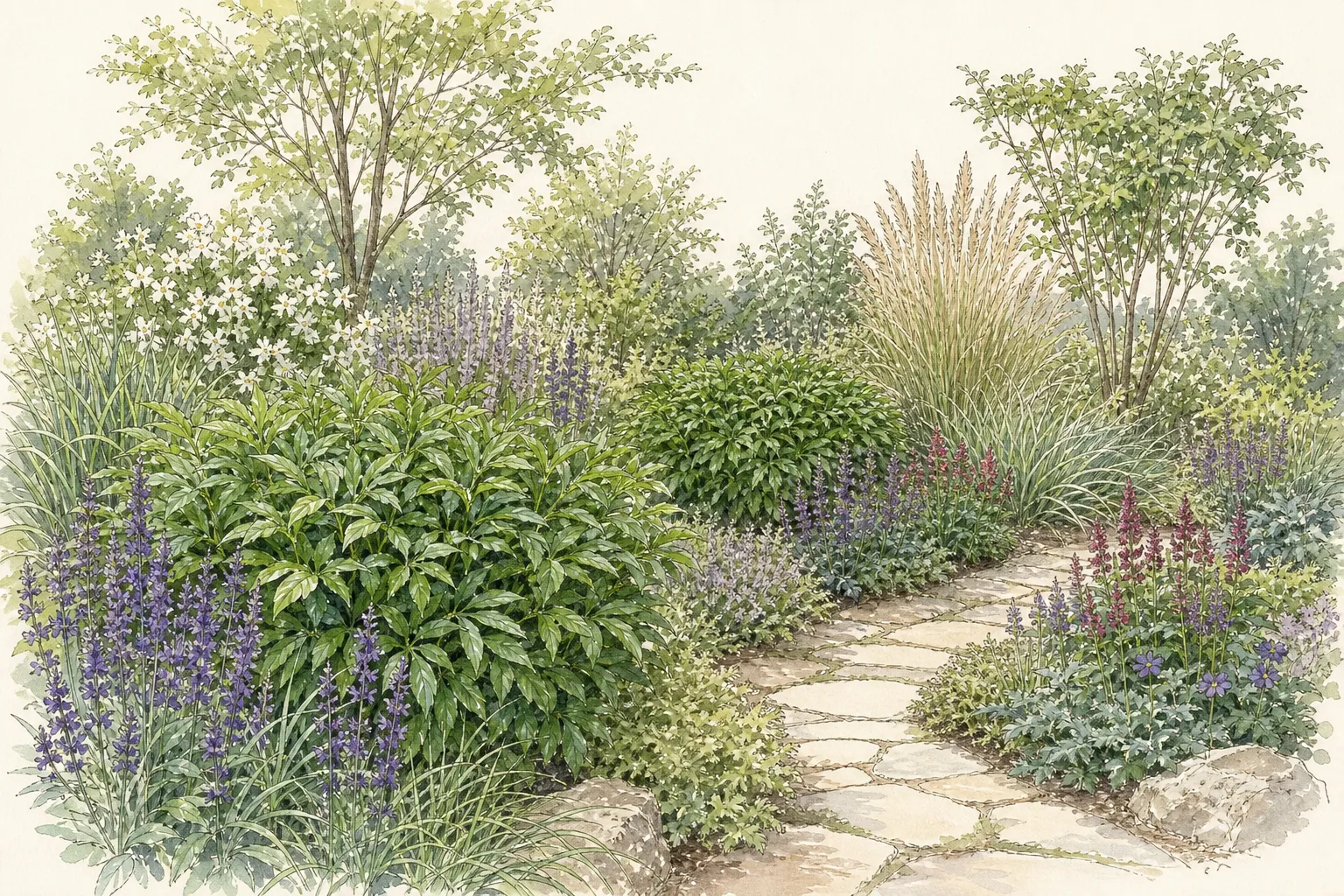
Geranium 'Rozanne' makes a 1- to 1½-foot-high, 1- to 2-foot-wide foreground according to NC State, with violet-blue flowers from late spring through much of summer. Panicum virgatum 'Northwind' forms a 4½- to 5-foot vertical, about 2½ to 3 feet wide, with late-season panicles and standing winter foliage. Draw both at maximum width and leave breaks in the geranium edge for hands and feet.
Use one measured central Iowa composition
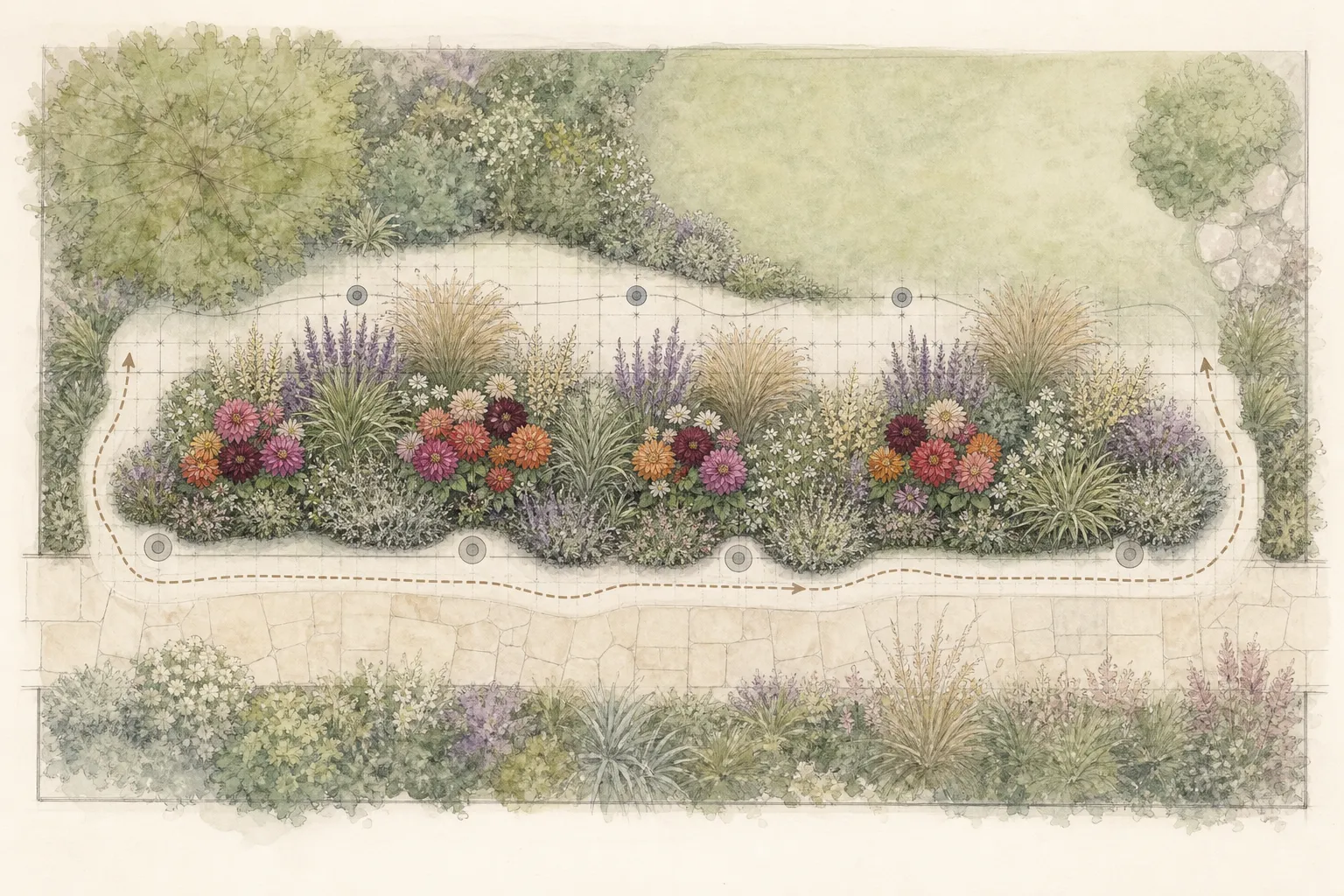
The worked border is 28 feet long and 12 feet deep in cold-winter central Iowa. It faces south, receives more than six hours of sun, has well-drained loam, and can be watered during establishment and summer drought. A public path borders the south edge. A 24-inch service strip occupies the north edge, with two fixed stepping spurs reaching the peony line. This plan is not for wet soil, deep shade, or a winter without adequate cold dormancy.
Place six peonies in a staggered middle row on 4-foot centers, two each of 'Coral Charm', 'Festiva Maxima', and 'Sarah Bernhardt'. Allocate every plant a circle at least 3¼ feet across. RHS describes 'Coral Charm' at up to 90 centimetres high and 0.5 to 1 metre wide, with salmon-pink flowers that change toward orange and yellow in late spring or early summer. Use it at the earlier end of the sequence.
Follow with 'Festiva Maxima', an RHS-listed plant to about 95 centimetres with a 0.5- to 1-metre spread and fragrant double white flowers flecked crimson. End the sequence with 'Sarah Bernhardt'. Missouri Botanical Garden records this late cultivar at 2½ to 3 feet high and wide, with fragrant double pink flowers around May to June in St. Louis. Calendar dates will shift in Iowa, so preserve the relative sequence and verify local nursery performance.
Set three 'Storm Cloud' amsonias behind the peony row, centered in the wider gaps and outside all crown circles. At the back corners and center, use three 'Northwind' switchgrasses at their full 3-foot width. Run five 'Rozanne' geranium groups along the front, leaving the two stepping spurs open. The sequence becomes amsonia and peony in late spring, geranium through summer, broad peony leaves as the middle mass, amsonia yellow and grass panicles in autumn, then tan grass in winter.
Support the double peonies with broad grow-through rings installed at emergence. Keep a mulch inspection band around each crown, and position drip outlets where they can be reached from a spur. Deadhead from the path side, then inspect the rear leaves from the service strip. In autumn, remove peony foliage after frost and sanitation checks while leaving sound 'Northwind' stems until late-winter cutback. The two access directions prevent care from becoming a reach across other crowns.
Substitutions must preserve more than color. A peony replacement needs comparable mature width, relative bloom timing, and support demand. A grass must stay clumping, fit the 3-foot bay, remain upright in the site's soil, and be acceptable under current local invasive and fire guidance. A front perennial must tolerate full sun and the bed's moisture while staying low enough to expose peony bases. If those conditions are unverified, leave the position open.
Keep water and air moving through the planting
Water at soil level when the root zone needs moisture, especially during establishment and dry early-season growth. Keep emitters visible and prevent the geranium edge from deflecting water away from a peony. A ring of wet foliage after every irrigation increases leaf-wetness time, while a buried emitter can leak unnoticed. The service route should allow a hand to check soil and a clear view of every outlet.
Maintain gaps between mature foliage masses instead of tying neighboring plants together. Iowa State recommends good air movement around peonies, and both Botrytis and other fungal problems are associated with cool, wet conditions. Remove affected buds or dead diseased tissue according to current local diagnostic guidance. Sound green leaves remain valuable after bloom, so sanitation should target confirmed damage rather than converting summer cleanup into a full cutback.
Feed only for a demonstrated need. Iowa State notes that excessive nitrogen can promote foliage at the expense of flowers. A soil test can identify nutrient or pH corrections without turning each planting hole into a rich pocket. Apply mulch across the bed to moderate moisture, then keep it from accumulating over peony buds. Recheck depth each spring because compost and repeated mulch layers can slowly change the effective crown grade.
Protect the foliage that supports next year
After petals fall, remove the spent flower at a useful leaf junction and retain the leafy stem. Iowa State warns that cutting peony foliage in July or August weakens the plant and can reduce future flowers. Leave healthy leaves until the first frost in its Midwest guidance. The companion sequence is responsible for carrying later color; the peony should not be stripped because its green mass seems quieter than June bloom.
Inspect foliage from both sides of the row. A few late-season powdery leaves do not justify removing an entire healthy canopy, while dead buds, collapsed tissue, or spreading lesions may need diagnosis and sanitation. Use clean tools and collect diseased debris away from the crown. If a plant repeatedly falls across the path, review support diameter, light, and mature spacing before cutting green stems merely to regain clearance.
Let 'Rozanne' and 'Northwind' carry motion around the peony leaves. Shear a front geranium only when it closes a stepping spur or when plant-specific care calls for it. Keep amsonia in full sun so its habit remains compact. The design works when peony foliage can stay intact without appearing abandoned, because later bloom and finer texture continue around it rather than asking the peony to flower all season.
At frost, cut dead peony stems near the ground and remove the material from the crown area. Clean reusable support rings before storage. Leave labels and the crown inspection band visible, then check that winter mulch has not buried the eyes. Grass stems may remain where they stand safely and local guidance allows, giving the border height until their late-winter or early-spring cutback.
Plan division and the winter outline
Healthy peonies can remain undisturbed for many years, so division is a response to relocation, propagation, or a specific crowding problem rather than routine border grooming. Iowa State places peony transplanting in September for Iowa and warns that moved plants may take two or three years to flower well again. Prepare every receiving hole and label before lifting, then reset the buds at the regional 1- to 2-inch depth.
Open access controls whether division can be done without damaging neighbors. Lift from the service strip or a stepping spur, keeping the fork beyond the crown center and the amsonia roots. Move companion foliage aside with soft ties only for the work period. If the mature plan has no route for a fork and a broad fleshy root mass, relocate the conflicting front layer before deciding that the peony itself is too large.
After peony stems are gone, the three 'Northwind' clumps describe the upper rhythm and the path plus mulch circles reveal the lower geometry. Amsonia and geranium are also herbaceous, so they cannot supply permanent winter mass. Where a site needs evergreen weight, add it outside this measured composition only after documenting mature size, light, soil, snow load, and local suitability. Do not squeeze an evergreen into a peony or service circle.
Review the same path and window views at bloom, in August, and after frost. A revision is warranted when a named role fails: a grass repeatedly flops, a geranium closes access, a support is too narrow, or an amsonia shades a peony. Preserve successful empty space. Adding a new plant to every winter opening would reverse the mature-spacing work that allows the border to stay healthy and serviceable.
Design ideas
- Style
- Layered ornamental planting with legible seasonal structure
- Space
- Home ornamental garden bed, border, courtyard, or seasonal container
- Climate
- The worked plan is for a sunny, well-drained central Iowa border with cold winter dormancy, humid summers, and supplemental water during establishment and drought. Wet, deeply shaded, hotter, or low-chill sites require different taxa and spacing.
- 1Repeat peonies in measured groups
Place two each of 'Coral Charm', 'Festiva Maxima', and 'Sarah Bernhardt' on 4-foot centers, giving every crown at least a 3¼-foot circle. The order moves from coral toward white and late pink while the repeated leaf form stays coherent. Another cultivar may enter only after its mature spread, relative season, support demand, and Midwest performance are confirmed.
- 2Frame with permanent shrubs
Use three 'Storm Cloud' amsonias as the late-spring bridge behind the peonies, each allotted up to a 3½-foot spread. Their fine leaves and yellow autumn color extend the border after bloom. Keep them in strong light and outside peony circles; a shade-loosened plant that needs repeated staking no longer serves this measured role.
- 3Thread early bulbs between access zones
If spring bulbs are added, place them in mapped pockets between access spurs and beyond the peony's crown and support circle. Choose named bulbs suited to the local climate and leave their foliage until plant-specific guidance permits removal. Bulbs are optional in this plan; an unverified mix should not occupy the only open ground needed for crown inspection.
- 4Add a fine-textured summer layer
Place three 'Northwind' switchgrasses in the rear band at their documented 2½- to 3-foot width. Their narrow columns and late panicles rise above broad peony foliage, then remain as winter silhouettes. Reject this grass where local invasive guidance, fire rules, rust pressure, shade, or rich wet soil compromises its fit and select a locally proven clumping vertical instead.
- 5Reserve discreet stepping points
Run a 24-inch service strip behind the bed and two firm stepping spurs through the planting. These are maintenance dimensions for this private garden, not accessible-route standards. Keep ring legs, emitters, and companion crowns outside the pads. A gardener should reach every peony from one of the three routes without standing on a fleshy root crown.
- 6Repeat late flowers beyond the crowns
Repeat five Geranium 'Rozanne' groups along the front, preserving its 1- to 2-foot width and leaving gaps at both stepping spurs. Violet flowers continue after the peonies while the mound hides none of their centers. Trim a group that crosses access, and relocate it if yearly control becomes necessary; the edge should remain a sequence, not a continuous mat.
- 7Use one support language
Fit broad dark grow-through rings to the double cultivars as the shoots emerge, setting each near half the mature plant height. Use the same finish throughout the row so hardware recedes. Label ring diameter at autumn storage, since returning a narrow frame to a wide crown causes more trouble than a visible but correctly scaled support.
- 8Keep a winter framework
After frost, let the rear grass rhythm and clear path geometry carry the border while the peony circles rest as open mulch. Remove diseased peony foliage and store rings, but leave sound grass stems where local conditions allow. Add an evergreen only outside all mature circles after its full size, light, moisture, snow, and local-use limits have been verified.
Related reading
Sources
- How to grow herbaceous and intersectional peonies. Royal Horticultural Society. Source record · Accessed 2026-08-30.
- Paeonia 'Coral Charm'. Royal Horticultural Society. Source record · Accessed 2026-08-30.
- Paeonia lactiflora 'Festiva Maxima'. Royal Horticultural Society. Source record · Accessed 2026-08-30.
- How and where do I plant peonies?. Iowa State University Extension and Outreach. Source record · Accessed 2026-08-30.
- Reasons Why Peonies Fail to Bloom. Iowa State University Extension and Outreach. Source record · Accessed 2026-08-30.
- Staking Perennials. Iowa State University Extension and Outreach. Source record · Accessed 2026-08-30.
- Paeonia lactiflora 'Sarah Bernhardt'. Missouri Botanical Garden. Source record · Accessed 2026-08-30.
- Amsonia tabernaemontana 'Storm Cloud'. Missouri Botanical Garden. Source record · Accessed 2026-08-30.
- Geranium 'Rozanne'. NC State Extension Gardener Plant Toolbox. Source record · Accessed 2026-08-30.
- Panicum virgatum 'Northwind'. NC State Extension Gardener Plant Toolbox. Source record · Accessed 2026-08-30.