Gardens · dahlia border hidden support permanent matrix
Design a Dahlia Border with Hidden Support and a Permanent Matrix
Plan dahlias as seasonal vertical color within a permanent ornamental framework, with early concealed supports, irrigation, lifting access, mature spacing, and an autumn exit.
Published Last updated
In this guide
Draw permanent structure before seasonal color
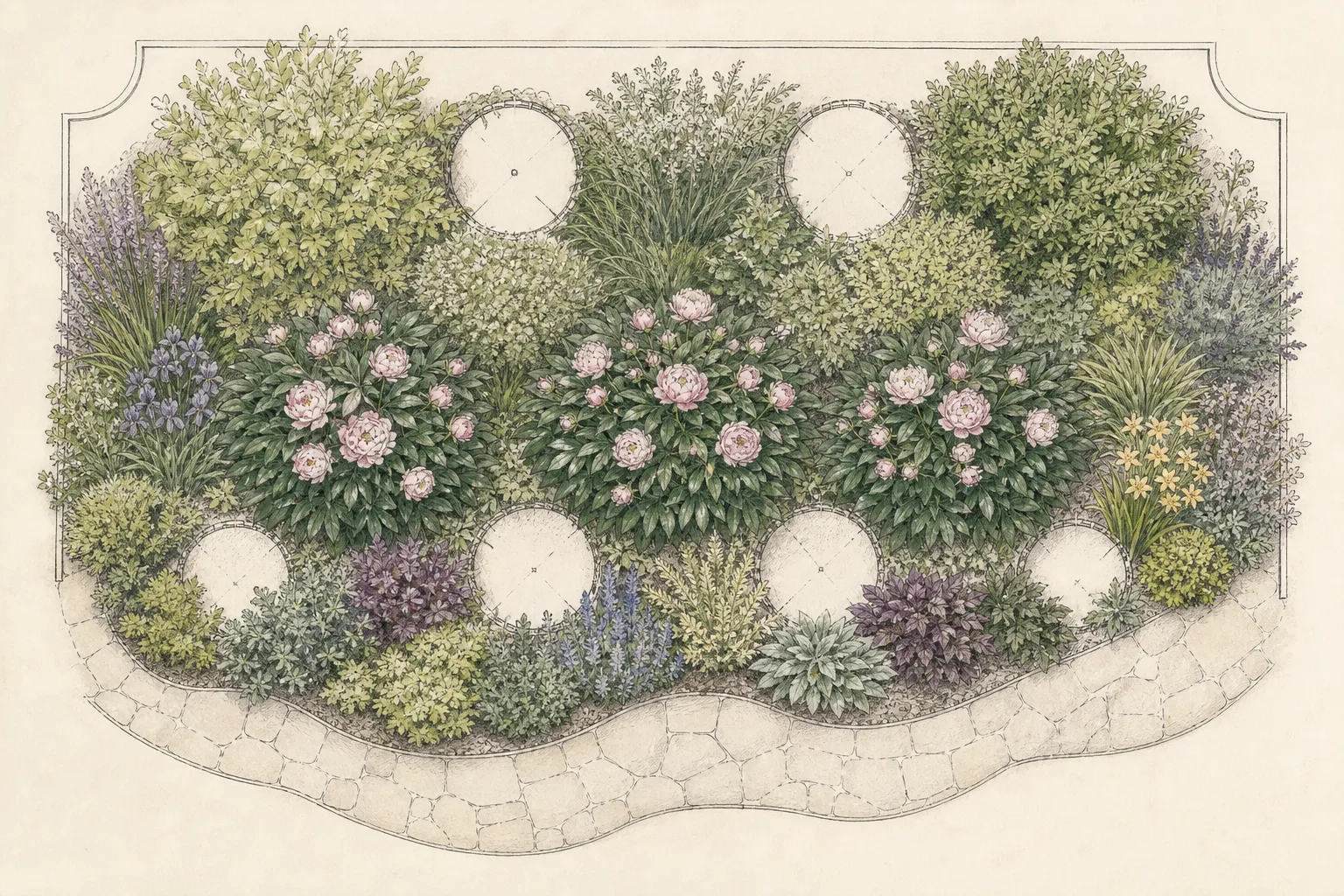
A dahlia border reads well when the tubers occupy planned summer positions inside a framework that survives their absence. Draw the public path, service route, irrigation line, permanent crowns, and winter silhouettes first. Then mark each dahlia at its documented mature height and maximum spread. The empty circles left after lifting are part of the drawing, because a border that depends on dahlia foliage for every edge and vertical line disappears after frost.
Separate the planting field into three layers. A narrow permanent back layer carries upright grass and gives the eye a winter rhythm. The middle layer contains the tallest dahlias and their supports. A low front layer masks bare soil without growing across the tuber stations. Leave deliberate openings between those layers for a foot, watering wand, labels, and a digging fork. Hidden support succeeds through early placement, while usable access depends on space that remains open in August.
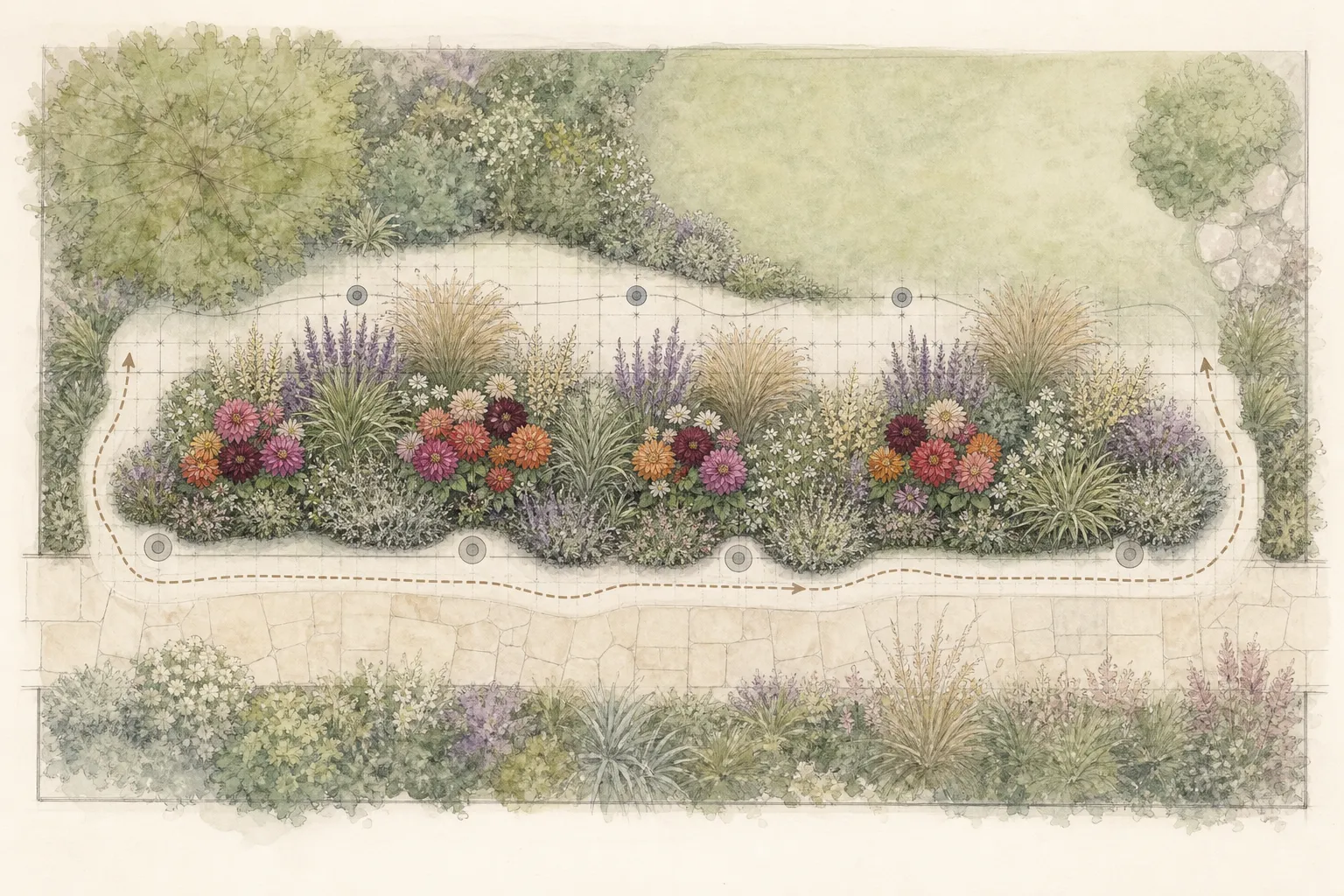
Scale the plan from named cultivars, not from dormant tubers or spring pots. RHS places 'Molly Raven' at 1 to 1.5 metres high and 0.5 to 1 metre wide. It lists 'Rainbow Silence' at the same height and up to 0.5 metre wide, while 'Tangerine Gem' reaches 0.5 to 1 metre high and up to 0.5 metre wide. Those broad ranges require generous circles and room for wind movement, even where nursery stock looks compact.
Match cultivar and site
Dahlias need a warm, sunny, sheltered position and fertile soil that stays moist while draining freely. RHS advises at least 60 centimetres, or 2 feet, between plants and more for large cultivars. Oregon State gives the same approximate spacing for Oregon gardens. Place each tuber where that minimum circle can remain open after companions mature. Reflected heat, a roof rain shadow, or a low wet pocket can make two positions in the same bed behave differently.
Choose flower size and stem habit with the support method already in mind. A 1.5-metre plant carrying broad double flowers needs a taller, better-anchored structure than a 75-centimetre single-flowered cultivar. The RHS trial also evaluated stem strength, flowering season, foliage quality, and disease resilience, so its height data describe plants observed in a specific Wisley trial rather than guaranteed Oregon performance. Confirm availability and local behavior before ordering a whole repeated group.
Inspect new stock before it joins an established collection. Firm tubers need an intact neck and at least one eye; distorted, stunted, or strongly mottled growth deserves isolation and diagnosis. Oregon State advises discarding plants and tubers affected by bacterial or viral disease because the living storage tissue can carry the problem. Keep the cultivar name attached from planting through storage, since a color memory is unreliable once frost has removed the flowers.
Work through a frost-prone Oregon valley plan
This worked composition is for a 24-by-12-foot bed in a frost-prone Oregon valley garden. It assumes full sun, shelter from the strongest wind, well-drained soil, summer irrigation, and a cool frost-free storage place. The main path runs along the south edge. A 24-inch private service strip runs along the north edge, with two firm stepping spurs entering the planting. This is not a coastal, high-desert, or permanently wet-soil prescription; those settings need different moisture and overwintering decisions.
At the back, place two Panicum virgatum 'Northwind' crowns near the outer thirds, outside every dahlia digging circle. NC State gives this upright grass a mature size of about 4 feet 6 inches to 5 feet high and 2 feet 6 inches to 3 feet wide. Draw the full 3-foot widths. The grasses supply narrow summer columns, tan autumn color, and standing winter structure, then receive their annual cutback in late winter or early spring.
Set three Dahlia 'Molly Raven' plants in the rear half on 5-foot centers. Its RHS range of 1 to 1.5 metres high and 0.5 to 1 metre wide makes it the dark-foliaged, coffee-pink upper canopy. In front, offset three 'Rainbow Silence' plants on wider 6-foot centers. Their salmon-red double flowers and height approaching 1.5 metres continue the vertical rhythm while the stagger keeps stems from forming a solid wall.
Use five 'Tangerine Gem' plants as a lower, dark-leaved sequence nearer the path, each allocated at least a 2-foot circle. RHS describes it at roughly 75 centimetres high in trial and up to 0.5 metre wide, with orange single flowers from summer to frost. Its profile marks the name status unresolved, so retain the nursery label and verify the supplied identity. Repeat nine Allium 'Millenium' in three groups outside the dahlia circles. NC State lists these at 1 to 1.5 feet high and 10 to 15 inches wide, flowering in mid- to late summer.
Finish the front edge with five Geranium 'Rozanne', drawn at the NC State range of 1 to 1.5 feet high and 1 to 2 feet wide. Its violet-blue flowers begin in late spring and may continue through much of summer, so it holds the low plane before the dahlias peak. Keep every geranium outside the marked lifting radius and cut back only growth that crosses a stepping spur. The result has spring foliage, early-summer geranium, midsummer allium, dahlias through frost, and grass structure after lifting.
These substitutions have firm limits. Replace a named dahlia only with one whose mature height, spread, flower weight, and local season fit the same support bay. Replace 'Northwind' where local invasive guidance, rust pressure, fire-safety rules, or soil moisture make it unsuitable. A front-edge perennial must share full sun and irrigated, freely draining soil without forming a dense crown over tubers. Similar color alone does not preserve the composition.
Allocate roots, water, and working space
Prepare the whole planting field before setting the permanent matrix, then mark every dahlia center with a durable numbered stake. Oregon State advises planting when soil has held around 60°F or warmer for several days. For tubers, it specifies a 4- to 6-inch-deep hole, the tuber laid horizontally with the eye upward, and about 2 feet between plants. A container-grown plant follows its own nursery grade, so do not apply tuber depth to a rooted pot.
Run dripline or individual outlets where they can be inspected from the stepping spurs. The aim is even moisture in the active root area without persistent saturation. Oregon State cautions against watering a newly planted tuber again until the first two leaves appear, because an unemerged tuber is vulnerable to rot. Once plants are growing, check soil beneath the mulch and water near the roots. Open flowers become heavier and stems can bend when overhead irrigation wets them.
Keep a visible mulch gap at each stem and a wider mapped circle for autumn digging. The rear service strip must carry buckets and storage crates without forcing a gardener through stems. Place stepping pads before roots expand, level them firmly, and keep their edges outside tuber holes. If a bed can be reached only by leaning across five feet of foliage, deadheading and tie inspection will be skipped precisely when tall plants need them most.
Install support before the border needs it
Put the main anchors in while each tuber position is exposed. Oregon State recommends a stake beside any dahlia expected to exceed 36 inches and places that stake before the tuber, a few inches from the eye. Its 4- to 5-foot minimum stake length suits many tall garden dahlias, although the buried portion and the cultivar's final height determine the needed product. A support that ends below the flower-bearing canopy cannot restrain the load it was chosen to carry.
For a repeated group, use three sturdy perimeter stakes and two or more horizontal twine levels, or a reusable grow-through grid sized to the mature outline. The 2023–2024 RHS trial found three canes per entry easier to adjust and more supportive than the prior five-cane arrangement used there. That trial result describes its own entries and ground. The useful design lesson is a small, reachable framework with adjustable contact points, not a mandatory cane count for every border.
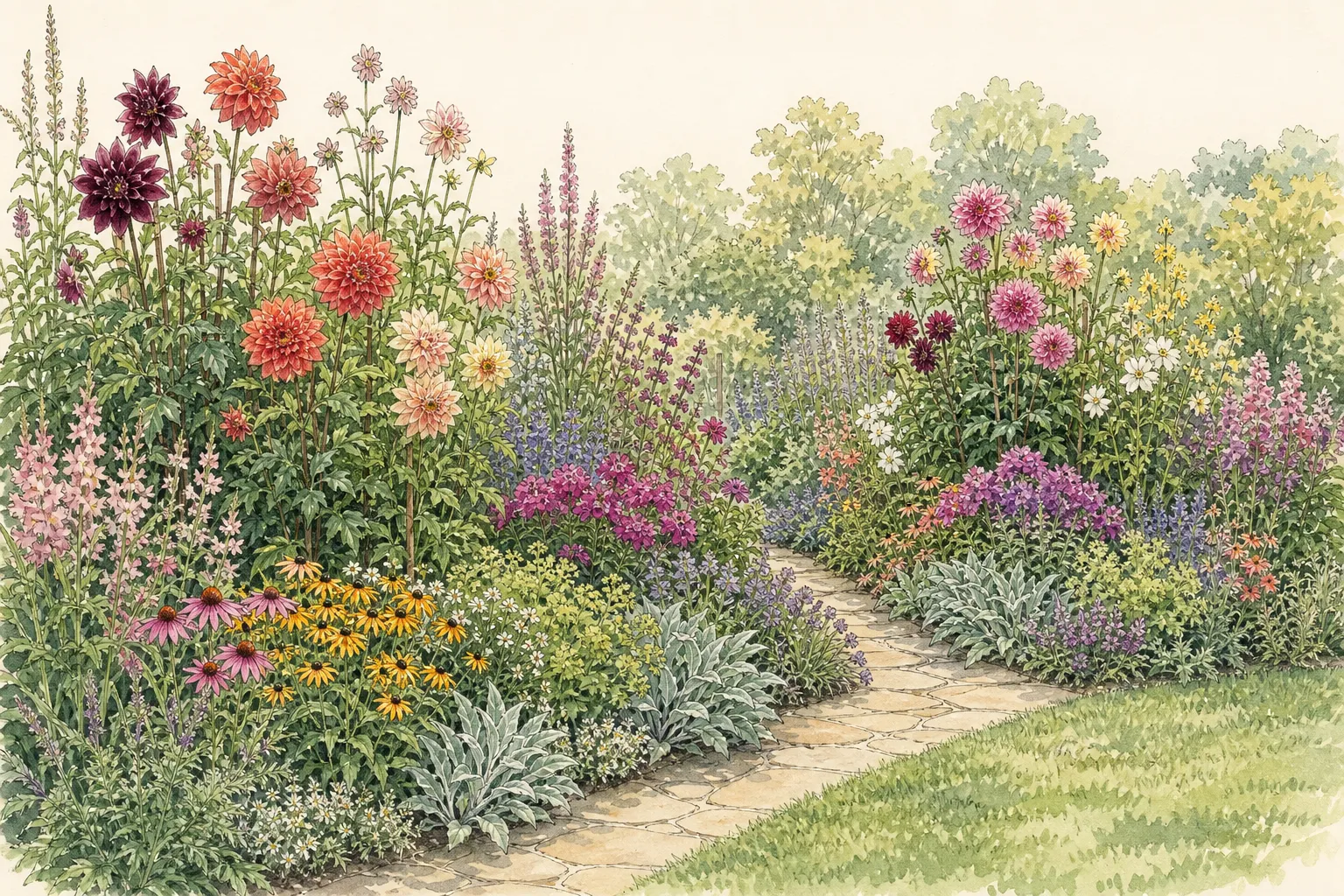
Set the first grid while shoots are short, then raise or add a tier before stems press sideways. RHS staking guidance favors early placement because foliage hides the structure and later insertion can damage growth. Use soft ties with space for stem expansion, and let the plant move slightly in wind. Inspect after heavy rain and at bud set. A leaning anchor, rubbing tie, or stem that has outgrown the upper tier calls for correction before flowers add more weight.
Build a permanent lower matrix
A useful matrix covers visual gaps while respecting the dahlia work zone. 'Rozanne' forms a low, mounding front layer; 'Millenium' adds narrow leaves and rounded summer flower heads; 'Northwind' supplies upright mass beyond the lifting circles. None should be planted directly over the route of a digging fork. Keep the centers visible from at least one access point and use mulch, not an extra plant, where mature foliage would close the route.
Match water as carefully as color. Dahlias need regular moisture during active growth but fail in waterlogged soil. 'Millenium' and 'Rozanne' both accept well-drained sites, while 'Northwind' tolerates a broader moisture range. An extremely dry companion planted inside the dahlia emitter pattern loses its intended habit, and a moisture-loving groundcover can hide saturated soil around the tubers. If the root-zone requirements diverge, move the companion to a separate irrigation zone.
After frost and lifting, the plan should still show a front edge, two vertical grass forms, and open mulched stations. The allium and geranium crowns remain dormant markers even when their top growth disappears. Leave sound 'Northwind' stems for winter where local fire and maintenance conditions allow, then cut them before new growth. Remove collapsed or diseased dahlia debris promptly so the open stations begin the dormant season clean and easy to inspect.
Maintain the summer display by evidence
Check moisture beneath the surface before watering, then deliver water slowly at soil level. The dahlia zone should be moist without remaining soggy. Oregon State links excessive nitrogen with weak stems, reduced flowering, and poorer tuber storage, so use a soil test and the current product label before feeding. Stop using fertilizer late enough for the tubers to mature under the regional guidance; its Oregon schedule begins withholding fertilizer in September.
Deadhead a spent pointed flower back to the next leaves, bud, or side shoot, preserving productive branching. Rounded compact heads may be unopened buds, so identify the shape before cutting. Clean pruners between suspect plants and keep the service spurs clear of stems. Regular cuts are also a chance to inspect the hidden grid, lower foliage, and labels, which cannot be reached safely if the permanent matrix has filled every opening.
Watch for abrupt mottling, yellow streaks, distorted growth, powdery foliage, or a plant that remains stunted while its neighbors expand. Oregon State distinguishes incurable bacterial or viral problems from fungal issues that may improve with sanitation, base watering, and airflow. Remove and discard infected tubers when diagnosis supports that action, and clean tools as directed. Do not use a broad pesticide response for an unidentified symptom; regional Extension advice and the current label govern any treatment.
Design the autumn exit
Choose the overwintering method before spring planting. Oregon State says in-ground overwintering can be possible in USDA Zone 7 or warmer when drainage is good, yet cold, standing water, and animals still create losses. Its recommendations are written for Oregon. In a colder region or a bed with winter saturation, plan to lift. The decision changes the spacing of permanent companions, the width of digging circles, and the storage capacity required for expanding clumps.
Before a hard freeze, confirm every label against the bed map and prepare ventilated containers. After frost kills the stalks, Oregon State describes cutting back, lifting with care, and beginning about 18 inches from the stalk to reduce tuber damage. Approach each station from the service strip or stepping spur. Lift the clump into a low crate rather than carrying it through the allium and geranium layer, then keep its number with it during cleaning and division.
Dry and store according to the chosen regional method. Oregon State gives 34 to 40°F as an ideal dark, nonfreezing storage range for its divided-tuber method and calls for periodic checks for condensation and rot. A cellar that freezes or a heated room that desiccates tubers falls outside that range. Discard rotting material, correct excess moisture, and note shriveling before it becomes severe. Different storage media need their own current instructions.
Once the tubers leave, inspect support parts in daylight. Clean them as appropriate for their material, discard frayed twine, repair bent grids, and bundle each height separately. Leave the permanent grass and sound perennial crowns undisturbed. The numbered mulch circles then show where spring plants return, while the access route remains open for soil checks and reinstallation before new shoots make the hardware difficult to place.
Design ideas
- Style
- Seasonal dahlia rhythm within a permanent perennial matrix
- Space
- Sunny mixed border or ornamental cutting edge with maintenance access
- Climate
- The worked plan is for a sunny, irrigated, frost-prone Oregon valley garden with freely draining soil and cool frost-free tuber storage. Coastal, high-desert, colder, wetter, and no-storage gardens must recalculate cultivar fit, water, support, and overwintering.
- 1Three repeated dahlia groups
Let 'Molly Raven' form the highest repeated group, offset 'Rainbow Silence' through the middle, and run 'Tangerine Gem' nearer the path. Draw each at the upper end of its documented spread and keep at least the regional 2-foot spacing. A substitute must match height, flower weight, branching width, and frost-season timing before it inherits a position.
- 2A concealed grid
Place anchors beside marked tubers at planting and fit the first grid while shoots are still short. Raise it or add a twine tier before stems press outward. Keep every tie soft and every anchor reachable from a stepping spur. The framework should support the flower-bearing canopy while foliage hides most of the hardware from the public path.
- 3A low foliage matrix
Use 'Rozanne' as a low front mound and 'Millenium' as a narrow summer accent, leaving marked mulch around every dahlia center. Their full mature widths belong on the plan. If either spreads into the digging radius, divide or relocate it during its proper season instead of accepting a carpet that conceals tubers and blocks irrigation inspection.
- 4A narrow service path
Reserve a 24-inch working strip behind the planting and connect it to the front with two firm stepping spurs. This is garden-service space, not a claim about accessible-route standards. It must accept a crate, watering wand, and digging fork while keeping feet outside permanent crowns. If mature foliage closes it, remove the conflicting plant rather than the access.
- 5One complementary flower family
Repeat the rounded purple heads of Allium 'Millenium' below the varied dahlia forms. Its 10- to 15-inch width allows small groups between work routes, and its mid- to late-summer bloom starts before the dahlia peak. Avoid adding another large flower class simply to fill a gap; foliage and open mulch can provide the quieter interval.
- 6Marked tuber stations
Give each tuber station a number on a durable stake and repeat that number on the storage container. Place the marker just outside the digging center where foliage will not pull it loose. The map should also show emitters and support anchors, allowing spring installation and autumn lifting to follow known positions even when no dahlia top growth is visible.
- 7A winter seedhead layer
Let the two 'Northwind' clumps carry the winter verticals where fire-safety and local maintenance rules permit standing grass. The dahlia circles remain open mulch, while allium and geranium crowns hold the lower pattern. Cut the grass in late winter before new growth, and remove any stem mass that lodges across the service strip after storms.
- 8A storage-linked map
Store the bed map with a simple tuber inventory: cultivar, station number, storage medium, inspection date, and losses. Reassign a spring position only after checking the mature plan, because moving a tall cultivar into a lower bay can block the path and exceed its support. An empty station is preferable to an unverified replacement that breaks spacing or season.
Related reading
Sources
- Dahlia Trial Results. Royal Horticultural Society. Source record · Accessed 2026-08-30.
- How to grow dahlias. Royal Horticultural Society. Source record · Accessed 2026-08-30.
- Perennials: staking. Royal Horticultural Society. Source record · Accessed 2026-08-30.
- Dahlias in Oregon: Planting for a Parade of Late-season Blooms. Oregon State University Extension Service. Source record · Accessed 2026-08-30.
- Dahlia 'Molly Raven' (D). Royal Horticultural Society. Source record · Accessed 2026-08-30.
- Dahlia 'Rainbow Silence' (D). Royal Horticultural Society. Source record · Accessed 2026-08-30.
- Dahlia 'Tangerine Gem' (Sin). Royal Horticultural Society. Source record · Accessed 2026-08-30.
- Allium 'Millenium'. NC State Extension Gardener Plant Toolbox. Source record · Accessed 2026-08-30.
- Geranium 'Rozanne'. NC State Extension Gardener Plant Toolbox. Source record · Accessed 2026-08-30.
- Panicum virgatum 'Northwind'. NC State Extension Gardener Plant Toolbox. Source record · Accessed 2026-08-30.