Gardens · frost lit morning view garden
Design a Frost-Lit Garden for the Morning View
Align an eastward view with backlit grass plumes, persistent flower heads, fine stems, and a low silver edge in a measured Zone 5b garden.
Published Last updated
In this guide
- Design the view, not the frost
- Keep the sunrise openings and moisture bands intact
- Give morning light several surfaces to reveal
- Use the background without blocking sunrise
- Separate moisture bands before choosing coordinates
- Set out one Zone 5b morning composition
- Keep the retained structure sound
- Observe light and frost as separate records
- Substitute for climate while keeping the light geometry
- Design ideas
Design the view, not the frost
Frost is weather, not a garden material that can be scheduled. The National Weather Service explains that frost forms on surfaces at or below freezing when moisture and surface temperature meet the frost point; clear skies and light wind favor strong night cooling, and the ground can be colder than the official air temperature measured several feet above it. A garden can be arranged to reveal frost when it occurs, but it should not be placed in a damaging cold pocket simply to increase the spectacle.
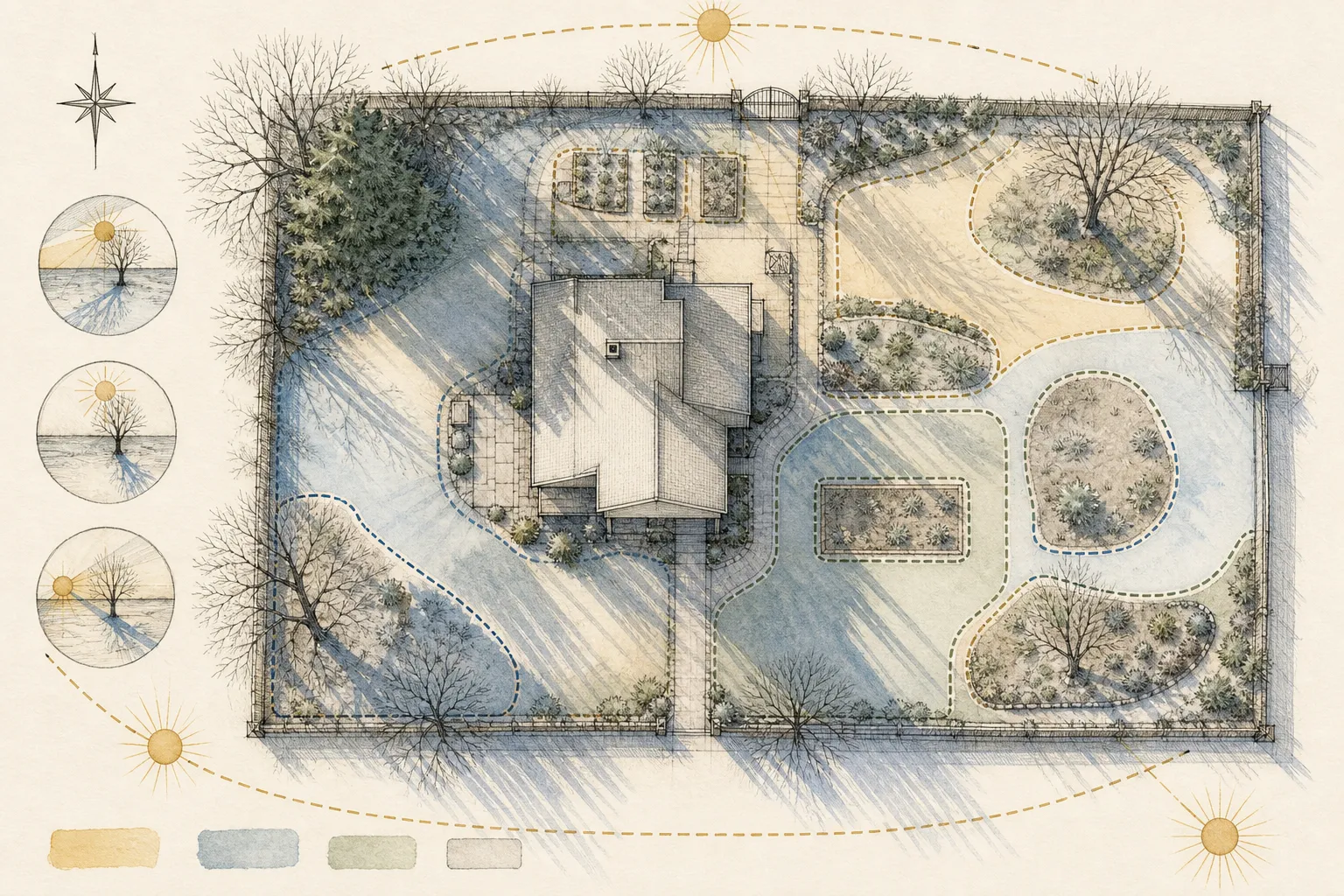
Choose the morning view first. An east-facing breakfast window looking toward an open eastern sky is useful because the low sun rises beyond the bed and can rim fine stems and plumes. Stand at the real indoor viewing position, not against the glass, and mark the vertical and horizontal limits of the scene. A bed that looks expansive outdoors may occupy only a narrow strip from a seated table; the composition must work inside that frame.
Record when direct light actually reaches the bed after leaf fall. A neighboring house, wall, hedge, or landform may delay sunrise illumination until frost has begun to melt. Photograph the empty site at fifteen-minute intervals on two clear late-autumn mornings. Note the first lit edge, the direction shadows fall, and which backgrounds make pale rims visible. This survey decides where fine texture and broad heads belong.
Keep plant health separate from visual ambition. Frost may be beautiful on hardy dormant structure while injuring tender growth. Select plants that fit the region and site in ordinary years, retain their sound stems after the growing season, and let weather add the temporary outline. The RHS describes frost catching frozen seed heads and branches as a winter spectacle; it does not make exposure a substitute for hardiness.
Keep the sunrise openings and moisture bands intact
Check the eastern light path and the declared soil gradient before using the frost-lit composition. Mature grasses and shrubs must leave the planned openings through which low sun can pass. Keep dry-edge plants out of the moister bands when substituting. The design can reveal naturally occurring frost, but neither its geometry nor its plant list guarantees a frosty morning.
Give morning light several surfaces to reveal
A frost-lit garden needs more than feathery grass. Use at least four surface types: narrow upright plumes, a cloud of fine branched panicles, broad persistent flower heads, and low leaves with a dense visible texture. Add a fifth layer of fine twiggy stems or narrow foliage. When frost is light, the finest edges appear first; after heavier deposition, broad leaves and panicles become brighter blocks. The same composition therefore changes with each morning.
Calamagrostis × acutiflora 'Karl Foerster' supplies the upright line. Missouri Botanical Garden documents a clump one and a half to two and a half feet wide, foliage around three feet, and flowering stems rising to five feet, with seeds and stems persisting into winter. Its narrow form can punctuate the far side of a small bed without becoming a broad screen. Adequate sun and medium to moist soil support the upright habit.
Deschampsia cespitosa 'Goldtau' creates the haze. The RHS describes a compact mound with long-lasting silvery brown and green plumes around seventy-five centimeters that mature gold, with a maximum height and spread of roughly half to one meter. Backlit frost on many fine branches becomes a luminous veil. Its moist but well-drained, acid-to-neutral soil preference differs from the dry front edge, so it belongs in the central moisture band.
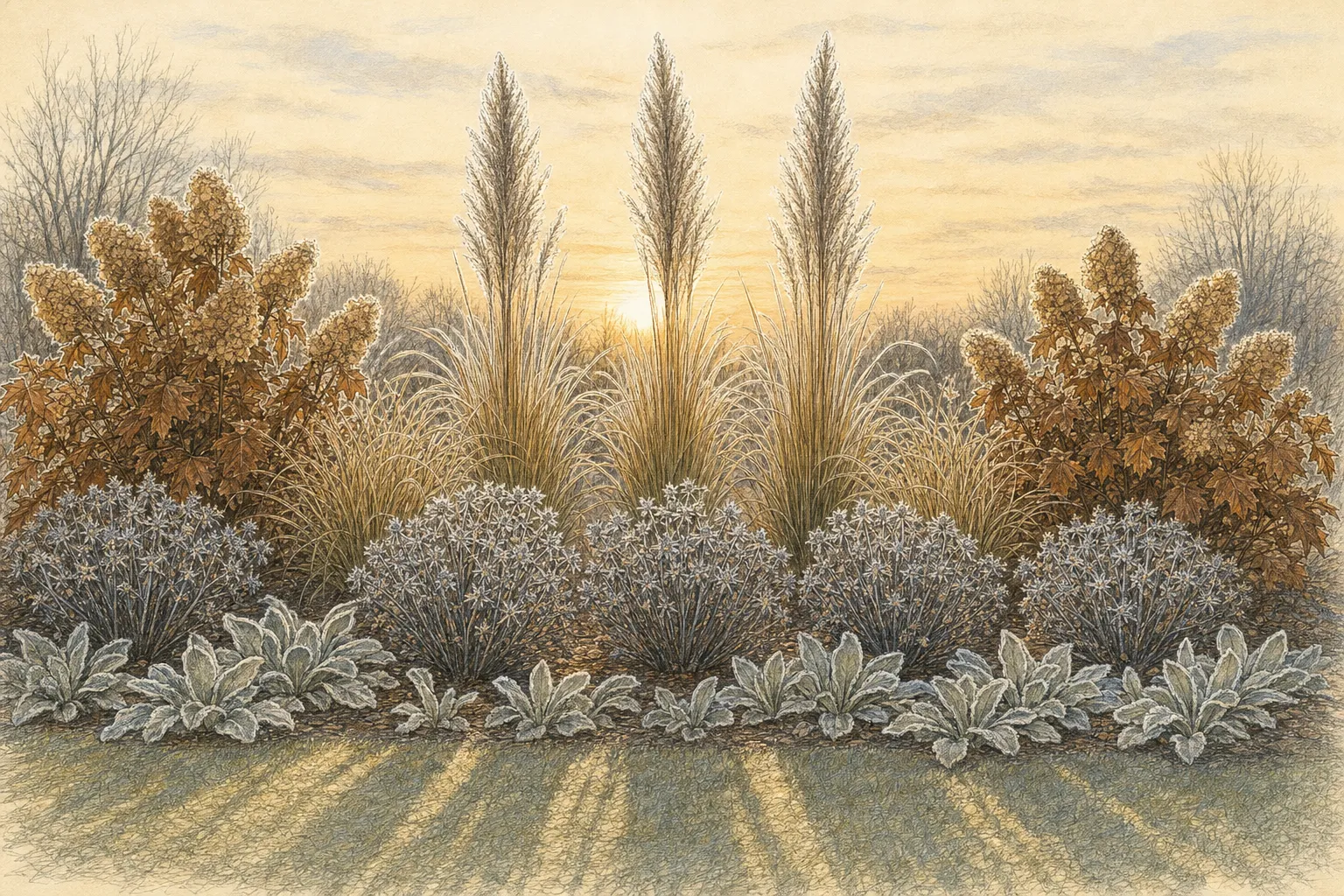
Broad heads and low texture make the light legible at other scales. 'Pee Wee' oakleaf hydrangea carries persistent brown panicles into winter, while 'Big Ears' lamb's ear makes a low mat of thick velvety silver-green leaves. Amsonia hubrichtii supplies two-to-three-foot fine clumps and narrow stems. Together they prevent the scene from reading as three rows of grass and give frost something to outline from six inches to five feet high.
Use the background without blocking sunrise
Backlight creates luminous edges but can flatten everything into one silhouette when the sun sits directly behind a dense mass. Place tall grass columns slightly to either side of the brightest sunrise corridor and leave small windows of open ground or sky between them. The sun can pass through fine plumes while the broader hydrangea heads occupy offset positions. A continuous hedge on the eastern boundary would erase the intended light path.
Dark contrast can come from a side background rather than the sunrise line. Existing evergreen foliage, dark bark, a shaded fence section, or the unlit side of the house can make one group of frosted stems visible. Keep that background north or south of the central eastward axis. Do not add a new evergreen wall simply for contrast before checking how its mature height and width will alter morning light.
The ground plane is also a background. Dark moist soil makes a white leaf edge clear; pale gravel can diminish a light frost but sharpen brown stems. In the worked composition, a narrow mineral or well-drained mulch strip supports lamb's ear at the west edge, while ordinary dark loam lies behind it. The contrast shifts as sunrise moves from the low leaves to taller layers.
View the bed from indoors after rain and on an unfrosted gray morning. If the arrangement depends entirely on white outlines, it will look empty most days. The grass columns, hydrangea blocks, fine amsonia mounds, and silver edge must create a coherent winter composition without frost; frozen crystals are an event that clarifies the structure already present.
Separate moisture bands before choosing coordinates
The selected plants do not belong in one uniform irrigation pocket. 'Karl Foerster' prefers medium to wet soil and remains more upright with adequate moisture. 'Goldtau' is documented for moist but well-drained or well-drained soil. 'Pee Wee' oakleaf hydrangea needs medium moisture and shelter at the cold edge of its range. Amsonia accepts moist, well-drained loam and occasional dryness. 'Big Ears' needs dry to medium, sharply drained soil and can rot where wet foliage and humid soil persist.
Map the existing drainage after a substantial rain. The worked bed puts the dry silver edge closest to the house-side path on a modestly raised, freely draining strip, moves amsonia into ordinary loam, and reserves the central-to-eastern band for the moisture-responsive grasses and hydrangeas. This is not a series of amended planting holes. It is a broad surface and soil gradient with continuous drainage.
Cold air and soil moisture are not design tools to intensify frost. The National Weather Service notes that cold air settles near the ground on clear calm nights, but deliberately blocking drainage or creating a low basin would risk roots and tender growth. Use the site's existing open exposure, maintain ordinary grade and runoff, and compose plants for the frost that naturally occurs.
Irrigation stays accessible after stems are retained. Mark soil-check points in each band and keep a stepping route that does not cross crowns. Winter appearance cannot justify a bed so dense that hydrangea roots, grass crowns, or the rot-prone silver edge are impossible to inspect.
Set out one Zone 5b morning composition
Use an eighteen-foot east-to-west by fourteen-foot north-to-south bed in USDA Zone 5b, immediately east of an east-facing breakfast window but beyond the roof drip line. The eastern horizon is open enough for low autumn and winter sun. Set the west edge nearest the house as x=0 and the south edge as y=0. The viewer looks east along the positive x axis. Soil is acid to neutral loam, with a freely draining raised strip at x=0–3 and moist but drained soil toward x=7–16.
Place three Calamagrostis 'Karl Foerster' at (15, 2.5), (15, 7), and (15, 11.5). The four-and-a-half-foot spacing leaves about two feet between their maximum two-and-a-half-foot widths and opens sunrise slits. Set two Hydrangea quercifolia 'Pee Wee' at (11, 4) and (11, 10). Six-foot centers give their documented roughly three-foot spreads room and offset the broad panicles from the three vertical grass columns.
Plant six Deschampsia 'Goldtau' as two loose triangles centered around (7.5, 4) and (7.5, 10), with crowns roughly two and a half feet apart. Their half-to-one-meter mature envelopes can overlap visually as a haze without being crowded. Put five Amsonia hubrichtii at (4.5, 2), (4.5, 5), (4.5, 8), (4.5, 11), and (4.5, 13), using three-foot centers at the upper end of their documented spread.
Along the dry west edge, use a discontinuous ribbon of nine Stachys byzantina 'Big Ears', centered near x=1.5 and spaced about eighteen inches along y from 1 to 13. Missouri Botanical Garden gives a one-to-two-foot spread and recommends twelve-to-eighteen-inch ground-cover spacing. Break the ribbon at y=7 for a two-foot maintenance entry. Keep the woolly foliage out of irrigation splash and wet depressions.
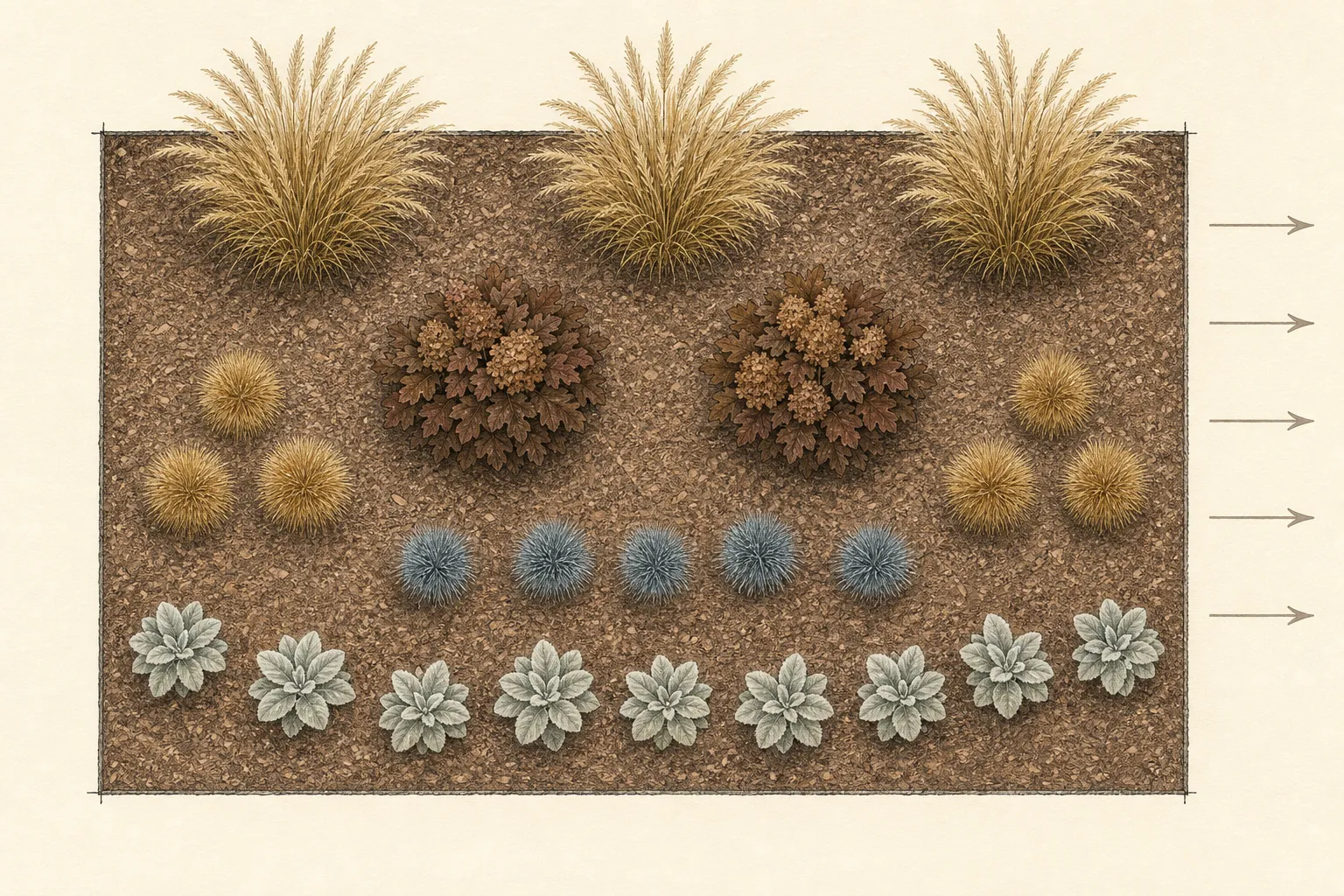
Mark the positions at full documented width before planting: three five-foot verticals, two broad panicle shrubs, six airy grass mounds, five fine amsonia clumps, and nine low silver rosettes. Look from the seated indoor position while markers are in place. Preserve the central sunrise gaps, end access, and the maintenance opening even if young plants make the first winter appear sparse.
Keep the retained structure sound
Leave 'Karl Foerster' and 'Goldtau' stems while they remain upright and useful, then cut them back before new spring growth under their source guidance. Hydrangea panicles can remain for winter interest, but 'Pee Wee' flowers on old wood; broad pruning during dormant cleanup can remove the next display. Remove only damaged stems when necessary and reserve any shaping for the plant's correct post-flowering window.
Amsonia can stand as a fine twiggy mound after its gold foliage falls. Its milky sap is exposed when stems are cut, so wear gloves and keep cut material away from eyes and mouth during spring cleanup. The design does not require every stem to remain. Remove broken material lying across the path or smothering nearby crowns, and keep sound upright structure until the scheduled cutback.
'Big Ears' is the most condition-sensitive part of the frost composition. Its woolly leaves can trap moisture and are susceptible to rot and leaf spot in humid or wet conditions. Remove damaged leaves, keep the strip drained, and accept that foliage may depreciate in a harsh winter. In humid summer regions or wet sites, replace it with a locally reliable low textural plant rather than increasing drainage only inside individual holes.
After wet snow, inspect before brushing or shaking frozen stems. Brittle iced material can snap under handling. Clear only what blocks access or loads a vulnerable shrub, using the plant-specific snow and ice guidance for the actual condition. The morning garden should age through weather, not be reset to a staged picture after every storm.
Observe light and frost as separate records
On a frosty morning, note the forecast low, sky condition, wind, and whether frost formed on grass, broad leaves, bare soil, roofs, or cars. Then record first direct light and the order in which each layer illuminates and melts. This separates a frost-distribution issue from a sightline issue. The low edge may frost heavily but remain shaded; the tall grass may catch light first even with a thinner coating.
Repeat the photographs from the exact indoor seat. A phone held against the window changes perspective and can include more sky than the viewer actually sees. Photograph once before sunrise, once at first light on the bed, and once when half the visible frost has melted. Three or four events reveal which structures consistently earn their place and which are hidden.
Do not move a healthy plant after one weak frost display. A calm clear night, a breezy night, and a cloudy freeze produce different surface patterns. Look for repeated composition problems: a hydrangea always blocks a grass column, a background erases fine panicles, the low edge never receives light, or the sunrise slit closes as plants mature. Correct the geometry after the pattern is real.
Use unfrosted mornings as the control. The garden should still show a tall rhythm, airy middle, broad panicle blocks, fine front mounds, and a low silver line. If it reads only when white, strengthen the ordinary contrast of form and background. Frost is the brief highlighter, not the underlying drawing.
Substitute for climate while keeping the light geometry
The named composition is bounded by Zone 5b, cool-to-moderate summers, an open east horizon, and its moisture gradient. 'Pee Wee' may need shelter in harsh Zone 5 winters; 'Goldtau' carries an RHS H5 rating in UK conditions rather than a USDA zone; 'Big Ears' can decline in humid wet summers. Confirm regional performance before buying and replace uncertain plants with locally tested equivalents.
Every equivalent keeps one surface and one measured layer: a narrow five-foot vertical, a two-to-three-foot airy haze, a three-to-four-foot broad persistent head, a two-to-three-foot fine mound, or a low textured edge. It also matches the correct soil band. A dry grass cannot simply replace 'Karl Foerster' in the moist eastern band, and a wide evergreen cannot replace a transparent column without closing the sunrise corridor.
In a west-facing morning view, direct sunrise backlight is impossible; use side light from an opening or design the garden for afternoon frost remnants and winter structure instead. In a courtyard where buildings delay sun, map the actual beam and shorten the composition to the lit strip. Geometry follows real light, not compass aspiration.
A smaller bed may keep one 'Karl Foerster', one 'Pee Wee', three 'Goldtau', three amsonias, and a short silver edge if mature envelopes fit and a sunrise slit remains. Reduce quantities before spacing. The frost-lit effect comes from distinct surfaces distributed along a real sightline, not from packing every named plant into view.
Design ideas
- Style
- Backlit late-autumn and winter garden built from vertical, airy, broad, fine, and low textural layers
- Space
- Eighteen-by-fourteen-foot garden viewed eastward from a breakfast window
- Climate
- The worked composition assumes USDA Zone 5b, cool-to-moderate summers, an open eastern horizon, acid-to-neutral loam, a dry raised west edge, moist but well-drained central and east bands, and no roof runoff or deicing salt. Frost frequency is not promised; the garden reveals naturally occurring frost and remains coherent without it.
- 1Three sunrise slits
Space three 'Karl Foerster' columns at four-and-a-half-foot centers along the eastern band. Their maximum two-and-a-half-foot widths leave open intervals for low sun, while five-foot plumes create tall frost-rimmed lines. Shift the row only after mapping actual sunrise from the indoor seat.
- 2Two broad panicle blocks
Offset two 'Pee Wee' oakleaf hydrangeas in front of the tall grass row. Their roughly three-foot spreads and persistent brown panicles add a broad frost-catching surface without forming a wall. Preserve the named cultivar, shelter it where Zone 5 winters require, and prune only with old-wood flowering in mind.
- 3An airy Goldtau veil
Set six 'Goldtau' hair grasses in two loose triangles through the moist, well-drained middle band. Their fine plumes rise to about seventy-five centimeters and mature gold, making a backlit haze. Keep crowns at roughly two-and-a-half-foot spacing and confirm regional hardiness beyond the RHS UK rating.
- 4Fine amsonia stepping mounds
Repeat five Amsonia hubrichtii clumps between the low edge and airy grass. Their two-to-three-foot mature envelopes create a fine-textured middle-low rhythm after golden foliage falls. Three-foot centers keep the mounds readable and preserve access between the house-side edge and central moisture band.
- 5A broken silver ribbon
Use 'Big Ears' lamb's ear as a low discontinuous west-edge ribbon at about eighteen-inch spacing, with a two-foot maintenance break. Its woolly leaves catch light near ground level but demand dry-to-medium, sharply drained soil. Replace it in humid wet climates where leaf rot undermines the role.
- 6One fixed indoor camera point
Photograph from the real seated viewing position before sunrise, at first light, and when half the frost has melted. Record sky, wind, forecast low, and which surfaces frosted. Repeated frames show whether a problem belongs to plant geometry, background, light timing, or weather.
- 7An unfrosted control view
Review the garden on gray mornings with no frost. Tall columns, airy haze, panicle blocks, twiggy mounds, and the silver edge should remain legible. Strengthen ordinary form and background when the bed looks empty without white; frost should reveal the composition, not create it from nothing.
- 8Surface-for-surface substitution
When climate or soil rejects a named plant, replace its exact visual layer and mature envelope: vertical, haze, broad head, fine mound, or low texture. Match the moisture band and preserve sunrise gaps. A locally hardy but opaque wide shrub is not an equivalent for a transparent grass column.
- 9A frost-safe maintenance corridor
Keep the broken west-edge opening and the spaces between mature clumps wide enough for soil checks and spring cutback. Use the corridor after frost has melted and footing is secure; the display is viewed from indoors, not reached by stepping among icy crowns. An accessible plan protects the moisture gradient and prevents maintenance from crushing the very structures meant to catch light.
Related reading
Sources
- Dew and Frost Development. National Weather Service. Source record · Accessed 2026-08-20.
- How to Have a Beautiful Winter Garden. Royal Horticultural Society. Source record · Accessed 2026-08-20.
- Deschampsia cespitosa 'Goldtau'. Royal Horticultural Society. Source record · Accessed 2026-08-20.
- Calamagrostis 'Karl Foerster'. Missouri Botanical Garden. Source record · Accessed 2026-08-20.
- Hydrangea quercifolia 'Pee Wee'. Missouri Botanical Garden. Source record · Accessed 2026-08-20.
- Amsonia hubrichtii. North Carolina Extension Gardener Plant Toolbox. Source record · Accessed 2026-08-20.
- Stachys byzantina 'Big Ears'. Missouri Botanical Garden. Source record · Accessed 2026-08-20.