Gardens · autumn leaf color succession garden
Design a Garden for Autumn Leaf-Color Succession
Plan overlapping gold, orange, red, and mahogany foliage across garden layers, then calibrate the sequence with a measured Zone 6b composition and local phenology notes.
Published Last updated
In this guide
- Design a sequence that can move with the weather
- Map succession as overlapping phases
- Build the palette from foliage scale
- Match the plants to one believable site
- Lay out a source-bounded Zone 6b border
- Tune color relationships without chasing a perfect year
- Use photographs to calibrate the succession
- Substitute by role when region or scale changes
- Design ideas
Design a sequence that can move with the weather
Autumn foliage is a living schedule, not a printed bloom chart. Shortening days cue seasonal change, while temperature, sunlight, summer moisture, wind, and plant health affect intensity and leaf retention. University of Illinois Extension explains that sunny fall weather and cool nights can strengthen red and purple pigments, while an early cold snap, drought, rain, or wind may shorten or dull the display. A garden promised to turn on fixed October dates will eventually fail its promise.
A useful succession is built from overlap and redundancy. One layer begins to color while another is still green; a third carries the saturated middle; a fourth holds foliage after the first leaves fall. If one weather event compresses the timing, the garden still has several colors and textures at once. If a warm autumn stretches the process, the same plants can hand visual attention from front to back over a longer interval.
Start with the view and the scale of each foliage mass. A gold perennial clump close to a path reads differently from a five-foot red shrub at the back of the bed. Map the garden in layers, then give each layer at least two plants or groups capable of doing the same seasonal job. This protects the composition from a weak individual and prevents the whole display from depending on one specimen whose leaves may drop in a single storm.
Color words need form beside them. Fine gold threadleaf foliage creates a luminous haze; quilted fothergilla leaves make mixed-color mounds; large lobed oakleaf hydrangea leaves build broad mahogany blocks; arching sweetspire makes a lower spreading red band. Their physical differences remain visible even in a year when their peak colors arrive together.
Map succession as overlapping phases
Use four relative phases rather than dates: first change, broad middle, late hold, and leafless structure. Observe them from the same position once a week. Record the first clear change on roughly one-quarter of a plant, the strongest whole-plant color, the point when half the leaves have fallen, and the remaining shape after drop. Two autumns of this simple record reveal the local order more honestly than a catalog description written in another region.
The first-change phase should appear in more than one height band. Amsonia hubrichtii gives a fine-textured gold perennial layer when grown in adequate sun, according to North Carolina Extension. Fothergilla gardenii brings a shrub layer capable of yellow, orange, and red, with the exact mix depending on growing conditions. These plants can start the visual transition with different leaf scales even if their local timing overlaps.
The broad middle needs mass. The U.S. National Arboretum describes Hydrangea quercifolia 'Ruby Slippers' as a compact rounded shrub about three and a half feet tall and five feet wide at seven years, with mahogany-red fall foliage. Several separated plants create repeated blocks of deep color. Itea virginica 'Henry's Garnet' adds orange to burgundy red and is documented by North Carolina Extension for color that can last toward winter.
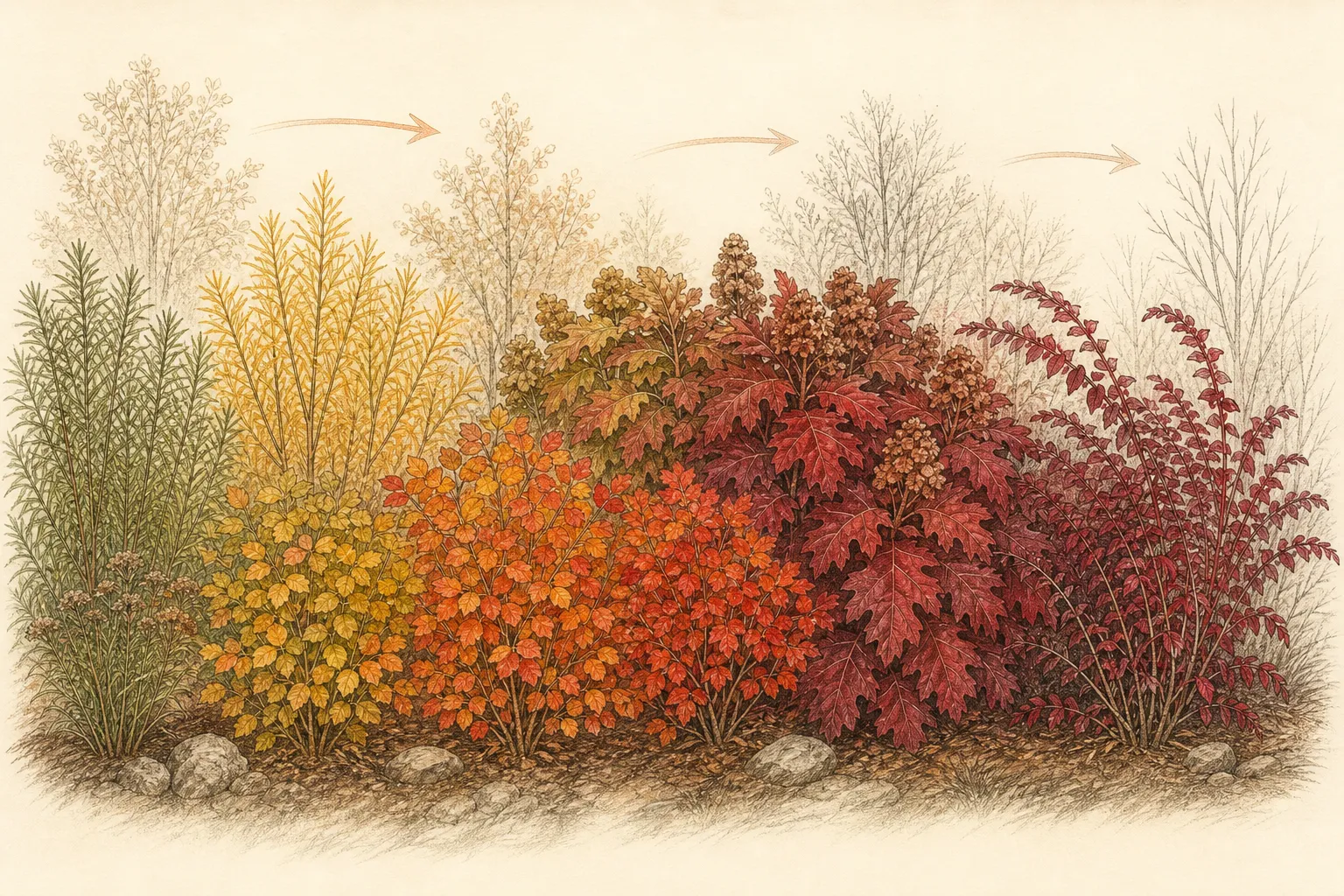
Late hold is a role to verify, not an entitlement. The Extension profile says 'Henry's Garnet' leaves often persist into early winter, but site and weather still decide the actual duration. Place it where retained foliage will remain visible after neighboring clumps thin. The leafless phase then reveals the rounded hydrangea framework, suckering tendencies of the shrubs, and the need for open access; succession should finish in an intentional winter outline rather than a crowded tangle.
Build the palette from foliage scale
Amsonia hubrichtii is the finest texture in the composition. North Carolina Extension gives it a mature height and width of two to three feet, clumping habit, full sun to partial shade, and golden fall color that is strongest in full sun. Repeated clumps create a front-layer haze rather than isolated yellow dots. Its narrow leaves also give fallen shrub leaves a contrasting background before the perennial itself turns.
Dwarf fothergilla supplies the mixed middle. The same Extension database places Fothergilla gardenii at roughly three to six feet high and two to six feet wide, maturing from a rounded habit and capable of suckering into colonies. Its leathery leaves can turn red, orange, and yellow. Give each plant a conservative six-foot envelope in a measured plan or choose a documented smaller clone; pruning is not a substitute for allowing the species room to express its mound.
'Ruby Slippers' changes both scale and saturation. The National Arboretum's primary introduction describes a three-and-a-half-by-five-foot rounded plant at seven years, dark green summer foliage, and mahogany-red fall color. Those numbers make it a useful back-layer shrub in a home border, but compact does not mean narrow. A five-foot-wide mature block needs clear space from paths and neighboring crowns.
'Henry's Garnet' provides the arching, spreading late band. North Carolina Extension lists it at three to five feet high and four to six feet wide, notes stronger flowering and fall color with at least four hours of sun, and warns that it can form colonies by root suckering. That spreading behavior can knit a background or moist edge; in a small formal bed it needs an accessible boundary where unwanted suckers can be edited.
Match the plants to one believable site
The worked palette belongs in a moist but well-drained, moderately acidic to neutral garden with sun through much of the day and some relief from the harshest afternoon exposure. It is not a dry gravel recipe. 'Henry's Garnet' accepts moist and occasionally wet conditions, fothergilla is associated with moist sites and tolerates wet soil, 'Ruby Slippers' comes from an oakleaf hydrangea lineage suited to medium moisture and shelter in colder edges, and amsonia accepts ordinary well-drained soil with some dry tolerance once established.
Light drives both plant form and fall color. Amsonia's gold is strongest in full sun. 'Henry's Garnet' can grow in shade but the retained source says four or more hours improves flowering and autumn display. Fothergilla color varies with conditions. Before laying out a sequence, map direct sun after summer leaf growth and again near autumn equinox. A bed shaded by a building all afternoon needs different taxa even when its hardiness zone matches.
Air and water must move through the finished plan. Broad shrubs should not be pressed against a wall or woven tightly through one another. Leave access to inspect bases, remove suckers, and water new root balls. Do not enrich isolated holes in a way that creates separate wet pockets. Improve the planting area broadly only when testing and site design support it, then preserve a continuous soil profile across the bed.
USDA Zone describes minimum winter temperature, not summer heat, humidity, soil, or the timing of leaf color. The worked Zone 6b example is a Mid-Atlantic or Ohio Valley model, with the U.S. National Arboretum's Zone 5–8 hydrangea release and the Extension profiles' broader hardiness ranges as bounds. A Zone 6b garden in a very different climate must recheck every taxon and substitute by role.
Lay out a source-bounded Zone 6b border
Use a thirty-two-foot-long by eighteen-foot-deep bed viewed from a path on the south. The site is USDA Zone 6b, receives at least six hours of direct sun with light late-afternoon shade, and has moist, well-drained loam. Set the southwest corner as (0, 0); x runs east for thirty-two feet and y runs north for eighteen. A simple mulch path or stepping access enters at each short end, and no roof runoff or deicing salt reaches the bed.
Place three Hydrangea quercifolia 'Ruby Slippers' at (6, 15), (16, 15), and (26, 15). Ten-foot centers leave about five feet between the documented five-foot-wide seven-year envelopes, so each mahogany block can be read separately. Their back-row position keeps the three-and-a-half-foot crowns visible above the front perennials while retaining access from the north edge for pruning only when plant health or old-wood flowering guidance calls for it.
Place four Fothergilla gardenii at (3, 10), (12, 10), (21, 10), and (30, 10). Nine-foot centers reserve a six-foot maximum design envelope with three-foot intervals. Put three Itea virginica 'Henry's Garnet' at (7, 6), (17, 6), and (27, 6), ten feet on center. Their four-to-six-foot spreads form arching red masses without immediately merging, and their row sits where suckers can be reached from the front or end access.
Use twelve Amsonia hubrichtii as four triangular drifts centered near x=4, 12, 20, and 28 at y=2.5, with crowns about two and a half feet apart inside each triangle. Their documented two-to-three-foot mature width creates connected gold clouds along the front while leaving small notches for stepping access. Keep the nearest crown at least its mature radius from the path edge so stems do not collapse into circulation.
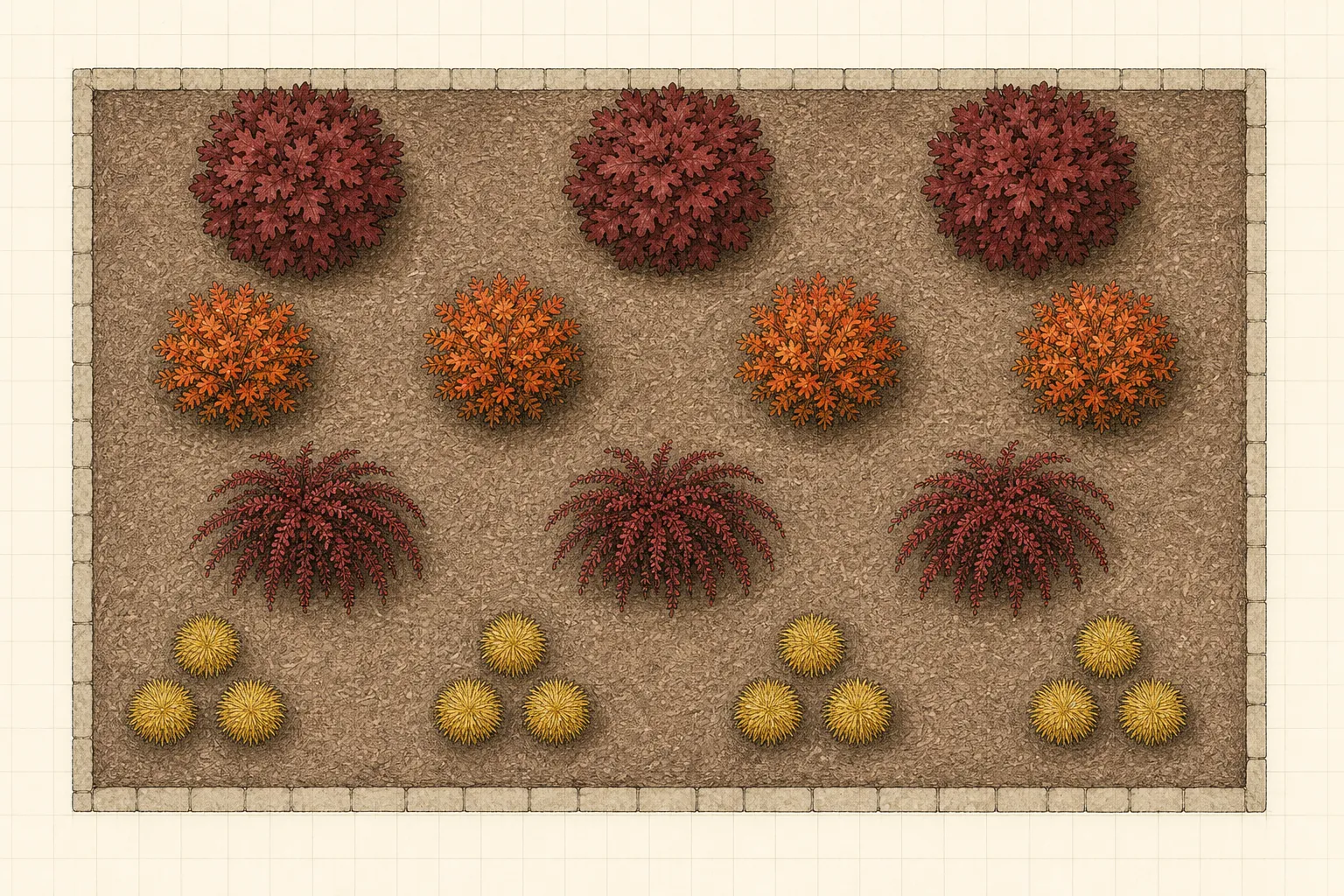
This composition contains three mahogany hydrangeas, four multicolor fothergillas, three long-holding garnet sweetspires, and twelve gold amsonias. Before planting, outline every conservative mature envelope with hose or marking paint and view the shapes from the house. Shift centers to protect drains, roots, and access while preserving the relative layers. The coordinates are a worked geometry, not permission to ignore the actual site.
Tune color relationships without chasing a perfect year
The palette uses gold as the lightest and most repeated color, mixed orange-red as the transition, mahogany as the deep block, and garnet as the late band. That creates a sequence even when peak dates overlap: the eye moves from fine bright foreground to mixed middle mounds, then to broad dark leaves and lingering arching shrubs. A distant viewpoint will merge tiny color patches, so repeat each role in masses large enough to be seen from the intended window or path.
Background changes the effect. Dark siding can swallow mahogany hydrangea while making gold amsonia glow. Pale stone can flatten gold but sharpen red and orange. Photograph sample leaves or colored paper against the actual background before planting. If the view is dominated by an existing evergreen hedge, the new deep-red layer may need more separation and the gold layer can move slightly farther back without changing the horticultural layout.
A muted year is not automatically a plant failure. Illinois Extension identifies weather as a major driver of brilliance and retention. Compare the whole plant with its health, irrigation history, light, and previous records. One early-browning branch may indicate stress; a garden-wide compressed season after wind or cold is a weather event. Design changes follow repeated patterns, not disappointment with one autumn.
Resist fertilizers or pruning intended to force better color without diagnosis. Fall display depends on healthy seasonal processes, and late disturbance can remove leaves before resources are recovered or remove next year's old-wood flowers on the shrubs. Support ordinary plant health, correct genuine site problems, and let the observed color record guide substitutions.
Use photographs to calibrate the succession
Choose one weekly observation day from the first visible change until half the late-holder leaves have fallen. Photograph from the principal view with consistent framing and note recent rain, wind, frost, and unusual heat. Give each plant group a four-part code: green, turning, peak, or half-dropped. The record needs no colorimeter; it needs consistency and enough seasons to reveal relative order.
After two autumns, look for gaps longer than a week in the visual sequence, but distinguish a timing gap from a scale gap. If color exists only in one small corner, adding another plant of the same phase may solve visibility. If the entire bed is green and then turns at once, introduce a locally documented earlier or later taxon. If leaves color well but are hidden, move the viewpoint layer or edit an obstruction rather than changing plants.
Keep labels attached to actual cultivars. 'Ruby Slippers' has a primary documented size and mahogany color; a generic oakleaf hydrangea can be much larger. 'Henry's Garnet' has documented persistence and spread; another sweetspire may behave differently. A succession plan loses its evidence when nursery substitutions are accepted under a shared common name without redrawing the mature envelopes and roles.
Winter photographs complete the review. They show whether hydrangea and shrub masses remain distinct, whether suckers are closing access, and whether amsonia stems create useful texture or simply lie across the path. Autumn color is one chapter of a four-season garden. The best correction lengthens fall without creating a crowded winter or a maintenance trap in spring.
Substitute by role when region or scale changes
A colder garden may keep the palette but require a more sheltered hydrangea position or a different mahogany shrub. A hot dry garden needs an entirely different moisture set. A compact courtyard can keep one fothergilla, one 'Ruby Slippers', one sweetspire only if its suckering boundary is accessible, and several amsonias; it cannot compress the full recipe into half the width. Mature envelopes remain the controlling measure.
For every substitute, document five things: mature height and spread, verified fall color range, local relative timing or persistence, light and soil fit, and post-leaf-drop form. Then assign it one job—first gold haze, mixed-color middle, deep mahogany mass, or late red hold. A plant with spectacular crimson but the wrong mature scale or drainage need is not a valid substitute for this composition.
Keep the phase record after substitution. The replacement may shift order because its microclimate differs from the source description and from the old plant's position. Design for succession is therefore iterative but not vague: the plan starts with source-bounded taxa and dimensions, observes them at fixed intervals, and changes only the role that local evidence shows is missing.
Design ideas
- Style
- Layered autumn foliage border with overlapping gold, orange-red, mahogany, and garnet phases
- Space
- Thirty-two-by-eighteen-foot mixed shrub and perennial border viewed from the south
- Climate
- The worked composition assumes a Mid-Atlantic or Ohio Valley USDA Zone 6b garden with six or more hours of sun, light late-afternoon shade, moist but well-drained loam, no salt or roof runoff, and room for documented mature shrub envelopes. Exact color dates are observed locally because weather, light, moisture, and plant health shift autumn phenology.
- 1Gold at the front edge
Repeat Amsonia hubrichtii in broad triangular drifts where its two-to-three-foot clumps and fine golden foliage can be seen against the path. Full sun supports the strongest color. Keep mature crowns out of circulation and use several groups so one weak clump cannot erase the first bright phase.
- 2Mixed-color middle mounds
Give Fothergilla gardenii conservative six-foot envelopes and let its yellow, orange, and red foliage bridge the gold foreground and deeper shrub colors. Space plants rather than shearing them into undersized balls. Preserve access to edit suckers and confirm that the moist, sun-to-part-shade site matches the species.
- 3Mahogany back-row blocks
Use three 'Ruby Slippers' oakleaf hydrangeas as separate five-foot-wide masses. The U.S. National Arboretum documents about three and a half feet by five feet at seven years and mahogany-red fall foliage. Keep the named cultivar and its envelope intact; generic oakleaf hydrangea is not an equal-size replacement.
- 4A persistent garnet band
Place 'Henry's Garnet' where arching four-to-six-foot spreads remain visible after front layers thin. Four or more hours of sun support better color, and the source notes foliage can persist toward winter. Treat that persistence as a local observation to verify, and maintain a reachable edge for suckers.
- 5Weekly phase photographs
From first change through late leaf drop, photograph the same view weekly and mark each group green, turning, peak, or half-dropped. Note wind, frost, rain, and unusual heat. Two years of relative timing provide a practical local succession map without pretending that fixed calendar dates survive every autumn.
- 6Color against the real background
Test gold, orange, garnet, and mahogany samples against the house, fence, evergreen hedge, or stone seen from the primary view. Dark walls strengthen gold and can swallow mahogany; pale ground changes the balance. Shift masses within their horticultural zones before adding more colors to compensate.
- 7A role-based replacement rule
Replace a taxon only with a plant documented for the same mature scale, autumn color role, local relative timing or retention, light, moisture, and winter form. Redraw the plan after every substitution. Shared common names and the word compact do not preserve the measured composition.
- 8Winter structure after the color
Photograph the bed again after leaf drop. Separate shrub frameworks, visible access, and unblocked crowns show that the autumn design can age well. If suckers, stems, or overlapping envelopes erase the plan in winter, edit the structural conflict before adding another color-phase plant.
- 9A two-season overlap test
After two complete autumn records, mark every week in which at least two color roles were visible from the principal view. A thin interval may need another group of an existing phase, a better background, or a locally documented substitute with different timing. Diagnose scale, visibility, and weather before changing taxa; one storm-shortened year does not prove a permanent succession gap.
Related reading
Sources
- Fall Color. University of Illinois Extension. Source record · Accessed 2026-08-20.
- Itea virginica 'Henry's Garnet'. North Carolina Extension Gardener Plant Toolbox. Source record · Accessed 2026-08-20.
- Fothergilla gardenii. North Carolina Extension Gardener Plant Toolbox. Source record · Accessed 2026-08-20.
- Amsonia hubrichtii. North Carolina Extension Gardener Plant Toolbox. Source record · Accessed 2026-08-20.
- U.S. National Arboretum Plant Introduction: Hydrangea 'Ruby Slippers'. U.S. National Arboretum. Source record · Accessed 2026-08-20.