Tools · winter grow light station for tender ornamentals
Set Grow Lights for Overwintering Tender Ornamentals
Build a winter light station for tender ornamentals by matching plant type, height, duration, darkness, airflow, and drainage rather than treating all overwintered pots like seed trays.
Published Last updated
In this guide
- Decide which plants need active light instead of dark storage
- Match spectrum and duration to the plant you brought in
- Build height zones for mixed winter stock
- Set distance by the manufacturer first, then by plant response
- Keep water, heat, and electricity on separate routes
- Diagnose legginess, bud refusal, and scorch as layout problems
- Maintain the winter station until outdoor return
- Keep a winter-station record by plant group
- Tool notes
Decide which plants need active light instead of dark storage
Not every tender ornamental should be overwintered under active lights. Some plants are better held as dormant tubers or stored crowns; others are best carried as leafy stock plants because the whole point is to preserve stems, cuttings, or winter bloom potential. Before you buy or hang a fixture, sort the collection by biology and purpose. A pelargonium saved for spring cuttings, a coleus kept for stock, a tuberous begonia still in leaf, and a canna rhizome in dry storage do not belong in the same winter system.
Illinois Extension's overwintering advice is helpful precisely because it does not treat indoor rescue as automatic. Tender plants come inside only if the gardener can actually supply the conditions they need. For actively growing or leaf-retaining ornamentals, light becomes the limiting factor first. A warm room without enough usable light does not really overwinter the plant; it stretches it toward failure. Once you see that, the first grow-light decision becomes whether a given plant deserves a lit station at all.
The decision also changes what success means. A flowering plant kept for winter bloom may need stronger or longer light than a stock plant you simply want compact and alive. A coleus can overwinter well with steady vegetative light and pinching. A flowering or bud-setting tender ornamental may need more day length and intensity to keep from becoming a pale houseguest. The station must be built around the plant's winter job, not around the fact that all of them came indoors on the same cold night.
This sorting step prevents the most common layout error: trying to make one shelf do every kind of holding at once. If a plant really belongs in cool dry storage, no amount of LED marketing fixes the mismatch. If it belongs under lights, it deserves a setup planned for its current winter architecture, not for a seed tray from spring.
Match spectrum and duration to the plant you brought in
NC State's indoor-light guidance is direct enough to be practical: blue light suits seedlings, leafy greens, and non-flowering houseplants; red light supports flowering plants; white or full-spectrum light is suitable for growing most plants. In a mixed overwintering station, that usually means a white or full-spectrum fixture is the most useful base because it lets you inspect leaf color honestly while still supporting a broad range of ornamental types. Color marketing alone is not a setup plan, but wavelength does matter once the plants are grouped by winter purpose.
Duration matters just as much. Iowa State recommends timers because plants still need darkness to grow properly, and because some species depend on that dark period for flowering. The same source gives home-garden ranges that are useful here: for most species, 12 to 14 hours is a good starting length, with a practical home range of 10 to 16 hours. NC State further narrows that by use: foliage houseplants around 12 to 14 hours, flowering houseplants around 14 to 16 hours. Those are not abstract numbers. They are how you decide whether the poinsettia substitute, flowering begonia, or stock pelargonium sits on the foliage shelf or the flowering shelf.
Do not erase the dark period because the window looks gloomy in December. Iowa explicitly notes that the dark period can be essential for flowering and fruiting. More light-hours are not a substitute for correct intensity or distance, and a fixture left on all night can give you exhausted, oddly timed growth rather than stronger plants. The winter station works best when duration, darkness, and spectrum are treated as a coordinated program rather than three separate gadgets.
Put those decisions on a written label at the shelf, not only in memory. A winter collection often shifts in and out as pests, cuttings, and bloom plants move. The label keeps a foliage bench from quietly inheriting a flowering schedule or vice versa. Good light stations are managed, not merely powered.
Build height zones for mixed winter stock
Overwintered tender ornamentals are not a flat canopy. Iowa's supplemental-light guidance repeatedly emphasizes adjustable height because the distance from fixture to foliage strongly changes the useful light reaching the plant. That matters more for mixed mature pots than it does for even seedling trays. A stubby coleus cutting, a compact tuberous begonia, and a lankier pelargonium mother plant cannot all live happily on one fixed plane if the goal is compact winter growth.
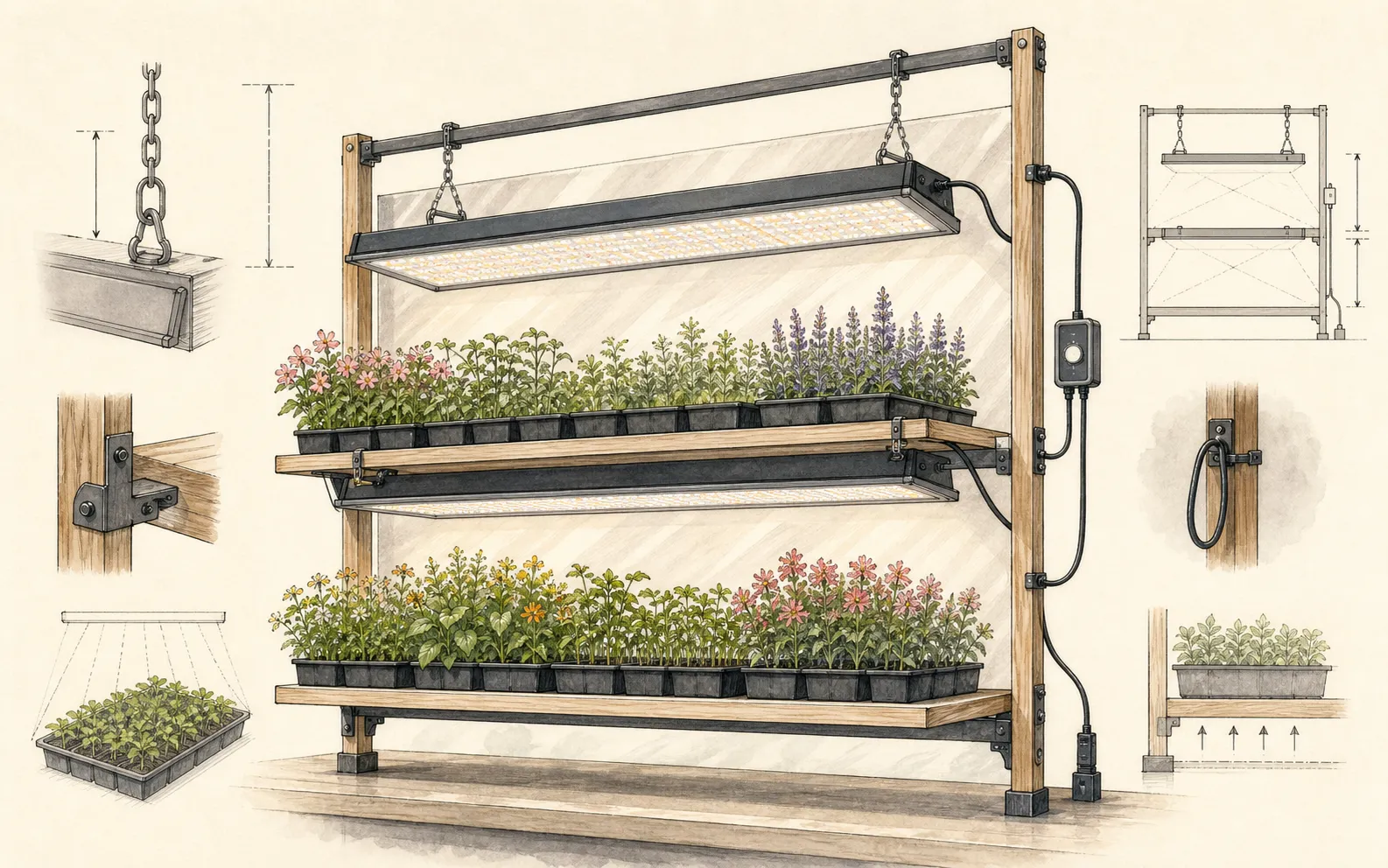
Build the station in height zones rather than species chaos. Group plants by current canopy height and by whether they need strong vegetative holding or flowering support. Use stable waterproof risers for short plants instead of raising the entire fixture for one tall pot. Iowa notes that the adjustment can be made by moving the light or by moving the plant. For mixed ornamentals, moving the plant is often easier and safer because it preserves the lighting zone for the rest of the shelf.
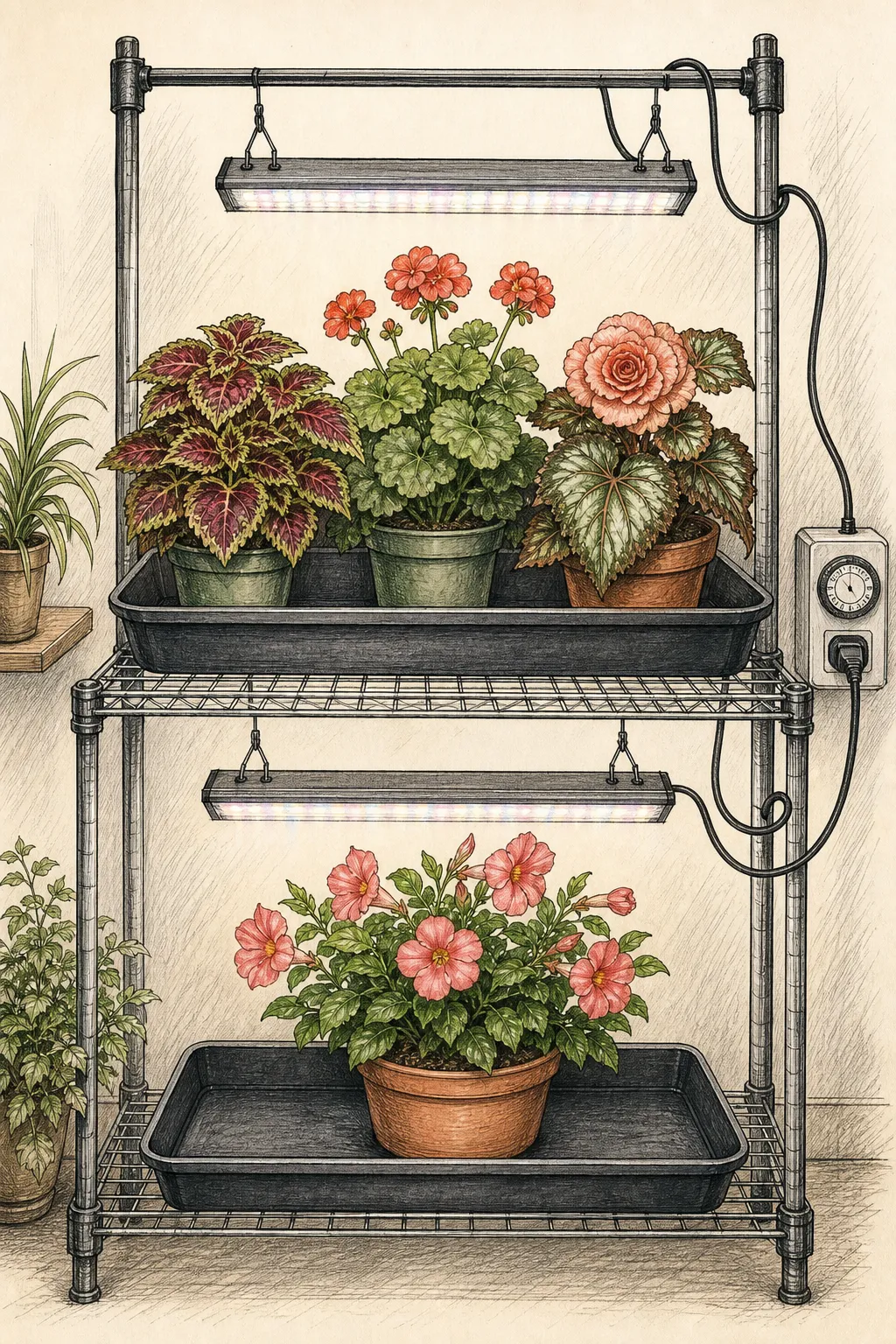
Leave service clearance between zones. A winter bench that forces your hand and watering can through a dense wall of foliage is not finished, no matter how bright it looks. You need room to remove yellow leaves, inspect the undersides for mites or whiteflies, and rotate or isolate one pot without dragging every other one sideways. Good air movement also depends on this spacing. Plants packed leaf-to-leaf under a fixture may be brightly lit and still fail because humidity and disease pressure stay trapped at canopy level.
Think in three dimensions, not one overhead beam. Iowa mentions side light as useful when it is hard to penetrate the whole canopy of taller plants. You may not need full vertical strips in every home setup, but the principle applies. Taller winter stock needs light across its useful foliage area, not only on the topmost leaves while the sides yellow in shadow.
Set distance by the manufacturer first, then by plant response
The package distance is the start, not the whole answer. Iowa gives plain home starting points for common non-specialized fixtures: standard LED shop fixtures about 18 inches from foliage and fluorescent fixtures around 9 inches, both with a 14-hour day, while noting that purpose-built grow lights should be installed according to the package directions. That is a helpful winter rule because many gardeners are using a mix of dedicated grow bars and everyday fixtures. Start from the labeled recommendation or the appropriate home baseline, then watch the plant response rather than the package imagery.
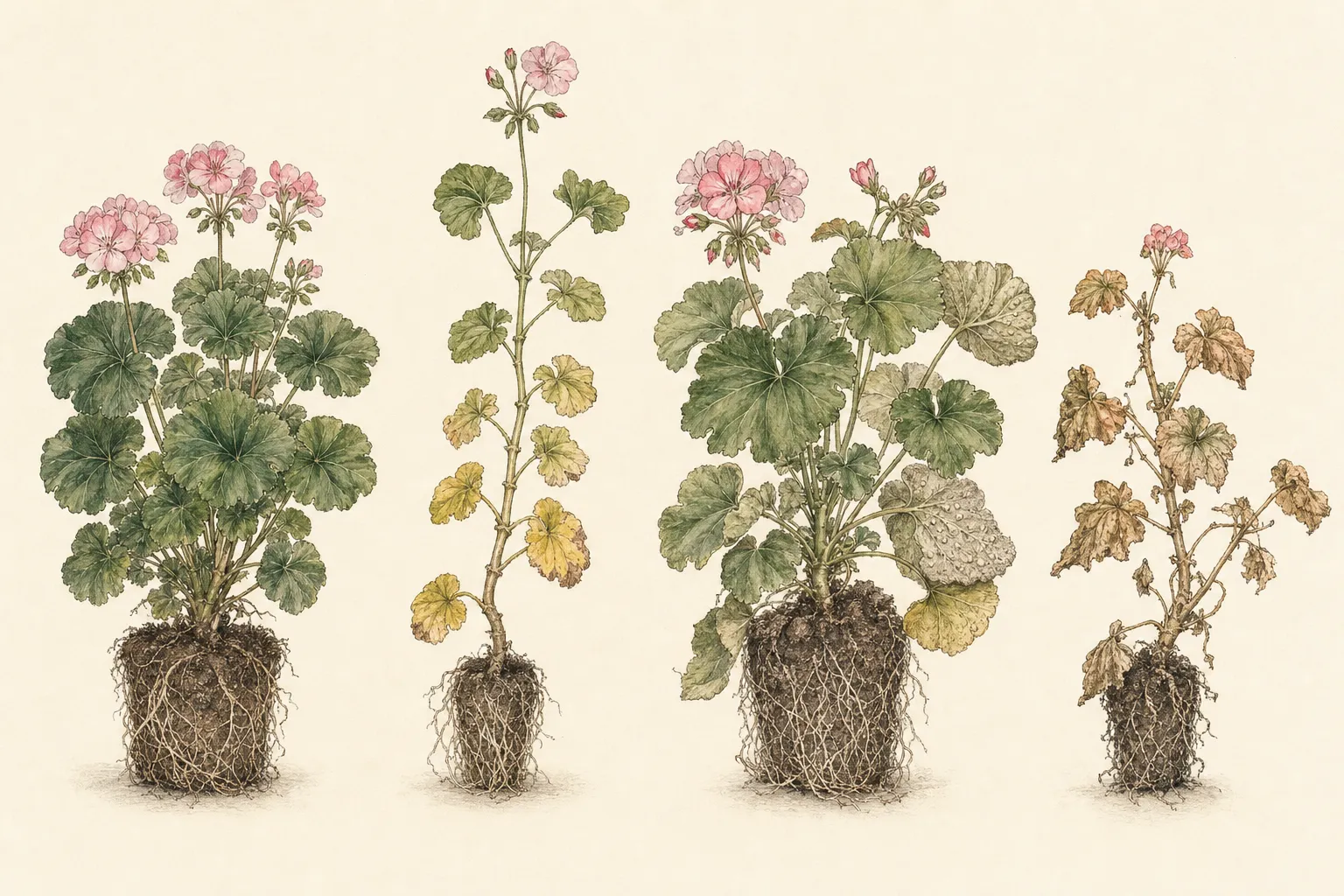
The symptoms Iowa lists for bad setup are exactly the ones winter tender ornamentals show: excessive stretching, spindly growth, yellowing, leaf drop, absent flowers when flowers should be present, or conversely scorch, bleaching, and excessively compact stressed growth. Those are not generic distress signals. They are setup instructions. If the pelargonium is pale and leaning, the answer may be a closer fixture, more even coverage, or a longer correct-day regime. If the begonia is bleaching and curling directly under the bar, the fixture may simply be too close or too intense for that zone.
Read the whole plant rather than one dramatic leaf. A flowering tender ornamental that stays leafy but refuses buds under a long but weak setup is telling you something different from a compact stock plant that only needs to survive. NC State's split between foliage and flowering durations helps here. So does Iowa's note that adjusting the day length is not the same as improving intensity. Leggy plants do not always need more hours. They often need better-quality hours at the right distance.
Keep the adjustments incremental and documented. One change at a time lets you identify whether height, duration, or grouping solved the problem. Three changes at once turn the plant into a mystery again. Winter light management is most effective when every correction creates a new readable baseline.
Keep water, heat, and electricity on separate routes
A winter grow-light station fails as often from sloppy routing as from poor horticulture. Iowa's lighting article and ordinary electrical sense converge here: lights belong on timers, cords need drip loops, and water should have a route that does not pass over live plugs, strips, or drivers. Mature potted ornamentals need deeper watering than seed trays, which means more lift, more runoff, and more opportunities to turn a shelf into a hazard. Build the water route first and let the fixture plan adapt to it.
Heat complicates the problem. LEDs produce less heat than old incandescent fixtures, but NC State still notes that incandescent sources run hot and encourage stretching. Iowa likewise warns that reflectors and enclosed setups can accumulate heat. Overwintered tender ornamentals already live inside heated rooms. If the station sits beside a radiator, above a floor vent, or in an enclosed bright corner, you may create warm weak growth even with technically adequate light. Light and temperature have to be read together.
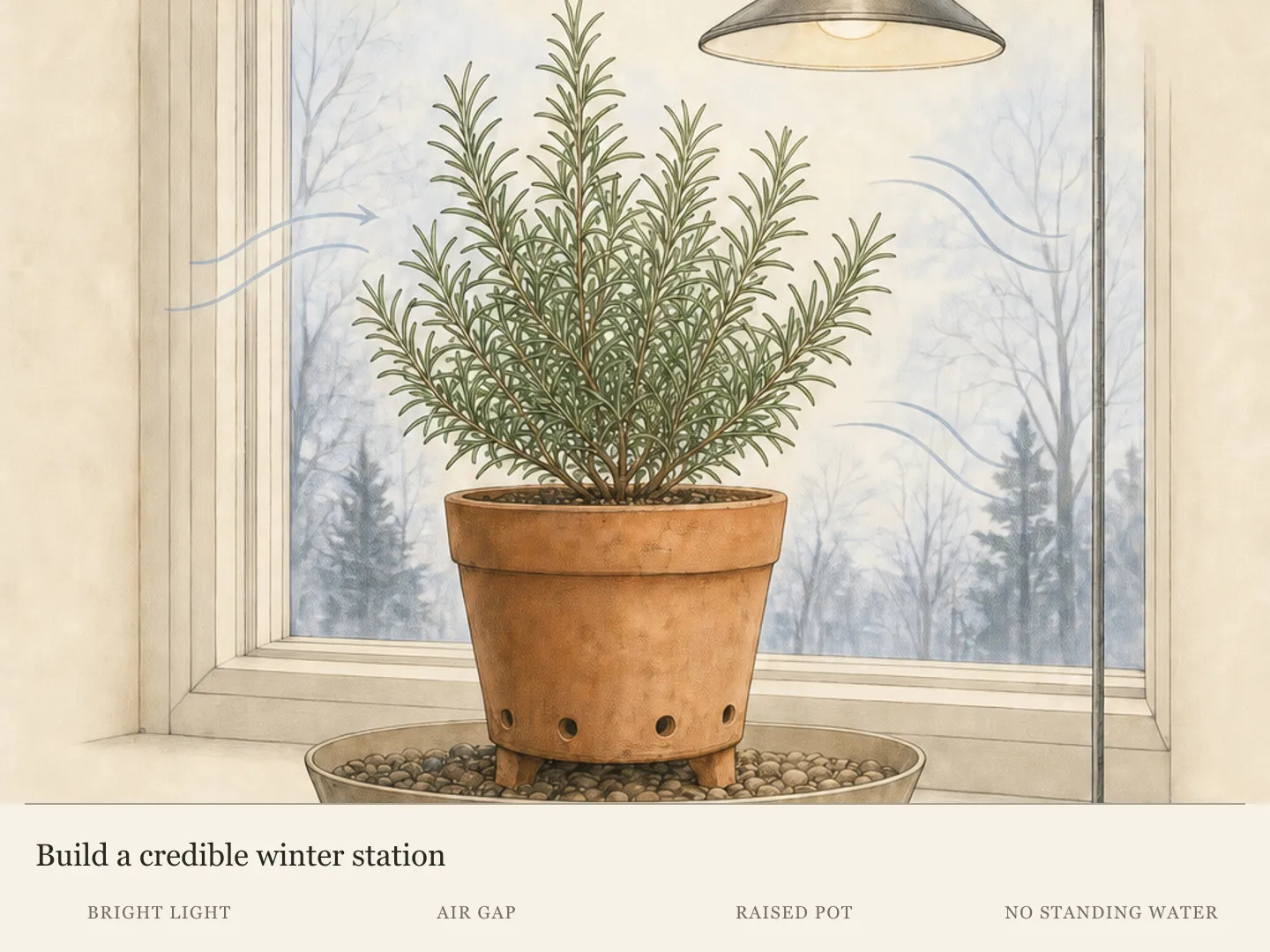
Drainage is part of the tool guide, not background housekeeping. Illinois reminds overwinterers not to overwater merely because a plant looks dry, and that warning grows sharper under lights. A plant using little water in a cool room can rot in a deep decorative sleeve while the grow light above it gets blamed. Empty saucers and cachepots after drainage. Use waterproof surfaces you can wipe, and keep the electrical side physically higher and drier than the irrigation side.
Airflow belongs in this same separation plan. A still overheated shelf makes mildew and pests easier, while a cold direct draft can over-dry leaves and mislead the gardener into overwatering the roots. The winter station should feel stable: light from above, air around the plant, water through the pot, heat moderate, and power out of the wet path.
Diagnose legginess, bud refusal, and scorch as layout problems
Leggy growth is often a geometry problem before it is a nutrient problem. NC State describes insufficient light well: indoor plants stretch, lean, fade in color, and grow poorly. On overwintered ornamentals, that may show as long weak internodes on pelargoniums, stretched coleus stock, or a flowering plant that keeps making leaves while buds stall. The temptation is to feed, pinch, and feed again. Yet if the light station is too high, too short in duration for the plant's purpose, or too dim at the edges, fertilizer only supports more distorted growth.
Scorch and bleaching need the same discipline in reverse. Iowa lists scorched, bleached, dropped, or excessively reddened foliage as signs that intensity should be decreased. That is valuable in winter because gardeners often assume more light is always safer indoors than outdoors. Tender ornamentals disagree. A plant held close to a strong fixture in a dry warm room can show stress that looks like disease or nutrient burn. Before treating the leaf, check the shelf map: distance, hot spots, reflected glare, and whether one pot is sitting on a riser directly beneath the brightest strip.
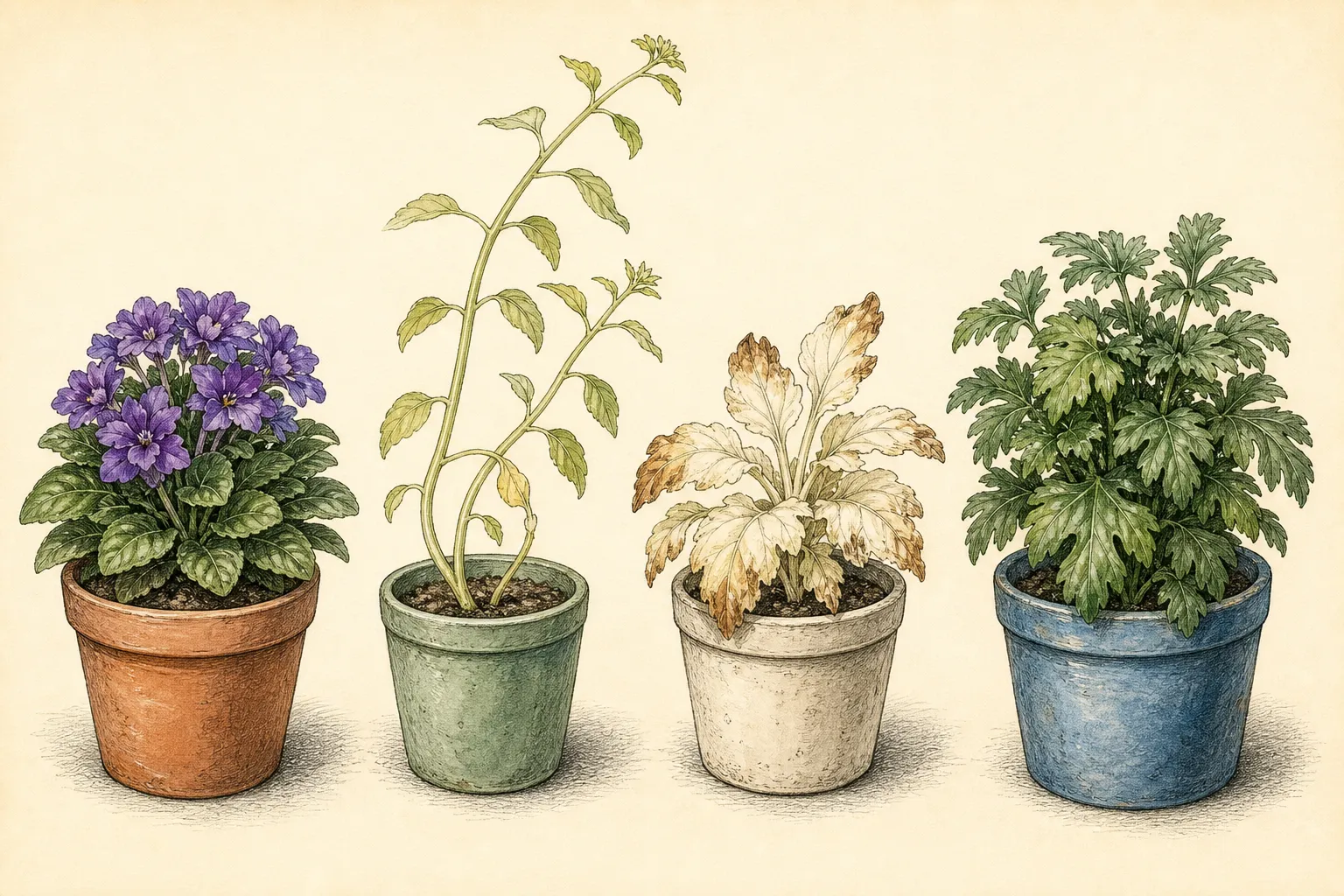
Bud refusal is not generic stubbornness. If a plant that should flower is healthy enough to keep leaves but never sets buds, reconsider duration, darkness, and spectrum before concluding that the plant is simply resting. NC State's flowering-houseplant range of 14 to 16 hours is useful precisely because it reminds the gardener that flowering stock and foliage stock do not share one automatic schedule. Iowa adds that dark-period pollution from lamps or room light can interfere with flowering. In winter houses, that detail matters.
Treat each symptom as a clue about the layout. Leggy means inadequate usable light or poor distribution. Scorch means too much local intensity or heat. Bud refusal may mean wrong duration or dark-period interruption. A good tool guide turns symptoms into settings rather than into panic chemistry.
Maintain the winter station until outdoor return
A winter grow-light station is not set once and forgotten. Iowa recommends monitoring growth over several weeks and making adjustments based on plant response. That is especially true with tender ornamentals because the collection changes over winter. Cuttings are taken, old leaves are removed, one plant flowers, another gets cut back, and the canopy you designed in November is not the canopy you still have in January. The fixture height, timer schedule, and spacing need recurring review.
Maintenance also includes hygiene. Fallen leaves hide moisture problems and harbor pests. Dust on fixtures and reflectors quietly reduces useful output. Timers lose settings after outages. Staking or risers that were stable for one plant become awkward hazards when the pot is moved. Overwintering fails in small preventable ways as often as in dramatic biological ones. The station should therefore be cleaned, re-labeled, and re-read as part of plant care, not after it.
Use the outdoor return as part of the winter design. Plants grown under lights still need an exit plan once frost danger passes. A very sheltered indoor winter canopy can scorch outside if it is moved abruptly into wind and full sun. The better your winter record of duration, height, and plant response, the easier it is to predict which plants will need the slowest transition back out. The station is complete only when it can hand the plant back to spring without shock.
The real success measure is not how much gear is on the shelf. It is whether the plants leave winter compact, alive, identifiable, and worth keeping. Anything in the system that does not serve that goal should be simplified before the next cold season.
Keep a winter-station record by plant group
Record the plant's winter purpose, canopy height, fixture model, manufacturer clearance, actual distance, timer setting, dark period, growth or flowering response, moisture checks and safe watering route. Maintain separate rows for stock plants and flowering plants when their needs differ. Change one recorded control at a time where practical, and preserve the previous setting so the next observation can be interpreted.
Tool notes
- Type
- Adjustable indoor supplemental-light system for mixed potted tender ornamentals
- Purpose
- Provide reliable winter light for tender ornamentals that remain in active leaf or bloom indoors, using a station sized for mature potted plants rather than seed trays. The system must match plant purpose, canopy height, timer-controlled duration, real dark hours, airflow, drainage, and safe electrical routing so stock plants stay compact, flowering plants receive the longer day they need, and the watering route never crosses the power route. Success is measured by plant response and safe repeatable management through the whole indoor season.
- Affiliate
- No commercial links
Maintenance
- Check timer settings after outages and seasonal clock changes, and verify that the dark period is still fully dark. Flowering ornamentals especially can fail quietly if the shelf inherits stray room light or a wrong timer program.
- Adjust fixture height or plant risers whenever a canopy changes enough that one group begins shading another. Mixed winter stock does not stay level for long, so weekly visual review is part of proper light maintenance.
- Dust fixtures, reflectors, and nearby pale surfaces so the intended light actually reaches the foliage. A dim dirty shelf can look bright to the gardener and still underlight the plants.
- Empty saucers, clean trays, and remove yellow leaves promptly. Standing water and plant debris confuse moisture diagnosis and encourage pests and mildew in the very station meant to preserve clean winter stock.
- Log each meaningful change in duration, spectrum choice, height, or grouping beside a short note on plant response. The most useful future setup record is not a product list but a response record tied to real plants.
- Before spring transition, reduce the shelf to the plants worth carrying onward and remove gear that only compensated for a temporary mistake. Each winter station should become simpler and more legible after one successful season.
Related reading
Sources
- Overwintering Tender Plants. University of Illinois Extension. Source record · Accessed 2026-08-19.
- How to Set Supplemental Lights for Indoor Plants. Iowa State University Extension and Outreach. Source record · Accessed 2026-08-19.
- Light Considerations for Indoor Plants. NC State Extension. Source record · Accessed 2026-08-19.