German Bearded Iris
Iris × germanica
A Botanical Index guide limited to German bearded iris, Iris × germanica: identify its bearded flower and rhizome, plant shallowly, preserve drainage and divide an aging clump.
Published Last updated
At a glance
- Light
- Full sun to very light shade, with best flowering in open sun
- Water
- Moderate during establishment and active growth; lower once established, never persistently saturated
- Soil
- Fertile but not overly rich, sharply drained soil with the rhizome at finished grade or only lightly covered
- Hardiness
- Zones 3–10
- Bloom
- May in the Missouri Botanical Garden's St. Louis reference; local climate and the named form can shift flowering
- Height
- 2–3 ft · 60–90 cm
In this guide
Overview
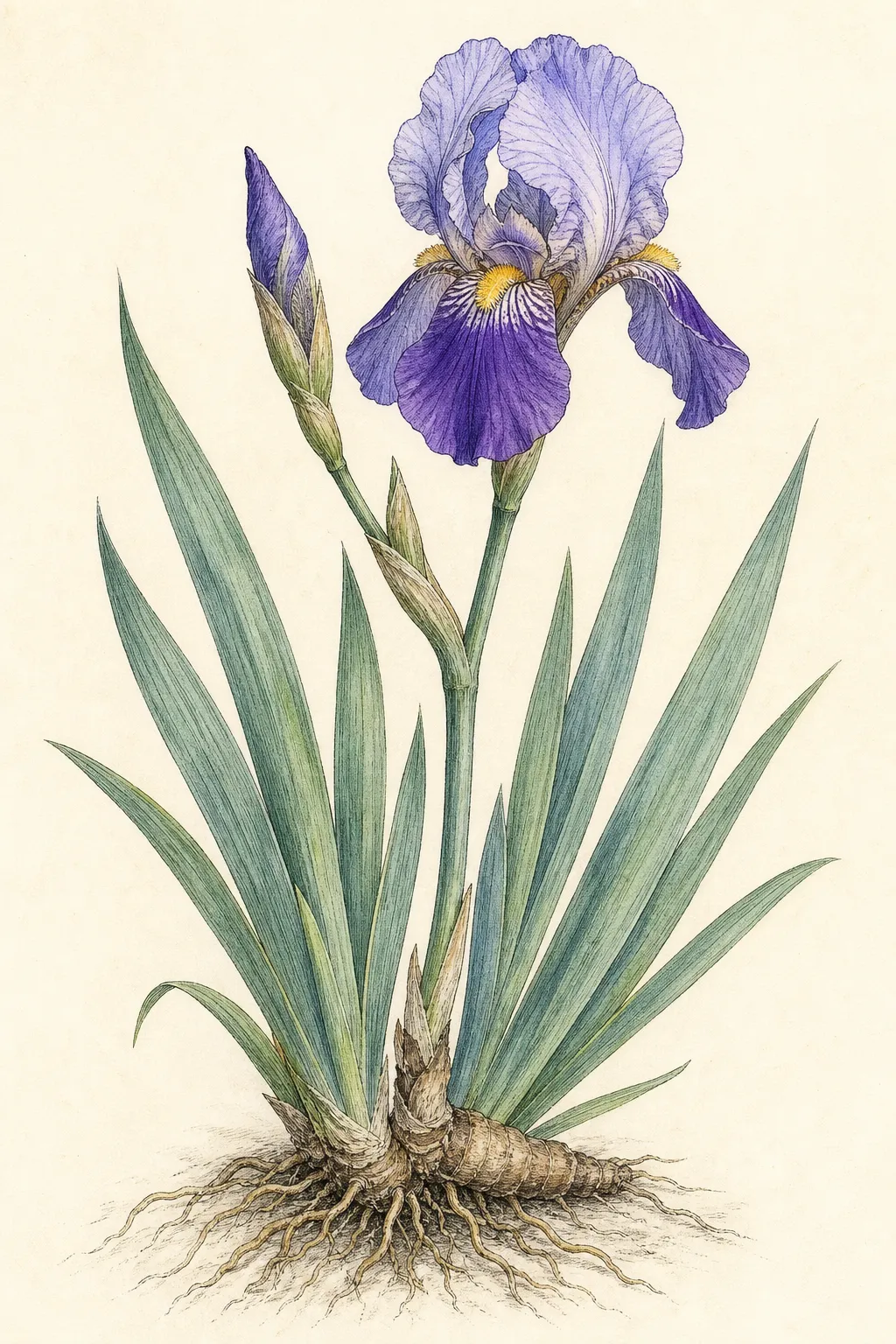
German bearded iris is recognized first at the flower. Three inner segments usually rise as standards, while three outer segments spread or descend as falls. A fuzzy line—the beard—runs along the central portion of each fall and separates Iris × germanica from beardless irises. The six-part flower rises above stiff, sword-shaped leaves arranged in flat fans. Color and pattern can vary, so neither purple flowers nor one decorative trait alone confirms the identity; keep Iris × germanica attached to the plant record.
Below the leaves is a firm horizontal rhizome, a modified stem rather than a bulb or ordinary root. New fans and roots form along this structure, and growth advances outward as older portions age. The direction of the newest fan shows where the clump is moving. This anatomy explains both shallow planting and periodic division: the rhizome needs a well-aerated surface position, while outward-growing branches eventually meet neighboring branches and reduce flowering space.
The name needs a firm boundary. Royal Botanic Gardens, Kew accepts Iris × germanica as an ancient hybrid derived from I. pallida and I. variegata, and North Carolina Extension uses the same hybrid interpretation. This record does not stand in for the thousands of modern bearded-iris hybrids with wider ancestry and formal height classes. If a plant is labeled only tall bearded, dwarf bearded or with another hybrid name, use a source for that group instead of transferring this profile's range and timing.
Missouri Botanical Garden gives German iris a direct garden envelope of 2–3 ft high and 1–2 ft wide, with May bloom in its St. Louis context. Use that range to reserve border space around a confirmed Iris × germanica plant, then keep any full cultivar or clone name because a selected form can differ. The measurements are not permission to compress several rhizomes into one opening or a claim that every modern bearded iris shares the same stature.
Choose an open site with abundant sun and rapid drainage. Missouri Botanical Garden and North Carolina Extension both emphasize full sun, well-drained soil and shallow rhizome placement; the latter allows the rhizome at soil level or lightly covered. The plant may tolerate light shade, but reduced light can weaken flowering and prolong surface moisture. Avoid roof runoff, low pockets, irrigated lawn edges and dense groundcovers that keep the rhizome hidden and damp.
The preferred pH range in this profile, 6.1–7.2, follows Virginia Cooperative Extension's iris guidance. Treat it as a useful soil-test interpretation range, not a reason to add lime or fertilizer without a test. Bearded irises do not need lush, nitrogen-driven leaf growth. Existing soil fertility, organic matter, water quality and cultivar response matter. Correct drainage and depth before treating a poor bloom year as a nutrient deficiency.
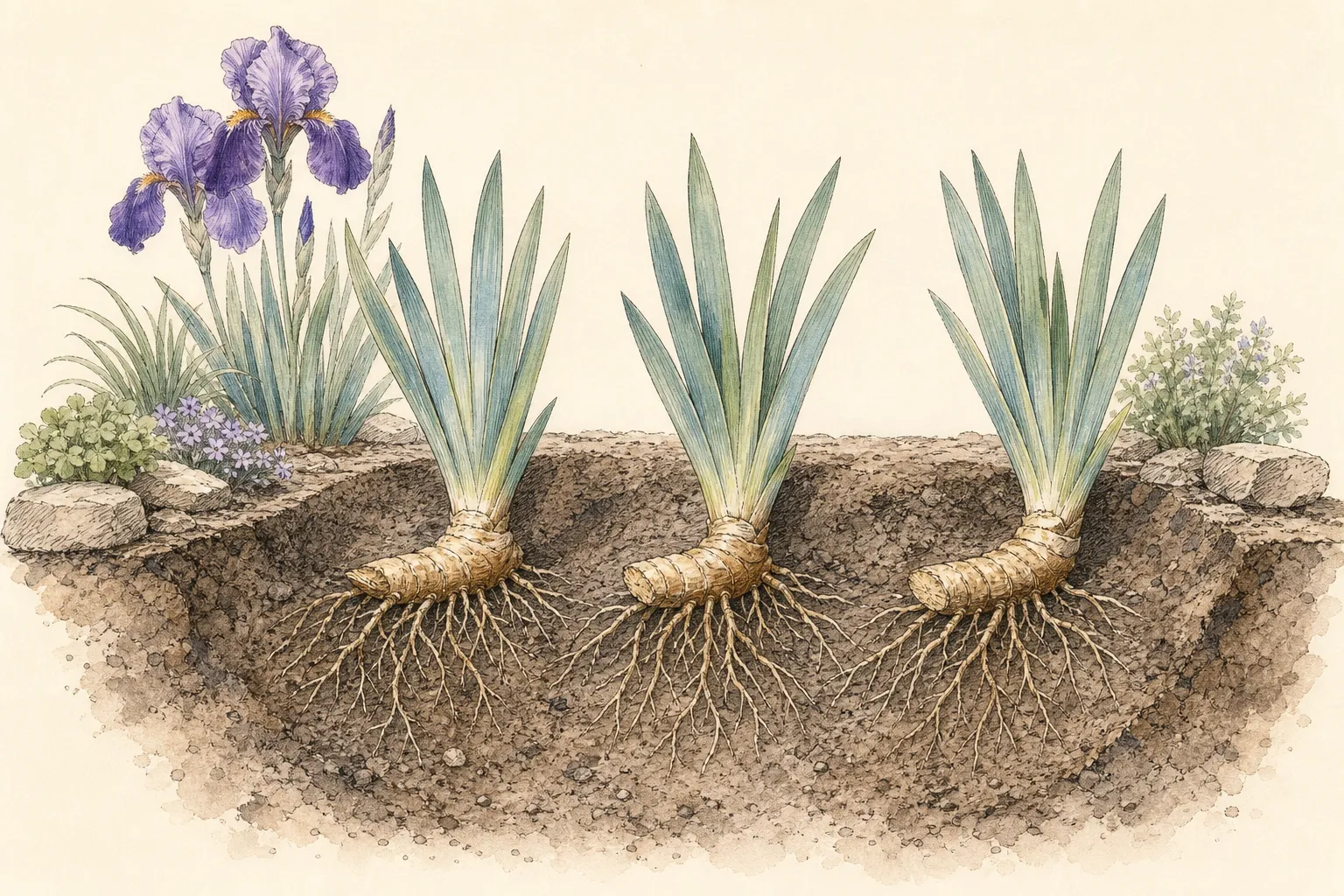
Shallow means the rhizome remains at finished grade or receives only the light cover supported by regional guidance and soil conditions, with roots spread downward into prepared soil. It does not mean leaving roots exposed, balancing the plant loosely on hard ground or following one universal fraction of an inch. In hot, exposed soil, local practice may lightly protect the upper surface; in heavy or wet soil, even a small added layer or deep mulch can become harmful. Recheck after settling and top-dressing.
A German bearded iris leaf fan remains useful after the flowers fade. Remove the spent flower stalk when its display is finished, but preserve healthy green leaves so the rhizome can continue building the next cycle. Remove only damaged or declining tissue as needed and clear fully dead material in the appropriate season. The tidy clipped fan sometimes seen at transplanting is a handling choice, not an invitation to shear an established green clump for appearance.
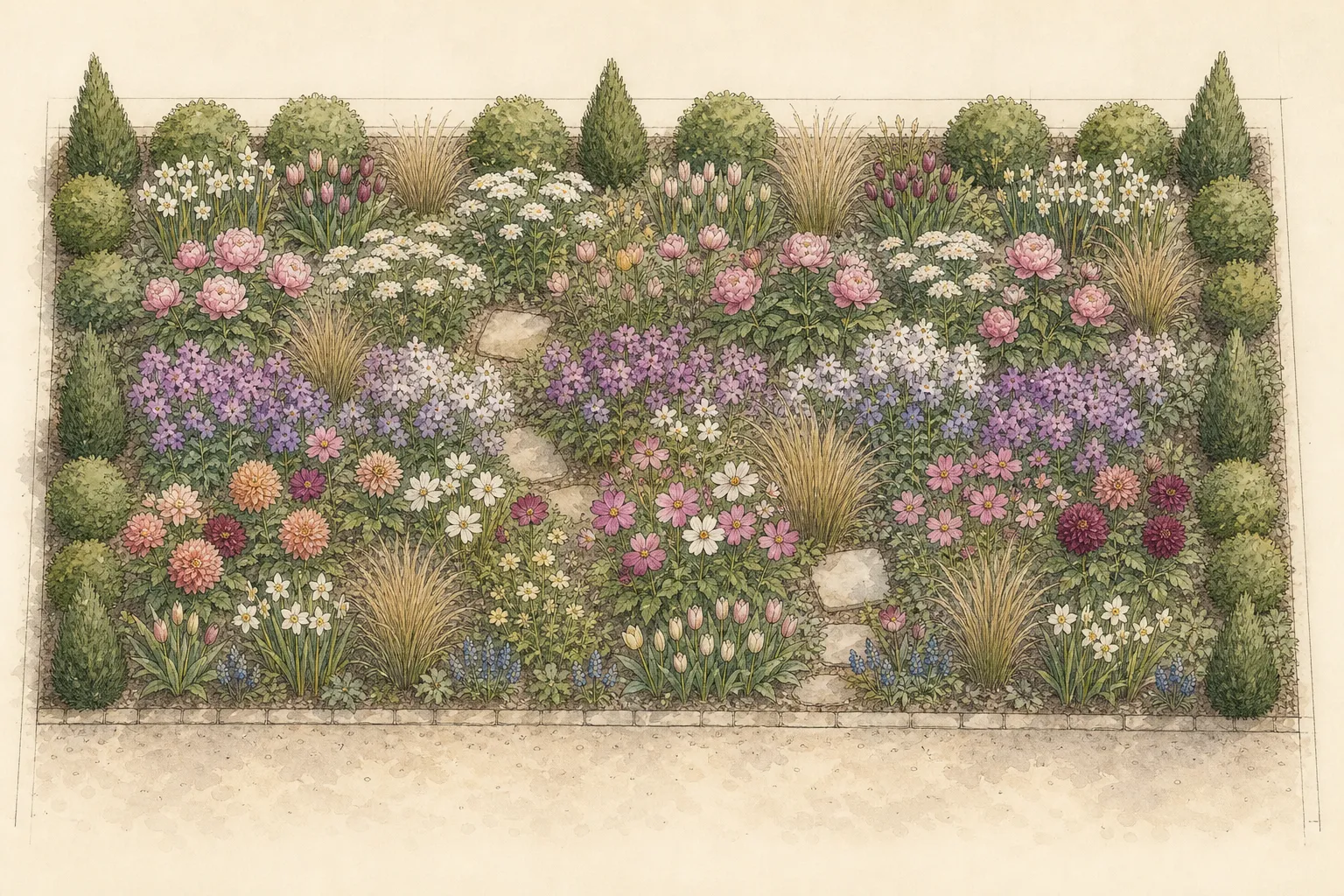
Use Iris × germanica where its structure can be read: sunny perennial borders, cutting gardens, low banks and dedicated drifts with visible rhizome shoulders. Pair it with companions that do not smother the surface or demand constant irrigation. The foliage is architectural before and after bloom, but persistence varies with cold, heat and moisture. Do not attach a later rebloom promise unless a source for the exact named form supports it.
- Family
- Iridaceae
- Range
- Northwestern Balkan Peninsula, following Kew's accepted record for the ancient hybrid Iris × germanica
- Soil pH
- 6.1–7.2
- Spread
- 1–2 ft · 30–60 cm
Planting & careHow to grow german bearded iris
This profile is limited to German bearded iris, Iris × germanica, which Kew accepts as the hybrid I. pallida × I. variegata from the northwestern Balkan Peninsula. Older horticultural references may print Iris germanica or describe origin more broadly; Kew's primary taxonomic record controls the identity here. Missouri Botanical Garden directly reports Zones 3–10, a 2–3 ft height, 1–2 ft spread and May bloom for its St. Louis reference, while Virginia Cooperative Extension places iris near pH 6.1–7.2 and names I. germanica as its bearded example. Those values do not describe every modern bearded-iris hybrid or height class. Confirm any named form against its current supplier and local Extension guidance before treating the envelope as a guarantee in wet-winter, very hot or short-season regions.
- 1Confirm Iris × germanica before using this profile
Record Iris × germanica and any additional cultivar or clone name from the label. Reject a transfer based only on the word bearded: modern tall, border, intermediate and dwarf bearded groups can have wider ancestry and different ranges. Use this record's 2–3 ft height, 1–2 ft spread, May reference and Zones 3–10 only for German bearded iris, then apply the exact label and local guidance.
- 2Choose a sunny, fast-draining position
Map direct sun, roof runoff, irrigation overlap and winter wetness. Keep rhizomes away from low pockets, dense groundcover, heavily watered lawns and aggressive roots. In poorly drained soil, create an appropriately engineered raised position or choose another site; adding a little loose material to one small hole does not repair a saturated surrounding profile.
- 3Use a soil test before changing fertility or pH
Interpret the result against the broad 6.1–7.2 iris range and local recommendations. Correct only documented deficiencies and avoid high-nitrogen feeding that produces excess soft foliage. Prepare a broad bed with stable drainage and let disturbed soil settle before setting depth, because a rhizome planted correctly in loose soil can sink below grade after watering.
- 4Inspect and orient the division
Keep firm rhizome sections with sound roots and at least one healthy fan or growth point. Discard soft, foul-smelling or extensively damaged tissue according to local sanitation guidance. Lay each piece so the newest fan and growing end face into their reserved open space, preventing several divisions from advancing immediately toward one crowded center.
- 5Spread roots below a shallow rhizome
Form a low ridge only if it helps place the rhizome steadily, drape roots downward on both sides and backfill around the roots. Keep the rhizome at finished grade or only lightly covered as local guidance supports. Do not bury it like a bulb, leave roots uncovered or add mulch over the shoulder. Recheck depth after soil settles.
- 6Space to the German iris envelope and outward growth
Reserve the Missouri Botanical Garden's direct 1–2 ft spread around confirmed Iris × germanica, using a narrower exact label only when its source is retained. Keep fans away from paths and companions so leaves remain visible and future division stays possible. In a small grouping, orient growing points outward and do not tuck later plants into expansion lanes because first-year rhizomes look sparse.
- 7Water the roots without saturating the crown
Water after planting to settle contact around roots, then monitor the actual root zone during establishment. Let drainage function between applications and reduce supplemental water as the plant establishes, except during meaningful drought. Redirect irrigation that repeatedly wets the rhizome surface, and expose the crown if soil, mulch or washed debris begins to accumulate.
- 8Label and photograph the shallow grade
Place a durable label outside the expansion path and photograph the rhizome against finished soil. Record planting date, depth, fan direction and source. This baseline makes later diagnosis possible: a rhizome that disappears beneath top-dressing, a clump that crowds its marker or a cultivar that flowers outside its advertised window can be corrected from evidence.
Pruning german bearded iris
Prune German bearded iris by plant function, not by shaping the fan. In spring, remove only leaves that are fully dead, collapsed or clearly damaged, cutting cleanly without nicking the rhizome or emerging flower stalk. Preserve healthy green foliage before and after bloom. During flowering, remove individual faded flowers if neatness or seed prevention is wanted; when the entire stalk has finished, cut the stalk near its base without cutting adjacent leaves. Do not pull a stubborn stalk from the rhizome. Through summer, remove naturally yellowing leaves and any confirmed diseased tissue with clean tools, keeping debris from lodging over the rhizome. Routine shearing of green fans after bloom is unnecessary and reduces useful leaf area. Divide when flowering falls because the clump is crowded, when the center has aged out, or when relocation is needed. Missouri Botanical Garden places division immediately after flowering, while local heat and winter onset control whether that window permits establishment. Lift with a fork outside the clump, wash or brush enough soil away to see the rhizomes, separate sound outward divisions and discard soft or severely damaged portions under local guidance. Some gardeners shorten leaves on divisions to reduce leverage and make handling easier; keep enough healthy fan to identify orientation and support establishment. Replant promptly at the correct shallow grade, water roots in and keep labels with each form. In autumn, clear dead foliage that can mat over the crown, but do not excavate or expose roots while tidying. Gloves are appropriate whenever sap, rhizomes or cut material are handled because Iris can irritate skin and is unsafe to ingest.
Seasonal care
Spring
Expose rhizome shoulders if winter debris or mulch covered them, check drainage after snowmelt or rain and remove only dead leaves. Confirm Iris × germanica before bloom, support an exposed stalk without piercing rhizomes, and use a soil test rather than automatic feeding. Record flower form, actual stalk height and bloom date against the Missouri May reference while identity is easiest to verify.
Summer
Remove finished flower stalks while retaining sound fans. Inspect whether the clump center is crowded, the rhizome has sunk or neighboring plants are shading the surface. Divide in the locally appropriate post-bloom window when needed, reset firm outward divisions shallowly and maintain establishment moisture without keeping the bed wet. Do not count a rebloom claim as a guarantee.
Autumn
Let leaves continue working until they naturally decline, then clear dead or confirmed diseased tissue so it does not mat over the rhizomes. Stop late interventions that would encourage soft growth before local cold, keep top-dressings off the crown and mark small divisions before nearby border cleanup. In mild regions, continue monitoring drainage through seasonal rains.
Winter
Protect the bed from standing water, soil heave and traffic rather than insulating rhizomes under deep wet mulch. Zones 3–10 come from the Missouri German iris record, but drainage, freeze-thaw exposure and a named form can narrow that envelope. Keep the Iris × germanica label attached and plan drainage or relocation corrections before spring growth begins.
Safety and garden spread
Common problems
Few or no flowers
- Look for
- Rhizomes below finished grade, mulch over the shoulders, fewer than expected hours of sun, lush soft leaves after high-nitrogen feeding, or a dense old clump with little open soil between fans.
- Action
- Recover the cultivar and planting record, expose and measure the rhizome grade, map light and use a soil test before feeding. Correct drainage or shade first; divide and reset sound outward pieces in the proper regional window if crowding is confirmed.
Soft or foul-smelling rhizome
- Look for
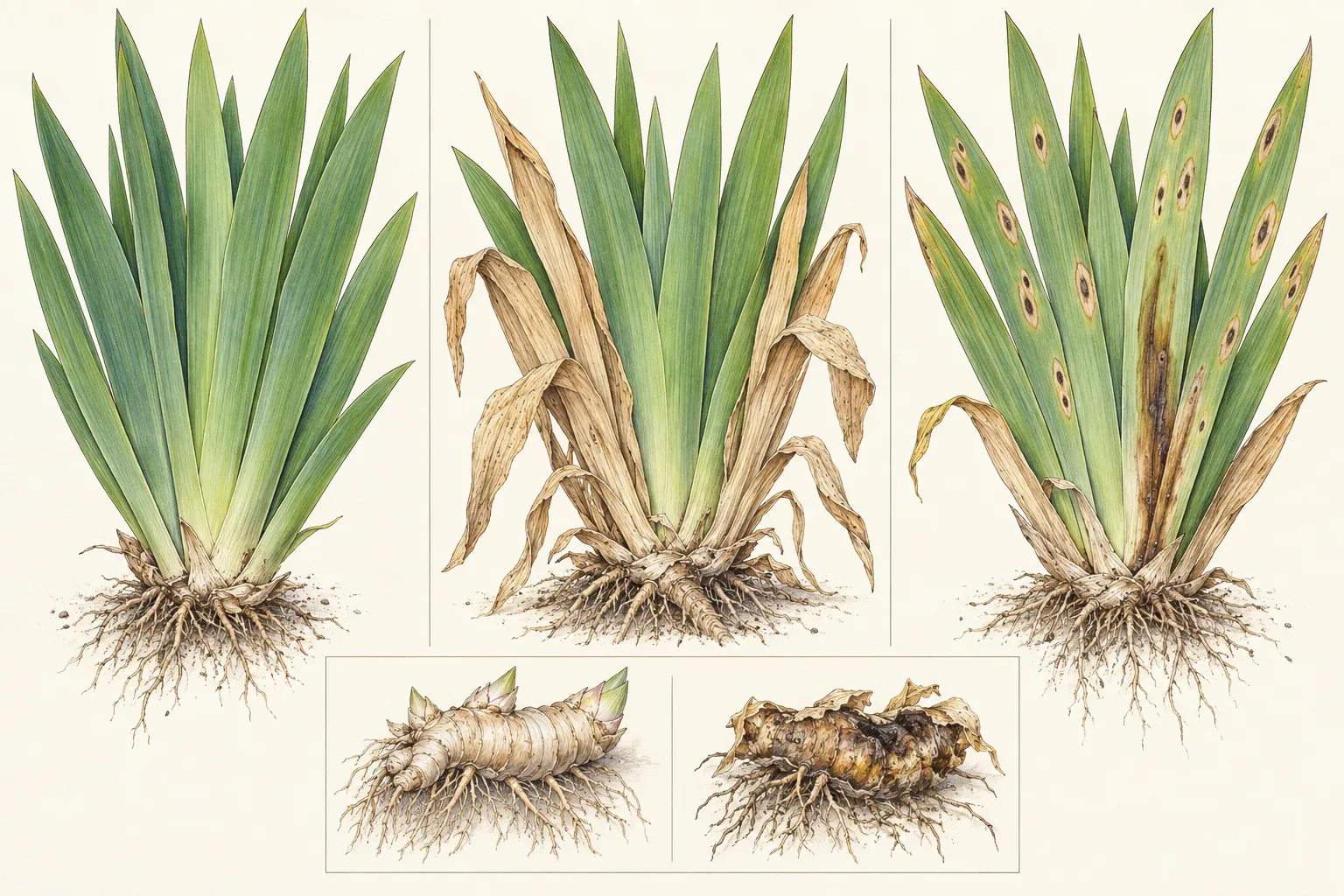
- A rhizome that yields to pressure, dark wet tissue, loss of attached fans or odor in a site that remains saturated or covered.
- Action
- Stop supplemental water, uncover the rhizome and keep people and animals away from removed material. Separate affected tissue only with clean tools and seek local diagnostic guidance when damage is extensive; correct the drainage and depth before replanting sound divisions.
Leaf spotting that expands in wet weather
- Look for
- Repeated tan, brown or dark lesions rather than uniform seasonal yellowing, especially where foliage stays crowded or irrigation wets leaves late in the day.
- Action
- Photograph the pattern, remove badly affected leaves without stripping the whole fan, improve spacing and redirect irrigation to the soil. Clear dead foliage at season's end and use a diagnostic service before applying any treatment.
Clump center dies out
- Look for
- A ring of active outer fans around old bare or weak central rhizomes, with flowering shifting steadily outward and neighboring cultivars beginning to merge.
- Action
- Label every cultivar while flowers or records confirm identity. After bloom in the local division window, lift the clump, retain firm young outer sections and reset them shallowly with growing points directed into open space.
Flower stalks lean or lodge
- Look for
- Tall stalks bending toward light, leaning after wind or rain, or emerging from a cultivar placed behind dense companions, while rhizomes remain firm.
- Action
- Compare the plant with the direct 2–3 ft German iris range, give it more sun and open space, use discreet support installed clear of rhizomes and move it if the site is persistently exposed. Do not bury the rhizome more deeply in an attempt to anchor the stalk.
Rhizome or sap exposure
- Look for
- Chewed rhizomes, access by a pet or child, gastrointestinal signs after suspected ingestion, or skin irritation after handling cut tissue.
- Action
- Stop exposure, wash contacted skin and contact an appropriate medical professional, veterinarian or poison-control service. Do not use this profile for treatment and do not leave divided rhizomes or trimmings where they can be eaten.
Related reading
Sources
- Iris × germanica L.. Royal Botanic Gardens, Kew. Source record · Accessed 2026-08-30.
- Iris × germanica: Bearded Iris. North Carolina Extension Gardener Plant Toolbox. Source record · Accessed 2026-08-30.
- Iris germanica. Missouri Botanical Garden. Source record · Accessed 2026-08-30.
- Small Scale Perennial Production Using Iris as an Example Crop. Virginia Cooperative Extension. Source record · Accessed 2026-08-30.
- Toxic and Non-toxic Plants: Iris. ASPCA Animal Poison Control Center. Source record · Accessed 2026-08-30.