Grow · mature pelargonium bare root winter storage
Overwinter Geraniums Bare-Root Before the First Autumn Frost
Lift suitable mature geraniums before frost, choose a cool bare-root storage space, monitor winter losses and restart surviving plants in spring.
Published Last updated
In this guide
- Start with the room, then decide which plants to lift
- Choose a mature Pelargonium with something worth saving
- Measure the shelf through changing weather
- Lift before frost and support the root area
- Surface-dry and pack with room for inspection
- Check living stems, not the presence of leaves
- Make spring space before opening all the bags
- Judge recovery by growth before returning plants outdoors
- Steps
Start with the room, then decide which plants to lift
Mature bedding geraniums can sometimes overwinter bare-root: lift them before the first autumn frost, remove loose soil, let surface moisture dry, and keep them in a cool, frost-free storage space. The stems must remain alive until you pot the plants again in spring. This is a space-saving option for suitable Pelargonium plants, with real losses possible. It is not a way to put any flowering summer pot into a cupboard and forget it.
Check the room before dismantling the container. Illinois and Minnesota Extension give about 45–50°F (7–10°C) for dormant storage; Iowa State allows a somewhat wider 45–55°F range. A heated living room and an outdoor shed that freezes are different environments, even if both have an empty shelf. If the only available place is warm, keep the geranium potted in adequate light or use the existing cuttings guide while suitable shoots remain.
Late September is a useful preparation point in many temperate Northern Hemisphere gardens, not a universal lifting date. The first frost can arrive much earlier in a cold inland garden and considerably later near a mild coast. Use the local forecast to schedule lifting before frost reaches the plants. A September 30 reminder should prompt a storage check even where the flowers can safely remain outside for several more weeks.
Choose a mature Pelargonium with something worth saving
The familiar bedding geranium is a Pelargonium, often a zonal hybrid with rounded, scalloped leaves and upright flower clusters. Hardy border geraniums belong to Geranium and need a different winter routine. Here the candidate is an established summer bedding plant with a substantial branched base. Keep its cultivar label if you have one; leaf markings alone are not a dependable way to recover the name after winter.
The RHS describes bare-root storage as its least reliable overwintering method and limits it to plants with tough woody stems. That warning should decide the selection. A small recently rooted cutting, a soft young plug and a mature plant with firm older branches are not interchangeable starting material. Keep young plants rooted and growing under suitable indoor conditions. A large canopy by itself tells you little about whether the basal framework is sound.
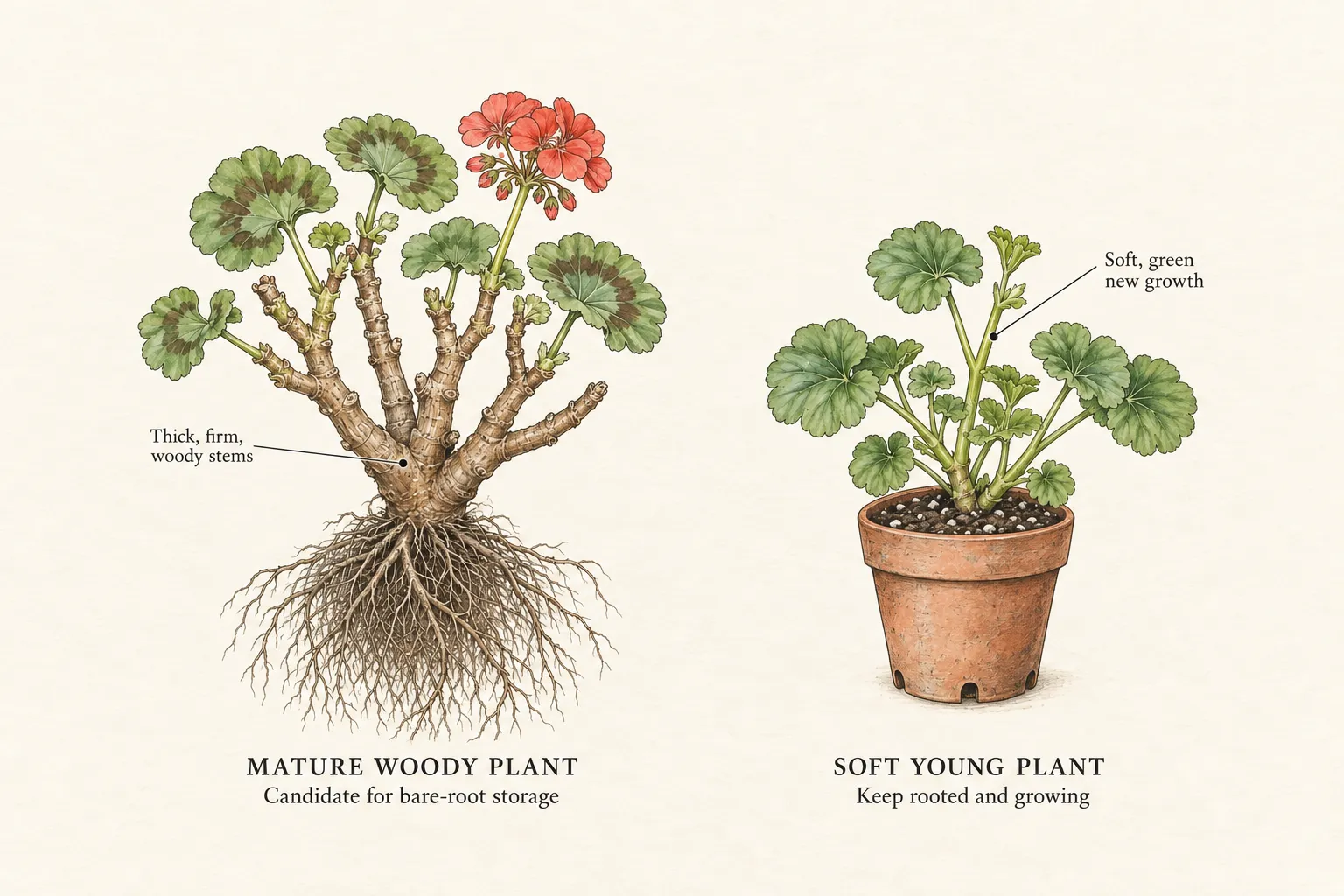
Look under the foliage and around the base before choosing. Illinois advises starting with healthy plants and excluding those showing disease or insect infestation. Set aside plants with unexplained spotted stems, collapse or obvious decay for diagnosis, separate from the storage batch. Brown, firm older stem surfaces can simply be woody tissue; blackened soft areas and a collapsing base deserve a different response. These observations screen candidates, but cannot identify a pathogen.
For a favourite cultivar represented by one plant, consider whether an uncertain storage trial is acceptable. Keeping that plant in a suitable bright room or taking healthy cuttings spreads the risk differently. For a large group of ordinary bedding plants, trying a few mature specimens may make sense. Record which ones enter storage and which remain potted; next spring you will know which method produced usable plants in your actual home.
Measure the shelf through changing weather
Put a minimum–maximum thermometer at plant height in the proposed storage area. Check it across cool nights and warmer days before lifting, then leave it there through winter. This is a practical check on the room, not a claim that one mild week predicts January. A shelf beside a furnace, a porch against cold glass and the interior of a garage can experience different temperatures within the same building.
Choose a position that you can reach easily throughout winter. Open paper bags need space around them, and fallen leaves need removing. Keep the batch away from direct heater output and from a floor or wall known to become wet. A dark storage position follows Iowa State’s bare-root method; it does not make a warm room suitable. If the thermometer shows that the space repeatedly falls outside the chosen range, change the location or the method.
The sources disagree in their descriptions of storage humidity. Iowa and Illinois specify a dry location; Minnesota says its challenging bare-root method requires a cold, damp cellar and includes occasional root soaking. The sources provide no humidity percentage that applies to every house. Use the Iowa/Illinois paper-bag arrangement as the starting setup here, keep plant surfaces dry and inspect for both shrivelling and decay. A sealed wet package is not an equivalent to a cool cellar.
Lift before frost and support the root area
Label each selected plant while its flowers and position still identify it. Lift a bed-grown plant with a fork or trowel working around the root area, then support the base as it comes free. Pulling upward on a long branch can break the part you intended to preserve. In a mixed container, loosen the geranium’s root area carefully and separate it from neighbouring plants before tipping away the remaining mix.
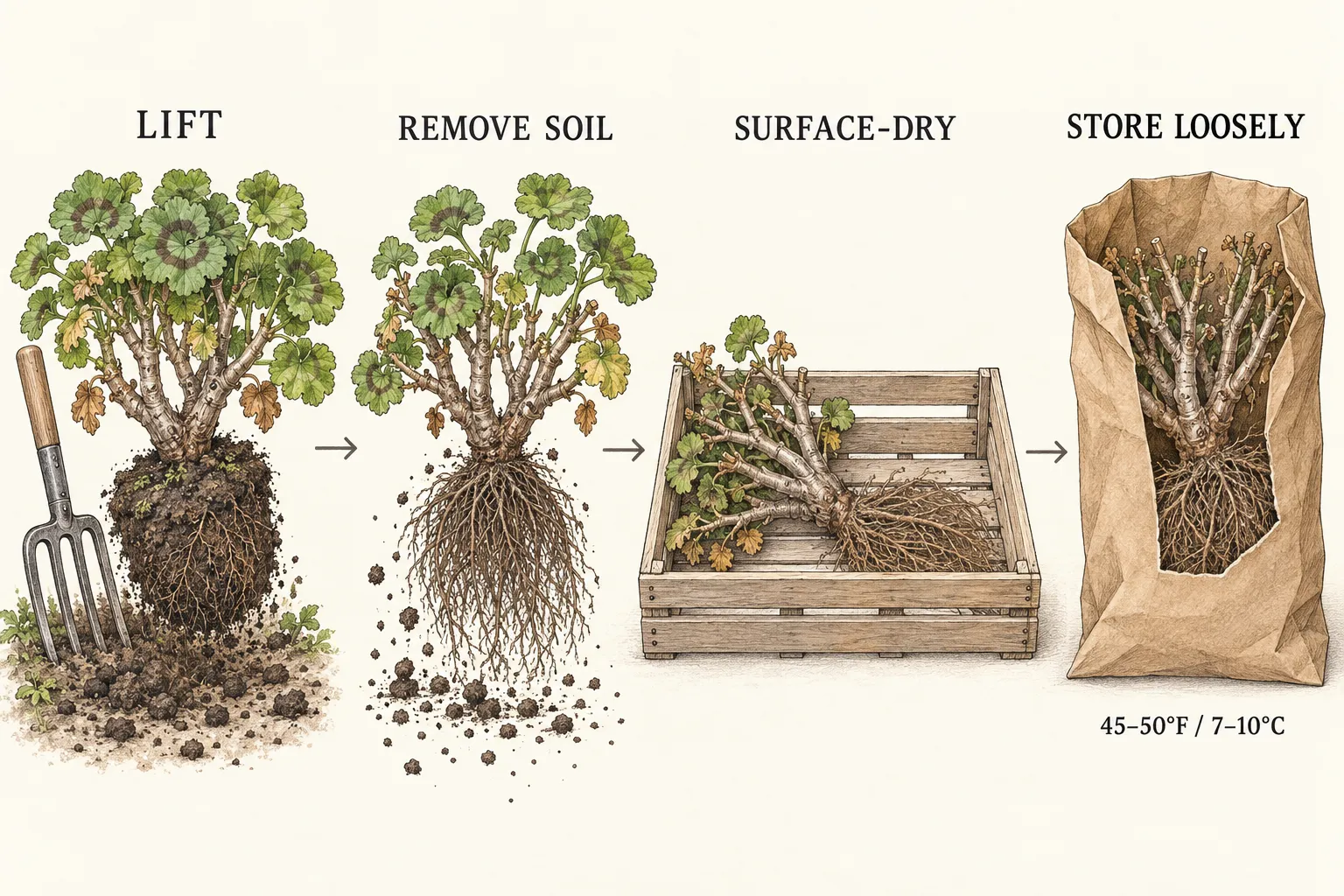
Shake and tease away loose soil from the roots. The target is a manageable bare-root plant, not a polished specimen with every grain removed. The institutional instructions call for soil removal, not scrubbing or a disinfectant bath. Stop working a stubborn root tangle if the next movement would tear sound stems from the base. If you cannot separate a valuable plant sensibly, retaining it in a pot is still an available choice.
Remove fallen leaves and spent flower debris caught among the branches. Save major reshaping for the spring viability check, when dead tips and living tissue can be distinguished in the stored plant. The autumn cutback given for a geranium that will remain a growing houseplant belongs to that separate method. There is no need to copy its reduction onto every bare-root specimen simply because the shears are already in your hand.
Surface-dry and pack with room for inspection
The RHS includes a drying stage before wrapping or hanging: lay lifted plants in crates or on a bench in a frost-free place until foliage and stem surfaces have dried. If rain has soaked the canopy, this stage matters particularly. Spread plants so you can see the branches; a heap of damp leaves defeats the purpose. Surface-dry means free of lingering external wetness, not baked until the living framework becomes brittle.
Place the prepared plants loosely in large paper sacks, or use newspaper and an open crate. Hanging upside down is another source-described arrangement, useful only where the attachment is secure and the whole plant remains accessible. The bag option contains much of the falling foliage and is easier to inspect on a table. Leave the sack open, as the Wisconsin Extension article advises, and resist squeezing an entire container collection into one small package.
Keep a label with each plant as well as on the outside of its bag. A name on a fallen leaf will disappear during the first cleanup. Place the bags on the measured shelf and leave enough clearance to lift each one out intact. Store the plants as plants: adding moist potting mix, fertiliser or a sealed plastic liner changes this into a different arrangement. Photographing the firm stems at this point can give you a useful comparison during later checks.
Check living stems, not the presence of leaves
Leaf loss during storage is expected in the Illinois method, and some shoot tips may die. A bare framework therefore does not, by itself, mean failure. Open a bag periodically and examine the base and main branches for firmness, while removing the detached foliage that hides them. Choose a recurring reminder that you will actually follow; no source establishes one inspection interval that can compensate for an unsuitable room.
Separate a plant with spreading softness, decay or mould from the sound batch. Inspect nearby specimens and the bag for wet debris, then reconsider ventilation and location. Conversely, progressively wrinkled, shrinking stems in a very dry room are a reason to investigate moisture loss before the whole plant becomes brittle. Neither problem is solved by adding fertiliser. These are observations for making storage decisions, not a diagnosis of a particular disease or a promise that damaged plants will recover.
Winter watering advice is genuinely variable. Minnesota recommends immersing bare roots for several hours on several occasions through winter; Wisconsin describes occasional soaking as a practice some gardeners use and acknowledges uncertainty about comparative results. The current Iowa and Illinois bare-root instructions omit routine soaking. Keep that distinction visible: there is no well-supported instruction here to water every bag monthly, nor to guarantee survival with absolutely no water.
If the batch is drying excessively and you choose the Minnesota root-soaking approach, take the plants out, immerse only the roots in a separate container, then let external moisture dry before returning them to storage. Keep stems and loose paper out of standing water. Write down which plants received this treatment. A plant that is already soft and decaying is a poor candidate for additional soaking; reassess its condition and discard specimens that are beyond recovery.
Make spring space before opening all the bags
Bare-root storage saves windowsill space during winter but does not eliminate the need for light in spring. Iowa and Illinois describe restarting in March for outdoor planting in May in their Midwestern setting. Use that as a regional example, with several weeks of indoor recovery, not a universal March appointment. Work backwards from your own safe outdoor season and confirm that there is room for the pots before reviving the whole batch.
Lay out each specimen and prune away dead, shrivelled parts until you reach firm, living green stem tissue. The decisive boundary is tissue condition. A dried tip does not require discarding a sound lower branch, while a completely dead framework has nothing useful to pot. The RHS includes soaking roots for a few hours before spring potting and cutting stems to about 10 cm (4 in); Iowa instead describes pruning to living tissue. Follow the latter condition-based boundary where a fixed height would leave dead material.
Pot the surviving plants in clean containers with drainage and fresh potting mix, giving the roots room to spread naturally. Water after potting and let surplus drain. Provide a sunny window or suitable supplemental light while the plants resume growth. Keep individual labels visible: bare stems that looked alike in February can represent quite different colours for the summer container plan.
Judge recovery by growth before returning plants outdoors
Give revived plants time to show what survived. Wisconsin cautions that stored geraniums can be slow to start again. A still-green stem immediately after potting is a useful sign, but new growth is stronger evidence that a plant is becoming usable. Count expanding shoots and watch the moisture in the pot; a leafless specimen does not demand the same watering frequency as a bushy plant on a warm sunny windowsill.
Use the soil as the watering cue and keep drainage open. Minnesota recommends fertilising indoor geraniums only during active growth, so wait for fresh leaves or shoots before starting a label-directed feeding programme. If growth becomes thin and stretched, reconsider light before increasing feed. Spring recovery is also the time to assess whether the framework will make an attractive container plant or whether healthy new shoots would be more useful as propagation material.
Acclimatise plants gradually before their final outdoor move. The RHS recommends about two weeks of hardening off and keeping pelargoniums protected until frost risk has passed. Start with a sheltered exposure and build toward their intended position while retaining the option to bring them back under cover. Neither the end of storage nor a single warm afternoon removes frost risk. Keep a place indoors for plants whose outdoor date has been postponed.
Compare the recovered batch with the autumn labels before ordering replacements. Note the room’s recorded temperatures, stem condition at lifting, any root soaking and which plants made useful spring growth. This small comparison answers a concrete question for next year: did this particular space keep mature geraniums well enough to justify repeating the work? If losses were high, reserve the shelf for another use and plan earlier cuttings or a smaller group of potted plants.
Steps
- Level
- moderate
- Time
- One autumn lifting session, periodic winter checks and several weeks of spring regrowth
- Tools
- Garden fork or hand trowel, Minimum–maximum thermometer, Clean pruning shears for spring revival, Plant labels and pencil
- Materials
- Healthy mature bedding geraniums with tough stems, Large paper sacks or newspaper and an open crate, Clean draining pots and fresh potting mix for spring
- 1Approve the storage space first
Place a minimum–maximum thermometer on the intended shelf. Aim for the 45–50°F (7–10°C) range described by Illinois and Minnesota, allowing for future cold weather. Confirm that the space stays frost-free and accessible. If it cannot supply cool storage, keep suitable plants potted under light or choose cuttings instead.
- 2Mark and screen the candidates
Select healthy mature Pelargonium plants with firm, tough basal stems. Keep young rooted cuttings out of this batch. Label flower colours or cultivar names while they can still be identified. Inspect the lower stems and foliage before lifting; exclude plants with unexplained decay, collapse or visible infestation.
- 3Lift and remove loose soil
Work before the first frost reaches the plants. Loosen roots with a fork or trowel, support the root area and keep pressure off individual branches. Gently shake away loose soil or potting mix. Separate mixed-container plants carefully, and retain a plant in its pot if removing it would destroy the sound framework.
- 4Dry surfaces and store loosely
Spread the lifted plants in a frost-free airy place until wet foliage and stems have dried externally. Transfer them to open paper sacks with labels attached to the plants. Set the bags on the verified shelf with room to remove and inspect them. Clear away loose leaves as they collect. Keep enough clearance to extract each specimen with its brittle branches intact.
- 5Inspect and respond to the actual change
Check stem firmness and paper condition periodically. Separate decaying specimens. For excessive drying, consider the source-described occasional root-soaking approach, allowing surfaces to dry before rebagging; keep that separate from routine watering of potted plants. Record any treatment and relocate the batch if temperatures cease to suit storage.
- 6Restart survivors under light
Several weeks before your outdoor season, remove the plants, prune dead tips back to firm green tissue and pot viable specimens in draining containers with fresh mix. Water and drain, then provide bright growing conditions. Wait for active growth before feeding. Harden off gradually and keep every plant protected until local frost risk has passed.
Related reading
Sources
- Growing Annual Geraniums. Iowa State University Extension and Outreach. Source record · Accessed 2026-09-16.
- How to grow pelargoniums. Royal Horticultural Society. Source record · Accessed 2026-09-16.
- Growing geraniums as annual flowers in Minnesota. University of Minnesota Extension. Source record · Accessed 2026-09-16.
- How to overwinter geraniums for next year’s garden. University of Illinois Extension. Source record · Accessed 2026-09-16.
- Overwintering Geraniums. University of Wisconsin–Madison Division of Extension. Source record · Accessed 2026-09-16.