Grow · soil led established rose care
Feed and Water Established Roses by Soil, Rose Class, and Season
Separate established-rose watering from feeding, then use the soil-test framework or rose-class schedule published for the garden's region.
Published Last updated
In this guide
- Check soil moisture before deciding whether to feed
- Build a soil and root-zone baseline
- Separate a water decision from a feed decision
- Probe moisture where the roots are using it
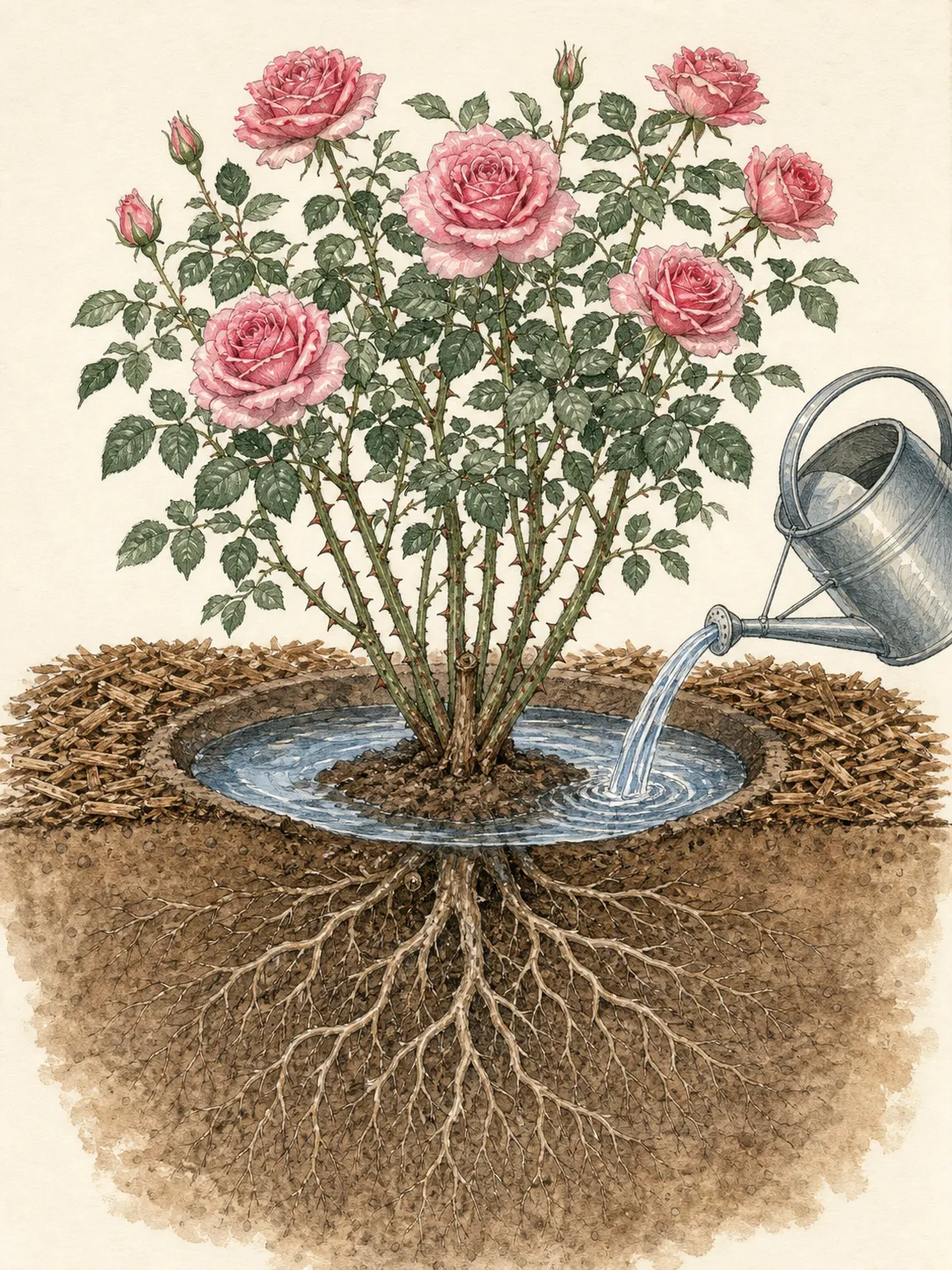
- Water slowly across the broad root zone
- Choose between corrective and maintenance feeding
- Interpret the rose before adding another input
- Adjust through heat, bloom, and dormancy
- Keep a short decision log
- Steps
Check soil moisture before deciding whether to feed
Water established in-ground roses when checks below the surface show dry soil; wilting in wet soil calls for drainage or root assessment first. Decide on fertilizer separately, using the soil-test or rose-class guidance for your region. Maryland, Illinois and UK recommendations below describe different feeding programs; keep each schedule within its own region and rose class. Newly planted roses and container roses need closer watering checks than established border plants.
Keep in-ground and container roses in different categories. The RHS says established border roses generally need supplemental water during dry spells, while container roses need much more water and may need daily attention in hot weather; their compost should neither dry out nor remain waterlogged. The routine follows the root environment as well as the plant's age.
Record rose class, growth stage, soil type, hot or dry exposure, and nearby competition. Illinois Extension makes watering frequency conditional on soil type and heat, while University of Maryland Extension notes competition for water. Those observations can explain changing water use, but active growth, a finished bloom flush, or recent pruning does not by itself prove a nutrient deficiency.
Build a soil and root-zone baseline
Begin with the soil rather than the fertilizer shelf. Observe texture, compaction, drainage after ordinary irrigation, slope, reflected heat, and competing roots. Send a representative sample to a qualified soil-testing service when nutrient status or pH is uncertain. University of Maryland Extension's Maryland guidance gives roses a pH range of 6.0 to 6.5, says to adjust pH only when the testing laboratory recommends it, and ties fertilizer to a deficiency indicated by a soil test. Treat those directions as a regional framework, not a reason to acidify or fertilize blindly elsewhere.
Do not infer the moisture available to a deep-rooted rose from the appearance of mulch or one surface touch. Pull mulch back and check the soil below at two or three representative points within the area actually reached by irrigation. A dry surface can sit above moist soil, and uneven delivery can leave one point unrepresentative. Record where each check was made; the comparison tests irrigation coverage and does not assume that every rose has the same root spread.
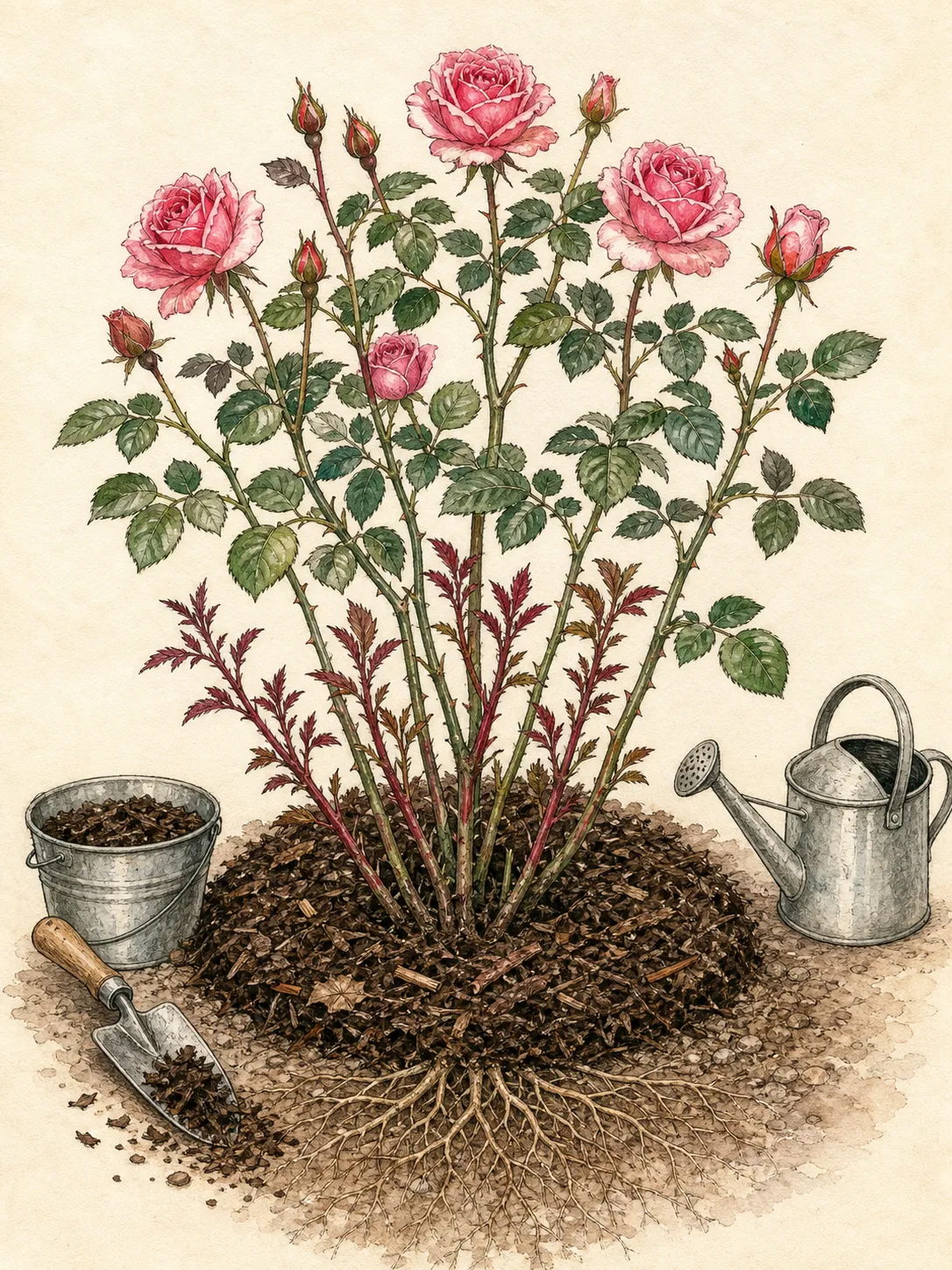
Correct standing water, runoff, and uneven delivery before escalating inputs. Maryland says roses need well-drained soil and identifies soggy soil and poor drainage as causes of decline; Illinois says mulch helps retain moisture and keep soil cool. Keep mulch clear of the stem base as the RHS and Illinois sources specify. Map emitters or a soaker hose so an assumed runtime is not mistaken for equal delivery to every rose.
Separate a water decision from a feed decision
Water and fertilizer answer different questions. Water maintains even soil moisture; feeding follows either a laboratory-confirmed correction under Maryland guidance or an applicable regional maintenance program such as Illinois's. A drooping or pale rose is not permission to apply both. Maryland lists heat and drought, excess fertilizer, overwatering, and poor drainage among distinct causes of rose symptoms, so check the site before adding an input.
Make the water decision first because soil moisture can be checked directly. Inspect below the mulch and surface at representative points, account for rainfall and irrigation, and ask whether water can enter and drain. If the checked soil is dry, water. If it is already moist or wet, do not add water solely because foliage is wilting; Maryland identifies lack of oxygen from poor drainage or too much water as a separate problem. If the checks disagree, postpone feeding until the physical cause is clearer.
Choose the feeding framework before the product. Maryland makes a soil-test deficiency the trigger; Illinois publishes an annual rose-class schedule; the RHS publishes a separate UK border-and-container schedule. A mature rose may have no corrective need under a soil report yet reach a maintenance point under its applicable local program. Neither a soil-only rule nor a calendar date should be exported beyond the region and rose class for which it was published.
Probe moisture where the roots are using it
Use a narrow trowel or soil probe to inspect below the fast-changing surface, then compare the result with recent rainfall and irrigation. Read feel in the context of soil texture: Illinois says sandy soils need more frequent irrigation than heavier clay soils, and the RHS calls out dry, sandy soil as a condition in which settled roses may need additional water. Compare the same locations after a thorough watering and as the bed dries; use the result as a local comparison, not a universal tactile threshold.
Use weather as an input, not a verdict. Maryland says to water when weekly rainfall is less than one inch in order to maintain even soil moisture. Illinois presents one inch per week as a rule of thumb and says soil type and heat alter amount and frequency. A shower or weekly total therefore does not replace a check below the surface. Recheck during hot, dry transitions, then lengthen the interval between checks when conditions stabilize.
The RHS treats container roses separately: they need much more water than roses in the ground, may need daily watering in hot weather, and should be kept from both drying out and becoming waterlogged. Check the compost before watering and confirm free drainage. If water runs through without wetting the mix evenly, reapply slowly; if the pattern persists, inspect the potting mix and root congestion rather than automating more frequent irrigation.
Water slowly across the broad root zone
When a moisture check shows a need, direct the flow onto the soil around the base, avoiding foliage and flowers, as the RHS and Maryland advise. Illinois encourages soaker hoses because they deliver water while keeping foliage dry. Whatever soil-level method is used, inspect the soil afterward at more than one point; a recommended delivery method is not proof that every emitter or runtime wetted the intended area evenly.
The RHS calls settled roses deep-rooted and recommends a good soak rather than frequent light watering, while Illinois calls for uniform soil moisture and says frequency varies with soil and heat. Treat the RHS figure of 5 to 10 litres per established border rose, up to once a week during high-summer dry spells, as UK guidance rather than a universal dose. Pause if runoff begins and check later to see where the water penetrated.
Maryland advises watering early in the day and aiming at the base to reduce leaf wetness. If the checked soil is dry, work within local watering restrictions rather than waiting for a supposedly perfect hour. After watering, replace mulch but keep it clear of stems: the RHS specifies a 10 cm gap around stem bases, while Illinois specifies an unmulched radius of about 6 inches. Preserve the applicable local detail rather than averaging the two measurements.
Choose between corrective and maintenance feeding
For a Maryland garden, use University of Maryland Extension's soil-test framework: fertilize only if a soil test indicates a deficiency, adjust pH only if the testing laboratory recommends it, and read the stated 6.0–6.5 range as Maryland rose guidance. UMD also says not to fertilize roses after early August. Use the report and product label to calculate any correction; do not turn Maryland's deficiency trigger into a universal rule.
For an Illinois garden, Illinois Extension publishes a rose-class and season maintenance schedule: one spring application is usually adequate for species roses; all other roses benefit from a second around June 15 or at the end of spring bloom; and continuous- or repeat-flowering roses may receive a third in mid-July. Its active-growth rule says no fertilizer after August 15, while the same page separately allows fall fertilizing after plants have gone dormant. These are Illinois directions, not universal appointments.
For UK gardens, the RHS uses another maintenance framework: border roses are fed in March or April before flowering and again after the first flush in mid-summer, especially repeat-flowering types; container roses are fed more often, from mid-spring to late summer, with a formulation change once flowering begins. Those UK timings should not be added to the Illinois schedule or used to overwrite Maryland's soil-test rule.
These frameworks disagree in their default posture, and the article does not resolve that disagreement by averaging them. Maryland conditions fertilizer on a tested deficiency; Illinois and the RHS publish recurring maintenance schedules. Use the current recommendation for the garden's own region, rose class, growing system, and stop date. A soil test guides pH and diagnosed nutrient corrections, but it may not by itself define annual nitrogen timing under a regional maintenance program; elsewhere, ask the local Extension or horticultural authority rather than stacking schedules.
Interpret the rose before adding another input
Look for patterns across the whole plant. Uniform pale new growth, color changes beginning on older leaves, weak shoots confined to one side, and scorch aligned with reflective paving suggest different causes. Compare several roses in the same soil and the same cultivar in different sites when possible. A single damaged cane or a few aging basal leaves should not trigger a bed-wide feeding event.
Return to roots and recent history. Was the bed waterlogged, excavated, heavily pruned, top-dressed, or exposed by the loss of a shade plant? Has an emitter clogged or a downspout shifted? Correct an observable site problem and allow time for new growth to reflect the change. Fertilizer cannot reopen a blocked drain, and extra irrigation cannot correct a high nutrient concentration in already wet soil.
Escalate persistent or unclear symptoms to a local Extension diagnostic service with photographs, soil-test results, watering records, cultivar, and a timeline. Avoid naming a deficiency solely from leaf color online. This article ties each feeding action to a named, bounded framework: Maryland's soil-test trigger, Illinois's class-and-season schedule, or the RHS's UK border-and-container schedule. Rootstock, cultivar, soil, climate, and management still affect diagnosis, so an unexplained symptom should not invite a speculative stack of water and fertilizer.
Adjust through heat, bloom, and dormancy
During hot, dry weather, increase observation before increasing frequency. A deep-rooted established rose may still have moisture after the surface dries, while a rose beside a wall may deplete its zone quickly. Blooming and a full leaf canopy can raise demand, but bloom is not a fixed number of watering days. Probe, irrigate when warranted, and preserve an even mulch layer so the interval responds to conditions rather than anxiety.
After a heavy flush or pruning, canopy size and water use may temporarily change, so recheck before continuing a former high-demand irrigation runtime. Keep the feeding decision separate. Under Illinois guidance, a repeat-flowering rose may reach a class-specific maintenance point; under Maryland guidance, feeding still requires a tested deficiency. A soil report can guide pH and diagnosed nutrients without automatically supplying annual nitrogen timing, and a bloom stage does not override Maryland's test trigger.
As growth slows toward dormancy in cold-winter regions, reduce irrigation according to checked soil moisture and use the local rose program for the last feed. Maryland stops fertilizer after early August. Illinois stops active-growth applications after August 15 but separately allows fall fertilizer after dormancy. The RHS container program runs only to late summer in its UK framework. These regional boundaries are not universal; local season and rose class govern feeding, while checked soil moisture governs watering.
Keep a short decision log
A useful log records only decisions that improve the next one: probe condition, meaningful rain, irrigation duration and reach, visible growth stage, soil-test date, and any amendment. Add photographs from the same angle at monthly intervals during active growth. This exposes whether a supposed weekly need was actually a one-time heat response or whether one end of the bed consistently misses irrigation.
Review the log before setting reminders. A reminder should say check moisture under the west rose or review the soil report, not water all roses or apply rose food. Seasonal reminders can prompt mulch inspection, emitter testing, and a soil sample when due. They should not predetermine the result. The garden remains the sensor; the calendar merely ensures that someone looks.
After a season, simplify. Keep the irrigation method that wetted the checked soil evenly, remove duplicate fertilizer events, and revise plans for containers, young plants, and established borders separately. A restrained routine is not neglect. It is active care in which water follows measured dryness, feeding follows one identified regional framework, and every input has a reason that can be checked later.
Steps
- Level
- easy
- Time
- Twenty to forty minutes for a root-zone and irrigation audit, plus soil-testing turnaround time when nutrient evidence is needed
- Tools
- Narrow trowel or soil probe, Watering wand, slow hose, or verified drip system, Straight-sided catch containers for an irrigation test, Gloves and eye protection, Notebook or garden log
- Materials
- Representative soil-test kit or laboratory submission materials, Organic mulch appropriate to the site, Only fertilizer or amendments supported by the selected regional framework or soil report, and by the product label, Replacement emitters or fittings if distribution is uneven
- 1Classify each rose and root environment
Separate first-season and recently moved roses from established plants, and separate containers from open soil. Record cultivar or rose class where known, canopy size, competition, slope, wall exposure, and irrigation type. This prevents the close attention needed by one young root ball from becoming the permanent treatment for every established shrub.
- 2Inspect soil, grade, mulch, and drainage
Pull mulch aside at several points in the area reached by irrigation. Note soil texture, compaction, runoff, standing water, and whether mulch touches stem bases. Correct runoff, blocked drainage, or uneven delivery first. If fertility or pH is uncertain, collect a representative sample for a qualified laboratory instead of choosing a fertilizer from leaf color alone.
- 3Make the moisture decision
Probe below the quick-changing surface in two or three representative locations. Compare the result with recent rain, heat, soil type, and irrigation reach. Water when the checked soil is becoming dry; postpone when it remains moist or wet. For a wilted rose in wet soil, investigate drainage and roots rather than adding water automatically.
- 4Apply water across the root zone
Use a slow soil-level application around the base and across the intended wetted area, pausing if runoff begins. Verify penetration with the probe after the cycle at more than one point. Adjust emitter position or duration until delivery is even. Keep the RHS 5-to-10-litre, up-to-weekly figure within its UK high-summer border context rather than promising a universal dose.
- 5Make the separate nutrient decision
Separate correction from maintenance. In Maryland, use the soil report for pH and diagnosed nutrient needs. In Illinois, use the current rose-class and season schedule. In the UK, distinguish the RHS border and container programs. Elsewhere, use the current local recommendation; do not combine these frameworks. Apply only a product and rate supported by the selected framework and its label.
- 6Apply only during suitable conditions
Feed under the conditions and at the rate specified by the selected regional program and product label. Maryland says not after early August; Illinois says not after August 15 during active growth but separately allows fall feeding after dormancy; the RHS uses different UK border and container timings. Keep material away from stem piles and wet foliage, and never combine regional schedules.
- 7Recheck before correcting symptoms
When foliage or growth changes, compare the whole-plant pattern, neighboring roses, verified moisture, drainage, recent pruning, and site disturbance. Correct one observable constraint and allow response time. Send persistent uncertainty to a local diagnostic service with records rather than stacking water, fertilizer, and amendments in a single speculative treatment.
- 8Turn reminders into inspections
Log meaningful rain, probe condition, irrigation reach, growth stage, and every applied material. Phrase recurring reminders as checks, not automatic actions. At season's end, retain only the frequencies the garden evidence supports and maintain separate plans for established borders, first-season roses, and containers.
Related reading
Sources
- Rose: Identify and Manage Problems. University of Maryland Extension. Source record · Accessed 2026-08-19.
- How to grow roses. Royal Horticultural Society. Source record · Accessed 2026-08-19.
- Care: Water, Mulch, and Fertilizer. Illinois Extension. Source record · Accessed 2026-08-19.