Grow · small garden fountain winterization
Drain and Winterize a Small Garden Fountain
Shut down a self-contained garden fountain before hard frost, empty every water-holding pocket, service the pump by its manual, and keep the dry basin from refilling through winter.
Published Last updated
In this guide
- Decide whether the fountain moves or stays
- Shut down electricity before touching the water
- Trace the water path before taking anything apart
- Drain, clean, and dry in that order
- Service and label the pump for spring
- Keep an outdoor fountain dry after the first drain
- Reopen only after freeze risk and a dry inspection
- Steps
Decide whether the fountain moves or stays
Begin with the fountain's own material, construction, and manual. A lightweight self-contained unit that can be lifted safely is usually best emptied, dried, disassembled, and stored in a dry covered place. Angelo Decor gives that sequence for its fountains when temperatures fall below freezing, while Campania likewise puts indoor or dry covered storage first. Those are manufacturer instructions for their products, not proof that every cast-stone, glazed, resin, metal, or composite fountain behaves identically. Find the model information before treating a general checklist as a warranty-preserving procedure.
A fountain that remains outdoors needs a different endpoint: every cavity must drain, the material must dry, and the setup must not collect fresh rain, snowmelt, or condensation. Size alone does not answer the question. A small bowl can be too awkward or fragile to carry, and a substantial pedestal may separate into manageable pieces. Test the route, door width, shelf strength, and lifting plan while the fountain is still empty enough to handle. If movement would risk a crushed finger, dropped bowl, or damaged finish, prepare it in place instead of turning winter care into a moving accident.
Treat frost resistance and protection from freezing water as separate claims. Haddonstone notes that its water features still need winter preparation even though the material is described as frost resistant. Campania similarly links damage to water accumulating in a fountain and going through freeze-thaw. The practical reading is simple: a material label does not grant permission to leave a basin full. If the maker permits outdoor overwintering, follow the exact drain, component, elevation, and cover directions for that construction. If no documentation can be found, the conservative small-fountain choice is dry, frost-free storage.
Shut down electricity before touching the water
Choose a dry day before the first expected hard frost, while fittings are flexible and surfaces are not icy. Switch the fountain off, disconnect it from its electrical supply, and keep the plug where it cannot fall back into the basin. The Angelo Decor pump manual requires power disconnection before hands enter the water or the equipment is handled. This is the first physical action, not something postponed until the pump is exposed. A stopped timer is not the same as an unplugged pump, and a wall switch does not make an unknown circuit safe to handle.
Look at the cord before moving the pump. Cuts, crushed insulation, a loose gland where the cable enters the motor, or a plug that has overheated are replacement questions, not winter-cleaning projects. The cited pump manual says its permanently attached supply cable cannot be replaced and the pump should be discarded if that cable is damaged. Other models may have different service arrangements, so follow the actual manual. Never lift a pump by its cord. Support the pump body, free the tubing without a twisting load, and keep small seals or adapters in a tray as they come off.
Make the wet work area deliberate. Water released from a tabletop basin can spread across paving, steps, or an outdoor receptacle. Route the drain water to a place that will not create a slip, icing, or erosion problem, and keep the disconnected plug dry. If the fountain has hardwired lighting, an auto-fill connection, or plumbing that cannot be isolated confidently, stop at shutdown and use a qualified service person. This guide owns a small plug-in recirculating fountain; it does not convert a hardwired architectural water feature into a do-it-yourself electrical task.
Trace the water path before taking anything apart
Sketch the operating loop while it is still recognizable: visible bowl, pump inlet, outlet fitting, flexible tube, riser or finial, upper spill, return path, and any concealed reservoir. Photograph connections and flow-control positions. An empty-looking basin is only one part of that loop. Haddonstone's care leaflet directs owners to check the pump intake, pipework, impeller, and rotor, while Campania names stoppers, tubing, lights, and the pump among removable internal components. The winter task succeeds when each water-holding part has an exit, not when the largest surface happens to be dry.
Locate drain plugs from both the visible and underside views. Some molded or double-walled pieces hold water between surfaces, and a hollow finial or tube can retain a narrow column after the main bowl drains. Remove only plugs that the manufacturer's instructions identify as drains, and keep them labeled for spring. Tilt a portable component gently through its designed orientations so openings become low points. Never lever or roll a heavy bowl by a thin rim. Use a sponge or wet vacuum for the last accessible puddle if the material and finish permit it.
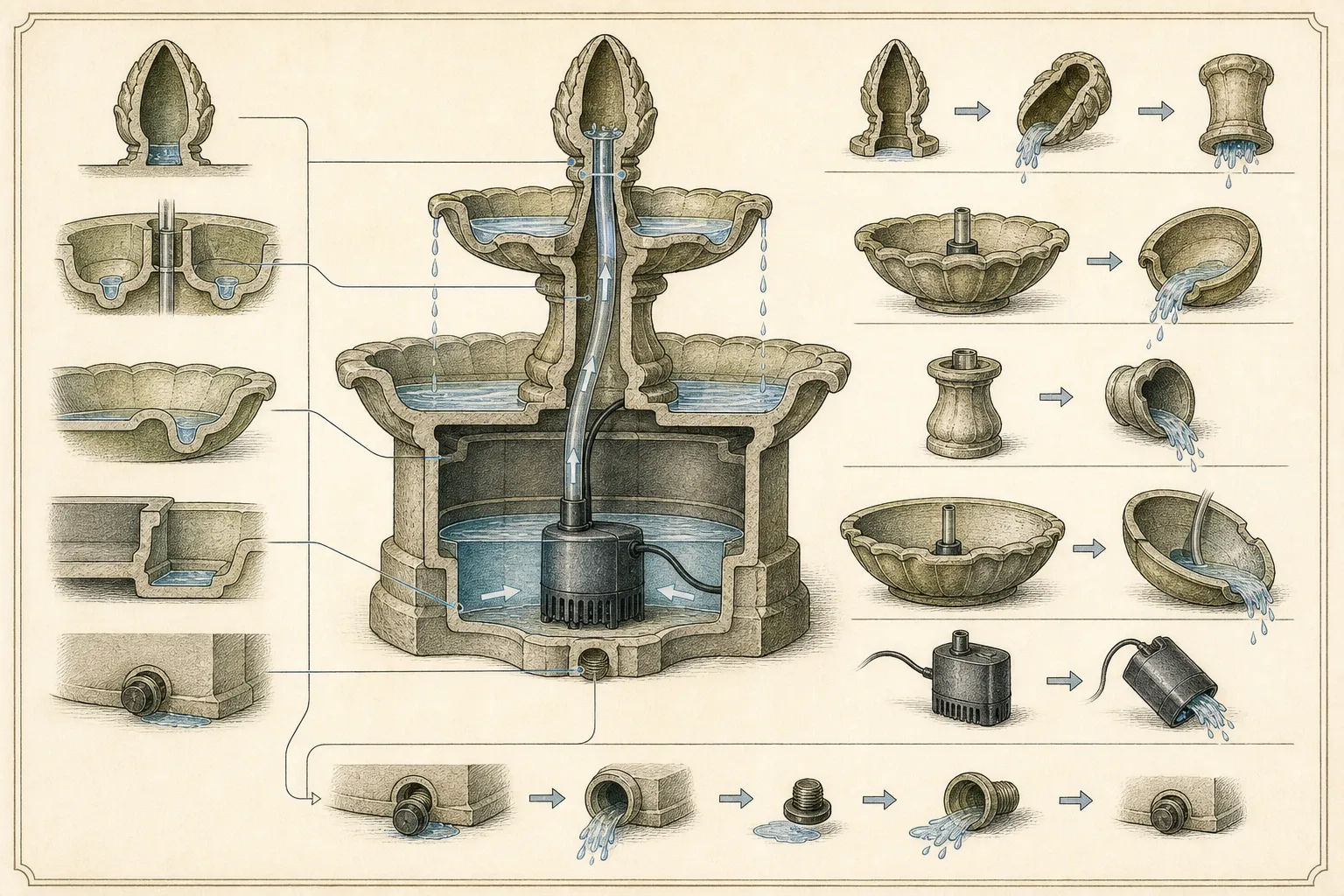
Separate model-specific exceptions here. Campania recommends bringing its internal components indoors but describes a dry, insulated in-place option for some pumps; the Angelo Decor pump manual requires removal, complete draining, drying, and frost-free storage below 0 degrees Celsius; Haddonstone tells readers to use the pump manufacturer's leaflet alongside its fountain guidance. These directions are not averaged into a universal storage trick. Identify the pump and obey its manual. A bucket of water, a dry shelf, and an in-place enclosure are materially different storage conditions, and choosing the wrong one can damage seals or invalidate product guidance.
Drain, clean, and dry in that order
Open the designed drain and let gravity do the first work. Disconnect accessible tubing and hold each length so one end becomes the lowest point; turn fittings through their normal range so water can leave valve pockets. Remove stoppers and drain plugs when the product instructions call for them. Then sponge the shallow films that gravity cannot move. Campania's sequence explicitly calls for complete draining and removal of drain plugs, and Haddonstone advises draining before winter and using a sponge for smaller fountains. The shared purpose is to eliminate standing water from every place it can freeze under constraint.
Clean after the bulk water is gone, because debris hides openings and keeps surfaces damp. Campania recommends a small soft brush with soap and water or diluted white vinegar for its pumps, and Haddonstone directs owners to remove debris and limescale from the impeller or rotor with warm water and mild detergent. Apply only cleaners approved for the actual finish and pump. Work over a tray so an O-ring, shaft, or small cover cannot disappear into gravel. Rinse away residue and inspect the impeller chamber, intake screen, tube ends, and flow control for trapped grit.
Drying needs time and airflow. Set removable parts on towels in their normal drainage orientation, then turn them so hidden lips and recesses can empty. Angelo Decor's winter storage advice emphasizes adequate drying time for porous fountain materials, and its pump manual calls for a completely dry pump in frost-free storage for the listed models. A surface can feel dry while a tube, plug recess, or porous seam remains wet. Give the fountain a dry-weather interval before covering or packing it, and leave compatible drains open so later condensation has a route out.
Service and label the pump for spring
The pump deserves its own small record. Photograph the nameplate, model, tubing size, flow-control setting, and the order of covers around the impeller. Remove loose debris with a soft brush and rinse as the manual allows. Inspect the rotor for free movement without forcing it, and check the intake and outlet for blockages. Haddonstone calls winter a useful time to dismantle and clean the pump, with particular attention to limescale on the impeller or rotor. The Angelo Decor manual also directs periodic cleaning of the rotor and magnet and removal of debris inside the impeller chamber.
Reassemble only enough for protected storage if that is what the manual shows. Put model-specific seals, adapters, and drain plugs in a labeled breathable container rather than loose in the fountain bowl. Coil the cord in a broad relaxed loop; sharp bends and knots make spring installation harder and can stress insulation. Keep the plug off a damp floor. If the pump must remain moist according to a different manufacturer's manual, use that exact method and label the container so nobody drains it casually. The retained sources here do not establish one storage medium for every submersible pump.
Write the shutdown result rather than relying on memory: pump dry or wet by manual, impeller cleaned, tubing location, missing washer, damaged cord, drain plugs stored, and cover date. This is also the moment to order a model-correct replacement instead of discovering failure after the fountain is refilled. Do not energize a pump on the bench to see whether it still works; the cited manuals require submerged operation and warn against running dry. Functional testing belongs in spring after inspection, reassembly, filling, and safe reconnection.
Keep an outdoor fountain dry after the first drain
A fountain left outside can be perfectly drained on Sunday and full again after Tuesday's storm. Build the winter condition around continued drainage. Keep manufacturer-designated drains open, clear the openings of leaves, and position movable pieces so their bowls cannot catch water. Campania advises a dry covered location where possible and recommends a breathable cover for fountains that remain out. The cover is a rain-shedding layer, not a sealed bag. It needs a high point and taut slopes so water and snow move off instead of collecting in a sag over the basin.
Inspect the cover from below before tying it. Fabric should not press a fragile finial sideways, close an open drain, or create a pocket that funnels runoff into the bowl. Campania specifically warns against a plastic cover for its fountains and calls for breathable material, while the manufacturer's elevation instruction addresses bases freezing to the ground. Apply those details only where they match the fountain's manual and material. A different maker may specify another cover assembly. The invariant is not a particular fabric brand; it is a dry, ventilated, drainable fountain with no loaded cover pocket.
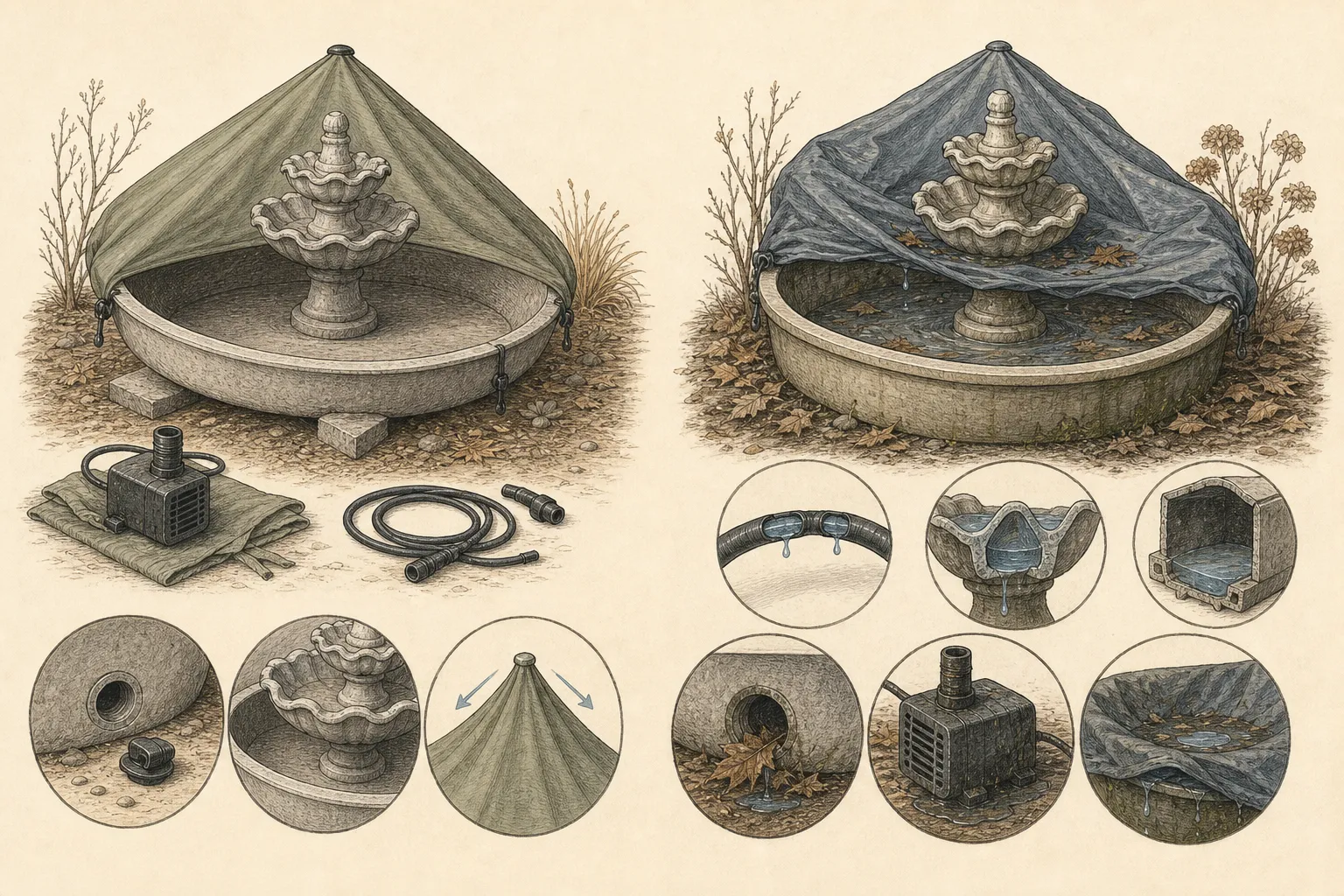
Recheck after the first driving rain, wet snow, thaw, and wind event. Look for standing water, a blocked drain, displaced padding, cover abrasion, or a base sitting in a new puddle. Correct the cause while the water is liquid. A cover that repeatedly fills indicates bad geometry, and a basin that refills despite open drains indicates a hidden blockage or an orientation problem. Winterizing is therefore a maintained state. The first drain creates it; periodic checks preserve it until hard frost has passed and the fountain can be reopened.
Reopen only after freeze risk and a dry inspection
Wait until the risk of hard frost has passed for the fountain's location and the manufacturer's seasonal guidance permits refilling. Remove the cover on a dry day and inspect every shell, seam, drain, stopper seat, tube, and electrical component before assembly. Frost damage may appear as a new crack, displaced fitting, flaking finish, or a piece that no longer sits level. Do not seal or conceal an unexplained crack simply to reach startup. Confirm whether the material maker provides an approved repair, and replace a pump whose cable or housing is damaged.
Reinstall the labeled drain plugs and components in the photographed order. Check seals, reconnect tubing without kinks, place the pump flat, and fill the basin before power is restored. The Angelo Decor and Haddonstone pump guidance both require the pump to be submerged during operation. Watch the first run from beside the receptacle: confirm steady return flow, no leaking joint, no exposed cable damage, and a water level that remains above the intake. Disconnect immediately if the pump hums without flow, trips protection, leaks, or exposes an electrical fault.
Use the reopening notes to improve the next shutdown. A tube that retained water needs a clearer drain orientation; a cover that sagged needs a better support shape; a pump coated in scale needs an earlier cleaning interval; a fountain too heavy to move needs an outdoor plan documented before autumn. The useful endpoint is not merely a working fountain in spring. It is a system whose hidden pockets, removable parts, storage requirements, and weather exposure are now known well enough that the next winterization can be completed before cold arrives.
Steps
- Level
- moderate
- Time
- About 60 to 120 minutes, plus drying time
- Tools
- soft-bristled brush, sponge or wet vacuum suitable for the fountain finish, shallow tray for plugs and fittings, clean towels, phone or camera for connection records, manufacturer-approved hand tools for pump covers
- Materials
- labels and a storage container for small parts, manufacturer-approved mild cleaner, taut breathable fountain cover if the unit remains outdoors, dry protective packing for movable components
- 1Read the fountain and pump instructions
Identify the fountain material, model, pump model, drain points, and permitted winter-storage method before disassembly. Decide whether the empty unit can be moved safely. Manufacturer directions control whether components store dry, remain protected in place, or require another condition; a general fountain checklist cannot replace those product-specific limits.
- 2Disconnect power and secure the plug
Switch off and unplug the pump before putting hands in the water. Keep the plug dry, inspect the cord without lifting the pump by it, and stop if a hardwired circuit, damaged cable, or unknown lighting connection makes the shutdown uncertain. Route drain water away from walking surfaces and electrical equipment.
- 3Record and open the complete water path
Photograph tubing, flow controls, plugs, and fittings, then trace the visible bowl, pump chamber, tubes, riser, finial, concealed reservoir, and double-walled cavities. Remove only designated drains and labeled components. Arrange every portable part so its opening becomes a true low point rather than trapping a narrow column of water.
- 4Empty every accessible pocket
Let gravity drain the large volume, disconnect tubing, rotate fittings through their normal range, and use a sponge or suitable wet vacuum for shallow residual water. Keep drains open when the manufacturer calls for it. An empty upper bowl does not prove that the pump chamber, pipework, shell cavity, or finial is empty.
- 5Clean and dry the pump by its manual
Brush debris from the intake and clean the impeller or rotor only with methods approved for the model. Rinse away compatible cleaner, allow hidden recesses to drain, and use the required frost-free storage condition. Label adapters, seals, and settings. Never energize a submersible pump on a dry bench to test it.
- 6Create a dry outdoor condition if needed
Orient bowls so they shed water, keep designated drains clear, and install the manufacturer-approved cover with a high point and taut runoff slopes. Keep the base out of standing water where the product guidance requires elevation. The cover must not close drains, load a finial, or create a pocket that catches snowmelt.
- 7Audit after weather and reopen carefully
Check the dry condition after rain, snow, thaw, and wind, correcting pooled water before it freezes. In spring, inspect for cracks and cable damage, restore labeled parts, fill completely, and only then reconnect power. Observe the first circulation cycle and stop immediately for leaks, blocked flow, or electrical protection trips.
Related reading

Sources
- Product Care & Information. Campania International. Source record · Accessed 2026-08-20.
- Fountain Pump Instruction Manual. Angelo Decor International. Source record · Accessed 2026-08-20.
- Pumps and Fountains: Care and Maintenance. Haddonstone. Source record · Accessed 2026-08-20.