Grow · garden records
Build a Year-End Garden Photo Audit for Next Season
Reassemble the season with mapped photo sets, light notes, plant names, and action labels so winter planning starts from evidence rather than memory.
Published Last updated
In this guide
- Decide what the photo audit must change next season
- Compare each bed across the year’s photographs
- Pair every photo set with a mapped base plan and light pattern
- Audit sequence, congestion, gaps and failure cues separately
- Record plant names, timings and standout behavior while evidence still exists
- Convert the archive into actions before orders and spring work
- Steps
Decide what the photo audit must change next season
A year-end photo audit is not a sentimental slideshow of what bloomed. It is a decision tool. Before you sort a single image, finish a sentence that gives the archive a job: next year I need this record to help me decide where the border looked thin, which plants smothered neighbors, which bed stayed dry first, which labels failed, or which combinations deserve repeating. Without that question, photographs stay decorative and memory stays in charge.
Illinois Extension's garden-journal guidance is valuable here because it frames record keeping as future use, not nostalgia. The journal should hold dates, weather, planting and bloom times, varieties, and what succeeded or failed so the gardener can plan the future more intelligently. Oregon State Extension makes the winter function even plainer in its January calendar: keep a garden journal and consult it in winter to plan the growing season. A photo audit is strongest when it serves that same winter-planning purpose.
This is also why the article promises an audit, not a simple album. Albums preserve chronology. Audits separate evidence into decisions. One folder might answer whether a peony ring was installed early enough. Another might show that a bed that looked full in June became vacant by August. A third might confirm that the west border received far more late-day sun than the plant list assumed. You are not merely saving pictures. You are sorting proof by the kind of garden choice it can support.
Set the scope at the beginning. Decide whether the audit covers the whole garden, one difficult border, every container grouping, or only the places likely to change next season. A smaller exact audit completed in one winter session is more useful than a heroic garden-wide archive that never reaches the action stage. The purpose of the first step is to keep the project answerable and tied to next year's real work.
Compare each bed across the year’s photographs
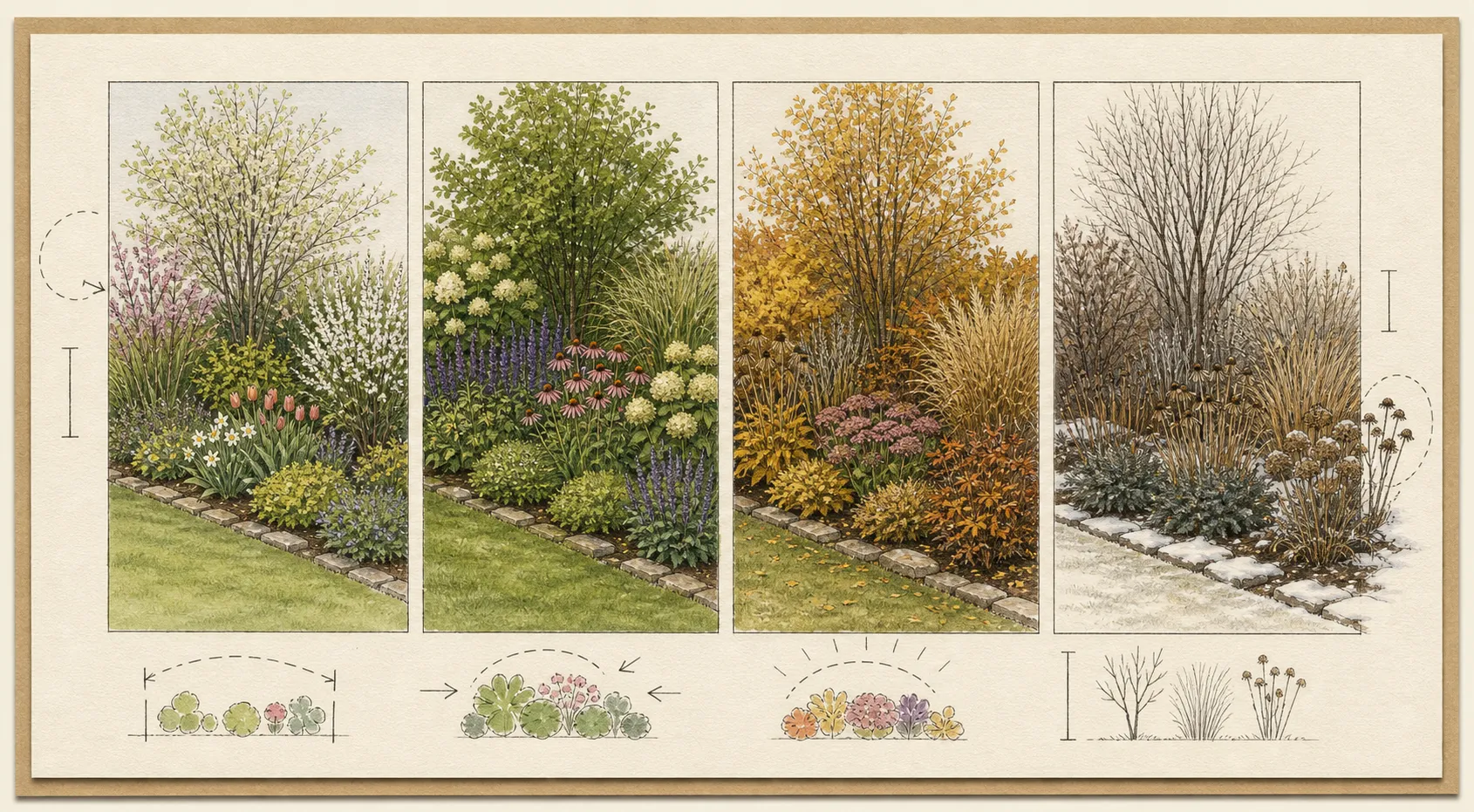
Memory compresses the season in ways that photographs can correct. A gardener may remember the lavender bed as continuously successful because July was glorious, or remember the front border as weak because autumn collapse was fresh and dramatic. A year-end audit rebuilds the season bed by bed so no one month gets to speak for the whole year. That means gathering images from spring, early summer, high summer, autumn, and winter structure where available rather than keeping only the most flattering moments.
Illinois Extension's journaling advice gives the right kind of details to recover while the season is still recent: date, weather, planting dates, bloom time, and specific varieties. The same article recommends sketches showing where plants are located and encourages adding photos directly into the record. That is a useful reminder that the photographs do not stand alone. When you sort them by bed or container, pull in the notes that explain whether a week was hot, wet, windy, or unusually late to emerge.
Work one bed or one viewpoint at a time. Create a simple sequence for each area: earliest growth, peak build, midseason stress, late-season performance, and dormant structure if you have it. Doing this area by area prevents two common failures. The first is drowning in volume. The second is comparing different places as if they were the same problem. A shaded bed and a hot reflected wall planting may both look sparse in one month, but the reasons and next actions are different.
Do not wait for a perfect image set before you begin. An audit can still work when one phase is missing, provided you label the gap honestly. If June is absent, note that the midseason transition is inferred from May and July images rather than pretending otherwise. The goal is not a museum archive. The goal is a decision file honest enough to show what was actually observed and what remains uncertain.
Pair every photo set with a mapped base plan and light pattern
Photographs become far more useful when they are tied to a map. Illinois Extension's youth-gardening planning page says a journal can include a map of the garden, what seeds were planted, weather, pictures of flowers, pollinator or wildlife visitors, and photographs of the harvest. University of Minnesota Extension similarly advises starting an inventory with an aerial photo or hand-drawn map so existing resources and opportunities are visible in one frame. Those two sources together provide the structure for a year-end audit: images should point back to a mapped location, not float free of the site.
RHS gives the next layer of rigor by recommending a rough sketch first, then measured mapping of the garden's size, layout, fixed objects, and where the sunlight falls. Even for an established garden, that reminder matters because photographs distort distance and can hide the relationship between plants and hard boundaries. A scale plan or clearly labeled rough plan tells you whether an apparent crowding problem came from one overgrown clump, a path that is narrower than memory, or a tree canopy that moved the light line over time.
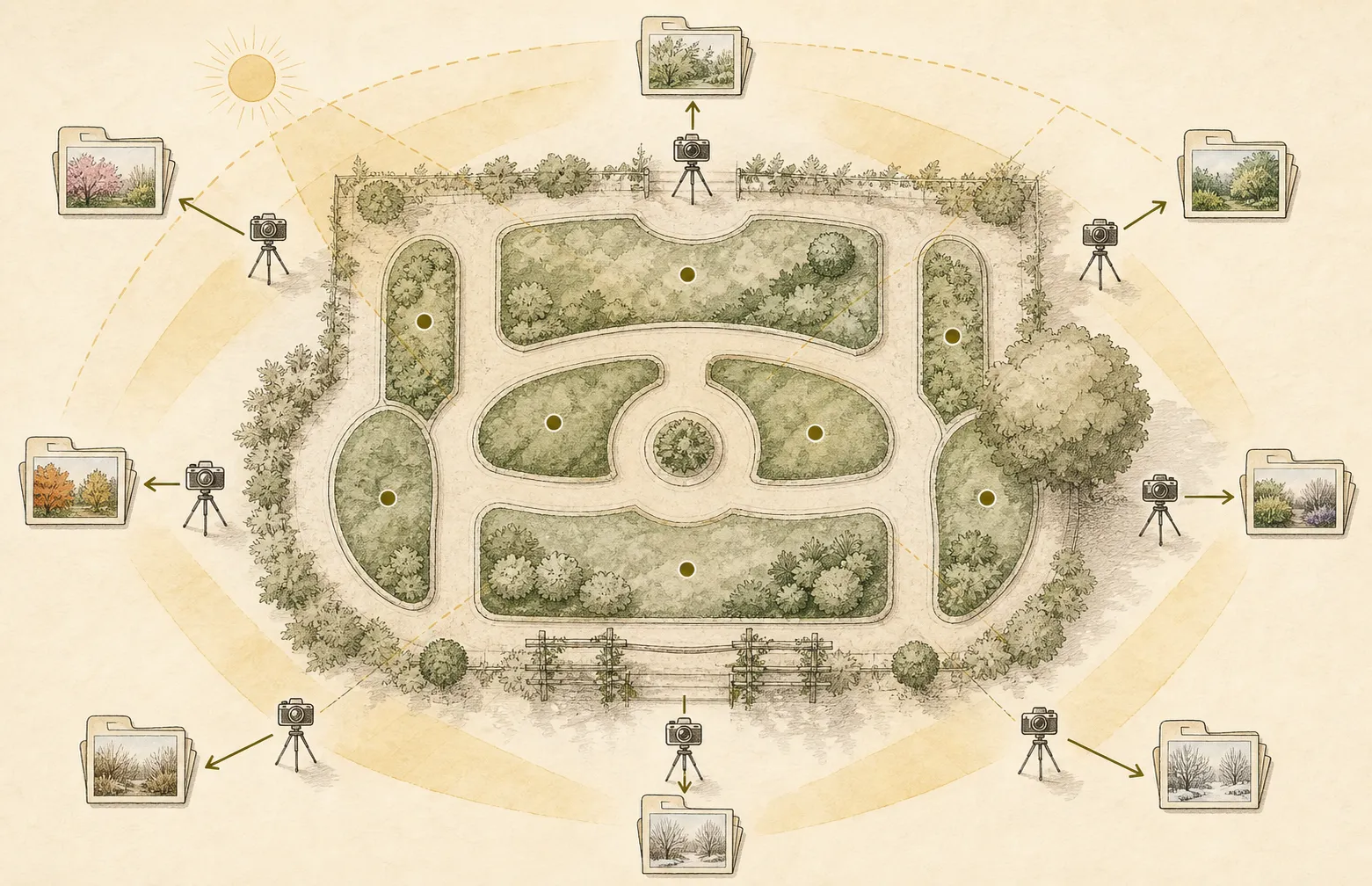
Choose fixed camera stations for future usefulness even if this year's images came from casual angles. Mark on the plan where a photo was taken from, which direction it faced, and which bed label it belongs to. The same view repeated next year becomes comparable evidence. Without that fixed viewpoint, the gardener may misread a wider angle as a larger gap or a close crop as a denser planting. The map stabilizes the perspective.
Add light notes to the same plan. RHS explicitly tells gardeners to map where sunlight falls, and that is one of the strongest correctives to wishful plant shopping. A bed that glowed in a spring morning image may sit in punishing late summer sun by afternoon. A supposedly shady corner may receive enough early light for one plant group and far too little for another. Pairing images with the light pattern converts beautiful pictures into horticultural evidence.
Audit sequence, congestion, gaps and failure cues separately
A useful photo audit does not ask whether the garden looked good overall. It asks separate questions that photographs can actually answer. One question is sequence: when did one plant group finish and the next begin, and where did the handoff fail? Another is congestion: which combinations looked promising in May but became a single undifferentiated mass by July? A third is gap structure: where did the bed open up after bulb foliage collapsed or early bloomers were finished?
Treat these as distinct passes through the images. In the first pass, mark sequence. In the second, mark crowding, flop, or access loss. In the third, mark bare phases, dead space, or uneven height transitions. When all questions are asked at once, the record becomes vague because every picture seems to show too many things. An audit becomes actionable when each image receives only the labels it can truly support.
Use the same discipline for failure cues. A photograph may show that one side of a plant browned first, that a path edge stayed wetter, that a support was visible because it was installed late, or that a bed lost definition after mulch slumped. What it does not automatically prove is the cause. Pair the cue with notes from the journal on weather, watering, bloom time, and plant identity before translating it into a conclusion. The visual record is strongest when it stays evidence-rich and interpretation-careful.
This separation also improves design work. A picture can show that a bed lacked winter structure even if it was colorful in July. Another can show that the same bed succeeded structurally but failed in bloom sequence. If those are marked as the same issue, next year's edit may solve only half the problem. The audit should distinguish aesthetic structure, seasonal continuity, horticultural stress, and maintenance access as different kinds of decisions.
Record plant names, timings and standout behavior while evidence still exists
The end of the season is the last easy moment to connect photographs to exact plant identity. Illinois Extension recommends recording scientific names because they make it easier to retrieve accurate information later. That advice matters even more in ornamental borders where similar leaf textures or flower colors can blur together once labels disappear. A photograph of a successful combination is much less useful if one of the two stars is remembered only as something purple or a salvia of some sort.
Use the audit pass to capture not only names but timings. Illinois Extension suggests writing down planting dates, bloom time, and harvest or equivalent seasonal milestones, and that habit translates directly to flower and foliage gardening. Note when the peony finished, when the clematis cover became dense enough to hide its support, when the hydrangea finally read as full, and when a gap opened after bulbs were spent. Sequence cannot be redesigned later if it was never dated while the season was legible.
Standout behavior deserves its own field. Record which plants leaned, reseeded, vanished under competition, stayed clean, colored well in autumn, or held useful winter structure. If pollinators or other wildlife use is part of the garden's purpose, the planning page from Illinois and the University of Minnesota inventory approach both support noting those visitors in relation to mapped places. That is not sentimental extra detail. It is evidence about how the garden is functioning in use, not only in appearance.
Photographs alone rarely preserve the invisible context. A plant may look sparse because it was newly divided, because it was mislabeled, or because a tree canopy had thickened since spring. Write those explanations onto the audit board while the information is still close at hand. The article's promise is next-season decision making, and decisions improve when the picture is anchored to real names, timing, and observed behavior rather than reconstructed later from a flattering thumbnail.
Convert the archive into actions before orders and spring work
An audit is finished only when every labeled image can point to one of a few action types. Leave and repeat. Move. Divide. Re-support. Relabel. Reduce. Add structure. Fill a seasonal gap. Recheck light before buying. Test soil before blaming the plant. Once the archive has those action labels, it stops being an end-of-year project and becomes a planning tool. Without them, it remains a beautifully organized memory bank that still leaves spring decisions vague.
Use winter to test the action list against the mapped plan. Oregon State's reminder to consult the journal in winter is exactly right because winter slows the garden enough for sequencing and purchases to be considered on paper. The photograph that showed August emptiness now meets the scale plan and the plant list. The note about a mislabeled rose or a crowded peony now meets the bed measurement. The action list becomes realistic because it is no longer floating free of space and time.
Keep orders, divisions, and construction inside the evidence boundary. If the audit never captured afternoon shade in the north bed, do not order sun-demanding fillers because a bright morning photo looked promising. If the map shows the path is already too narrow, do not solve a seasonal gap by adding another broad perennial there. Evidence protects the gardener from designing against the known conditions of the same site.
Reopen the audit just before spring work starts. One last look at the mapped photo sets, plant names, and action labels is often enough to prevent impulsive buying or misplaced dividing. That is the value of a year-end garden photo audit. It carries the garden's own evidence across the dormant season so that next year's work begins from observed truth rather than from whatever the memory of one beautiful week chose to keep.
Steps
- Level
- easy
- Time
- About 60 to 90 minutes for a small to medium home-garden audit once photos are gathered
- Tools
- phone or camera, printed plan or notebook, pens or colored markers, access to the season's photo library, plant labels or records for identification checks
- Materials
- one mapped garden plan or a clearly labeled rough sketch, seasonal photo folders or printed contact sheets, garden journal pages or digital notes tied to dates and beds
- 1State the decision the audit must support
Write the exact question the photo audit must answer next season, such as where sequence failed, which border needs more structure, or which plants should be moved rather than repeated. A year-end review is only useful when the archive has a job beyond admiration. Limit the scope to the whole garden, one border, or one set of containers if that makes completion more likely.
- 2Gather the season by bed or viewpoint
Pull together images from spring through autumn, plus winter structure when available, and sort them by bed, container group, or fixed viewpoint instead of by date alone. Add any missing context from your notes, including weather, bloom timing, plant identity, or unusual events. Sequence matters more than isolated highlight shots.
- 3Attach each image set to a mapped plan
Use a rough sketch, scale plan, aerial photo, or hand-drawn map and label every bed or viewpoint clearly. Mark where each photo was taken from and which direction it faces. Add sunlight or shade notes while the pattern is still familiar. Images become reusable next year only when they can be returned to the same place and angle.
- 4Run separate passes for sequence, gaps, and congestion
Review the images once for seasonal handoff, again for crowding and flop, and again for bare phases or structural weakness. Do not ask every question in a single pass. Clear labels such as gap, crowding, support visible, late color, or strong winter structure keep the archive honest and make later planning faster.
- 5Record plant names and timing while evidence is fresh
Write down scientific or cultivar names where known, along with bloom periods, division dates, and any repeated behavior such as lodging, mildew, or strong late-season color. Add notes about pollinator or wildlife use if that is part of the bed's purpose. The photo is much more valuable when the plant and its timing are no longer guesswork.
- 6Translate labels into action categories
Convert each observation into a next-step label such as repeat, move, divide, remove, relabel, test soil, add support, or fill late-season gap. Keep the action specific to the evidence the image actually shows. The audit is complete only when the archive can direct a planting, editing, or maintenance decision rather than merely describe a past problem.
- 7Match the actions against space and light
Check each planned change against the garden map, bed dimensions, and light pattern before you order plants or schedule divisions. A photograph can suggest beauty or failure, but the mapped plan tells you whether there is room, suitable light, and a clear route for the proposed correction. Winter is the best time to resolve those conflicts on paper.
- 8Reopen the audit before spring buying and work
Read the action list once more just before the new season begins. Confirm that purchases, divisions, support repairs, and labeling work still match the evidence gathered at year end. This final reopening is what turns the photo audit into a practical bridge between one season's observation and the next season's garden decisions.
Related reading
Sources
- Garden Journal: A helpful gardening tool. Illinois Extension. Source record · Accessed 2026-08-19.
- Planning. Illinois Extension. Source record · Accessed 2026-08-19.
- Creating your garden plan. Royal Horticultural Society. Source record · Accessed 2026-08-19.
- Creating a pollinator management plan. University of Minnesota Extension. Source record · Accessed 2026-08-19.
- January garden calendar. Oregon State University Extension Service. Source record · Accessed 2026-08-19.