Virginia Sweetspire
Itea virginica
A practical species profile of Itea virginica, with identification, garden placement, soil and seasonal care guidance.
Published Last updated
At a glance
- Light
- Full sun to partial shade
- Water
- Moderate to high; tolerates periodically wet soil
- Soil
- Moist, fertile soil; slightly acidic is preferred, but the shrub is adaptable
- Hardiness
- Zones 5–9
- Bloom
- Late spring to early summer
- Height
- 4–10 ft for the species; cultivars may be smaller · 1.2–3 m for the species; cultivars may be smaller
In this guide
Overview
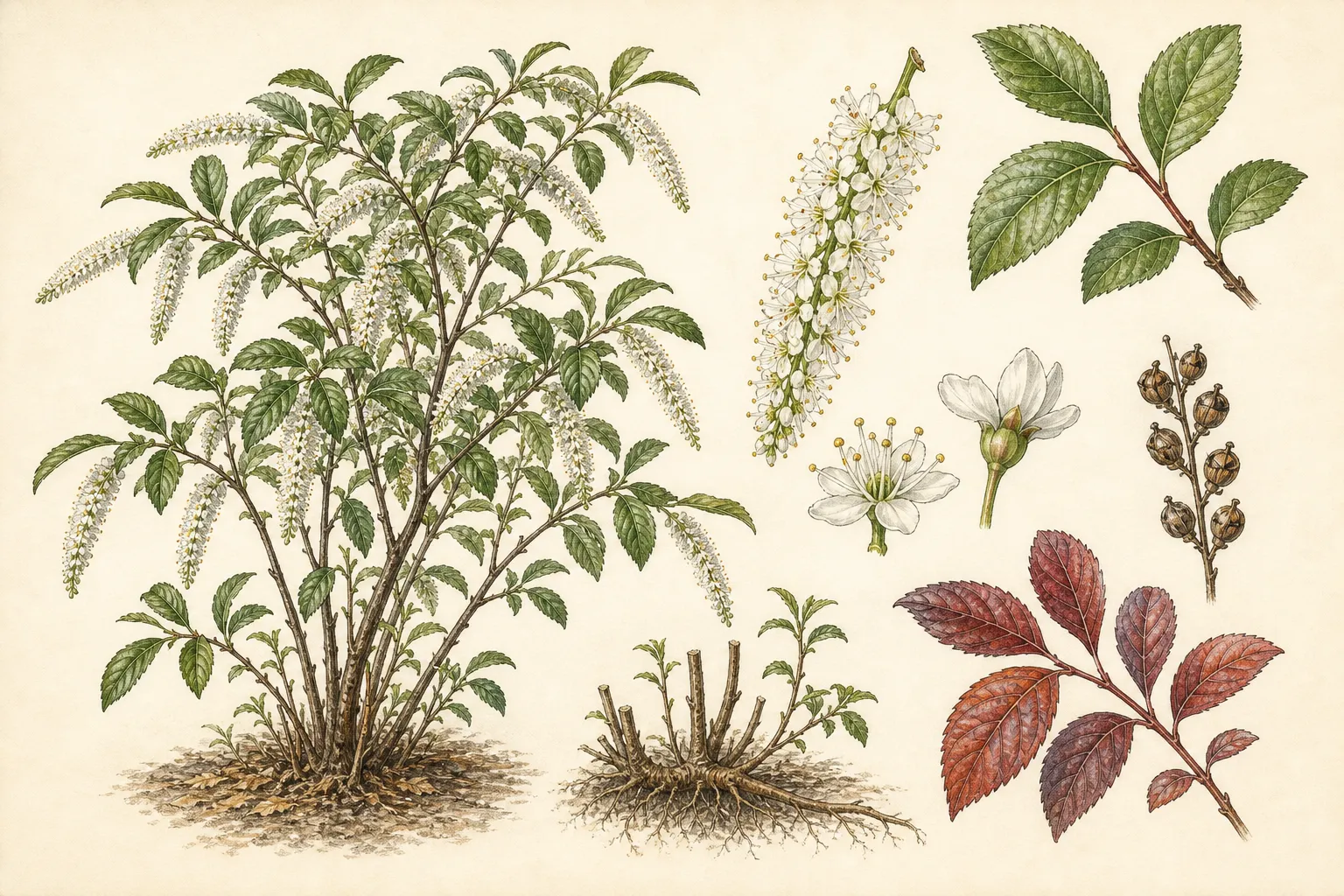
Virginia sweetspire is an arching deciduous to semi-evergreen shrub of moist woods, swamps, wet pine barrens, and stream banks in the central and eastern United States. Fragrant white flowers form narrow 3–6-inch racemes in late spring to early summer, followed by persistent brown capsules and autumn leaves that can turn orange, red, or burgundy.
Species dimensions in the retained Extension sources range from about 4 to 10 feet tall, while nursery cultivars can be substantially smaller. Preserve the full cultivar name and size the site from that record. A compact cultivar label is not permission to assign the wild species a 3-foot limit, and a species seedling should not be planted beneath a low window on the expectation of annual clipping.
Flower clusters form on the previous season's growth. Full sun generally supports the densest growth, strongest display, and best autumn color, though the shrub also accepts partial or dappled shade. The relationship matters when diagnosing a green, loosely flowered plant in deep shade: pruning or fertilizer cannot replace the missing light.
Moist, fertile soil is the natural fit, and the shrub tolerates occasional wetness and periodic flooding. It also tolerates drier ground once established. Use those traits in rain gardens, bioswales, slopes, and woodland edges only after matching the root zone to local hydrology; a newly planted root ball still needs establishment watering even beside a wet-tolerant species.
Root suckers create dense colonies. That is useful for erosion control and massing, but it can make the shrub weedy in a narrow mixed border. Decide at planting whether a colony is the design goal, then leave a mowable or inspectable boundary. Repeatedly shearing the top does nothing to stop underground expansion.
The species is rarely the plant sold most often; 'Henry's Garnet' and other named cultivars dominate nurseries. Cultivars change size, color, and colony behavior, so keep the label. Confirm whether an emerging shoot belongs to the same root system before deciding that it is a seedling or an unrelated weed.
- Family
- Iteaceae
- Range
- Central and eastern United States
- Soil pH
- 5.1–7.5
- Spread
- 3–6 ft before colony spread · 90–180 cm before colony spread
Planting & careHow to grow virginia sweetspire
Virginia sweetspire is native across much of the central and eastern United States and is listed by NC State for Zones 5–9. It may be deciduous or hold foliage longer in mild regions. Sun improves flowering, density, and autumn color, while shade and periodic flooding are tolerated; neither tolerance means that every cultivar will flower or color equally in a dark, permanently saturated site.
- 1Confirm species or cultivar scale
Record the complete nursery name and its documented mature dimensions. Allow the species roughly 4–10 feet in height and 3–6 feet in individual spread, plus any ground intended for a sucker-formed colony; use cultivar-specific measurements when they are narrower.
- 2Choose light for the intended display
Use full sun when dense flowering and autumn color are priorities, or partial shade where a looser woodland habit is acceptable. Keep enough access to inspect and remove suckers at the planned colony edge.
- 3Read the whole moisture pattern
Observe the site after ordinary rain and, for a rain garden, during overflow. Match the shrub to moist or periodically wet soil without placing the original root ball in a permanently isolated sump or assuming drought tolerance before establishment.
- 4Set the woody base at grade
Dig no deeper than the root mass requires, correct serious circling roots, and set the upper structural roots at the finished soil surface. Keep lower stems and future sucker origins visible rather than covering them with amended soil or deep mulch.
- 5Water the root ball and adjacent soil
Settle the planting and keep both the container root mass and surrounding soil evenly moist through establishment. Adjust irrigation to rainfall and site hydrology; periodic flooding tolerance is not a reason to keep the crown continuously submerged.
- 6Mark a colony boundary
Define where root suckers may remain and where they must be removed. Record the original stems and cultivar so future shoots can be traced, and maintain a boundary wide enough to reach the oldest trunks for renewal pruning.
Pruning virginia sweetspire
Virginia sweetspire flowers on growth made the previous season, so any elective thinning or shaping belongs immediately after the late-spring to early-summer bloom and before new buds form later in summer. Preserve the arching outline and remove an entire unwanted stem to its origin rather than shearing every tip. For an aging colony, NC State recommends periodic rejuvenation by taking selected oldest, thickest stems at the base to encourage flowering replacements. Remove root suckers only outside the planned colony; top pruning will not contain them.
Seasonal care
Spring
Watch previous-year stems for flower racemes and avoid pre-bloom shaping that removes them. Check moisture around new plantings, expose any buried woody base, and identify fresh root suckers against the planned colony boundary.
Summer
Immediately after flowering, make the year's limited thinning and renewal cuts, then leave new shoots to form next season's buds. Maintain establishment moisture, avoid overfertilization, and remove only suckers that cross the intended edge.
Autumn
Compare autumn color across sun and shade and retain the persistent capsules where winter texture is wanted. Map the colony's expansion, transplant well-rooted suckers if needed, and keep leaves or mulch from concealing the basal stems.
Winter
Read the arching framework and mark dead, damaged, or oldest stems for the post-bloom window. Check that winter water follows the intended rain-garden route and that stored snow or debris has not flattened young stems or buried the base.
Safety and garden spread
The Extension and Kew sources do not flag Itea virginica as poisonous. Bird use of its seeds and one source's edible-fruit tag are not a recommendation for human or pet consumption; keep the capsules and all other parts for ornamental use.
Common problems
Few flowers
- Look for
- Sparse racemes on a shaded plant, previous-season stems removed before bloom, or vigorous soft growth after heavy fertilization.
- Action
- Review the light pattern and pruning record before feeding. Preserve current summer growth for next year's buds, shift routine cuts to immediately after bloom, and relocate only if the site cannot supply enough light for the intended display.
Suckers escape the planting
- Look for
- New rooted stems forming beyond the rain-garden, slope, hedge, or massing boundary.
- Action
- Trace each shoot to the colony and remove it at ground or root origin while small, or lift a rooted sucker for transplanting. Maintain a physical access strip and replace the shrub with a less-colonizing choice if the site cannot accommodate recurring control.
Weak autumn color
- Look for
- Healthy leaves staying mostly green or dull brown in deep shade while sunnier stems color more strongly.
- Action
- Confirm cultivar identity and compare the daily light pattern. Thin only after flowering if self-shading is severe, and accept a shade-grown foliage result or move the shrub rather than applying fertilizer for color.
New planting wilts despite a wet-tolerant label
- Look for
- A recently planted root ball drying inside looser surrounding soil, or roots sitting in a sealed saturated hole before they have expanded.
- Action
- Compare moisture inside the root ball with the adjacent soil and correct irrigation or planting-hole drainage accordingly. Establishment still requires direct monitoring; do not infer that native wetland tolerance makes either drought or continuous submersion harmless to a new container plant.
Plant details
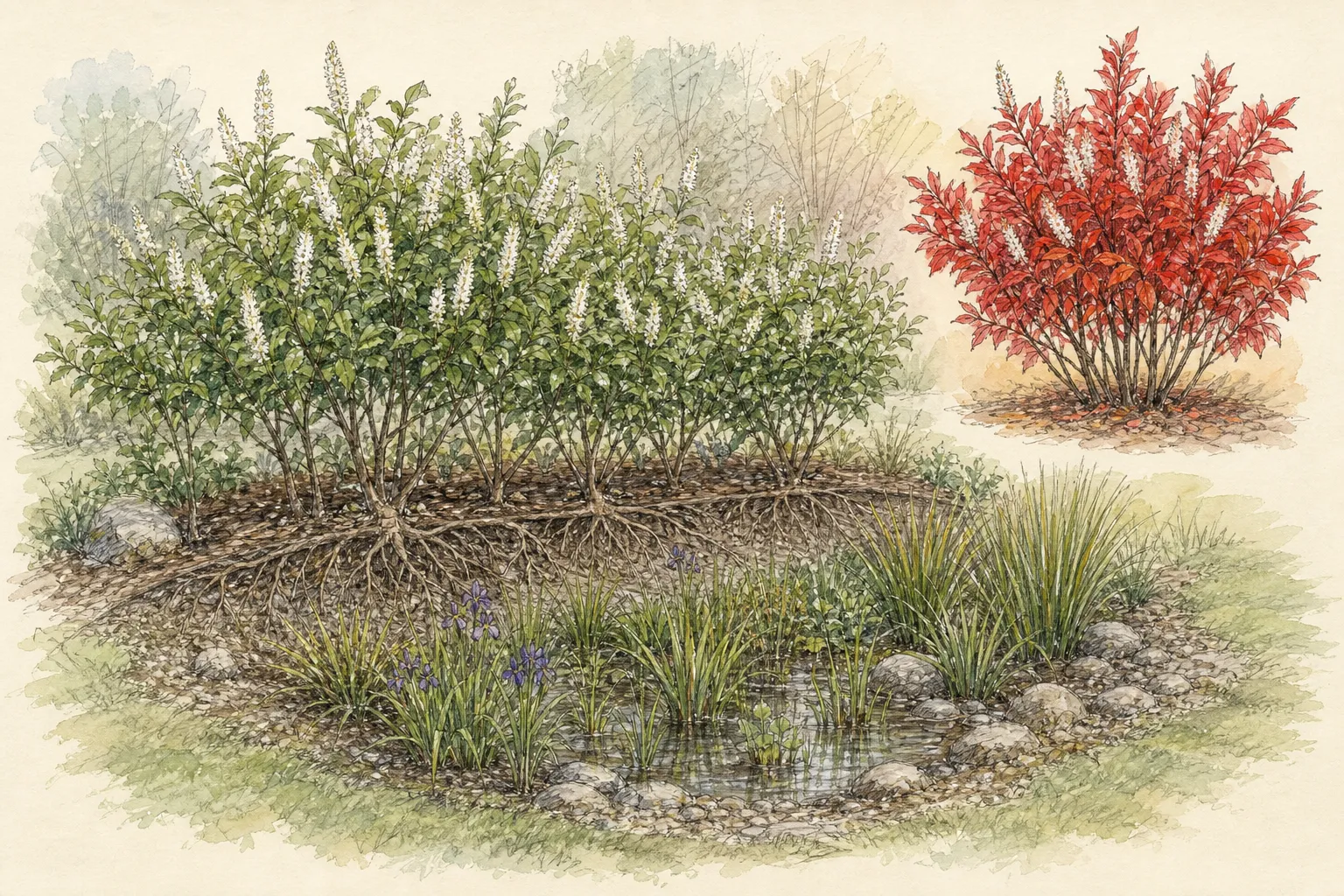
Garden placement study showing mature Virginia Sweetspire in an ornamental planting
Related reading
Sources
- Itea virginica. North Carolina Extension Gardener Plant Toolbox. Source record · Accessed 2026-08-30.
- Virginia Sweetspire. University of Maryland Extension. Source record · Accessed 2026-08-30.
- Itea virginica L.. Royal Botanic Gardens, Kew. Source record · Accessed 2026-08-30.