Star Magnolia
Magnolia stellata
A profile of Magnolia stellata, the compact Japanese shrub or small tree with fuzzy buds and starry flowers before leaf-out.
Published Last updated
At a glance
- Light
- Full sun to part shade
- Water
- Medium; even moisture during establishment
- Soil
- Moist, organically rich, well-drained soil
- Hardiness
- Zones 4–8
- Bloom
- Early spring before the leaves expand
- Height
- 15–20 ft · 4.5–6 m
In this guide
Overview
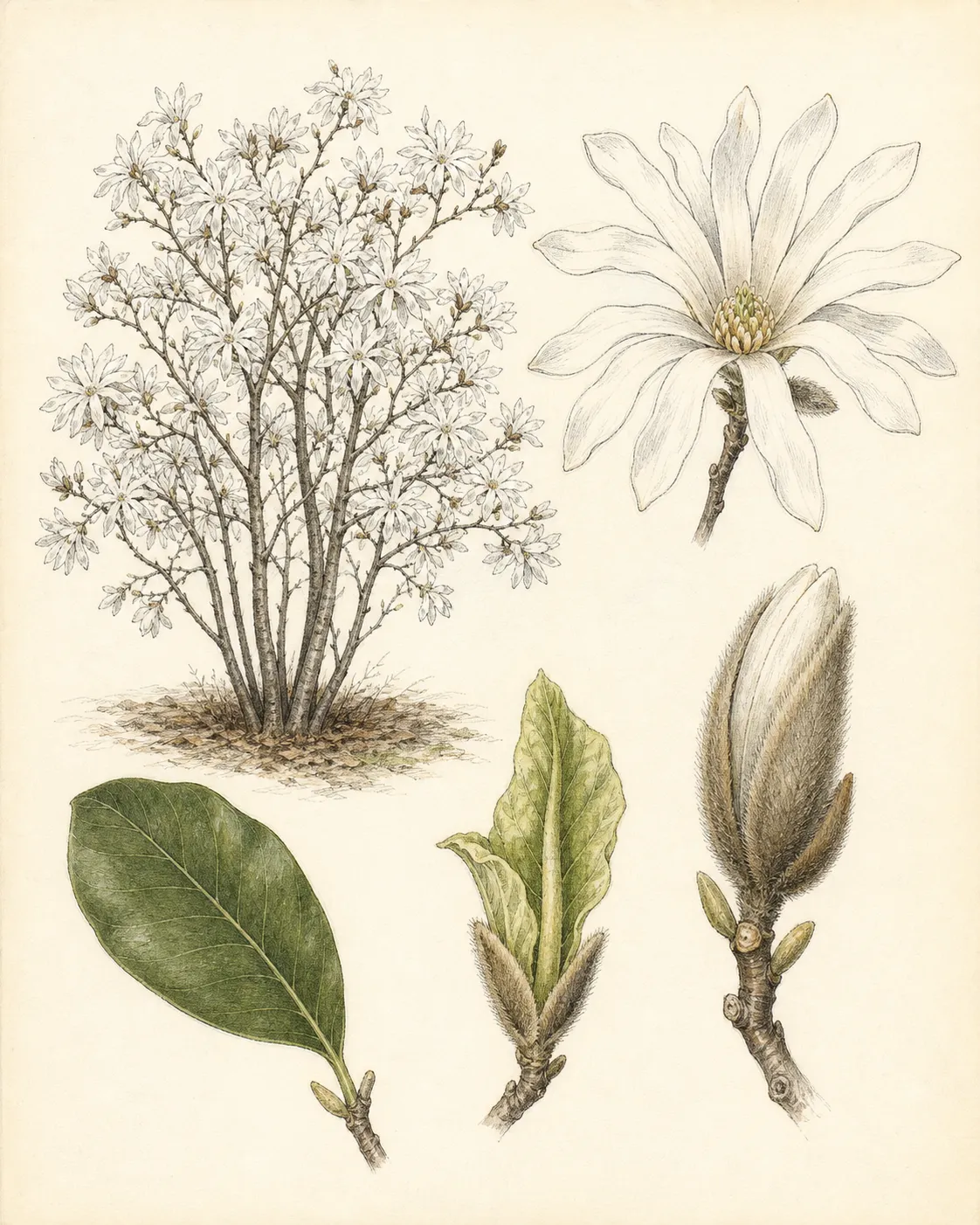
Magnolia stellata is native to south-central Honshu, Japan, and usually grows as a dense multi-stemmed shrub or low-branched small tree. Silvery, softly hairy buds open before the leaves into fragrant white flowers 3–4 in (8–10 cm) across, each with roughly 12–18 narrow tepals. Those fuzzy buds and strap-like tepals are more reliable identifiers than white flower color alone.
A species plant commonly matures around 15–20 ft high and 10–15 ft wide. Named selections may be more upright, pink-flowered, or later to open, so the nursery label matters when planning a permanent position. Give the rounded crown room to remain low and layered; a narrow foundation strip creates a recurring pruning problem.
Full sun supports the strongest flowering, while part shade is tolerated. The roots need moist, organically rich soil with good drainage and are sensitive to both prolonged dryness and waterlogging. A shallow organic mulch can conserve moisture, but it belongs over the root zone rather than against trunks or over the first structural roots.
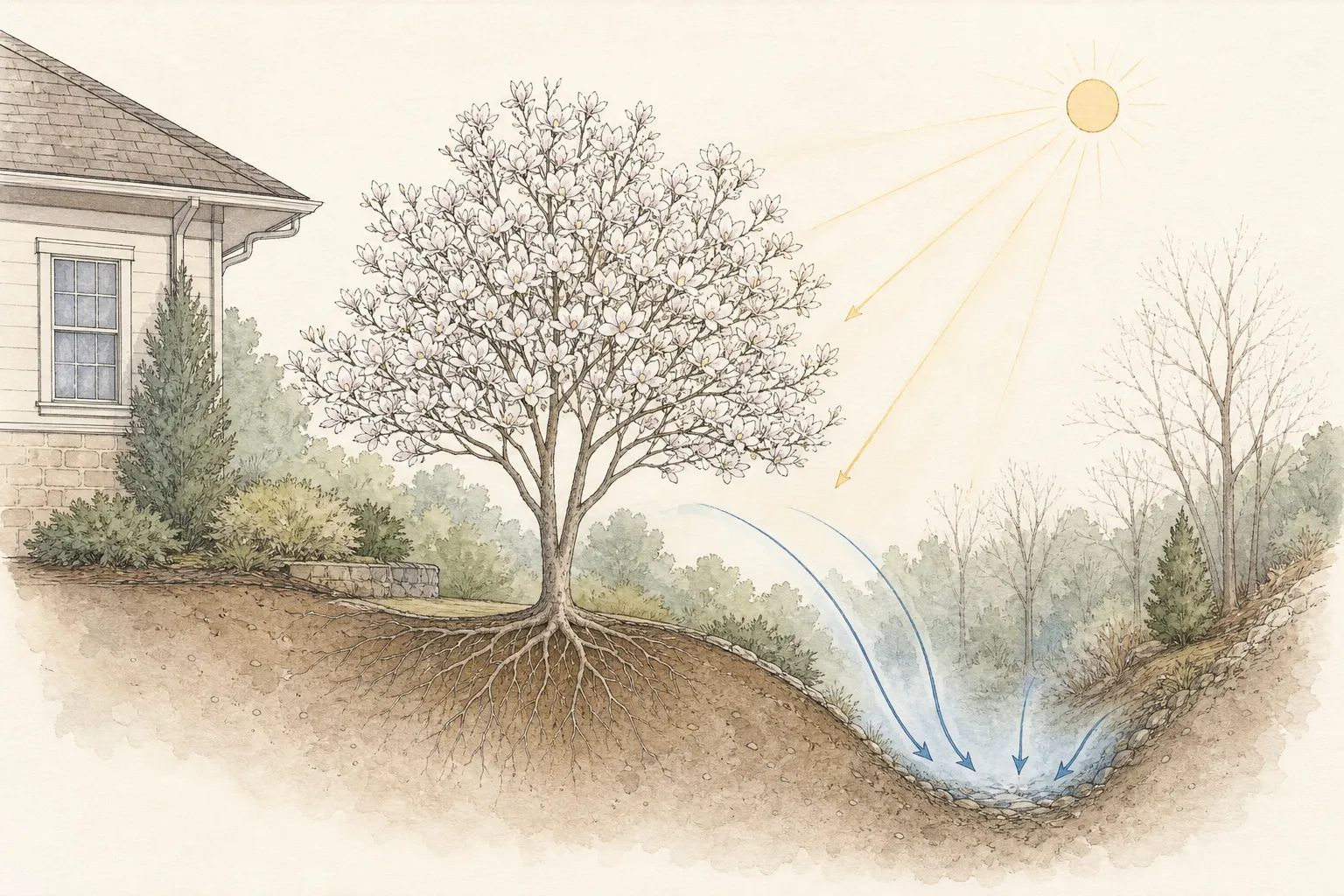
The very early flowers are vulnerable to late frost. A sheltered site away from a cold-air pocket and severe wind can preserve more of the display, although no position can prevent every weather loss. Browned petals after frost do not by themselves show that the branches or root system have died.
Star magnolia needs little routine pruning. Its flower buds are already present before spring, so corrective cuts are best made immediately after flowering. Preserve the natural multi-stem framework and remove only dead, damaged, rubbing, or genuinely misplaced growth.
High-pH soil can produce chlorotic foliage, and magnolia scale or powdery mildew may occur. Diagnose a recurring pattern before changing soil chemistry or applying a treatment; product labels and local Extension guidance govern any pesticide use.
- Family
- Magnoliaceae
- Range
- Japan
- Soil pH
- 5–7
- Spread
- 10–15 ft · 3–4.5 m
Planting & careHow to grow star magnolia
The flower buds open early and can be browned by late frost. A position sheltered from a frost pocket and harsh morning sun can preserve more of the short spring display.
- 1Reserve the mature crown
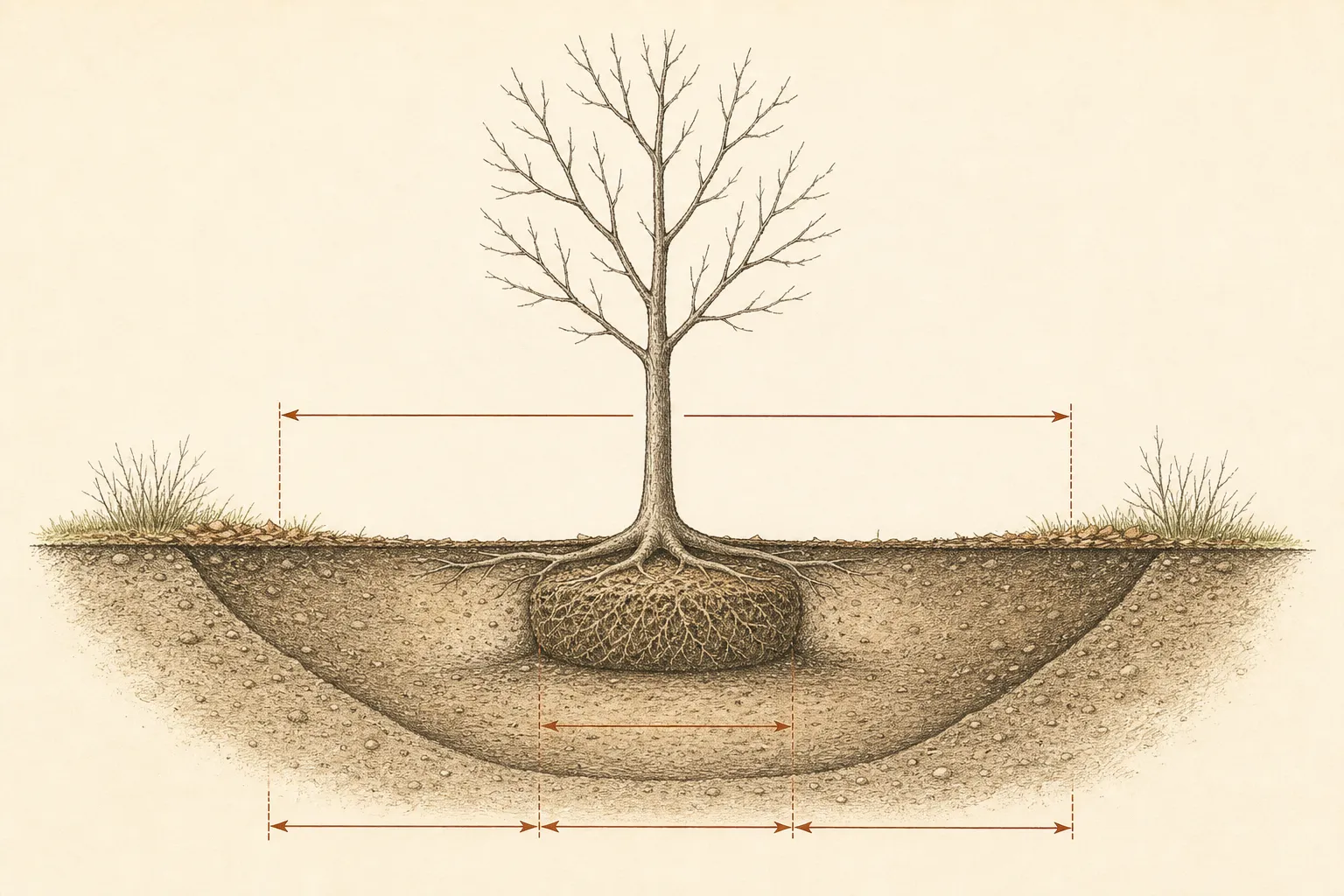
Use the dimensions for the named selection and keep the future 10–15 ft species spread clear of walls, paths, utilities, and plants that would force repeated clipping.
- 2Choose shelter with useful light
Favor full sun or light part shade outside the lowest frost pocket, with protection from strong wind. Avoid a hot wall or roof edge that alternates drought with concentrated runoff.
- 3Check the soil after rain
Use moist, organic-rich soil that drains freely. Correct a broad drainage or compaction problem before planting instead of setting the root ball into a water-holding pocket.
- 4Set the structural roots at grade
Place the first structural roots at finished soil level on a firm base, spread or correct circling roots where practical, and backfill with the excavated site soil.
- 5Establish even moisture
Water the nursery root ball and surrounding soil thoroughly, then monitor both zones during establishment. Let excess water drain before the next application.
- 6Mulch without burying stems
Spread a shallow organic mulch over the root zone to moderate moisture and temperature, leaving the trunks and visible structural roots clear.
Pruning star magnolia
Prune only when correction is needed, immediately after flowering. Remove dead, damaged, rubbing, or poorly placed stems at a sound branch union and preserve the naturally low, multi-stemmed outline. Routine shearing and large reductions spoil the layered framework and can remove developing flower-bearing growth.
Seasonal care
Spring
Watch buds and flowers for frost injury, maintain even moisture as leaves expand, and make any necessary corrective pruning immediately after bloom.
Summer
Check newly planted roots during dry weather and watch for chlorosis, scale, or mildew. Water deeply when the root zone is drying, while preserving drainage.
Autumn
Inspect mulch depth and branch spacing after leaf fall, keep the root zone free of compaction, and plant only while local soil remains workable.
Winter
Leave the fuzzy flower buds and sound branches intact, remove only storm-broken hazards that can be reached safely, and note where winter water or cold air collects.
Safety and garden spread
No major ornamental-garden toxicity is commonly cited, but unidentified plant parts should not be eaten.
Common problems
Late-frost flower damage
- Look for
- Open tepals turn brown or translucent soon after a freeze while stems and later leaves remain sound.
- Action
- Leave sound branches in place and assess the plant again after leaf-out. If damage repeats, improve shelter or consider a later-flowering selection rather than pruning healthy wood.
Poor flowering
- Look for
- A mature, otherwise healthy crown carries few flower buds or blooms sparsely.
- Action
- Review light, cultivar identity, recent pruning, winter bud injury, and establishment age. Correct the supported cause and judge the result during the next normal flowering cycle.
Chlorotic leaves
- Look for
- New leaves become pale between greener veins, especially in alkaline soil.
- Action
- Test the soil before attempting to change pH and confirm that drainage and roots are sound. Use local Extension recommendations for any correction.
Scale or mildew
- Look for
- Fixed scale insects and sticky residue on stems, or a persistent white coating on leaves.
- Action
- Confirm the organism with a local diagnostic service, improve plant vigor and air movement, and use only a treatment and timing supported by current local guidance and its label.
Related reading
Sources
- Magnolia stellata. North Carolina State Extension. Source record · Accessed 2026-08-30.
- Magnolia stellata. Royal Botanic Gardens, Kew. Source record · Accessed 2026-08-30.
- Star magnolia. Morton Arboretum. Source record · Accessed 2026-08-30.