Panicle Hydrangea
Hydrangea paniculata
A cold-hardy hydrangea with conical summer flower panicles on new growth, suited to moist, well-drained soil and generous garden space.
Published Last updated
At a glance
- Light
- Full sun to partial shade; morning sun and afternoon shade suit hot sites
- Water
- Medium, consistent moisture; do not let new plants dry out
- Soil
- Organically rich, moist, well-drained acidic to neutral soil
- Hardiness
- Zones 3–8
- Bloom
- Midsummer to autumn
- Height
- 8–15 ft · 2.4–4.5 m
In this guide
Overview
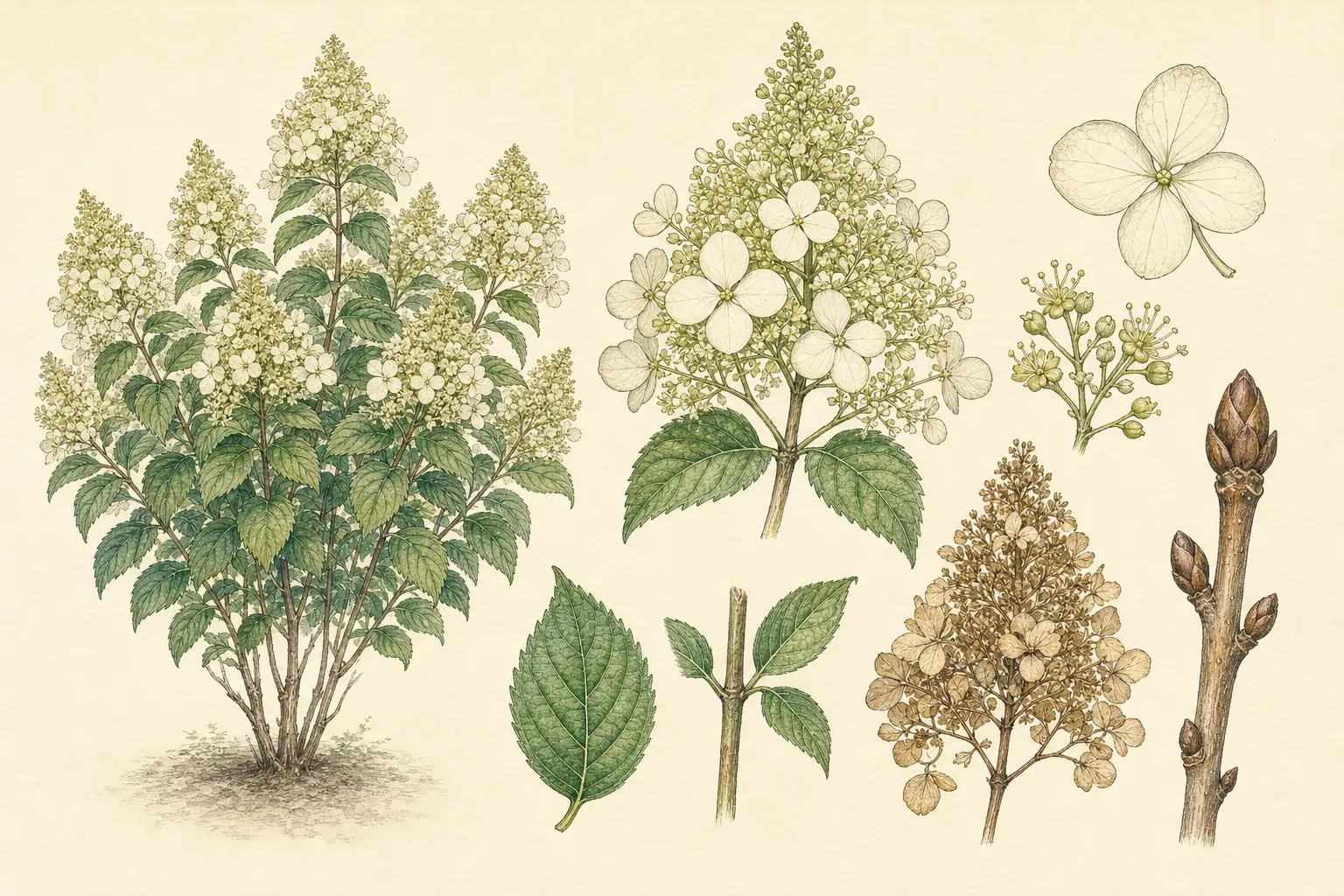
Hydrangea paniculata is a fast-growing, multi-stemmed deciduous shrub or small tree. Serrated leaves sit opposite one another, and terminal cone-shaped panicles open creamy white in midsummer before aging through pink to tan or brown.
The species commonly reaches 8–15 feet and can become larger, although named cultivars range from compact shrubs to full-size specimens. Choose the plant by its cultivar dimensions and leave room for arching flower-laden stems instead of planning to hold it indefinitely in a narrow strip.
Unlike bigleaf hydrangea, panicle hydrangea forms flowers on the current season’s shoots. Late-winter or early-spring pruning therefore does not remove preformed flower buds, but severe annual cutting is a design choice rather than a requirement for bloom.
Full sun produces sturdy growth and good flowering where moisture is reliable. In hotter climates, morning sun with afternoon shade reduces stress; very dense shade and overly rich growth can leave stems weak beneath the large panicles.
- Family
- Hydrangeaceae
- Range
- Central and southern China, Sakhalin, the Kuril Islands, Japan, and Taiwan
- Soil pH
- 5.5–7.5
- Spread
- 6–12 ft · 1.8–3.7 m
Planting & careHow to grow panicle hydrangea
Guidance fits temperate gardens in USDA zones 3–8. Panicle hydrangea is unusually cold hardy for the genus, but hot sites benefit from afternoon shade and exposed sites can damage its brittle stems.
- 1Match the cultivar to the space
Verify the selected cultivar’s mature size; the species can reach 8–15 feet tall and needs clearance from windows, eaves, paths and neighboring shrubs.
- 2Choose sun with moisture
Use full sun in cool climates or morning sun with afternoon shade in hotter gardens, and avoid sites that dry hard or remain waterlogged.
- 3Keep the woody root flare visible
Set the uppermost structural roots at surrounding grade, spread the roots into a broad hole, and do not bury the multi-stemmed base under added soil.
- 4Establish the shallow roots
Water deeply after planting and whenever the upper root zone begins to dry during establishment; use soil moisture, not a fixed calendar, to time irrigation.
- 5Mulch without burying stems
Apply a broad, shallow mulch layer over the root zone to conserve moisture, keeping it pulled back from every stem and the visible flare.
Pruning panicle hydrangea
Prune in late winter or early spring before active growth because the flower panicles form on new shoots. Remove dead, damaged, rubbing and weak stems first; then shorten or thin selected live stems only as needed for a balanced shrub. Hard annual cutting can produce fewer, larger panicles but is not necessary for flowering.
Seasonal care
Spring
Finish structural pruning before new growth expands, renew the shallow mulch over the root zone, and water newly planted shrubs whenever the soil begins to dry.
Summer
Maintain medium moisture while the current season’s shoots carry developing panicles; check drought stress, leaf disease and stems bending under flower weight.
Autumn
Leave sound tan panicles for winter texture or remove them at a branch junction, and continue watering recently planted shrubs during dry weather until the ground cools.
Winter
Inspect the dormant multi-stemmed framework for wind breakage and mark the stems that need removal, postponing routine pruning until late winter.
Safety and garden spread
Common problems
Few or small panicles
- Look for
- Long leafy shoots with sparse bloom, especially on the shaded side of the shrub.
- Action
- Increase light if the site is deeply shaded, avoid excess nitrogen, and complete any needed pruning before spring growth rather than repeatedly clipping new shoots.
Drought wilt or leaf scorch
- Look for
- Drooping leaves, dry brown margins and premature browning during heat.
- Action
- Check moisture several inches into the shallow root zone, water deeply when it is dry, and restore a mulch layer that does not touch the stems.
Bent or broken stems
- Look for
- Flower-heavy shoots arching into paths or brittle stems snapping after wind.
- Action
- Remove broken wood cleanly, reduce exposure where practical, and thin weak stems during the next dormant pruning instead of shearing the whole shrub.
Leaf spots or powdery growth
- Look for
- Expanding spots, rusty pustules or a pale powder on leaves, sometimes with early leaf drop.
- Action
- Improve air movement, keep irrigation off the foliage and obtain a diagnosis before treatment; powdery mildew, leaf spot, rust and blights are documented on the species.
Plant details
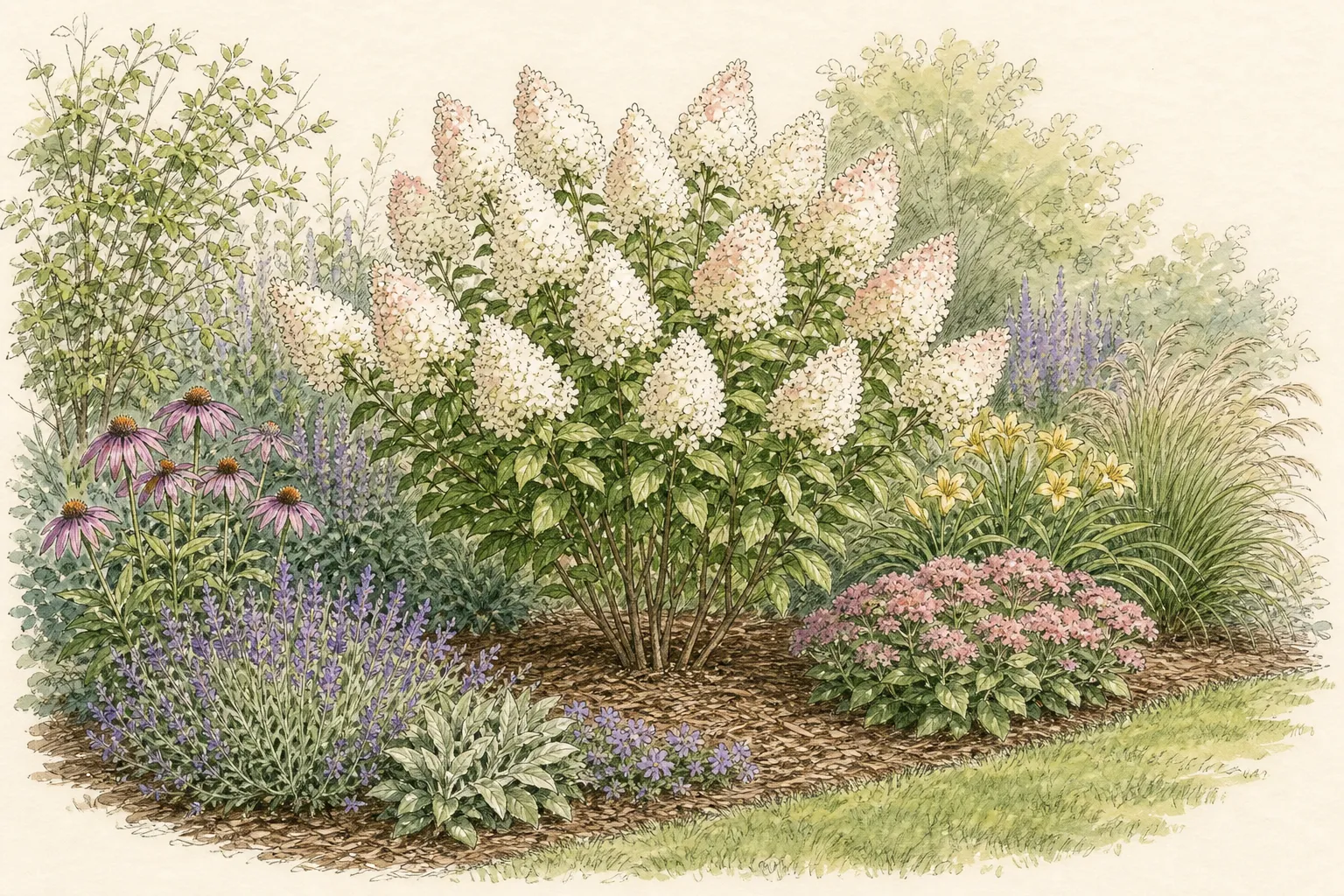
Garden placement study showing mature Panicle Hydrangea in an ornamental planting
Related reading
Sources
- Panicle Hydrangea cultivation profile. North Carolina Extension Gardener Plant Toolbox. Source record · Accessed 2026-08-20.
- Hydrangea paniculata horticultural guidance. Missouri Botanical Garden. Source record · Accessed 2026-08-30.
- Hydrangea paniculata taxonomy and distribution. Royal Botanic Gardens, Kew. Source record · Accessed 2026-08-30.
- Toxic and Non-toxic Plants: Hydrangea. ASPCA Animal Poison Control Center. Source record · Accessed 2026-08-30.