Japanese Maple
Acer palmatum
A highly variable small deciduous tree valued for layered branching, finely shaped leaves, and autumn color, with cultivar form and exposure deciding its garden fit.
Published Last updated
At a glance
- Light
- Partial shade to gentle sun; shelter from drying exposure
- Water
- Medium; evenly moist with good drainage
- Soil
- Organically rich, moist but well-drained
- Hardiness
- Zones 5–8
- Bloom
- Spring; flowers are small and secondary to foliage
- Height
- 15–25 ft for the species; cultivars vary · 4.5–7.5 m
In this guide
Overview
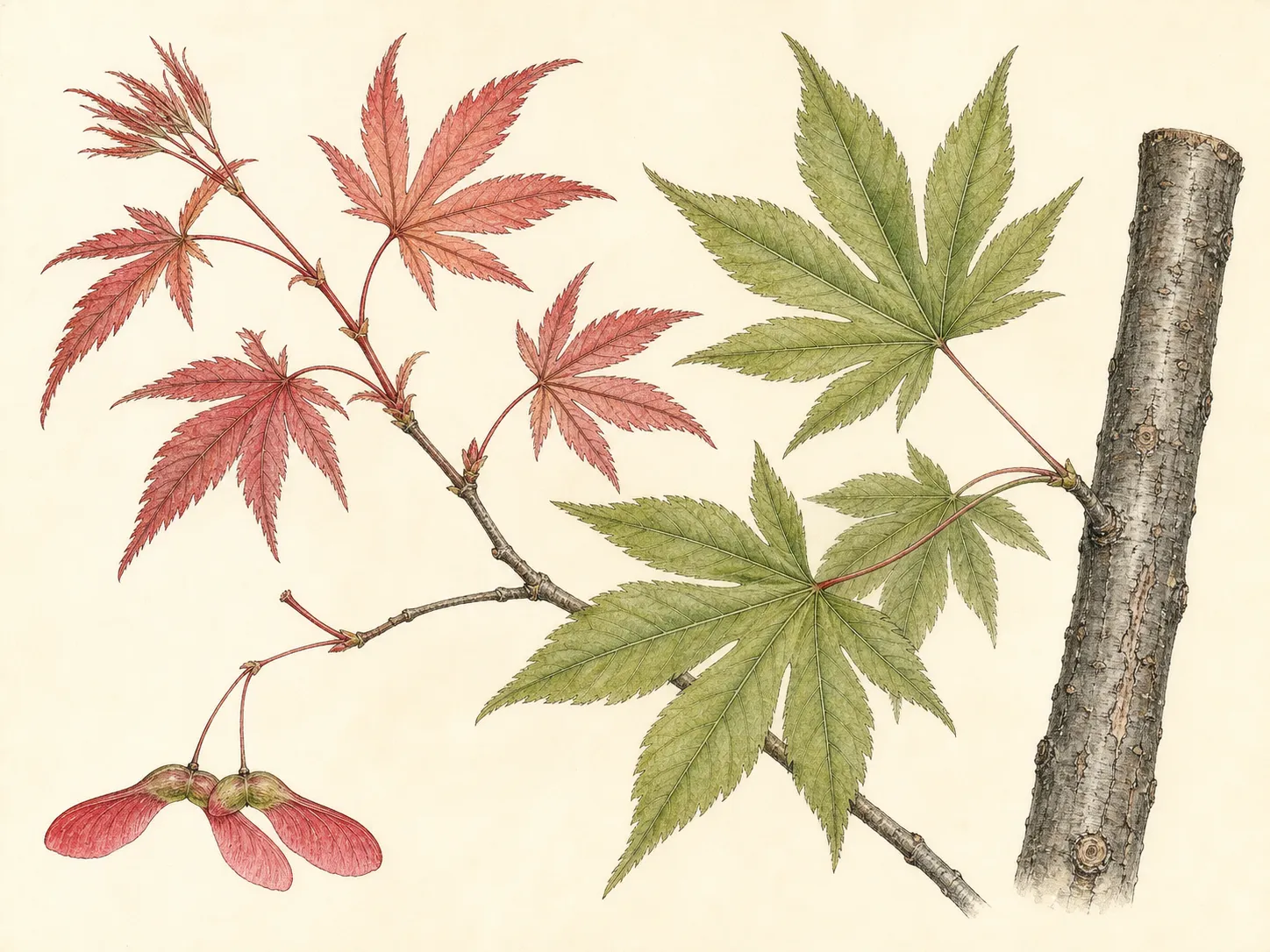
Japanese maple is a slow- to moderate-growing deciduous tree or large shrub with opposite leaves divided into five to nine pointed lobes, fine green to reddish twigs and paired winged samaras. The species commonly becomes a rounded or spreading 15–25 ft tree, but that silhouette is only a baseline. Hundreds of cultivars range from compact mounds and cascading dissected forms to upright small trees, with green, red, variegated or seasonal foliage.
The complete cultivar name controls the garden decision. Most named selections are grafted, so record mature height, width, branch habit and leaf color and keep the graft union visible. A red-leaved selection may green in insufficient light, while a pale or finely cut cultivar may scorch in an exposure tolerated by a robust green-leaved form. Seedlings do not reproduce a named cultivar and can differ in both habit and color.
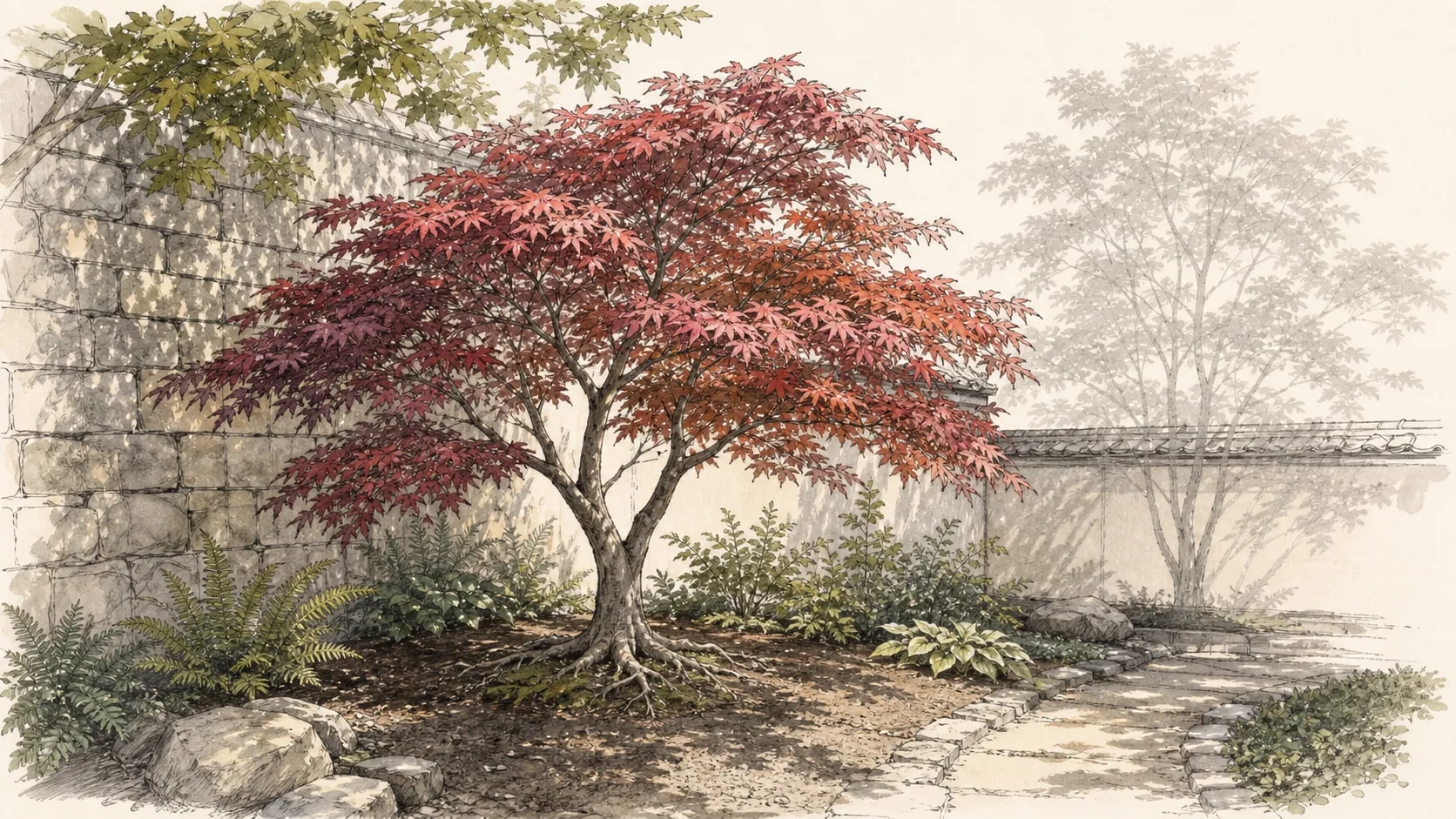
Start with dappled or partial shade, shelter from drying wind and evenly moist, well-drained soil. More direct sun can work in cooler northern sites; hot southern or reflected afternoon exposure increases scorch risk. Leaf-edge browning can result from sun, wind, drought or a damaged root system, so check the pattern and moisture below the surface before adding water. Standing water is not a remedy for scorch.
Japanese maples have a relatively shallow root system. Set the first structural roots and root flare at finished grade, keep any graft union above soil and leave a broad uncompacted root zone. The RHS advises no more than 1 inch of soil over the main roots. Apply organic mulch over the surrounding soil but keep it away from trunk and flare. Deep planting, a mulch mound and a saturated container all reduce oxygen where fine roots need it.
Natural branch architecture is much of the plant's value. A cultivar selected for the available space generally needs little more than removal of dead, damaged or badly placed growth. The RHS Japanese-maple guide places necessary pruning from July through January to reduce sap bleeding, with late autumn suitable for a strong unwanted vertical shoot. Trace a branch to a well-placed side branch or collar and leave no stub; repeated heading and shearing destroy the layered form.
Use an upright form as a small specimen at a woodland edge or sheltered terrace, and use a documented dwarf or cascading cultivar where a large container or low composition is intended. Size the site from mature label dimensions, not the nursery pot. Before planting near woodland or another natural area, check regional invasive-plant guidance: North Carolina Extension notes self-seeding and invasive listing in Virginia and the District of Columbia.
- Family
- Sapindaceae
- Range
- Southwestern Korea and central to southern Japan
- Soil pH
- 5–7.4
- Spread
- 10–25 ft for the species; cultivars vary · 3–7.5 m
Planting & careHow to grow japanese maple
Kew's accepted species record limits the native range to southwestern Korea and central and southern Japan; broader horticultural descriptions that include China refer to older treatments, cultivated occurrence or the wider Japanese-maple group. Zones 5–8 and species dimensions do not describe every cultivar: upright trees, low dissected forms, dwarfs and cascading selections differ sharply in mature size, exposure and container suitability. North Carolina Extension also reports self-seeding and notes invasive listing in Virginia and the District of Columbia. Check current local status before planting near natural areas, remove seedlings where required and never treat a cultivar label as evidence that escape risk is absent.
- 1Record the exact cultivar
Keep the full cultivar name, rootstock or graft information when available, mature dimensions, habit and expected seasonal leaf color. A label that says only Japanese maple is insufficient for a narrow courtyard, a container or a color-critical design because forms within Acer palmatum differ dramatically.
- 2Check regional fit and escape status
Confirm Zones 5–8 against local cold, summer heat and late-frost patterns, then consult current invasive-plant guidance before planting near natural areas. Where Japanese maple is listed or seedlings establish beyond cultivation, choose a suitable alternative or follow local containment requirements.
- 3Map sun, wind and reflected heat
Observe the position through the day in the leafy season. Favor dappled light, morning sun or partial shade with shelter from drying wind. Red foliage may need useful sun for color, while variegated and finely dissected leaves often need stronger afternoon protection. Keep the canopy away from hot walls and paving.
- 4Test the root zone
Use well-drained soil with organic structure and an acid-to-neutral reaction; Cornell gives a broad tolerated pH of 5.0–7.4. Observe drainage after substantial rain and use a soil test before correction. Do not create a richly amended sump inside compacted soil or plant where water stands around the roots.
- 5Find the flare and graft union
Remove loose potting mix from the trunk base until the first structural roots are visible. Identify the graft union, inspect the root ball for severe circling or matting and correct roots according to current woody-plant practice. Do not use the top of loose nursery media as the depth reference.
- 6Set structural roots at grade
Dig broadly and only as deep as the prepared root system requires. Support the tree on firm soil with the flare at finished grade and the graft above soil. Backfill compatibly, water to settle large voids and recheck depth after settling; never mound soil around the trunk to make the surface look level.
- 7Water both soil zones
Check moisture in the original root ball and surrounding soil separately through establishment because they can dry at different rates. Keep both evenly moist, then let excess drain. Increase attention during heat and wind, especially for container plants, without converting a well-drained site into constant saturation.
- 8Mulch broadly and keep the base open
Apply an organic surface layer over the root zone, leaving the flare, graft and trunk visibly clear. Keep turf, compacting traffic and aggressive roots away. Store the label and photograph the young framework so later pruning and color judgments are tied to the actual cultivar.
Pruning japanese maple
Prune Japanese maple only when a defined defect or clearance need outweighs the value of its natural form. Remove dead or broken twigs after their boundary is clear, and take a badly placed, crossing or competing shoot back to a sound side branch or branch collar rather than shortening every tip. RHS guidance places needed work between July and January because maples can bleed sap at other times; late autumn is suitable for correcting a strong vertical shoot on a young tree. Keep cuts small and few, retain the cultivar's layered or cascading structure and never top or shear the canopy. Remove rootstock shoots arising below the graft at their origin after confirming the graft. Large elevated branches, progressive dieback and major size reduction require a qualified arborist or diagnostic service; pruning cannot make an oversized cultivar permanently fit a small site.
Seasonal care
Spring
Watch early leaf expansion during late frost, keep mulch off the flare and begin establishment moisture checks as the canopy opens. Confirm cultivar color before diagnosing pale, red or variegated growth. Avoid elective early-spring pruning because sap flow is active, and do not feed an in-ground tree automatically.
Summer
Compare exposed and sheltered leaves for scorch, probe both root ball and surrounding soil during heat and protect containers from complete dry-down or standing water. From July, make only necessary small pruning cuts within the RHS window. Remove seedlings before they establish where local invasive guidance calls for control.
Autumn
Record foliage color and the mature direction of branches, plant suitable stock as cool conditions begin and keep watering young trees until rainfall is adequate. After leaf fall, inspect the framework and graft before deciding whether any late-autumn cut is needed. Keep fallen mulch and added soil away from the flare.
Winter
Protect container roots and the canopy from severe drying wind, check ties and guards and complete necessary minimal pruning before the end of the locally suitable July–January window. Do not pile insulating material against the trunk. Plan relocation or replacement when mature cultivar dimensions cannot fit the site.
Safety and garden spread
No toxicity claim in this profile should be read as food or pet-safety approval. Japanese maple is presented as an ornamental plant; keep prunings and seeds out of routine ingestion and consult appropriate professional guidance after exposure concerns.
Regional invasive risk
Self-sown seedlings can escape gardens. NC State reports invasive listing in Virginia and Washington, DC; check current regional advice near natural areas.
Reported region: Virginia and Washington, DC, United States
Common problems
Leaf scorch
- Look for
- Tan or crisp margins and interveinal patches concentrated on the hot, sunny or windward side, often worsening during drought or container dry-down.
- Action
- Check root-ball and surrounding-soil moisture and the daily exposure pattern together. Restore even moisture when dry and add shelter or relocate in a suitable season when ordinary site conditions repeatedly exceed the cultivar's tolerance. Do not keep roots saturated.
Late-frost injury
- Look for
- Blackened, limp or distorted new leaves soon after a freeze while older twigs and sheltered buds remain sound.
- Action
- Wait for new growth to reveal the living boundary, maintain ordinary moisture and remove only tissue confirmed dead. Improve siting or temporary frost protection for recurrent exposure; do not fertilize or make large cuts in response to one damaged flush.
Verticillium wilt or progressive dieback
- Look for
- Sudden wilt or branch death that does not follow a sunward edge or correct after measured watering, sometimes progressing through part of the canopy.
- Action
- Preserve representative samples, avoid moving suspect soil or wood and request diagnosis through a local Extension or plant-health service. Prune only confirmed dead material and do not replant another susceptible tree before the site and diagnosis are understood.
Container root stress
- Look for
- Rapid wilting, water bypassing a shrunken root ball, roots filling drainage holes, poor drainage or repeated freeze injury to an exposed pot.
- Action
- Compare moisture through the root ball, clear blocked drainage and repot during the RHS April or September window before roots become severely congested. Use a slightly larger stable container and preserve the previous planting depth.
Unexpected foliage color
- Look for
- A red cultivar turning greener in deep shade, variegated leaves scorching in hard sun or color that never matches the retained label.
- Action
- Confirm cultivar identity, compare the full daily light pattern and allow for normal seasonal change before moving the tree. Seek a balance between enough light for color and protection from heat; feeding cannot correct a mislabeled plant or incompatible exposure.
Self-sown seedlings
- Look for
- Young palmate-leaved maples appearing beyond the intended root zone or in adjacent woodland, especially where regional authorities list Japanese maple as invasive.
- Action
- Confirm current local status, remove seedlings before seed production where required and dispose of them according to local guidance. Do not distribute seedlings under the parent cultivar name, because they are genetically variable.
Related reading
Sources
- Acer palmatum Thunb.. Royal Botanic Gardens, Kew. Source record · Accessed 2026-08-30.
- Acer palmatum. North Carolina State Extension. Source record · Accessed 2026-09-07.
- Acer palmatum [1]. Royal Horticultural Society. Source record · Accessed 2026-08-30.
- How to Grow Japanese Maples. Royal Horticultural Society. Source record · Accessed 2026-08-30.
- Woody Plants Database. Cornell University. Source record · Accessed 2026-08-30.