Flowering Dogwood
Cornus florida
Identify Cornus florida, site its shallow root system for cool moisture and drainage, and choose cultivars with regional hardiness and disease limits in mind.
Published Last updated
At a glance
- Light
- Part shade to full sun where root-zone moisture and heat are moderated
- Water
- Even moisture during establishment and dry periods, with no persistent saturation
- Soil
- Moist, organically rich, acidic to near-neutral soil with reliable drainage
- Hardiness
- Zones 5–9
- Bloom
- Spring, with timing shifting from early to late spring by region, elevation, weather and cultivar
- Height
- 15–30 ft · 4.5–9 m
In this guide
Overview
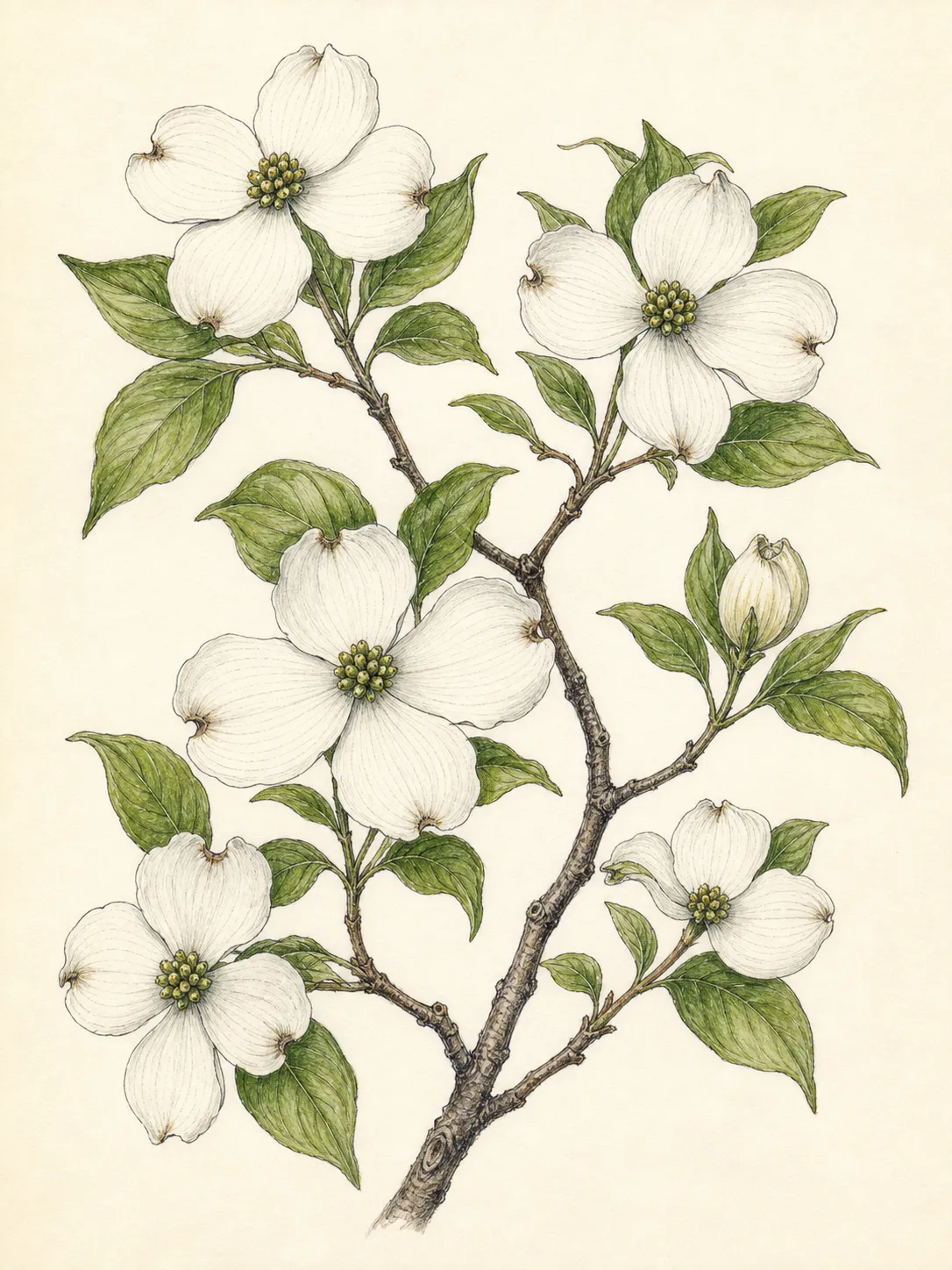
Flowering dogwood is a small deciduous tree whose strongest garden effect comes from a sequence rather than one bloom week. Rounded terminal buds open in spring to compact clusters of tiny true flowers. Four broad, usually white bracts surround each cluster and create the familiar cross-like display; their notched tips are a useful identification cue. Pink to red bracts belong to selected forms and cultivars, not to a different definition of the species. The tree then carries a layered green canopy, develops red drupes and red to purple autumn color, and reveals a fine branching pattern and increasingly blocky bark in winter.
Accept the site only when the mature canopy and a broad, suitable root zone can both fit. Pruning cannot compensate for a permanently narrow or stressed position. Preserve the layered framework and identify the cause of spreading dieback before choosing sanitation cuts. Cultivar disease resistance must be read for the particular disease, without treating one resistance claim as protection from every leaf or twig problem.
Confirm identity from several traits. Leaves occur in opposite pairs, are simple and ovate, and show lateral veins that curve toward the tip. The apparent petals are bracts, while the true flowers occupy the center. Autumn fruits are separate glossy red drupes held in small clusters rather than the fused raspberry-like fruit associated with kousa dogwood. Mature gray bark breaks into small blocks. Seedlings and young trees may not show every mature feature, so retain the nursery label and compare twigs, buds, leaf arrangement, flowers and fruit through a full season.
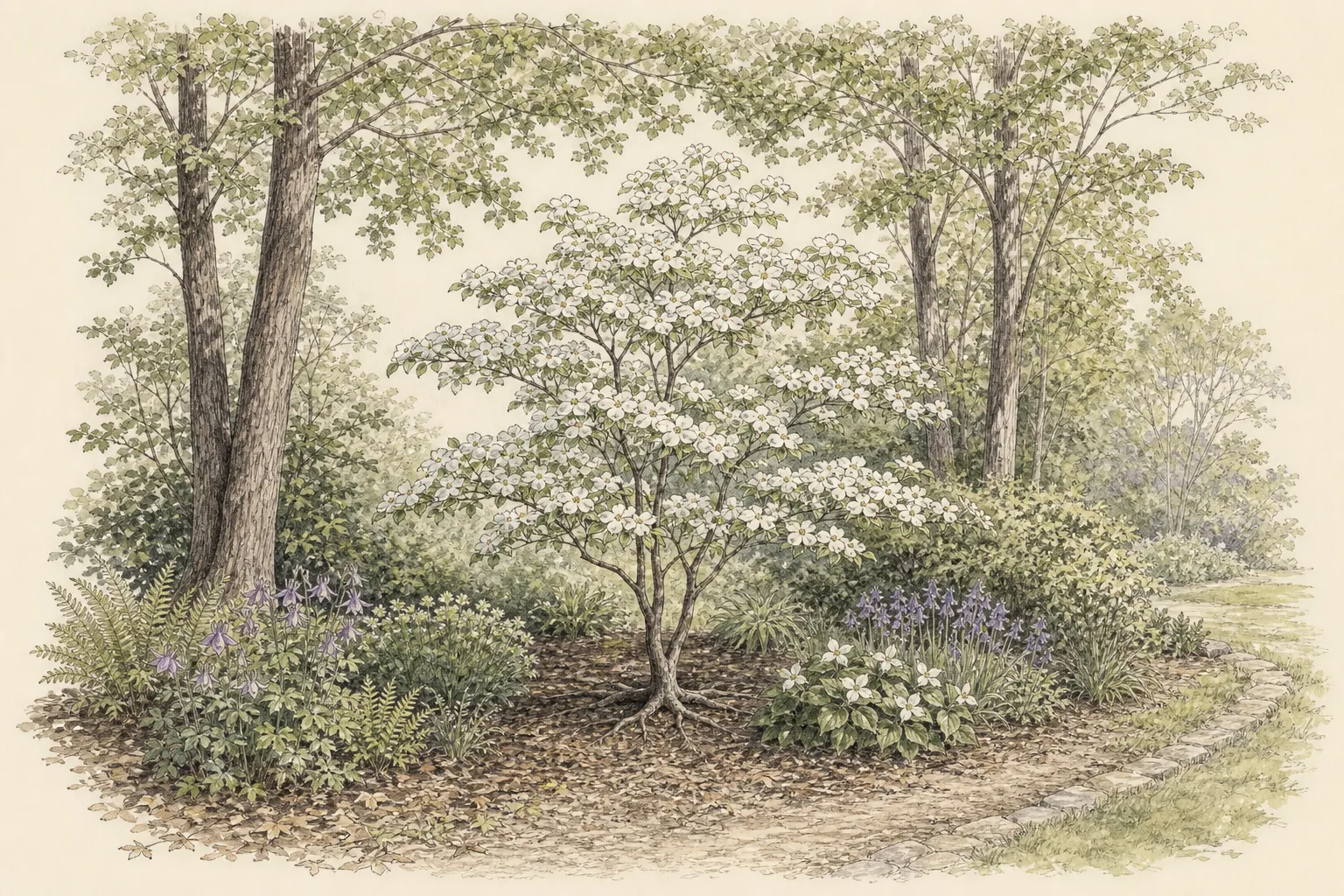
The natural model is an understory or woodland-edge tree, but garden siting must balance light with moisture and disease pressure. Part shade can protect foliage and roots from severe afternoon heat, especially in warmer regions. More sun can support a dense flowering canopy where soil stays evenly moist and the root zone is not baked by pavement. Deep shade can reduce flowering, while hot exposed turf or a reflected-heat courtyard can create drought stress. Select the position by observing summer sun, rain drainage and irrigation reach together.
Root-zone quality matters more than a decorative planting-hole recipe. Flowering dogwood performs in moist, well-drained soil with organic matter and an acidic to near-neutral reaction. It declines in a water-holding basin and also suffers when a small root area repeatedly dries. Preserve a broad, uncompacted soil surface under the canopy. A wide organic mulch ring can buffer moisture and temperature, but mulch piled against bark conceals the root flare and keeps the trunk base damp. Lawn competition, mower injury and repeated foot traffic all work against a shallow, active root zone.
Cultivar names carry practical information. Bract color, bloom timing, mature habit, cold provenance and resistance to individual diseases can vary. A label that says only pink dogwood does not reveal those limits. University of Maryland lists Appalachian Spring as resistant to dogwood anthracnose but not to powdery mildew or spot anthracnose, while other cultivars show different patterns. Read each resistance column separately and remember that resistant does not mean immune. A cultivar tested in one region still needs a suitable site and local evaluation elsewhere.
Use flowering dogwood where its scale and seasonal transitions can be seen without forcing it into a narrow slot. It can stand at a woodland edge, beside a patio with adequate root room, or as a small specimen against a quiet evergreen background. Keep future branches away from roofs, vehicles and circulation routes. Underplant only after the tree is established, using compatible shallow-rooted plants in carefully opened pockets rather than cultivating across the entire root zone. The clear space beneath the branching structure is part of the composition, not unused ground that must be filled.
Four-season care is largely preventive. Establish the root system with measured watering, preserve cool open soil, prune lightly and keep bark intact. Watch leaves and twigs for patterns that differ from ordinary seasonal change, especially in regions with known dogwood anthracnose. Do not diagnose from one brown margin or one spotted leaf. Weather stress, drought, root injury and several foliar diseases can overlap. Photograph the whole tree and close symptoms, note their position and progression, and use a regional diagnostic service before making treatment decisions.
- Family
- Cornaceae
- Range
- Eastern North America from southeastern Canada through the eastern United States, with related native populations extending into eastern Mexico
- Soil pH
- 6–7
- Spread
- 15–30 ft · 4.5–9 m
Planting & careHow to grow flowering dogwood
Zones 5–9 are a broad landscape range, not proof that every seed source or cultivar is suitable throughout it. Virginia Cooperative Extension notes that southern-origin material may not be hardy at the cold edge. Heat, drought, reflected sun and poorly drained soil can shorten performance at the warm or exposed edge. Dogwood anthracnose pressure is regional and site-dependent, and resistance is disease-specific: University of Maryland data distinguish dogwood anthracnose, spot anthracnose and powdery mildew rather than treating a cultivar as universally disease-proof. Confirm local disease history and buy a named, regionally tested cultivar from a reputable source.
- 1Verify species, cultivar and origin
Keep the complete botanical and cultivar label. Confirm expected bract color, mature size, regional hardiness and separate resistance ratings for dogwood anthracnose, spot anthracnose and powdery mildew. Treat seed source and local trial history as meaningful at the cold and warm edges of the range.
- 2Read the site through a full day
Map direct sun, afternoon heat, roof runoff, low wet pockets, nearby tree roots, paving and irrigation. Choose a position that offers useful light without repeatedly drying the root zone and that drains after substantial rain. Avoid a narrow lawn island or reflected-heat pocket that cannot support a broad protected soil surface.
- 3Reserve the mature canopy and root zone
Use the named cultivar's mature dimensions rather than the nursery pot. Keep branches clear of buildings, wires and paths, and reserve a broad mulched area that will not be compacted or crossed by mowing equipment. Locate utilities before digging and preserve access for watering and inspection.
- 4Find the root flare before setting depth
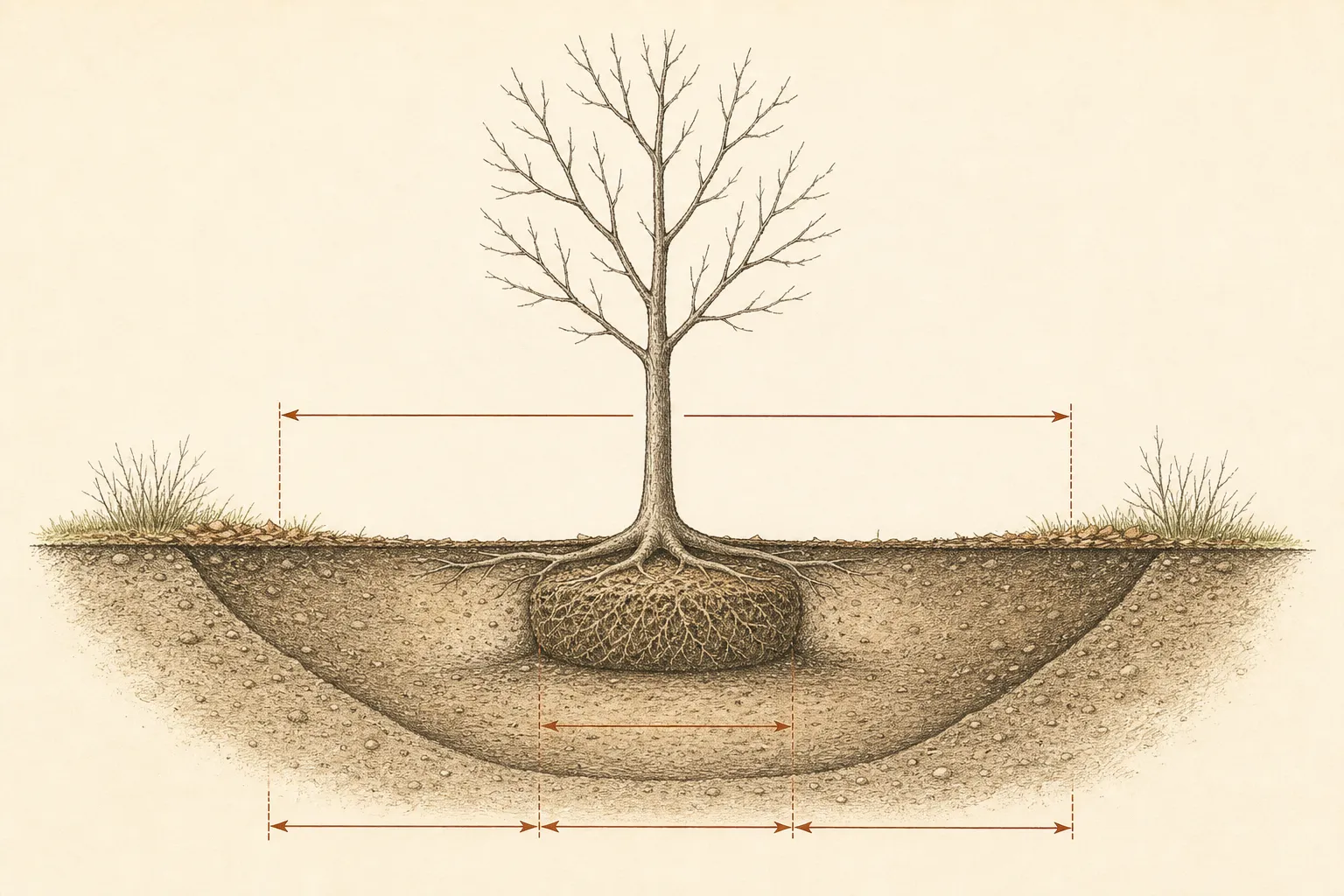
Remove loose container media from the stem base until the first structural roots are visible. Measure from that flare, not from the top of the pot or burlap. Correct circling, kinked or damaged roots according to current woody-plant guidance and reject stock with a buried or badly compromised trunk base.
- 5Set the flare at finished grade
Open a broad hole no deeper than needed for the root system, support the tree on undisturbed or firmly settled soil and keep the visible flare at finished grade. Backfill with the excavated soil unless a local soil recommendation calls for another approach; do not create a soft amended sump inside dense surrounding soil.
- 6Water the root ball and surrounding soil
Settle soil with water, then check moisture in both the original root ball and adjacent ground because they can dry at different rates. Water when the active root zone begins to dry and let excess drain. Adjust to rainfall, soil texture, season and canopy growth instead of using a fixed calendar amount.
- 7Mulch broadly and protect the trunk
Apply an organic surface layer over the root zone while leaving the flare and trunk visibly clear. Keep mowers, string trimmers, stakes and ties from wounding bark. Stake only when site or root-ball stability requires it, allow controlled movement and remove the system after establishment guidance says it is no longer needed.
Pruning flowering dogwood
Prune flowering dogwood for structure, clearance and sanitation, not to force a dense formal outline. At planting, remove only broken, dead or clearly conflicting material unless qualified nursery guidance identifies another need. Preserve the species' layered branching and a single coherent trunk structure where appropriate. Make removal cuts at the branch collar without flush-cutting or leaving long stubs, and do not coat ordinary cuts unless a regional authority recommends it for a specific problem. Limit the size and number of live cuts in one session; a neglected mature tree should be assessed by a qualified arborist rather than rapidly reduced. Remove dead or confirmed diseased twigs in dry working conditions with clean tools, but obtain regional diagnosis when dieback is spreading because dogwood anthracnose, cankers, drought and root injury can look related from a distance. Never top the canopy. Keep basal sprouts only when a multi-stem design intentionally uses them, and remove unwanted sprouts while small without cutting into the trunk or root flare.
Seasonal care
Spring
Observe bud opening, bract condition and the distribution of new leaves. Refresh the broad mulch ring without covering the flare, test irrigation before dry weather and remove only dead or damaged twigs after their condition is clear. Record bloom timing for this cultivar and region rather than comparing it with a calendar from another climate.
Summer
Check soil moisture below the surface during heat and drought, especially in the original root ball of a young tree. Watch for marginal scorch, wilting, spots or twig dieback and note whether symptoms begin in sun-exposed, wet or wounded areas. Preserve airflow and avoid repeated foliage wetting without assuming that every leaf mark is infectious disease.
Autumn
Enjoy fruit and foliage while keeping drupes out of human food use. Compare autumn color and leaf drop with prior years, remove fallen diseased material where regional guidance recommends sanitation, and continue establishment watering until soil cools if conditions are dry. Do not add soil or a deep mulch mound over the flare.
Winter
Use the leafless silhouette to inspect branch unions, crossing growth, bark wounds and the visibility of the root flare. Plan limited structural work for an appropriate local window and consult an arborist for large limbs or advanced decline. Check that de-icing salt, stored snow, standing water and protective hardware are not burdening the root zone or trunk.
Safety and garden spread
Common problems
Dogwood anthracnose risk
- Look for
- Expanding leaf lesions associated with veins, blighted shoots, twig dieback or cankers, especially where the disease is established regionally and cool wet conditions favor it.
- Action
- Photograph the pattern, reduce avoidable stress, keep the trunk and roots unwounded and seek a regional diagnostic confirmation. Use local cultivar-resistance tables for replacement decisions; resistance to this disease does not establish resistance to powdery mildew or spot anthracnose.
Powdery mildew
- Look for
- A white to gray surface coating, distorted young leaves or recurring late-season discoloration that differs among cultivars and sites.
- Action
- Confirm the diagnosis, improve useful light and air movement without exposing roots to harsher heat, and avoid crowding the canopy. When replacing a repeatedly affected tree, consult disease-specific cultivar ratings rather than a general resistant label.
Spot anthracnose or other leaf spots
- Look for
- Small distinct spots or lesions on bracts and leaves that do not match drought scorch, with severity varying by weather and cultivar.
- Action
- Retain samples or clear photographs, note whether spots occur on bracts, leaves or twigs and request local diagnosis if damage is significant. Keep sanitation and irrigation practices proportionate to the confirmed problem.
Drought and heat stress
- Look for
- Wilting, curled leaves, dry margins, early color or twig dieback in a hot exposed site or a root ball that dries faster than surrounding soil.
- Action
- Probe moisture in both soil zones, water slowly across the active roots when needed and expand the trunk-clear mulch ring. Correct reflected heat, turf competition and irrigation misses before assuming a nutrient deficiency or disease.
Poor drainage or root decline
- Look for
- Persistent wilt despite wet soil, sparse growth, root-zone odor, buried flare or decline concentrated in a low or compacted planting pocket.
- Action
- Stop routine watering, expose the flare carefully without severing roots and assess drainage beyond the original hole. Use an arborist or diagnostic service before excavation; correcting the surrounding site is more useful than adding amendments to a saturated pocket.
Weak bloom or unsuitable cultivar
- Look for
- Sparse bracts with otherwise living growth, excessive shade, chronic drought, severe prior pruning or cold injury on material of uncertain provenance.
- Action
- Recover the cultivar and seed-source record, compare light and care with local guidance and allow for establishment and annual weather. Improve the site where possible; replace only after confirming that hardiness, disease profile or mature size is genuinely mismatched.
Related reading
Sources
- Flowering Dogwood - Cornus florida. North Carolina Extension Gardener Plant Toolbox. Source record · Accessed 2026-08-30.
- Flowering Dogwood | Silvics of North America. USDA Forest Service Research and Development. Source record · Accessed 2026-08-30.
- Growing Flowering Dogwood Trees. University of Maryland Extension. Source record · Accessed 2026-08-30.
- Flowering Dogwood, Cornus florida. Virginia Cooperative Extension. Source record · Accessed 2026-08-30.
- Arbor Day – Planting a Tree Correctly. Purdue University Extension. Source record · Accessed 2026-08-30.
- Pruning Trees and Shrubs. University of Minnesota Extension. Source record · Accessed 2026-08-30.