Coral Bells
Heuchera americana
A species-led profile of Heuchera americana, with identification, planting and four-season care separated from the far more variable garden hybrids sold as coral bells.
Published Last updated
At a glance
- Light
- Part sun to open or dappled shade; protect from strong afternoon sun in hot-summer regions and verify the exact cultivar before using a sunnier site
- Water
- Even moisture during establishment, then moderate moisture with drainage; the species can tolerate some dry intervals once rooted but not a persistently saturated crown
- Soil
- Loamy or rocky, organic, moderately acidic to neutral soil with excellent crown drainage
- Hardiness
- Zones 4–9
- Bloom
- Late spring into early summer, with timing and duration shifting by region
- Height
- About 1 ft foliage; flower stems commonly 1.5–3 ft · About 0.3 m foliage; flower stems commonly 0.45–0.9 m
In this guide
Overview
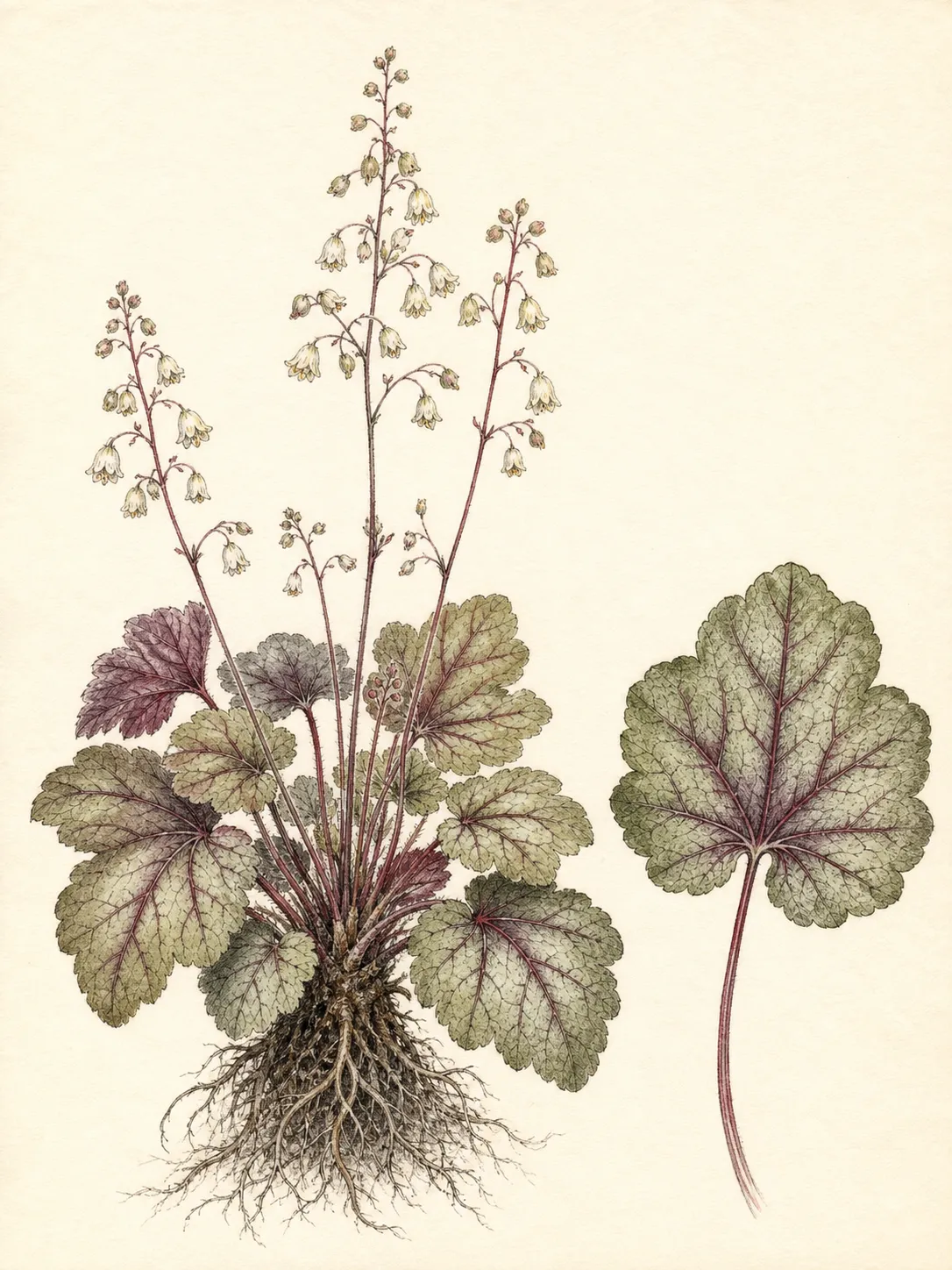
Coral bells are grown first as a foliage layer, but the plant's architecture is more precise than a mound of colored leaves. Heuchera americana makes a short central crown at soil level. Individual long petioles radiate from that crown and hold rounded to heart-shaped leaves with shallow lobes, toothed margins and visible palmate veins. The basal rosette stays low while thin, almost leafless flower stalks rise well above it. Small nodding flowers sit on loose branching panicles, producing an airy veil rather than a dense floral spike.
The straight species is usually quieter than modern retail displays. Its leaves are green, often with maroon, bronze, purple or silvery veining and marbling rather than a solid sheet of saturated orange or black. The spring-to-early-summer flowers are small and commonly greenish, cream or faintly tinted. This contrast is a useful identification cue: a large ruffled lime plant with bright pink bells may be an excellent coral-bells cultivar, but it should not be identified automatically as H. americana. Keep the nursery name attached so morphology and care can be traced accurately.
Kew accepts Heuchera americana as a perennial species in Saxifragaceae and places its native range from southeastern Canada through much of the eastern and north-central United States. In nature and regional references it is associated with rocky woods, ledges and well-drained slopes. That habitat suggests a crown that receives moisture yet is not buried in stagnant soil. Garden descriptions range from moist, rich shade to moderately dry rocky ground, which is not a contradiction when drainage, establishment and regional climate are stated. The species is adaptable, not aquatic.
Choose part sun or open shade as the dependable starting point. Gentle morning light can sharpen leaf pattern and support flowering, while high shade keeps the rosette legible beneath shrubs or small trees. Strong afternoon sun in a hot region can bleach, scorch or curl foliage, especially on light-colored hybrids. A cool northern site may carry more direct sun when root-zone moisture remains even. Observe the hours and intensity of light rather than treating full sun as one uniform condition across latitudes.
Build the site around drainage at the crown. Loamy or rocky soil with organic structure suits the species better than a deep pocket of water-holding compost in compacted clay. The retained sources place it from moderately acidic into neutral conditions; pH 5.5–7.0 is a planning range, not a reason to acidify blindly. Test soil before correction. Preserve a connected root zone, keep mulch away from the crown and avoid low spots where irrigation or winter runoff collects.
Use the plant near the front or middle of a shade border where its foliage can be seen and its tall stems can pass through neighboring mounds. Repetition works better than a collection of unrelated leaf colors. Several green-marbled species plants can make a calm ribbon beneath ferns or flowering shrubs; one named purple or silver cultivar can repeat at intervals as a darker note. Reserve its mature footprint so neighboring groundcovers do not climb over the short crown and conceal changes in grade or moisture.
The rosette may remain semi-evergreen in mild or sheltered sites, while cold, wind, snow, or exposed winter sun can leave leaves ragged or collapse them. That variability changes cleanup, not plant identity. Retain sound foliage through winter where it continues to serve the design, then remove damaged leaves individually as new growth begins. Do not shear the whole plant during a warm autumn spell or pile protective material over the crown; both actions can leave tender tissue or trapped moisture at the plant's most vulnerable point.
Garden hybrids require their own reading. Breeders have combined species and selected foliage color, size, ruffling, flowers and climate response. UC guidance notes that hot inland sun is often poorly tolerated, particularly by yellow-green foliage, while other hybrid lines may be sold specifically for heat or sun. A species-led profile supplies the botanical baseline, not a universal warranty. Confirm the full cultivar name, compare local trial or Extension information, and use observed performance to decide whether a plant belongs in sun, filtered light, a container, or a cooler part of the garden.
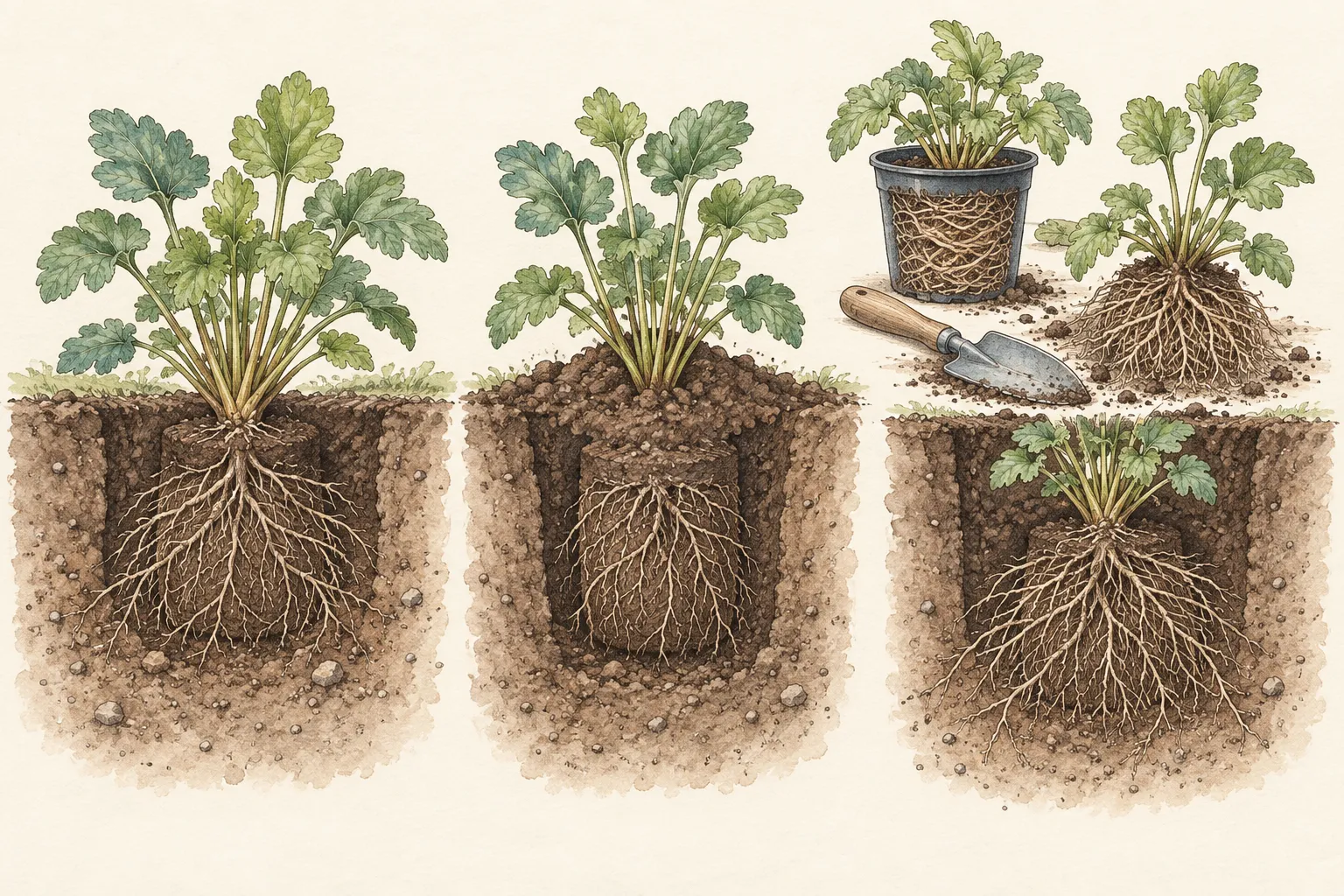
Division is a response to a woody, lifted, divided or badly placed crown, not an automatic annual chore. As the short stem elongates, its active rosettes can sit above the surrounding soil and lose close root contact. In a suitable cool period, lift the clump, retain young rooted outer sections, discard dead woody center material, and replant crowns at the surrounding grade. A healthy species clump may remain useful without frequent division; cultivar vigor, winter heaving and local soil determine the actual interval.
- Family
- Saxifragaceae
- Range
- Southeastern Canada through north-central and eastern United States
- Soil pH
- 5.5–7
- Spread
- About 1–1.5 ft · About 0.3–0.45 m
Planting & careHow to grow coral bells
This profile is anchored to the accepted species Heuchera americana, which Kew records from southeastern Canada through the north-central and eastern United States. NC State and Tennessee references describe an eastern North American garden plant suited broadly to zones 4–9, but regional ecotypes, taxonomic treatments, winter moisture, summer heat and snow cover affect performance. The straight species usually has green foliage with maroon or silvery marbling and small greenish cream flowers. Many nursery plants sold as coral bells are selected forms, interspecific hybrids or cultivars involving other Heuchera species. They may be purple, peach, silver, chartreuse or nearly black, and can differ in heat tolerance, sun tolerance, crown size, foliage persistence and flowering. Use the exact tag and local trial information for a hybrid; do not transfer the species' entire range or care envelope to every colored selection. In hot inland climates, UC guidance favors filtered light, especially for yellow-green foliage. In cold or wet-winter districts, drainage and frost-heave observation can matter more than nominal zone alone.
- 1Verify species or cultivar identity
Read the full botanical and cultivar name before choosing a site. A true H. americana should make a compact green to marbled basal rosette with airy greenish cream flower panicles. A solid peach, black, silver or chartreuse plant is likely a selection or hybrid with different heat, sun and size limits. Record the tag, source, hardiness claim and mature spread rather than filing every purchase under one generic coral-bells routine.
- 2Map light at leaf height
Observe direct sun in morning and afternoon during the active season. Favor part sun, open shade or dappled light for the species, with stronger afternoon protection as summers become hotter. Check reflected heat from paving and walls. For a named hybrid, replace the species default with reliable local performance information; a cultivar promoted for sun in one climate may still scorch in hot, dry inland exposure.
- 3Approve crown drainage
Probe the intended position after rain and irrigation. Reject a depression that remains saturated or a clay pocket surrounded by compacted soil. Loosen a broad area and blend finished organic matter only where it improves structure throughout the root zone. Preserve rocky or mineral drainage where it is already useful. Do not create a soft compost bowl that collects water under a shallow perennial crown.
- 4Reserve the mature rosette
Allow roughly 1–1.5 feet for the species foliage and account separately for flower stems that may rise 1.5–3 feet. Keep the crown clear of aggressive groundcovers and the leaf edge away from repeated foot traffic. Use the exact tag dimensions for hybrids, which may be more compact or substantially larger. Place tall neighbors where they will not collapse onto the airy panicles.
- 5Set the crown at finished grade
Water the nursery plant, slide it from the pot and loosen circling outer roots without tearing the crown apart. Set the junction of roots and leaf bases level with the surrounding finished soil. Spread a division's fibrous roots naturally and keep its growing crown visible. Backfill gently, remove major voids and avoid pressing wet soil into a hard collar around the short stem.
- 6Join the root ball to surrounding moisture
Water after planting so the original root ball and adjacent soil become evenly moist, then recheck both zones below the surface. A peat-heavy nursery plug can dry while nearby soil remains damp, or stay wet inside a drier rocky bed. Adjust frequency from actual moisture, weather and drainage. Established H. americana can handle some dry intervals, but a new division needs consistent contact while roots expand.
- 7Mulch around, never over, the crown
Use a light locally appropriate organic surface layer to moderate moisture and suppress competing seedlings, leaving a visible open ring around leaf bases and the crown. Pull back material that drifts inward after rain. Mark the plant in cold regions so spring cleanup does not rake out a heaved crown. Recheck grade after the first winter and reset exposed rooted sections during a suitable season.
Pruning coral bells
Coral bells need selective grooming rather than formative pruning. In late winter or early spring, wait until new leaves show where the living crown sits, then trace each torn, flattened or browned leaf petiole to its base and remove it without nicking emerging growth. Retain healthy winter foliage where it still contributes color. Do not shear the rosette into a flat dome; half leaves remain half leaves, and a close cut can expose the crown. Flower stalks can remain through bloom for their airy structure. Cut a spent stalk near its base when a clean foliage effect is wanted, or retain it until capsules mature when seed is part of the plan. Seed from hybrids may not reproduce the parent. Remove scorched leaves only after correcting or documenting the light and moisture cause, because immediate total cleanup can expose the crown to more heat. When the short stem becomes woody and lifted, pruning cannot push it back into the soil. Lift and divide during a regionally suitable cool period, retaining vigorous rooted rosettes and replanting them at grade. Avoid autumn shearing in climates where new tender growth could meet early cold, and never bury the crown under compost as a substitute for proper resetting.
Seasonal care
Spring
Find the crown before raking. Remove only damaged winter leaves as fresh growth opens, keeping tools above the short stem. Check whether freeze-thaw has lifted rooted sections and reset them at grade in workable soil. Spring is a useful time to divide a woody or congested clump, retaining vigorous outer rosettes. Restore even moisture after replanting, renew a light crown-clear mulch and protect flower stems from neighboring plants that may lean into them. Compare emerging leaf color with the recorded cultivar so stable marbling is not mistaken for stress.
Summer
Probe the root zone during heat rather than watering by the leaf surface alone. The species can tolerate some dry intervals after establishment, but prolonged drought can curl or crisp foliage; saturated warm soil threatens the crown differently. Give hot-climate plants afternoon protection and observe pale cultivars for bleaching. Remove spent flower stems if seed is not wanted, or leave selected panicles to mature. Keep groundcovers and mulch from closing over the crown, and record whether the named hybrid is actually meeting its advertised light tolerance in this garden.
Autumn
Keep sound foliage in place as temperatures cool. Reduce irrigation only as weather and soil moisture permit; do not leave the crown dry before winter or saturated by an unchanged summer schedule. Early autumn division can work where roots have ample time to establish before hard freeze, but cold-region gardeners may prefer spring. Remove collapsed flower stems and unstable debris while preserving the rosette. Pull fallen mulch and heavy leaves back from the crown, and label cultivars before their colors dull or foliage becomes weathered.
Winter
Expect foliage retention to vary with cultivar, exposure, snow cover and regional cold. A semi-evergreen rosette may remain useful, become bronze, or look flattened without the crown being dead. Prevent downspout water, plowed snow and repeated foot traffic from loading the site. After freeze-thaw cycles, check whether the crown has risen above the soil, but wait for workable conditions before resetting it. In mild wet climates, prioritize drainage and air around the crown; in exposed cold climates, use only a light protective mulch that does not bury leaf bases.
Safety and garden spread
Common problems
Crown lifted above the soil
- Look for
- A woody short stem or rooted rosette sitting visibly above grade, rocking in wind, or drying despite moist soil nearby.
- Action
- Lift and divide in a suitable cool season, keep vigorous rooted outer sections and reset their crowns at finished grade. Do not solve repeated heaving by piling wet compost over leaf bases.
Crown decline in saturated soil
- Look for
- Soft dark leaf bases, a loose crown, yellowing or collapse associated with soil that stays wet rather than merely moist.
- Action
- Stop automatic watering, pull mulch away and inspect drainage. Salvage only firm rooted rosettes, clean tools between cuts and relocate healthy divisions to a draining root zone.
Sun bleaching or scorch
- Look for
- Faded color, tan translucent patches, crisp margins or leaf curl concentrated on the side receiving strong afternoon or reflected sun.
- Action
- Check moisture and light together. Restore even root-zone moisture if dry, then move the plant in a suitable season or add filtered shade when the exposure exceeds the species or cultivar limit.
Ragged winter foliage
- Look for
- Flattened, browned or torn older leaves after cold, wind, snow or freeze-thaw while new buds at the crown remain firm.
- Action
- Wait for spring growth to reveal the living crown, then remove damaged leaves individually at the base. Preserve sound foliage and avoid cutting into emerging rosettes.
Sparse flowers or loose growth
- Look for
- Few panicles, stretched petioles or a thin rosette in deep shade, or weak growth where the root zone repeatedly dries.
- Action
- Confirm identity, then compare actual light and moisture with the species or cultivar needs. Increase gentle light or relocate only after drainage, drought, grade and crown condition have been checked.
Cultivar does not match the species profile
- Look for
- Leaf color, mature size, flower color, heat response or winter persistence that differs substantially from green-marbled H. americana.
- Action
- Recover the nursery name or seek horticultural identification. Use the cultivar's reliable regional guidance instead of forcing a hybrid to follow the species dimensions or sun envelope.
Plant details
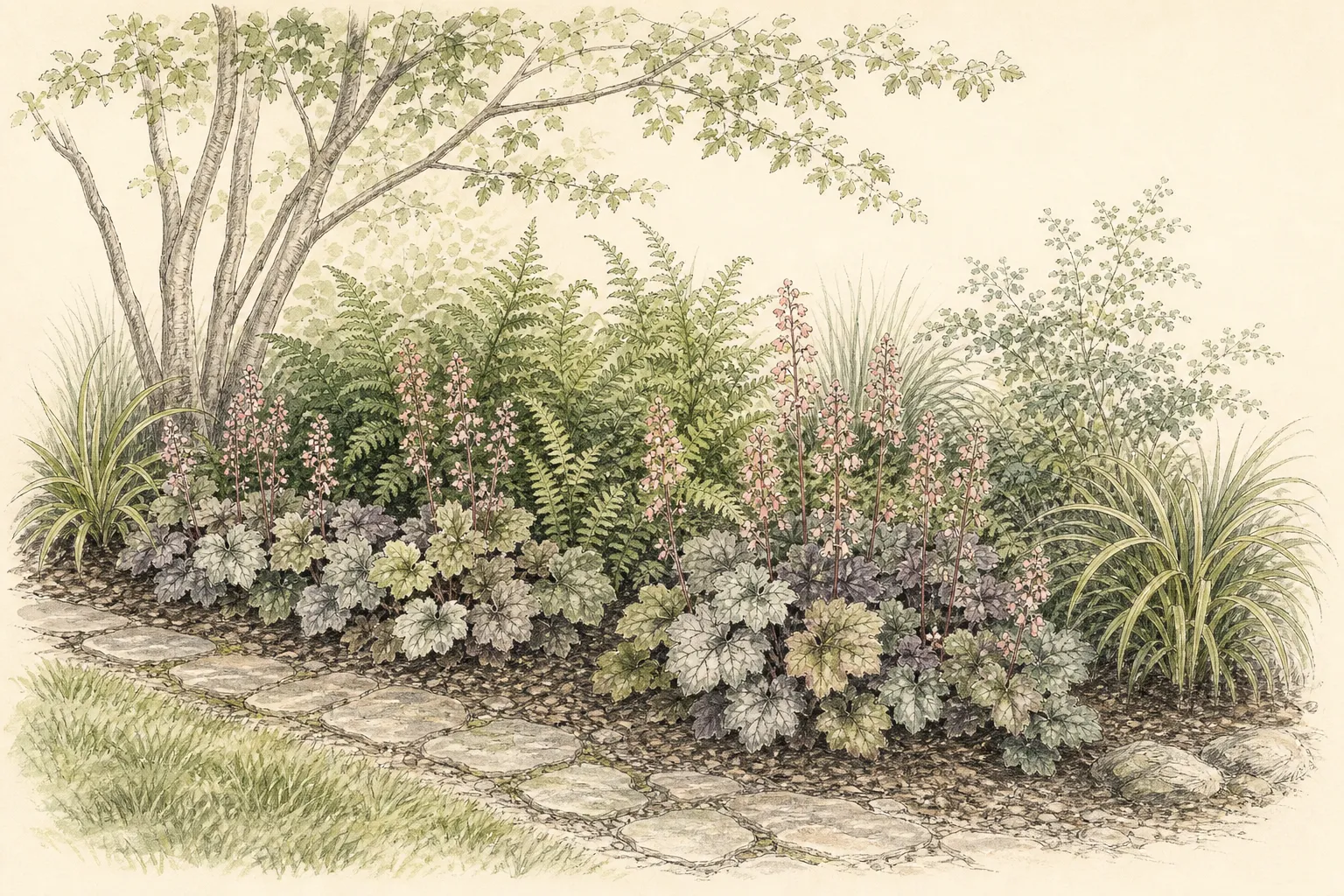
Coral bells repeated between ferns and sedges in a lightly shaded ornamental border
Related reading
Sources
- Heuchera americana L.. Royal Botanic Gardens, Kew. Source record · Accessed 2026-08-30.
- Coral Bells: Heuchera americana. NC State Extension. Source record · Accessed 2026-08-30.
- Heuchera americana. University of Tennessee Smart Yards. Source record · Accessed 2026-08-30.
- Heuchera Hybrids (Coral Bells). UC Master Gardener Program of Sonoma County. Source record · Accessed 2026-08-30.
- Toxic and Non-toxic Plants: Coral Bells. ASPCA. Source record · Accessed 2026-08-30.