Christmas Fern
Polystichum acrostichoides
Christmas fern is a wintergreen eastern North American fern for shaded, well-drained ground; this profile covers its two frond forms, crown placement, restrained cleanup, and winter behavior.
Published Last updated
At a glance
- Light
- Partial to full shade
- Water
- Dry to medium; water regularly during establishment
- Soil
- Organically rich, acid-to-neutral, well-drained woodland soil
- Hardiness
- Zones 3–9
- Bloom
- Non-flowering; fertile pinnae appear in late spring
- Height
- 1–2 ft · 30–60 cm
In this guide
Overview
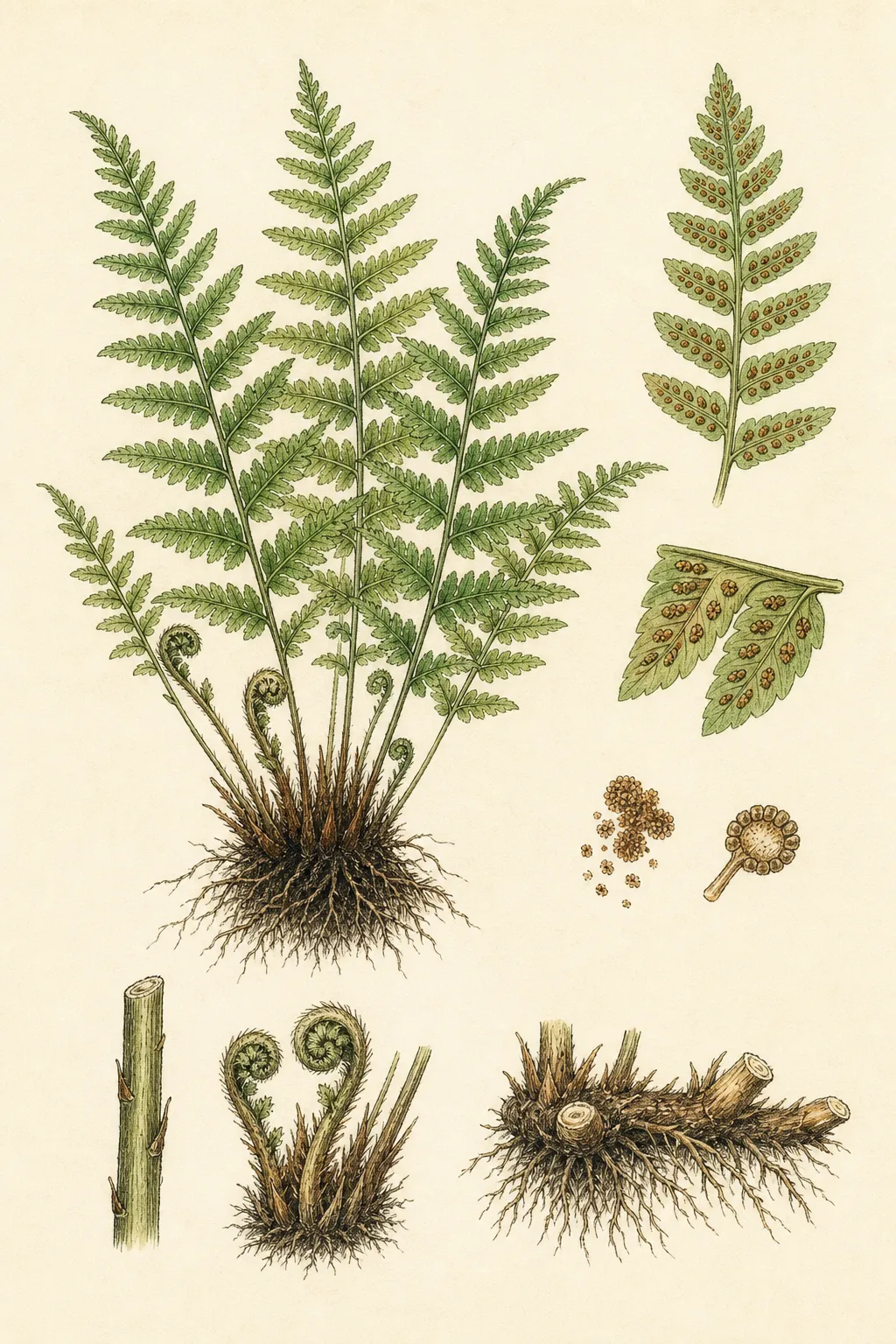
Polystichum acrostichoides is a wintergreen fern in the wood-fern family, Dryopteridaceae. Its leathery, once-pinnate fronds arise in a vase-shaped clump. Each pinna has a small ear-like lobe at its base, and the upper third of a fertile frond narrows into reduced spore-bearing pinnae.
Unlike a running fern, Christmas fern holds a discrete crown that slowly increases in size. Mature plants are generally 1–2 ft tall and wide, useful as repeated winter structure on a shaded slope or among spring ephemerals.
The species accepts dry-to-medium moisture better than many garden ferns, but it still needs water while establishing. Partial to full shade and acid-to-neutral, organically rich, well-drained soil are the dependable combination. Winter-wet depressions invite crown rot.
Keep the central growing point at the soil surface. Missouri Botanical Garden notes that angling a bare rhizome can help shed water where crown rot is a concern; container plants should retain their nursery grade. Add only a thin woodland mulch around the crown.
Old fronds often flatten beneath snow while remaining green. Maryland Extension advises that cutting them as new fiddleheads appear is unnecessary in most gardens and reduces photosynthetic capacity. Remove only fully brown, broken, or diseased fronds.
The plant does not flower. Sori develop on the undersides of reduced fertile pinnae near the frond tip, while the broad sterile portion and separate sterile fronds continue the foliage display.
- Family
- Dryopteridaceae
- Range
- Eastern North America
- Soil pH
- 4.5–7
- Spread
- 1–2 ft · 30–60 cm
Planting & careHow to grow christmas fern
The fern occupies both dry and moist shaded slopes across eastern North America. Evergreen fronds may flatten under snow without dying, while poorly drained winter soil creates a more serious crown-rot risk.
- 1Space discrete fern crowns
Allow a 1–2 ft circle for each slowly enlarging crown. Repeat separate plants across a slope rather than expecting one rhizome to run through the bed.
- 2Choose shade that drains in winter
Use partial to full shade and acid-to-neutral soil. Check the site after heavy winter rain as well as during summer; the crown tolerates some dryness better than prolonged saturation.
- 3Leave the growing point at the surface
Set a container plant at nursery grade and keep the central crown visible. For a bare rhizome in rot-prone soil, follow the supplier’s orientation and consider the slight angle described by Missouri Botanical Garden.
- 4Water new crowns, then taper
Water the full root ball during establishment, then let the surface begin to dry before watering again. Do not apply the constant irrigation used for wetland ferns.
- 5Use a thin woodland mulch
Spread leaf litter around the plant while leaving the crown open. A deep wet cap over the growing point defeats the species’ need for winter drainage.
- 6Expect winter flattening
Do not mistake snow-flattened green fronds for dead growth. Wait for the spring fiddleheads, then remove only old fronds that are fully brown or damaged.
Pruning christmas fern
Routine cutback is unnecessary. In spring, remove only fully brown, broken, or diseased fronds close to the crown; preserve sound wintergreen foliage and never cut the emerging fiddleheads.
Seasonal care
Spring
Watch silvery scaled fiddleheads rise through the older fronds. Trim only dead or broken foliage, keep the growing point clear, and check for soft tissue if winter drainage was poor.
Summer
Water newly planted crowns during dry spells. On established plants, accept moderate dryness but investigate bleaching or crisping that follows unexpected direct sun.
Autumn
Leave the leathery fronds attached; they provide winter cover and continue functioning. Clear only debris that is packed tightly into the center of the crown.
Winter
Snow may press the fronds flat without killing them. Monitor pooling water around the crown, and postpone cosmetic cleanup until new fiddleheads show what tissue remains sound.
Safety and garden spread
The retained institutional profiles do not flag this species as harmful. That does not establish edibility; keep it ornamental and use routine hygiene when handling soil or old fronds.
Common problems
Crown rot
- Look for
- The center softens, smells decayed, or fails to produce fiddleheads after a winter in saturated soil.
- Action
- Clear mulch from the crown and correct the drainage problem. Remove irrecoverable tissue, and reset only a firm healthy division with its growing point at the surface.
Sun-scorched fronds
- Look for
- Exposed fronds bleach or develop crisp patches while shaded fronds stay dark green.
- Action
- Confirm the change in light, especially after tree work. Restore shade or move the crown during cool weather; do not treat scorch as a fungal disease without diagnosis.
Flattened winter foliage
- Look for
- Snow or ice lays still-green fronds against the ground.
- Action
- Leave sound fronds attached; flattening is normal and they can continue photosynthesizing. Remove them only after they become fully brown or physically broken.
Deer browsing
- Look for
- Frond tips are torn away at browsing height, sometimes despite the fern’s deer-resistant reputation.
- Action
- Confirm tracks or repeated feeding before intervening. Maryland Extension notes that heavy deer pressure can overcome resistance, so use locally recommended exclusion where losses are material.
Plant details
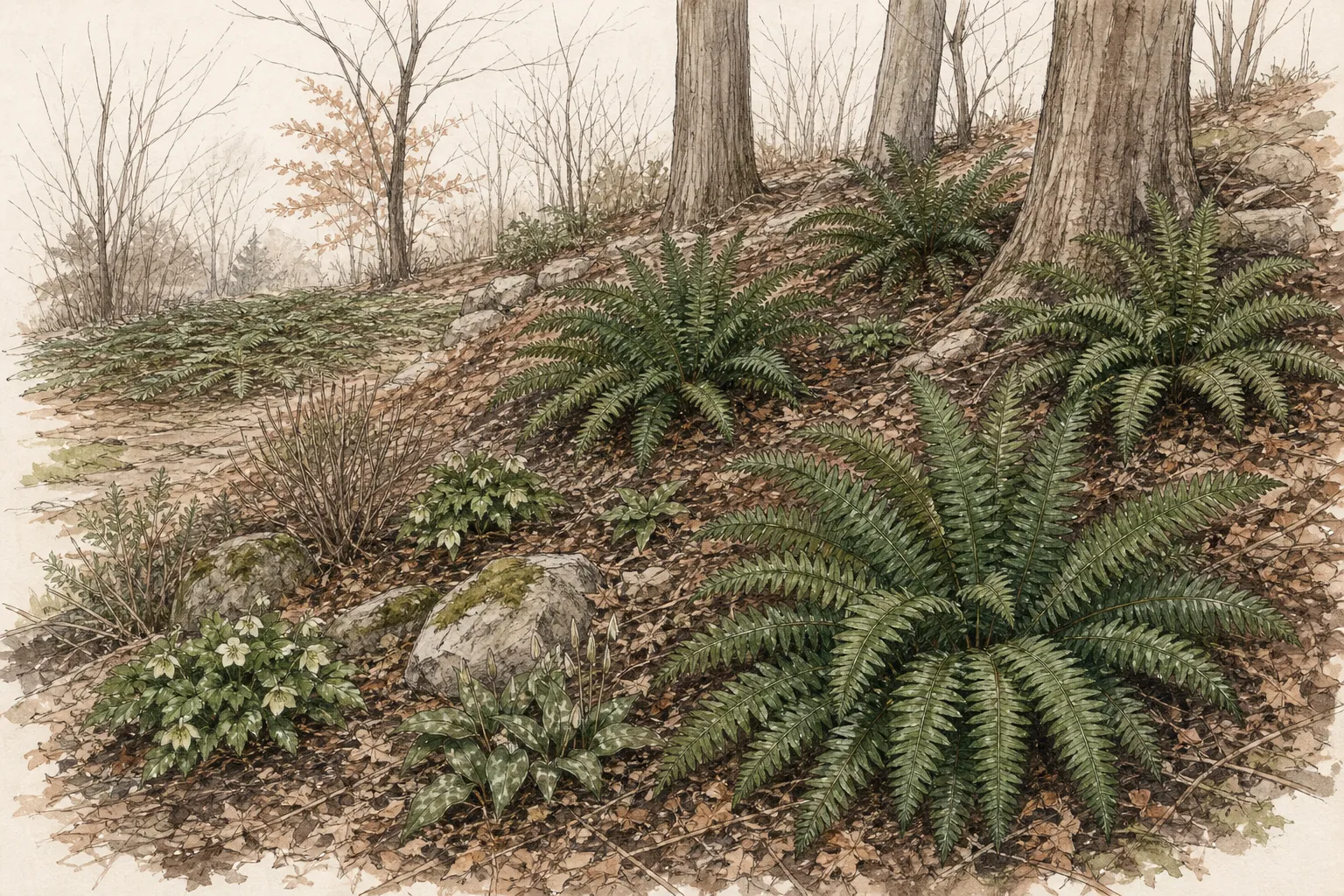
Garden study showing the placement and growth habit of Christmas Fern
Related reading
Sources
- Christmas fern garden profile. University of Maryland Extension. Source record · Accessed 2026-08-30.
- Polystichum acrostichoides Plant Finder record. Missouri Botanical Garden. Source record · Accessed 2026-08-30.
- Polystichum acrostichoides account. Flora of North America. Source record · Accessed 2026-08-30.