Balloon Flower
Platycodon grandiflorus
A late-summer Platycodon grandiflorus profile for sunny to lightly shaded borders, with balloon-like buds, careful siting, slow spring emergence and low-disturbance care.
Published Last updated
At a glance
- Light
- Full sun to partial shade; choose a bright position that can hold steady moisture
- Water
- Medium and reliably moist during growth, with drainage that prevents winter saturation
- Soil
- Deep, light and fertile loam that stays moist but drains freely; slightly acidic soil is suitable
- Hardiness
- Zones 3–8
- Bloom
- Summer into late summer, often continuing toward early autumn depending on climate and cultivar
- Height
- 1–2 ft · 30–60 cm
In this guide
Overview
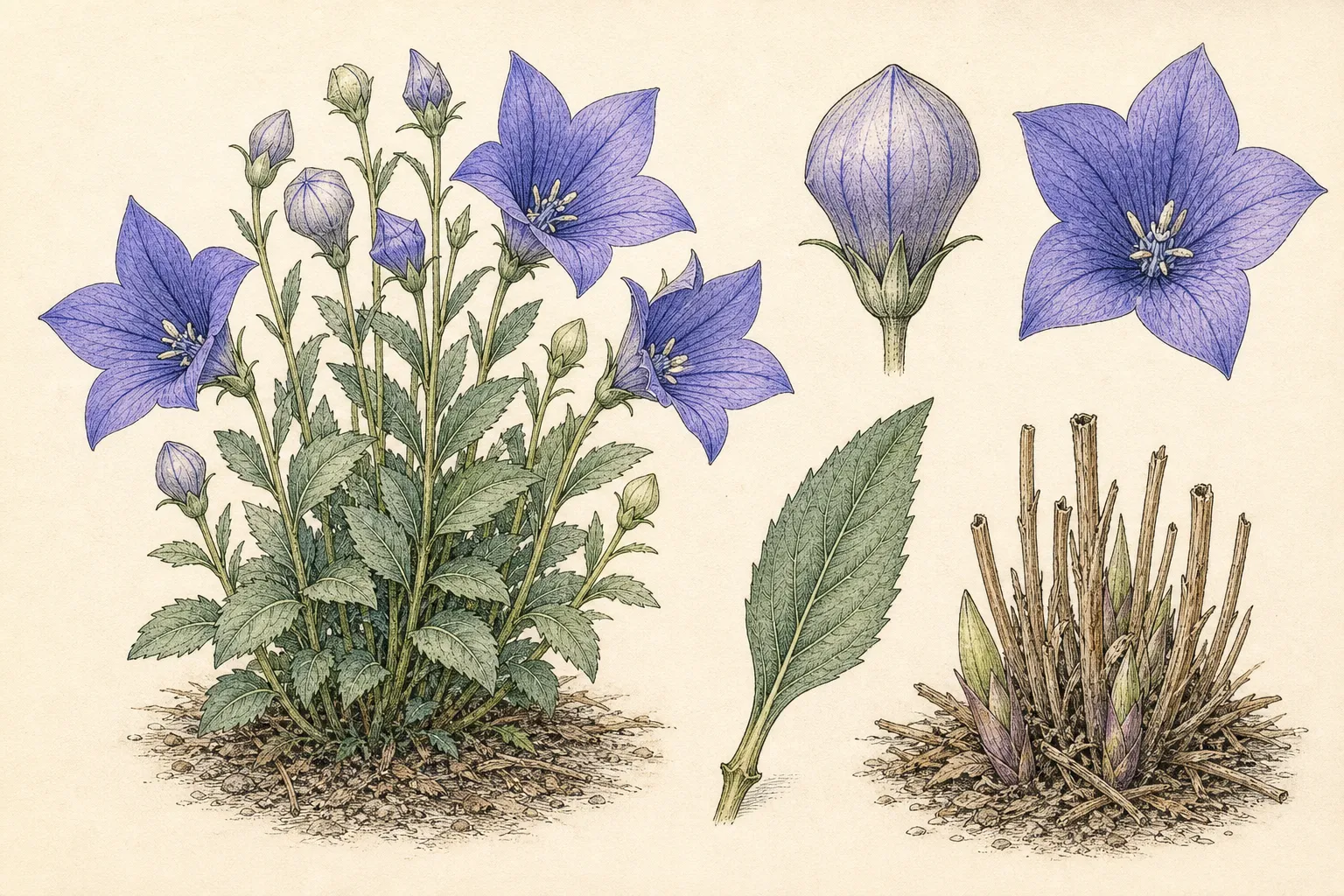
Balloon flower is easy to recognize once you see the bud: each unopened flower swells into a round, inflated form before opening into an outward-facing bell with five pointed lobes. Platycodon grandiflorus makes a compact clump of blue-green, toothed leaves and upright stems carrying blue-purple or white flowers. That sequence of bud to bell gives a late-summer border a stage of interest that a flower-only profile misses.
The foliage and habit help confirm the identity before bloom. Leaves are simple, blue-green and toothed, while the plant grows as a clump rather than a spreading mat. The stems can lean when growth is soft or the position is too dim, so the plant is most legible in the front or middle of a border where its flowers rise above a lower companion without being hidden by it.
Kew treats Platycodon grandiflorus as an accepted species with a native range from southeastern Siberia through Korea, Japan and China. Common names overlap with other plants, and RHS records older names including Campanula grandiflora and Platycodon leweri. Keep the botanical name with the label when buying seed or a named cultivar; the name is the reliable link between the plant in hand and its care limits.
Give balloon flower full sun or partial shade in deep, light, fertile loam that stays moist but drains freely. N.C. State describes it as best in well-drained, slightly acidic soil, while the RHS profile allows acid, neutral or alkaline ground. The practical agreement is more important than a narrow pH target: choose a root zone that does not dry repeatedly in summer and does not remain saturated after rain.
Expect a useful but moderate scale. Plants commonly reach about 1–2 feet in height and 1–1.5 feet in spread, so a group can edge a path, fill the front of a mixed border or sit among rock-garden plants without becoming a wall. Leave the clumps visible and accessible; the fleshy root system resents disturbance, and division or transplanting is harder than the plant’s low-maintenance reputation suggests.
Spring is the season that most often causes an avoidable mistake. Balloon flower can be slow to emerge, and Iowa State specifically recommends marking late-emerging perennials so early cultivation does not damage them. Once growth appears, the plant is steady: deadheading can extend the bloom period, seed is a practical propagation route, and the old top can be cut back after autumn dormancy.
- Family
- Campanulaceae
- Range
- Southeastern Siberia through Korea, Japan and China
- Soil pH
- 5.5–8
- Spread
- 1–1.5 ft · 30–45 cm
Planting & careHow to grow balloon flower
Kew lists Platycodon grandiflorus as an accepted species native from southeastern Siberia to Japan and China. North Carolina Extension lists USDA zones 3a–8b; the RHS H5 rating is based on UK conditions and is not a direct USDA conversion. Use the bright end of its light range where summer moisture is dependable, and give every site free drainage through winter. Iowa State identifies balloon flower as a late-emerging perennial, so mark the crown before spring cultivation.
- 1Buy by botanical name
Check the label for Platycodon grandiflorus and keep it with the plant. Balloon flower, Chinese bellflower and Japanese bellflower are overlapping common names, while older synonyms can still appear in collections and catalogues.
- 2Choose the brighter workable edge
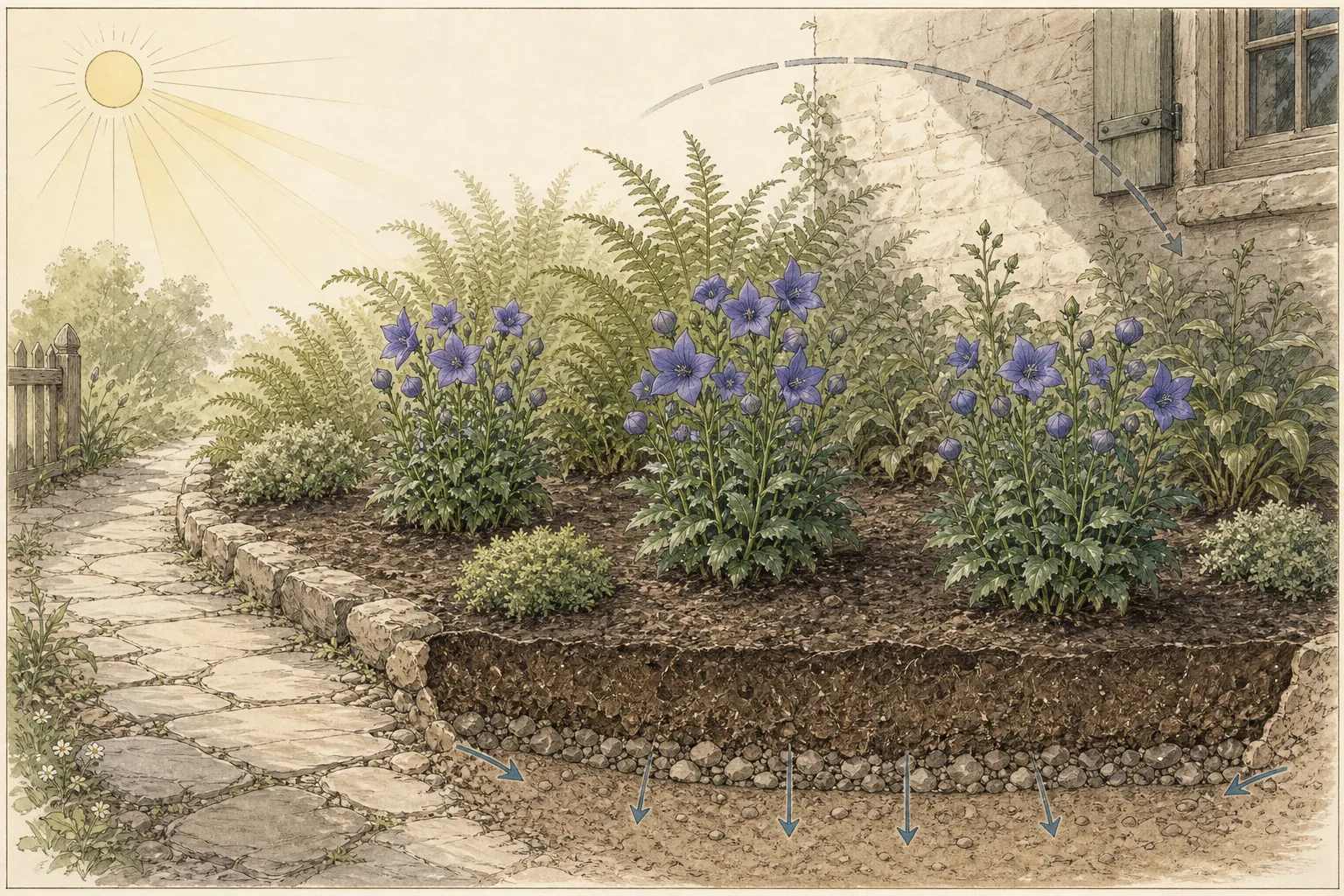
Use full sun or partial shade, placing the clump where it receives enough light to flower and where neighboring foliage will not close over it. In a hot garden, a site that holds moisture is more useful than a dry, exposed position.
- 3Test the soil after rain
Dig into the proposed bed and look for deep, fertile loam that is moist but not stagnant. If water sits in the root zone, improve the bed or select another position before planting; surface mulch cannot repair poor drainage.
- 4Reserve the mature footprint
Allow roughly 1–1.5 feet of spread and up to 2 feet of height. Set groups along the front or middle of the border, leaving an open margin so the stems, buds and lower foliage can be inspected.
- 5Disturb the fleshy roots lightly
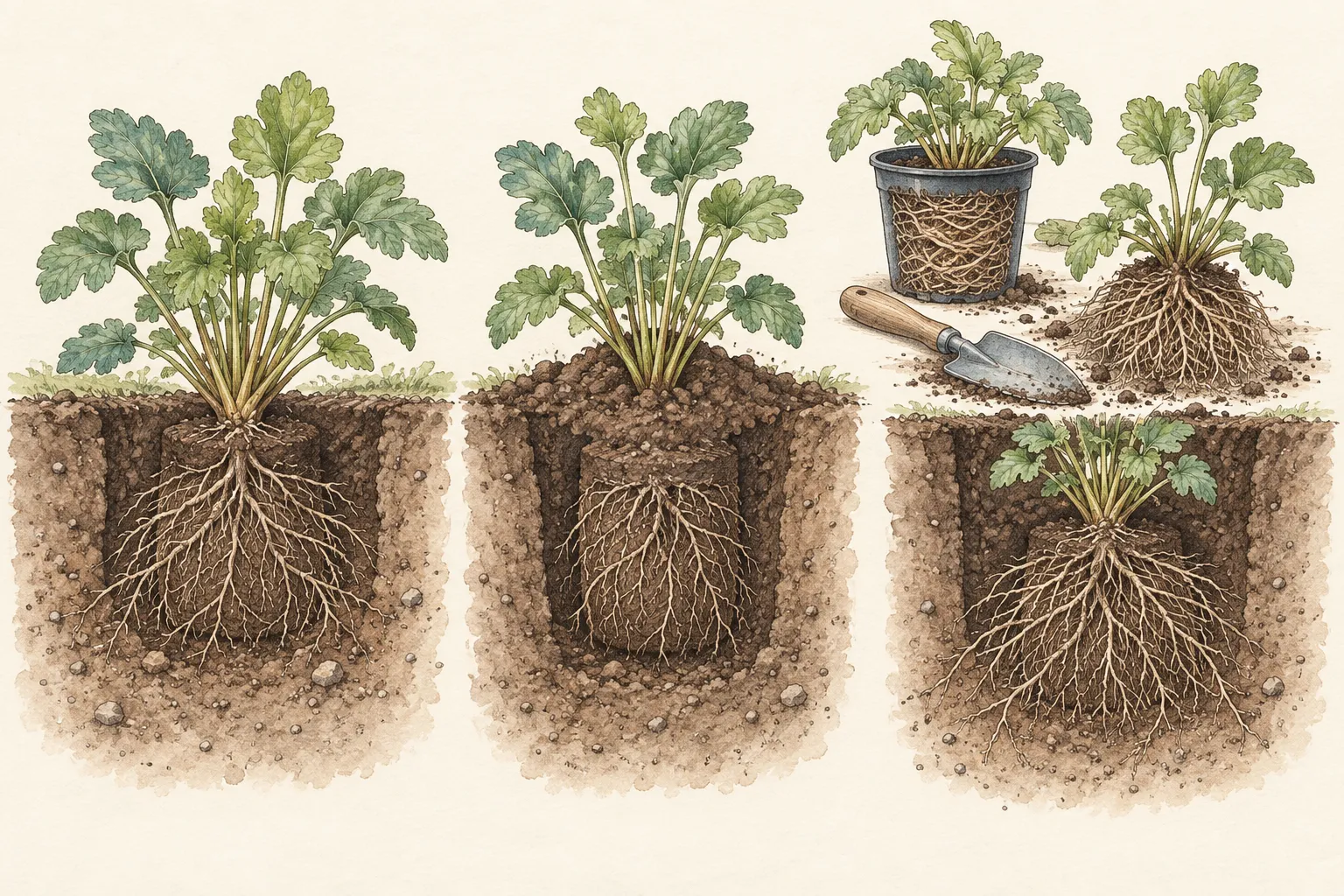
Set a container-grown plant at the depth it occupied in its pot, firm the soil around the root ball and water it in. Handle the root system gently because division and transplanting are difficult once it is established.
- 6Water through establishment
Keep the occupied root zone evenly moist while the plant settles and during dry spells, then let excess water leave the bed. A measured soak is more useful than frequent shallow wetting in compacted or poorly drained soil.
- 7Mark the crown for spring
Place a durable label or discreet marker beside the clump before the top dies back. Balloon flower emerges late in spring, so the marker prevents early cultivation or replanting from striking a living crown.
- 8Deadhead with a purpose
Remove spent flowers when you want a longer display or fewer developing seed capsules. Leave selected capsules if you want to collect seed, and support taller stems early if they begin to lean.
Pruning balloon flower
Balloon flower needs little routine pruning. Remove individual spent flowers to prolong the display or to limit seed production, leaving a few capsules when seed collection matters. After the top has finished for the season, cut the dead stems back to the base in autumn. Keep the crown marker in place through winter and spring because new shoots can be late to appear.
Seasonal care
Spring
Treat the bed as occupied even when it looks empty. Keep the crown marker visible, wait for the late shoots before cultivating nearby soil, and begin watering when new growth appears and the root zone starts to dry.
Summer
Hold steady moisture without waterlogging the bed, deadhead selectively and watch the stems as buds enlarge. Add discreet support before a tall stem leans across a path or neighboring plant.
Autumn
Enjoy the final bells, decide whether to leave a few capsules for seed, and cut the spent top to the base after dormancy begins. Remove fallen debris while keeping the plant label in position.
Winter
The plant is dormant below ground. Keep the site freely drained, avoid digging over the crown, and leave its marker visible so spring maintenance does not mistake the empty space for a vacancy.
Safety and garden spread
The retained horticultural profiles do not identify a specific poisoning hazard for Platycodon grandiflorus. This does not establish edibility or pet safety; grow it as an ornamental and seek case-specific advice after a concerning ingestion.
Common problems
Late spring emergence
- Look for
- An apparently empty planting spot in early spring even though the crown was healthy the previous year.
- Action
- Check the marker and wait before cultivating, dividing or replacing the plant. Iowa State identifies balloon flower as a late-emerging perennial and recommends marking its location.
Flopping stems
- Look for
- Flowering stems leaning into a path or across neighboring plants as buds develop.
- Action
- Check whether the clump is receiving enough light, add discreet support while stems are still upright and avoid moving an established plant just to correct a seasonal lean.
Root decline in wet soil
- Look for
- Poor growth or collapse where the bed remains saturated after rain instead of draining between watering events.
- Action
- Read the soil profile and correct the drainage pattern before watering again. Replace the plant only after the site can stay moist without holding standing water.
Slugs and snails
- Look for
- Irregular holes or ragged leaf margins on young foliage, especially where the planting is cool and sheltered.
- Action
- Inspect after damp weather, remove hiding places around the crown and confirm the cause before choosing a control. The RHS lists slugs and snails among the pests to which balloon flower may be susceptible.
Related reading
Sources
- Platycodon grandiflorus (Jacq.) A.DC.. Plants of the World Online, Royal Botanic Gardens, Kew. Source record · Accessed 2026-09-02.
- Chinese Balloon Flower - Platycodon grandiflorus. North Carolina Extension Gardener Plant Toolbox. Source record · Accessed 2026-09-02.
- Platycodon grandiflorus | balloon flower. Royal Horticultural Society. Source record · Accessed 2026-09-02.
- It's early May, but I don't see any signs of my balloon flowers. Should I be worried?. Iowa State University Extension and Outreach. Source record · Accessed 2026-09-02.