American Royal Fern
Osmunda spectabilis
American royal fern is a large deciduous wetland fern with broad, widely spaced leaflets and fertile tips; this profile covers accepted identity, wet-soil placement, crown care, and seasonal dieback.
Published Last updated
At a glance
- Light
- Partial shade; tolerates deep shade or sun where moisture is constant
- Water
- Consistently moist to wet; low drought tolerance
- Soil
- Acidic, humus-rich, moist to wet soil
- Hardiness
- Zones 3–9
- Bloom
- Non-flowering; fertile pinnae mature in late spring
- Height
- 2–5 ft · 60–150 cm
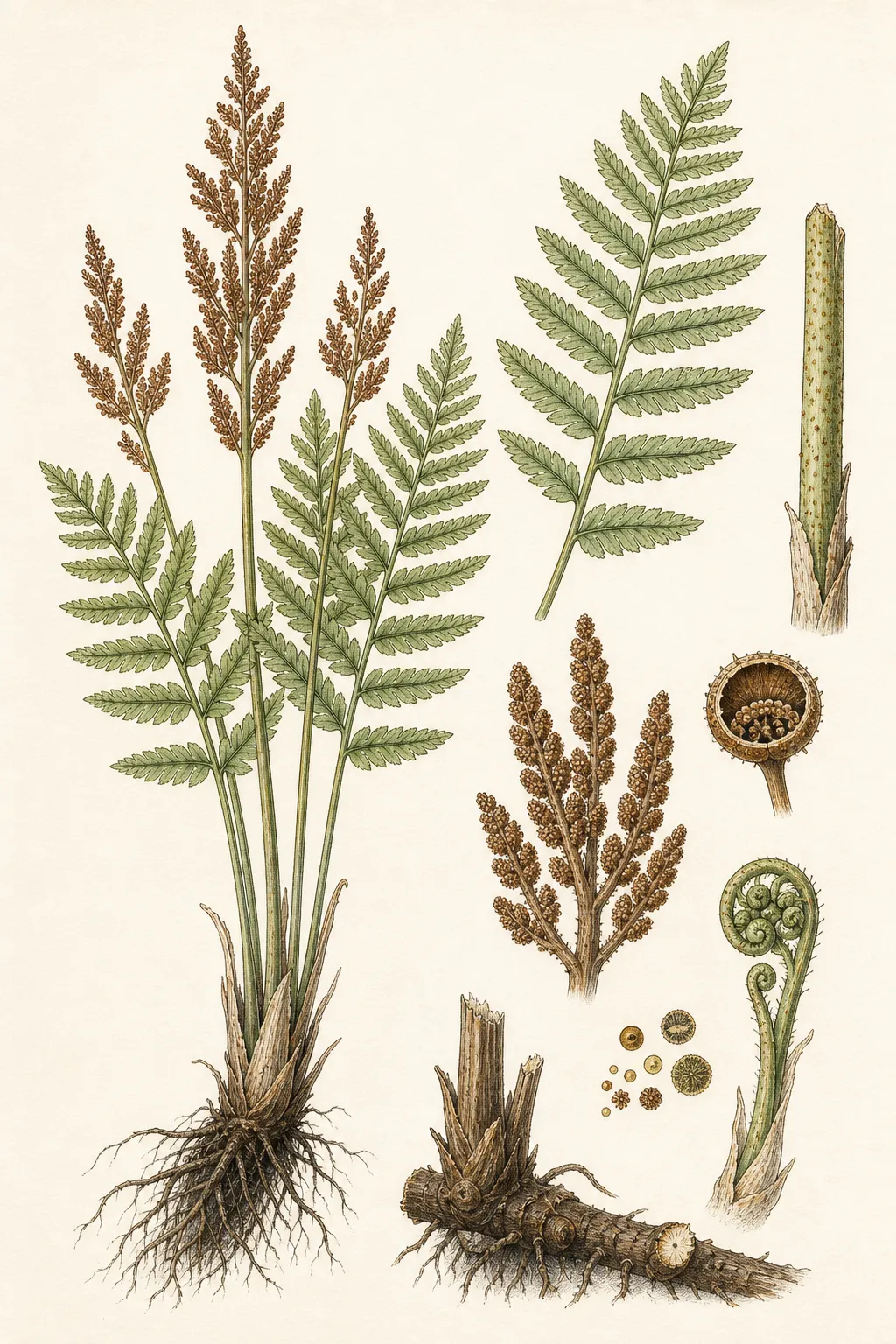
In this guide
Overview
Osmunda spectabilis is the accepted name for the American royal fern, formerly treated by many references as Osmunda regalis var. spectabilis. It is a deciduous clump-forming fern in Osmundaceae, native through the New World.
Broad, twice-divided fronds have widely spaced leaflets that look less feathery than many woodland ferns. On fertile fronds, the upper quarter becomes a rusty-brown cluster of spore-bearing pinnae; these are normal reproductive tissue, not dead flower heads.
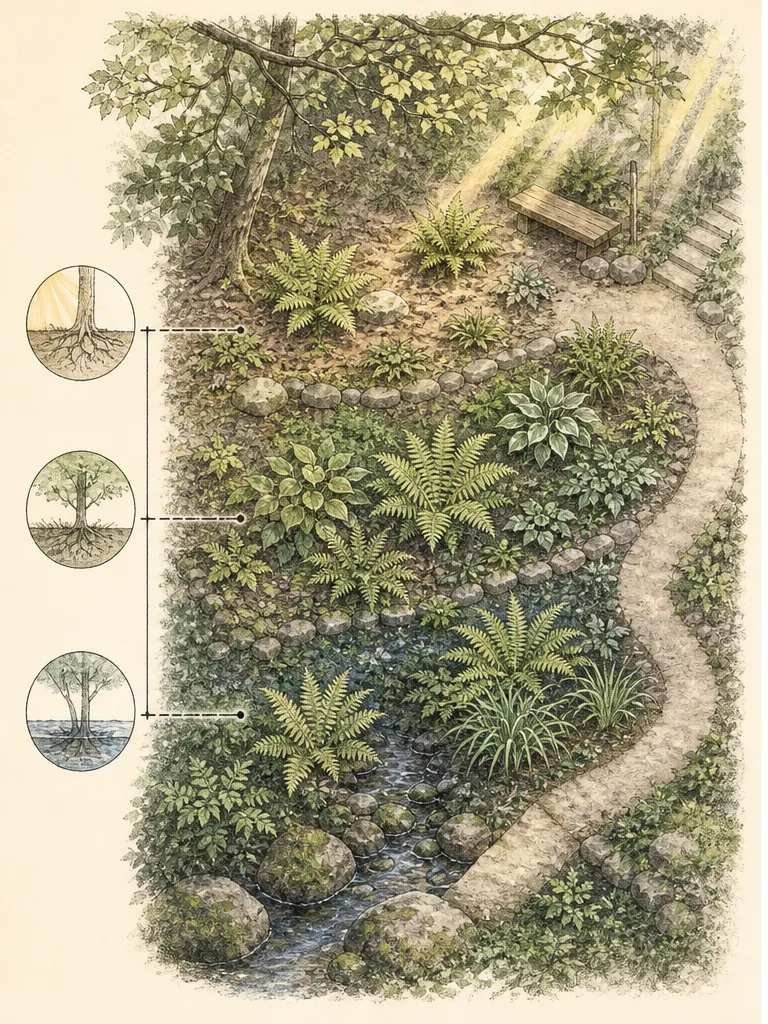
A mature crown is usually 2–5 ft high and 2–3 ft wide. It suits pond margins, wet woodland openings, and the consistently moist zone of a rain garden, where its full vase can develop without blocking a path.
Acidic, humus-rich soil should remain moist to wet throughout active growth. Partial shade is the easiest exposure. Deep shade is tolerated, while sun requires constant moisture and is less forgiving in hot-summer climates.
Plant the crown at the same grade at which it grew in the nursery and keep mulch outside the growing center. The substantial rootstock enlarges slowly and seldom needs division; disturbing it delays the architectural effect.
After spores mature, the brown fertile tips may remain for texture. The entire frond eventually turns yellow to golden brown in autumn and can be cut only after it collapses, before the next spring’s reddish-brown fiddleheads expand.
- Family
- Osmundaceae
- Range
- The Americas, from eastern North America through Central and South America
- Soil pH
- 4.5–6.5
- Spread
- 2–3 ft · 60–90 cm
Planting & careHow to grow american royal fern
This wetland fern tolerates more sun in cool climates only when water is constant. Dry shade produces a smaller crown, while warm exposed sites can scorch rapidly; match the planting to local hydrology rather than trying to compensate with fertilizer.
- 1Give the frond vase a broad circle
Reserve a 2–3 ft-wide circle for a crown that can send fronds 2–5 ft high. Keep it clear of narrow paths so the broad fronds do not require support or trimming.
- 2Confirm year-round wet-soil capacity
Choose acidic, humus-rich ground that remains moist to wet through summer. A temporary rain puddle over otherwise dry soil does not provide the consistent root-zone moisture this fern needs.
- 3Set the fern crown at grade
Place a container-grown plant with the top of its crown level with the surrounding soil. Backfill, water deeply, and keep leaf mulch away from the central growing point.
- 4Keep the wetland root zone supplied
Do not let a new crown dry between waterings. Extend moisture beyond the original root ball so roots grow into an equally moist bed rather than remaining confined.
- 5Protect the slow-growing center
Mark the crown before spring work and keep feet and tools out of it. Do not divide a healthy plant simply to make it fill the site faster.
- 6Read fertile tips correctly
Expect the top quarter of fertile fronds to turn rusty brown as spores mature. Leave that tissue unless it is physically damaged; it is not a sign that the whole frond should be removed.
Pruning american royal fern
Leave rusty fertile tips until spores mature if their texture is welcome. Cut entire fronds only after they yellow and collapse in autumn or before spring fiddleheads expand; avoid routine division of the heavy crown.
Seasonal care
Spring
Locate reddish-brown fiddleheads before working the bed. Remove last year’s collapsed fronds without cutting new growth, and restore moisture early if the crown sits above a drying waterline.
Summer
Maintain constant moisture as fronds reach full height. Treat rusty-brown fertile tips as normal, while widespread edge browning or collapse calls for an immediate root-zone moisture check.
Autumn
Allow the deciduous fronds to turn yellow or golden brown. Once they collapse, cut them at the base and keep the central crown free of a heavy wet mat.
Winter
The crown is dormant below the removed fronds. Keep its marker visible and make sure winter work around a pond or rain garden does not lower the water supply for spring.
Safety and garden spread
The retained institutional profiles do not flag this species as harmful. That does not establish edibility; keep it ornamental and use routine garden hygiene.
Common problems
Drought-browned fronds
- Look for
- Frond margins crisp, leaflets droop, or the whole vase loses height during a dry interval.
- Action
- Check moisture through and beyond the root ball immediately. Restore sustained moisture and add shade in hot sites; fertilizer cannot correct a drying wetland crown.
Small, sparse fronds
- Look for
- New fronds remain much shorter than 2 ft or the crown thins over successive seasons.
- Action
- Check whether the water table, irrigation coverage, shade, or root competition has changed. Correct the site condition gradually and leave the slow rootstock undisturbed.
Damaged fiddleheads
- Look for
- New crosiers are snapped or bruised before they unfurl, leaving gaps in the year’s vase.
- Action
- Keep cultivation, foot traffic, and maintenance equipment outside the marked crown. A broken fiddlehead cannot be restored, so protect the remaining growth.
Normal fertile tips mistaken for dieback
- Look for
- Only the upper quarter of selected fronds turns rusty brown while the broad lower leaflets remain green.
- Action
- Inspect for organized spore-bearing pinnae. Leave the fertile portion through spore maturation and remove the whole frond only when it naturally yellows and collapses.
Plant details
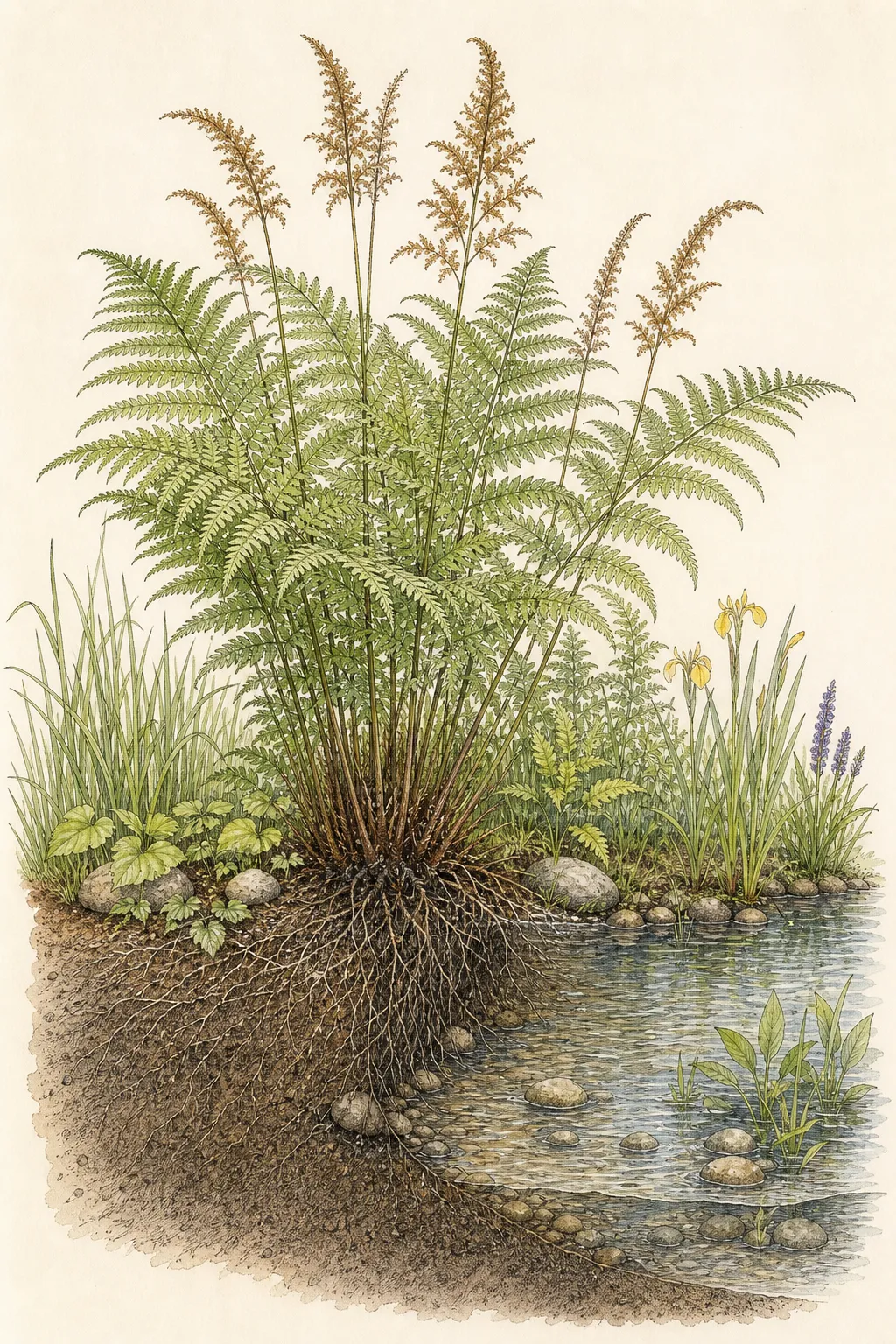
Garden study showing the placement and growth habit of American Royal Fern
Related reading
Sources
- Osmunda spectabilis plant profile. NC State Extension. Source record · Accessed 2026-08-30.
- Growing Ferns in Iowa: Royal Fern. Iowa State University Extension and Outreach. Source record · Accessed 2026-08-30.
- Osmunda spectabilis taxonomy and distribution. Royal Botanic Gardens, Kew. Source record · Accessed 2026-08-30.