Grow · start elephant ears indoors
Start Elephant Ears Indoors for a Strong Ornamental Foliage Display
Wake elephant-ear corms in warmth and restrained moisture, then acclimate the rooted plants gradually to an outdoor container or bed.
Published Last updated
In this guide
- Use the biological cue for elephant-ear corms for ornamental foliage
- Read the site and the whole plant together
- Set a visible finish line before beginning
- Prepare the work while every part is still identifiable
- Carry out the central operation in a controlled sequence
- Protect roots, crowns, and new growth after the work
- Diagnose a weak response before adding another treatment
- Leave a record for the next seasonal decision
- Steps
Use the biological cue for elephant-ear corms for ornamental foliage
Begin only when indoor warmth and light can support growth until frost danger has passed and both air and soil are reliably warm outdoors. Firm Colocasia corms are commonly started six to eight weeks before that outdoor window. Count backward from the local last-frost pattern, then confirm that a warm bench, bright position, and enough headroom will remain available as the first leaves expand. Holding a sound corm dormant for another week is safer than waking it into a cold, dim room where roots cannot match leaf demand.
A viable corm feels firm across its base and has no spreading soft patch, sour leakage, or collapsing growing point; exact top and bottom vary with propagule form and supplier. Inspect every piece under good light because rot can remain confined to one corm while the rest of a shipment is usable. Set questionable pieces apart on a washable tray and compare them again after the sound stock is labeled. That separation prevents one leaking propagule from defining the condition of an otherwise healthy group.
Cold wet mix before rooting, deep burial, indoor shade, and an abrupt move into sun or wind can rot the corm or scorch emerging foliage. Early warning appears as a crown that loses firmness, mix that stays heavy for days, or a pale leaf leaning toward the window. Start one representative corm first when orientation or storage quality is uncertain, then use its root and shoot response to set moisture for the rest. A cool, saturated test pot calls for more warmth and air around the mix before another corm is planted.
Elephant ears may overwinter outdoors in warm zones but are seasonal or lifted in cold climates; moisture needs also differ between Colocasia and similar-looking genera. Use the article date only to place indoor starting within a temperate spring sequence. The deciding evidence is a named genus, a firm storage organ, a warm bright indoor interval, and forecast nights that will be suitable at hardening time. Local Extension guidance should settle any conflict between a general schedule and the behavior of the labeled cultivar.
Read the site and the whole plant together
Use a broad draining pot in a warm bright place with room for large leaves, then select an outdoor site whose moisture and light suit the named Colocasia. Check the carrying route while the pot is still empty: door width, steps, soft lawn, and the final watering position all matter once wet mix and tall petioles make the container awkward. At the destination, watch morning and afternoon light separately and note where wind accelerates around a wall or corner. Those observations determine whether hardening can continue in place or needs a sheltered staging area.
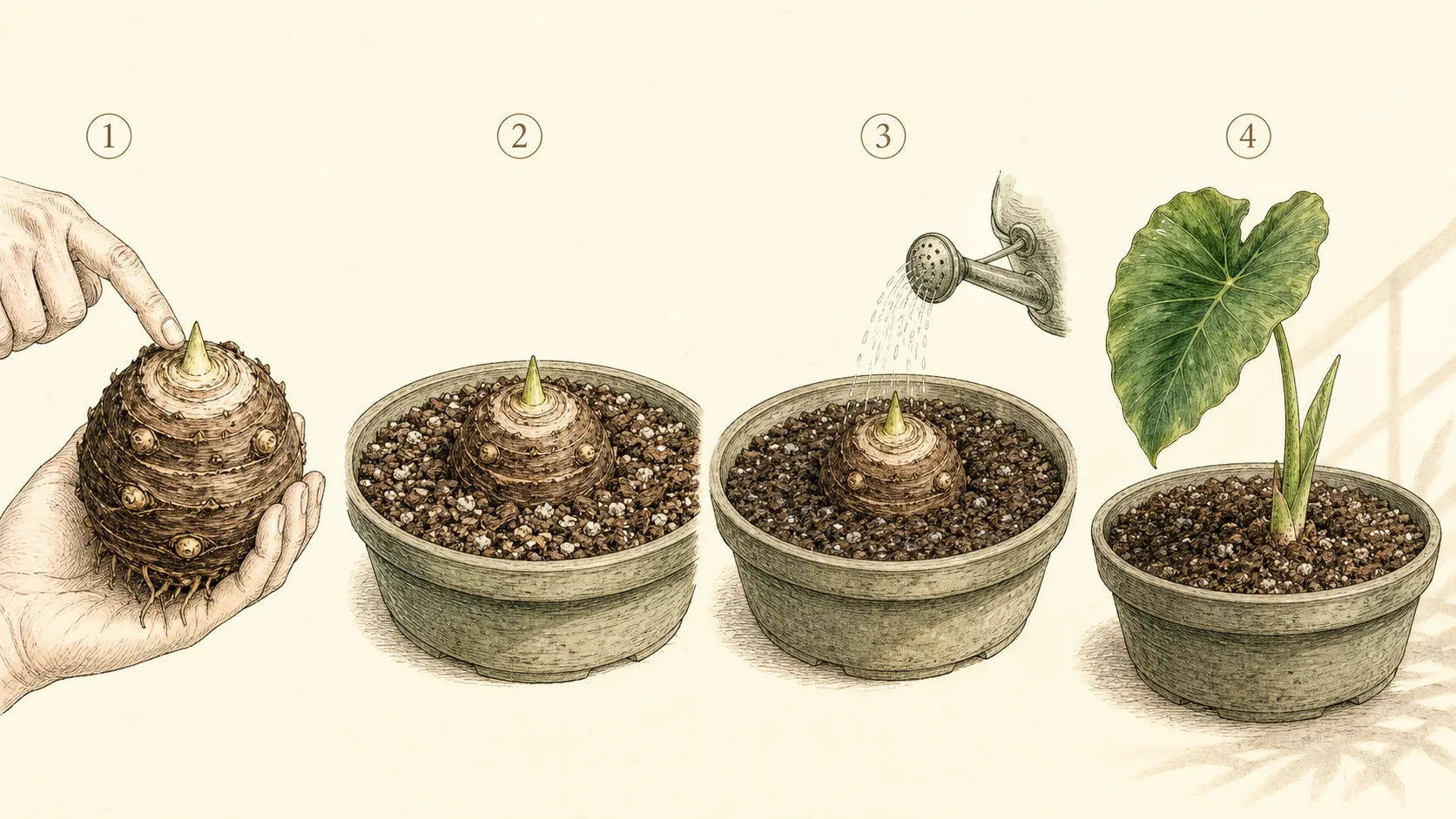
Keep the corm assessment tied to individual labels. A firm, clearly oriented piece can enter the normal starting sequence, while a firm but ambiguous piece remains shallow and separately marked; any soft or leaking piece stays isolated. After shoots appear, compare crown firmness and pot weight across the labeled pots. A single slow corm can simply be dormant, whereas the same softening pattern in several pots points to mix temperature or watering practice.
The indoor phase is complete when roots hold the mix, at least one leaf is unfolding normally, the crown remains firm, and the pot can be lifted without the corm shifting. Confirm those points at the drainage hole and soil surface before beginning outdoor exposure. A tall leaf alone is weak evidence because stored reserves can extend a petiole before the root system is ready. Root hold plus crown condition gives a practical stop line for indoor production.
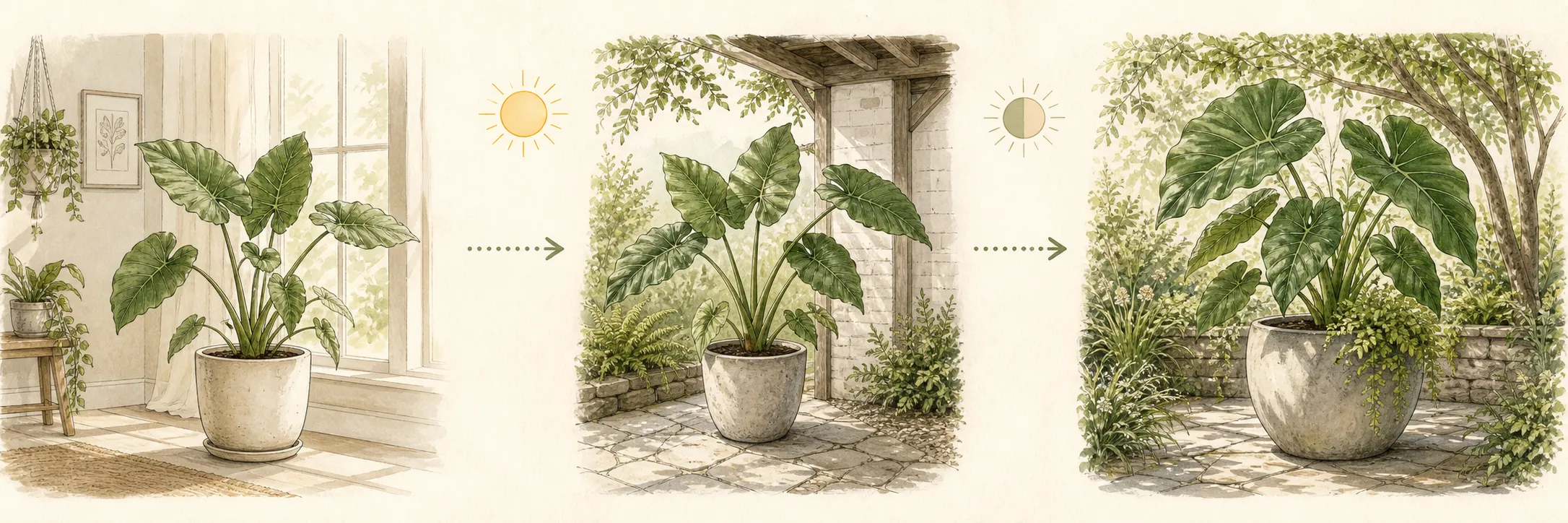
A small corm can produce foliage wider than the starting pot within weeks. Reserve clearance from glass, lamps, and neighboring plants, and keep a path wide enough to rotate or move the container without folding petioles. For the outdoor position, allow for the cultivar's mature spread and the reach of its irrigation. A placement that blocks a path or competes with a dry-site perennial should be changed while the plant is still portable.
Set a visible finish line before beginning
Write four finish checks on the label or bench card: roots holding the mix, an unfurling leaf, a firm crown, and stable growth before hardening. A dated overhead photograph can show crown exposure, while a side photograph records petiole strength and leaf angle. These references distinguish useful root establishment from the temporary drama of one rapidly extending leaf. Variations in corm shape or leaf angle need correction only when they accompany soft tissue, poor anchorage, or contact with the pot edge.
Rot risk rises when an unrooted corm is buried deeply in cold wet mix; later, shade-grown foliage can scorch during an abrupt move into sun or wind. Pause potting when the genus is unknown, the growing point cannot be located without cutting, or several corms show spreading softness. During hardening, return plants indoors if nights approach 50°F or leaves lose turgor in wind despite moist mix. Each pause preserves a specific option: re-identification, warmer rooting, or a slower exposure schedule.
Separate Colocasia from Alocasia and Xanthosoma before assigning one indoor routine. The common name covers genera with different leaf posture, storage organs, moisture tolerance, and overwintering behavior. This article’s wet-soil outdoor guidance is bounded to named Colocasia stock; a rhizomatous Alocasia or a tissue-cultured plant without a mature corm should follow its supplier’s container method, free of a generic bulb schedule.
Prepare the work while every part is still identifiable
Inspect and label corms, choose a broad pot with drainage, use fresh airy mix, and reserve a warm position away from cold glass. Pre-fill each label before opening storage bags so genus, cultivar, and propagule type stay attached to the right piece. Set dry mix, pots, trays, and a measured watering can within reach, then handle one labeled corm at a time. A firm corm needs no trimming; if decayed tissue would require deep cutting or the piece cannot be held securely, isolate it rather than turning potting into a salvage operation.
Label genus, species or cultivar, propagule form, and start date on the pot. Dark-leaved Colocasia may need brighter outdoor light for color, while many Alocasia prefer filtered light and better drainage. The label therefore controls final placement as well as identity; losing it can turn successful indoor growth into sun scorch, drought stress, or an inappropriate water-garden planting.
Use a washable potting surface away from food preparation and keep every corm and trimmed root out of reach of children and pets. Reserve enough space that the first leaves can unfurl without rubbing a window or grow light. Set the pot on a stable waterproof tray and keep the tray free of drainage water around an inactive corm.
Carry out the central operation in a controlled sequence
Place the growing point upward, cover shallowly according to propagule form, water lightly, and increase moisture only as roots and leaves become active. Pot the clearest corm first and photograph its orientation before adding the final mix; use that reference only for pieces of the same form. Leave the upper contour close enough to the surface that crown firmness can be checked without digging. After the first watering, verify that the drainage hole runs freely and that the corm has not floated or tipped, then repeat the measured depth and water volume for the matching stock.
Watch the top layer and pot weight during the first week. Mix that remains glossy, compressed, or heavy long after watering signals too little air around an inactive corm; a settling crown should be reset while roots are still short. By contrast, a warm pot that lightens evenly can receive another modest watering even before the leaf expands. Separate those moisture patterns from sun scorch, which appears later as bleached or papery areas after outdoor exposure.
Set a named Colocasia corm with its growing point near the surface, matching Wisconsin Extension’s guidance, and settle porous mix around it without compacting the crown. Give only enough water to moisten the mix initially. Increase volume as roots and leaves become active; an unrooted corm cannot use the copious moisture that an established outdoor Colocasia may later require.
Protect roots, crowns, and new growth after the work
Rotate for balanced light, pot on before severe congestion, harden off in shade and shelter, and introduce stronger sun gradually where the cultivar tolerates it. After each move, recheck that the crown is still exposed, the label remains legible, and drainage water leaves the tray. Keep leaf litter and spilled mix away from the petiole bases so a soft crown is visible early. A clear space around the pot also makes changes in lean or root anchorage easier to notice.
Delay feeding until roots are visible or the pot is drying faster because foliage is actively expanding. Water and oxygen are the first needs of a recently awakened storage organ; soluble fertilizer in persistently wet mix can add stress without correcting cold or poor light. Once growth is steady, use the product rate appropriate to the container and record the date so repeated feeding is intentional.
Night temperature governs the outdoor transition. Wisconsin Extension notes that elephant ears falter when temperatures remain below 50°F, so a warm afternoon does not make the season ready. Begin hardening in shade and shelter, bring plants in before cold nights, and add sun gradually according to cultivar. Wind can tear an otherwise acclimated leaf even when temperature and light are acceptable.
Begin hardening only after roots hold the mix, a leaf is unfolding, and the crown stays firm through a normal watering cycle. When those signs remain stable for several days, handle the pot less often and judge it at the same time each day. Repeatedly pulling at the shoot or disturbing the surface can break new roots and make a sound corm appear loose. Let pot weight, leaf angle, and crown firmness provide the evidence.
Diagnose a weak response before adding another treatment
Track pot weight, crown firmness, leaf angle, root emergence, and outdoor night temperature instead of watering from a fixed indoor schedule. Read them in pairs: a lighter pot with a firm crown suggests normal uptake, while a heavy pot with increasing softness points toward rot. A new white root at the drainage hole confirms progress more reliably than petiole length alone. Record the same indicators after each hardening session so cold, wind, and light injury can be separated.
A corm that remains firm but inactive may need more warmth and time; a softening crown in cold wet mix needs less water and immediate inspection. Pale stretched leaves point to insufficient light, while bleached patches after outdoor exposure point to hardening failure. Diagnose those different patterns before feeding or watering again, and isolate a rotting corm so leakage does not contaminate neighboring pots.
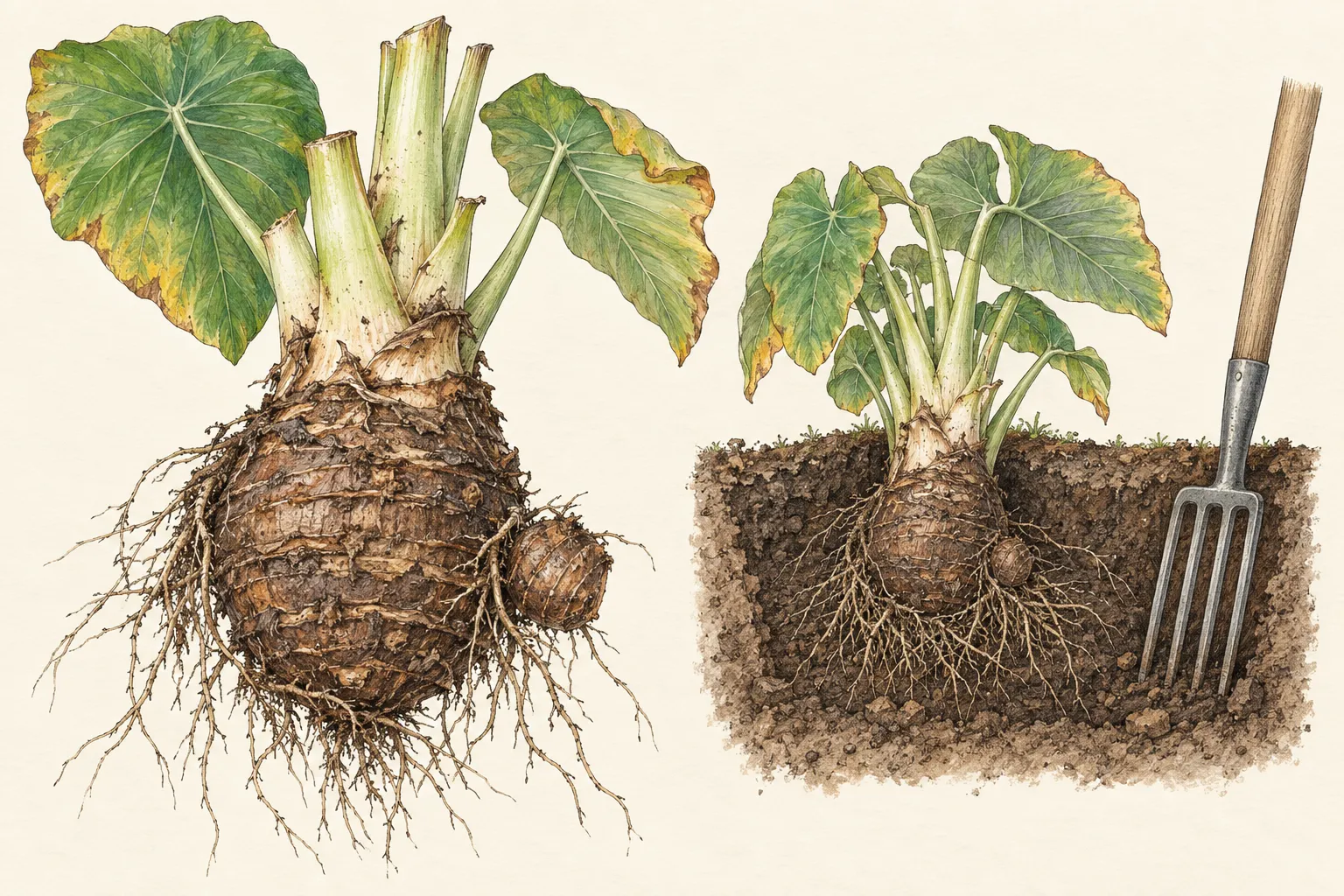
After growth resumes, reassess the storage organ as well as the shoot. A formerly wrinkled surface may remain harmless if the base is firm and fresh roots are extending, while a green leaf can still be running on reserves above a softening corm. Wait for root attachment before shifting the plant to a larger pot or outdoor bed. That interval reveals whether the shoot and root system are advancing together.
End a repeated watering or warming adjustment when the crown continues to soften, leakage spreads, or neighboring pots begin to smell sour. Move the affected pot away from sound stock, photograph the tissue boundary, and retain one healthy comparison pot under the original conditions. A local Extension diagnostic service can help when decay keeps advancing despite corrected temperature and moisture, especially if multiple corms from one lot are involved.
Leave a record for the next seasonal decision
Close the record with pot weight, crown firmness, leaf angle, first visible root, and the lowest outdoor night temperature during hardening. Add the date of each move and take side photographs from the same marked bench position. This sequence shows whether a change followed watering, potting-on, cold exposure, or brighter light. It also provides a usable starting point for the same cultivar next year.
Note any firm corm held dry because its identity or orientation remained uncertain, and any Alocasia or tissue-cultured plant kept outside the Colocasia routine. Those exceptions protect living stock from a false uniform treatment. Keep water and extra mix off unresolved propagules until their type and orientation are clear.
Revisit the regional assumption that elephant ears may overwinter outdoors in warm zones but are seasonal or lifted in cold climates; moisture needs also differ between Colocasia and similar-looking genera. Compare the recorded night temperatures with leaf response and rooting speed, then identify the specific limit that delayed planting out. A cold spring may shift the hardening window, while a slow corm in an otherwise successful batch may call for earlier individual starting. Keep those two conclusions separate when setting next year's date.
Record genus, start date, first shoot, first full leaf, pot-on date, and the outdoor night temperatures during hardening. The next decision is whether that cultivar can move to a moist bed, remain in a container, or needs the better-drained filtered-light conditions of another elephant-ear genus. That record also shows whether next year’s indoor start should move earlier or later.
Steps
- Level
- moderate
- Time
- One focused session, followed by scheduled checks
- Tools
- Broad draining nursery pot, Potting scoop, Plant label, Watering can
- Materials
- Firm elephant-ear corm, Fresh porous potting mix, Container support if the final site is windy
- 1Identify the elephant ear
Confirm whether the stock is Colocasia, Alocasia, Xanthosoma, or a tissue-cultured plant without a true dormant corm. Use this sequence for firm named Colocasia corms. Follow supplier guidance for another genus or propagule. Start only when warm bright indoor space can support growth until frost danger and cold nights have passed.
- 2Inspect and label the corm
Keep only firm material without spreading soft tissue or sour leakage. Locate the growing point where the propagule makes it clear and leave an ambiguous corm intact. Label exact identity and start date. Isolate questionable stock, clean the work surface, and keep corms away from food, children, and pets.
- 3Choose a broad draining pot
Use fresh porous mix in a stable pot with unobstructed drainage and room for the mature leaf stalks. Set it in a warm bright position away from cold glass and direct radiator heat. Confirm that the future outdoor site has the moisture, light, wind shelter, and space required by the named cultivar.
- 4Keep the top near the surface
Place the growing point upward and the top of a Colocasia corm close to the soil surface, following supplier detail for its form. Settle mix around it without packing the crown and water lightly once. Keep the medium warm and only lightly moist until roots or a leaf show active uptake.
- 5Increase water with active growth
Track crown firmness, pot weight, and leaf expansion. Increase water and begin normal feeding only when roots and foliage are growing strongly. Rotate the pot for balanced light and move up a pot size before roots or petioles become unstable. Keep the crown visible enough to catch softening early.
- 6Harden after nights stay warm
Wait until frost danger has passed and nights remain reliably warm. Start outdoors in shade and shelter for short periods, then extend exposure and light according to the cultivar. Colocasia intended for moist ground can receive abundant water after establishment; keep another genus in the drainage and exposure supported by its identity.
Related reading
Sources
- Elephant Ears. North Carolina State Extension. Source record · Accessed 2026-08-30.
- Elephant Ears: Colocasia, Alocasia, and Xanthosoma. University of Wisconsin Extension. Source record · Accessed 2026-08-30.
- Planting and Caring for Tender Perennials. Iowa State University Extension and Outreach. Source record · Accessed 2026-08-30.