Grow · tomato support selection
Choose a Tomato Support Before the Plant Outgrows It
Match cages, stakes, or trellises to tomato growth habit, fruit load, access, and anchoring so the support works before summer stems become difficult to handle.
Published Last updated
In this guide
- Start with growth habit, not the object on sale
- Match the structure to the growth habit
- Choose a footprint that preserves access
- Anchor first and tie without constricting
- Train in small visits
- Prepare for peak load and weather
- Adapt the support to containers and raised beds
- Recognize when the chosen system is failing
- Make the structure part of crop cleanup
- Steps
Start with growth habit, not the object on sale
A tomato support must carry the plant the cultivar will become, not the seedling in front of you. Determinate tomatoes produce a more concentrated flush on a relatively bounded framework; indeterminate tomatoes continue extending and flowering until weather or disease stops them. Container labels are not always complete, so confirm the cultivar habit before selecting a short decorative cage that may disappear under six feet of vine.
Fruit size matters, but branch architecture matters more. A cherry tomato can make an enormous indeterminate canopy, while a compact slicing cultivar may remain manageable in a broad cage. Estimate mature height and spread, then consider how much pruning the system requires. A support that works only when every side shoot is removed is not a low-maintenance choice for a gardener who wants a full, lightly pruned plant.
Choose the harvest experience as well. Dense cages provide many resting points but can make fruit in the center harder to reach. A flat trellis opens two faces for picking and airflow but occupies a planned line. A single stake uses little footprint yet demands repeated tying and pruning. No system is universally best; each trades labor, space, access, and canopy freedom differently.
Match the structure to the growth habit
Use a strong, wide cage for a determinate or lightly managed semi-determinate plant when you want to retain several branches. The cage should be tall and broad enough that the mature canopy rests on multiple rings or panels rather than bending over one top wire. Openings must admit a hand and harvested fruit. Thin, narrow cone cages often suit peppers better than vigorous tomatoes unless they are reinforced and combined.
Use stakes when you are prepared to manage one or a few leaders. The stake must extend high enough above ground for the planned plant and deep enough below ground to resist a wet, fruit-laden canopy in wind. A stake concentrates load at each tie, so the gardener must return throughout the season. It is a relationship, not a one-time installation.
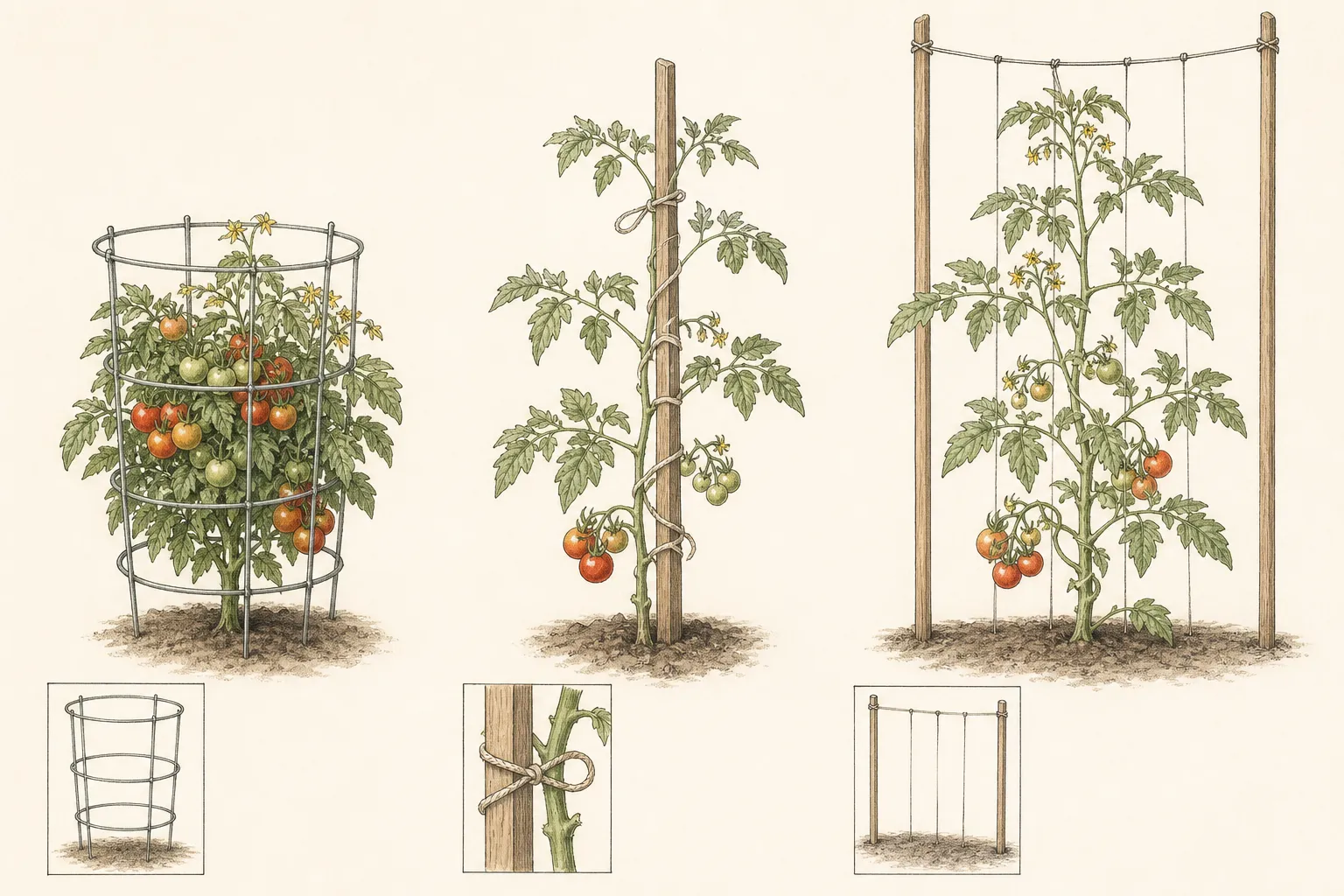
Use a trellis when several plants can share a straight, strongly anchored run. Rigid panels, woven systems, and suspended strings can all work, but their pruning and training differ. A rigid panel accepts several leaders and side branches. A string system generally asks for closer leader management and a sound overhead frame. Do not hang a season of tomato mass from a light garden ornament or a loose fence board.
Choose a footprint that preserves access
Place supports so the gardener can reach both the plant and the soil. A cage pressed against a wall can make the rear half unpickable. A trellis installed at the bed edge may shade a lower crop or force every harvest from the path. Consider sun direction, neighboring plants, irrigation lines, and the width of a loaded branch before committing the anchor points.
Leave enough room around each plant for the support shape, not merely the stem. Closely spaced cages can merge into one humid thicket and make lower leaves hard to inspect. Trellised plants can be closer only when the pruning system and cultivar support that density. National spacing is a starting point; local humidity, disease pressure, cultivar vigor, and the number of retained leaders determine whether the canopy will actually dry.
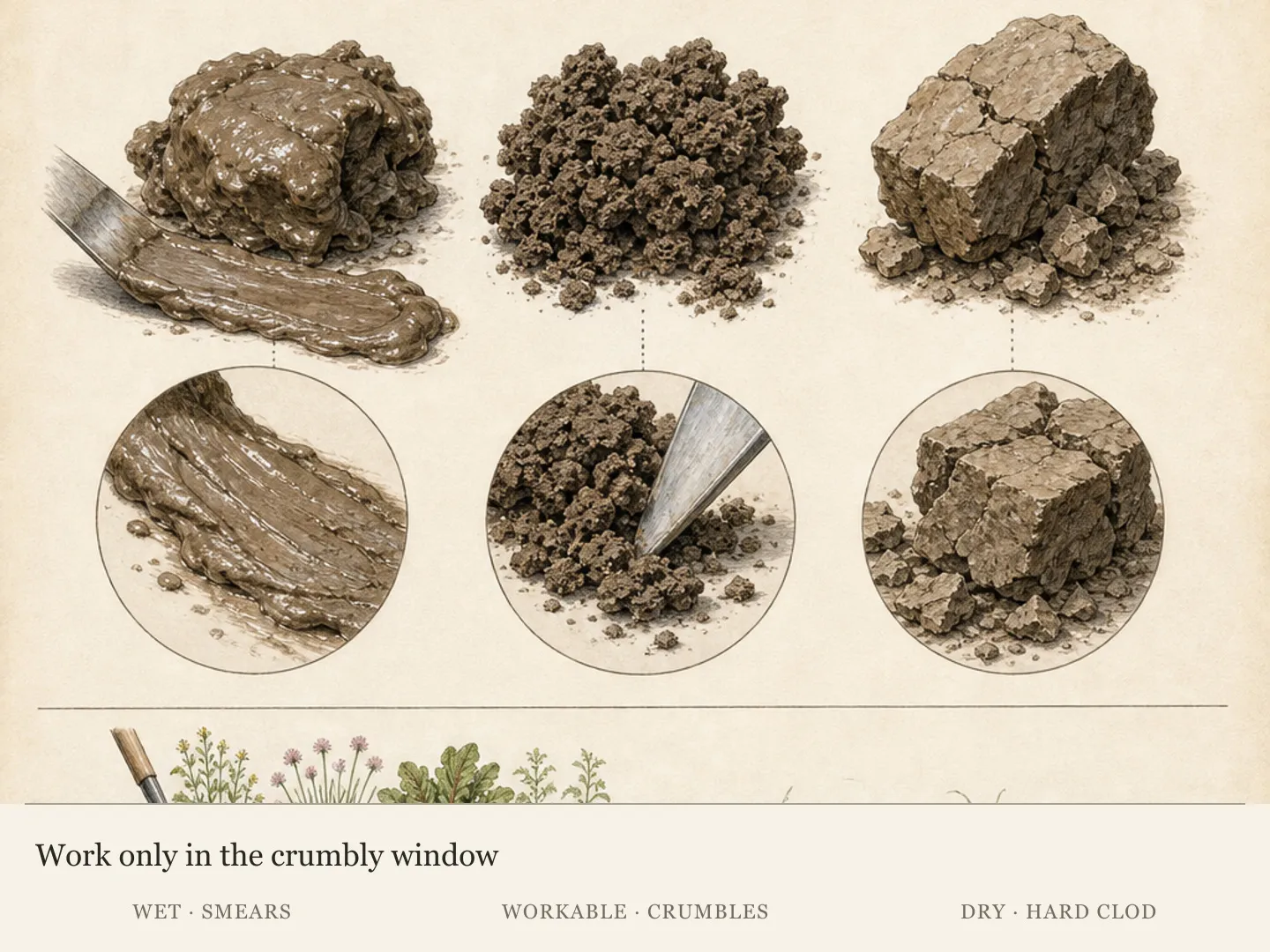
Keep the root zone in the plan. Driving a large stake after roots have filled the bed can slice them, and moving a cage through a mature canopy breaks stems. Install at planting or while plants are still small. Mark drip lines before pounding anchors. A support that arrives early is easier on both plant and gardener and can be tested before it carries meaningful load.
Anchor first and tie without constricting
Push cage legs fully into firm soil, then add external stakes where wind, soft ground, or a large cultivar could overturn the structure. Fasten the cage to those stakes at more than one height. For a panel trellis, brace end posts against the direction of pull and tension only after the posts are stable. Waterlogged soil reduces holding strength, so an anchor that felt solid in spring may need reinforcement before storm season.
Use broad, soft ties in a loose figure eight, with one loop around the support and one around the stem. The crossing point keeps the stem from rubbing directly on the stake. Leave room for diameter growth and movement; tomato stems expand quickly and a tight tie becomes a girdle. Avoid bare wire, thin monofilament, and adhesive contact that cuts or abrades living tissue.
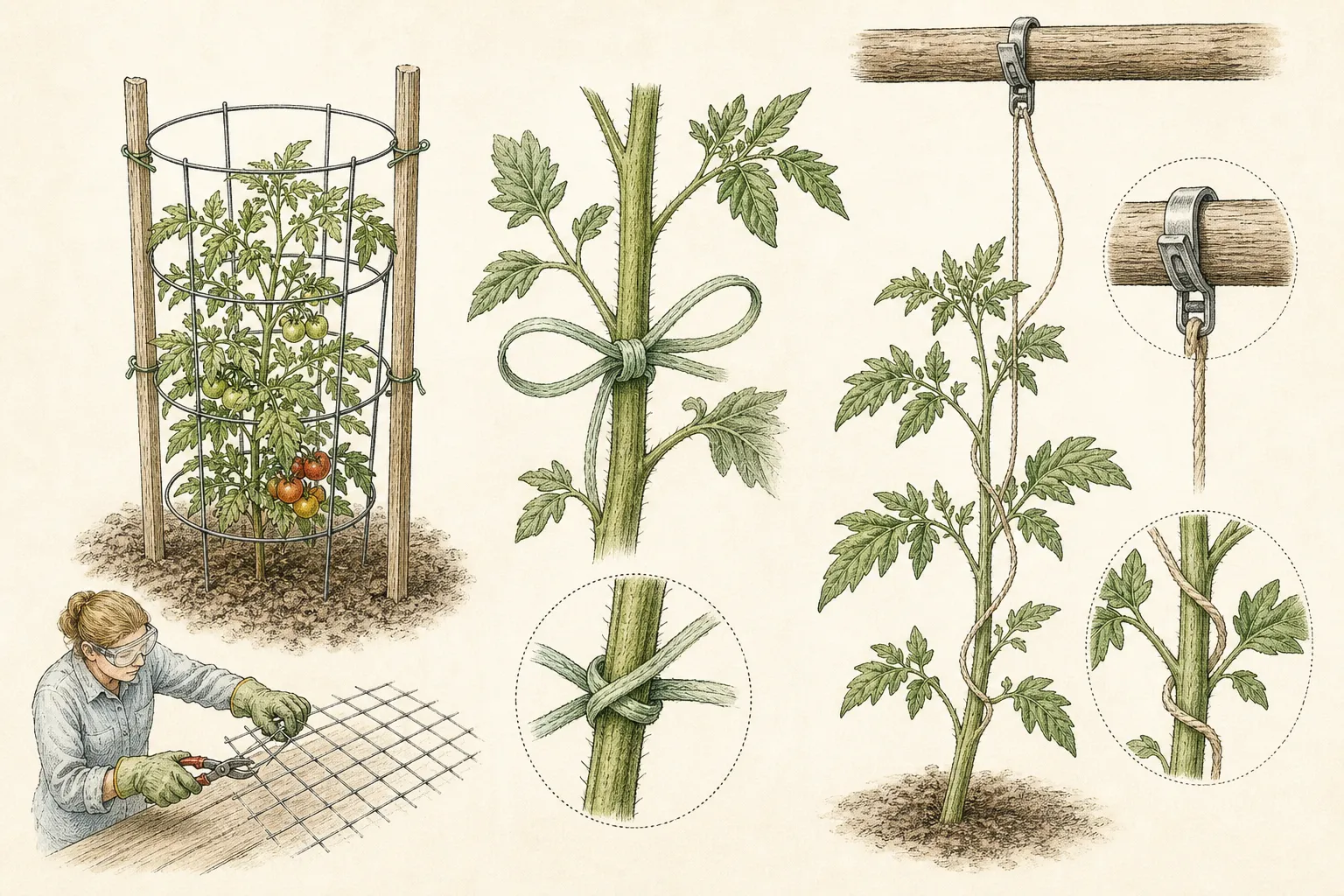
Support the main stem below a heavy fruit truss rather than tying the truss itself. Add ties as the plant grows so no single point carries a long lever of foliage and fruit. On a cage, guide branches through openings while young and flexible, then let the frame carry them. Forcing a thick bent stem back through wire late in the season often creates the break the support was meant to prevent.
Train in small visits
Inspect once or twice a week during rapid growth. Slip young cage branches onto the next ring, wind or clip trellis leaders according to the system, and add stake ties before the top becomes heavy. Small corrections preserve natural curves. Waiting until the plant sprawls into the path turns training into a risky reconstruction with brittle stems and hidden fruit.
Prune only to the degree the support and cultivar require. Removing every sucker is not a universal tomato rule; it reduces canopy and potential fruiting sites and changes sun exposure. Staked or string-trained indeterminate plants usually need deliberate leader selection, while caged plants can retain more growth. Keep enough foliage to shade fruit, and never strip a stressed plant simply to make it resemble a diagram.
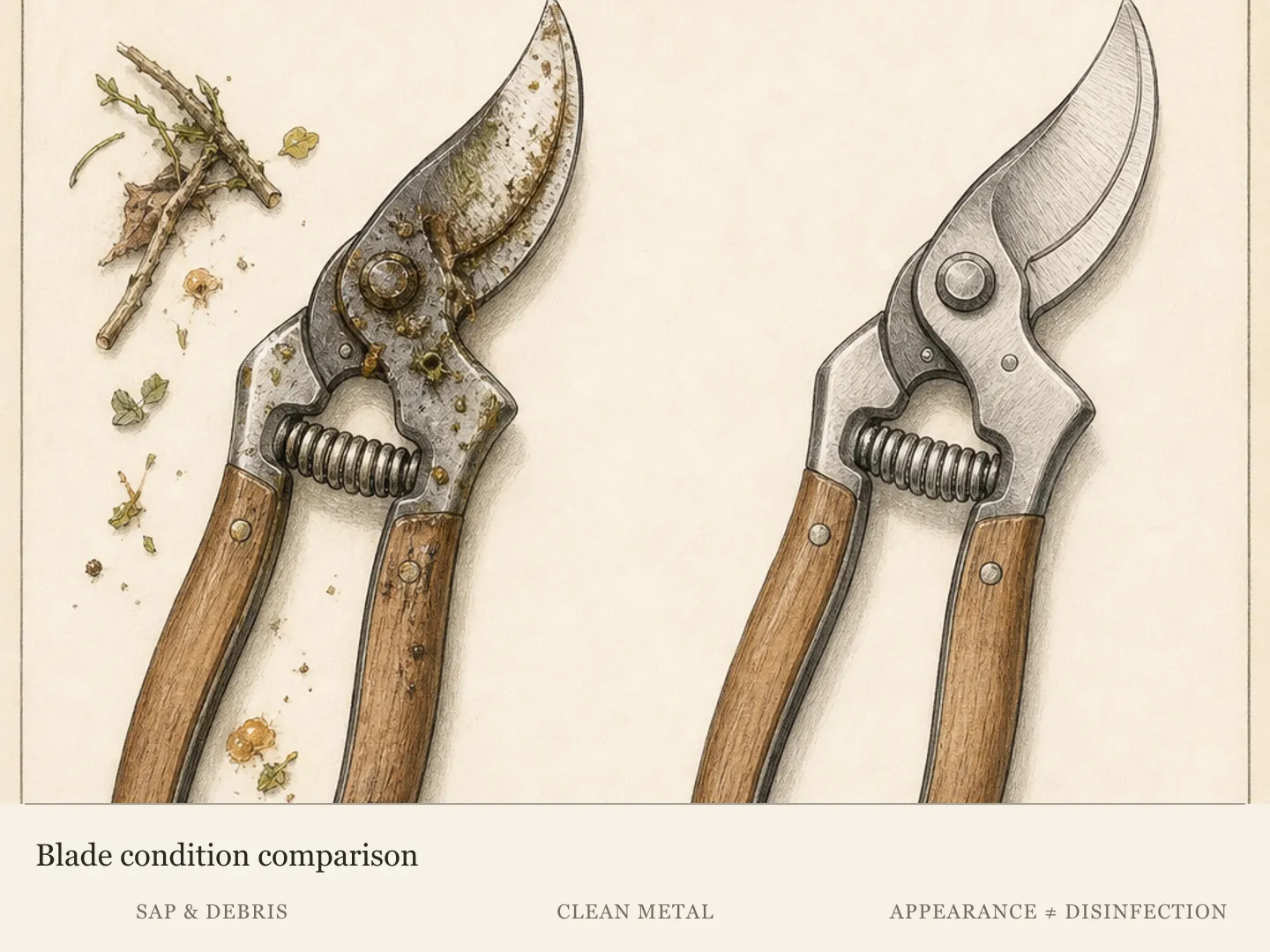
Remove leaves that are diseased or touching soil according to sound diagnostic guidance, but keep sanitation separate from structural pruning. Clean tools between suspect plants. If a lower branch must be removed to restore access, cut cleanly at its origin rather than repeatedly bending it around wire. The support should reveal the plant for observation, not create a hidden knot of wounded stems.
Prepare for peak load and weather
Recheck anchors as fruit sets and before forecast storms. Tighten cage-to-stake connections, replace degraded twine, and confirm that overhead string supports have not loosened. Soil can soften after prolonged rain, and wooden stakes can decay at grade. Test by applying gentle pressure in the direction the canopy will pull; movement at the base deserves reinforcement before wind supplies a stronger test.
Distribute weight rather than cinching the plant upright at one point. Add a second stake to a leaning cage, another tie below a heavy section, or a sling under an exceptionally burdened branch. Do not force a mature curved stem perfectly vertical. Support it in its existing line and remove only damaged growth. Sudden straightening can split internal tissue even when the outside remains green.
At season end, remove ties before they disappear into stems and clean reusable supports of soil and plant debris. Repair sharp wire ends, loose welds, and splintered stakes before storage. Record which cultivar overwhelmed its structure and which system made harvest easy. The best support decision next year will come from that evidence, not from buying a taller version of the same failed object without changing the system.
Adapt the support to containers and raised beds
A support in a container is anchored to a limited mass of potting mix, so a tall cage can turn the whole pot into a lever. Choose a broad, heavy container that suits the mature tomato and stabilize the structure as a unit. A stake driven only to the bottom of a lightweight nursery pot may still tip with the pot. Where appropriate, connect the cage to an external rail or use a purpose-built self-supporting frame that does not depend entirely on loose mix.
Raised beds create a different edge problem. Deep soft soil is favorable for roots but may not hold a narrow post under a loaded canopy. Attach trellis posts to the outside of a sound bed frame or drive them into undisturbed ground beyond the fill when the construction allows. Do not assume the wooden bed board can carry lateral load; thin or aging boards can split when a taut trellis and summer wind pull in the same direction.
Keep portable systems truly movable only while the plant is young. A container tomato intertwined with a railing or shared trellis cannot be shifted for a storm, paint work, or changing light without damage. Decide whether mobility or structural connection matters more before training begins. If the pot must move, keep all ties and anchors within its footprint and test the loaded path before branches extend beyond the rim.
Recognize when the chosen system is failing
A leaning top is not the only warning. Soil opening around a post, a cage rotating after watering, ties sliding together, or one trellis end bending inward all show that load is concentrating. Fruit hidden against wire and stems polished by repeated rubbing reveal contact problems. Inspect the support from ground level upward so a cosmetic correction at the top does not conceal movement at the base.
Reinforce the structure before pruning a large amount of healthy canopy. Add an independent stake, brace an end post, or distribute a heavy branch across another support point. Removing leaves and fruit merely to save an undersized frame sacrifices the crop and can expose fruit to sunscald. Structural weakness deserves a structural response unless a branch is already cracked, diseased, or impossible to support safely.
If failure occurs during a storm, wait until conditions are safe, then lift stems in stages. Support their existing curves with slings or broad ties and remove only tissue that is torn beyond a clean cut. Water needs may change after canopy loss, so inspect the soil rather than soaking automatically. Record the direction and point of failure. That information identifies whether next season needs deeper anchors, wider bracing, more contact points, or a different support family.
Make the structure part of crop cleanup
At final harvest, untie stems before pulling the root system so wire and twine do not snap through the canopy. Collect every reusable clip and remove synthetic ties from compostable vines. Soil and plant debris held in cage joints can shelter residue and make spring inspection difficult, so brush supports clean and follow material-appropriate sanitation guidance when disease was present. Let metal dry before storage and keep wooden stakes where air can circulate.
Inspect the empty structure while defects are visible. A ring that opened, a post that bent at grade, or a line abraded by one season of movement will not improve in storage. Repair or label it now. Record the cultivar, number of retained leaders, peak height, and the first failure point. Those four details distinguish an undersized frame from an anchoring or training mistake and make the next support purchase evidence-based.
Steps
- Level
- moderate
- Time
- 30 to 60 minutes to install, then brief weekly training
- Tools
- Post driver or mallet, Pruners, Work gloves, Measuring tape
- Materials
- Cage, stakes, or trellis sized for the cultivar, Broad soft plant ties, Additional anchor stakes where needed
- 1Confirm determinate or indeterminate habit
Use the cultivar description to estimate mature height, spread, and duration of growth. Add the number of leaders you intend to keep and the pruning time you will actually provide. Do not size a support from seedling height or fruit size alone.
- 2Choose cage, stake, or trellis by labor
Select a broad cage for a multi-branch plant, stakes for one or a few managed leaders, or a rigid or string trellis for a planned row. Reject any system whose required pruning, tying, or harvest access does not fit the way you garden.
- 3Place the full mature footprint
Set the support where both faces remain reachable, neighboring plants retain light and air, and irrigation is not pierced. Allow for the loaded canopy around the frame, not just the stem spacing printed on a generic diagram.
- 4Install and brace while plants are small
Drive stakes and posts into firm soil before roots and branches occupy the work area. Brace cages in windy or soft sites and test trellis end posts before tensioning. Mark buried lines and avoid late pounding beside an established root ball.
- 5Guide stems with loose broad ties
Use a figure-eight tie around stake and stem, leave expansion room, and support below heavy sections. Add contact points as the plant grows. Never bind a fruit truss, use bare wire against tissue, or wrench a thick stem through a cage opening.
- 6Audit the system before storms
Check anchors, connections, ties, and soil firmness as fruit load increases. Reinforce movement at the structure rather than over-tightening the plant. After the season, remove all ties, clean the frame, and note whether the chosen system matched the cultivar.
- 7Stabilize container and raised-bed anchors
Treat a container and its support as one structure, using sufficient pot mass and external bracing where appropriate. In raised beds, anchor posts to sound framing or undisturbed ground instead of relying on loose fill. Decide whether a container must remain movable before vines are trained onto any fixed rail or shared trellis.
- 8Respond to early structural warnings
Look for soil opening around posts, rotating cages, grouped ties, bent end supports, and stem abrasion. Reinforce the frame at its base or load point before removing healthy canopy. After storm damage, support stems along their existing curves, make only necessary clean cuts, and record where the system failed for next season.
- 9Clean up the support as a system
Remove ties before pulling vines, collect reusable clips, and separate synthetic material from compostable growth. Brush soil and debris from joints, dry the support, and repair bends, sharp ends, or worn lines. Record cultivar, leader count, peak height, and first failure point so next year’s adjustment addresses the actual weakness.
Related reading
Sources
- Growing tomatoes in home gardens. University of Minnesota Extension. Source record · Accessed 2026-08-19.
- Trellises and cages to support garden vegetables. University of Minnesota Extension. Source record · Accessed 2026-08-19.
- Tomatoes: From Seedlings to Fruit. Penn State Extension. Source record · Accessed 2026-08-19.
- Grow your own tomatoes and tomatillos. Oregon State University Extension Service. Source record · Accessed 2026-08-19.