Grow · holiday cactus after bloom rebloom cycle
Care for a Holiday Cactus After Bloom
Guide a holiday cactus from its last flowers through rest, spring growth, and autumn bud set so it recovers cleanly and reblooms on schedule.
Published Last updated
In this guide
- Confirm which holiday cactus has just finished flowering
- Ease the plant out of display mode
- Use the short rest to inspect roots and potting mix
- Restart growth on purpose in spring and summer
- Set up autumn bud initiation before the calendar slips
- Solve the common post-bloom failures by reading segments and roots
- Keep a rebloom ledger instead of chasing memory
- Use new growth as the handoff point
- Steps
Confirm which holiday cactus has just finished flowering
The label on a gift plant often says Christmas cactus even when the plant is actually a Thanksgiving cactus, and that naming slip matters less to aftercare than most gardeners fear. The common holiday cacti are epiphytic forest cacti in the Schlumbergera group, not desert survivors that want long droughts and blazing sun as soon as the last bloom fades. After flowering, the plant still needs bright filtered light, drainage, and a root zone that never stays sodden.
Start by removing what is truly finished and leaving what still works. A spent flower, a soft ovary at the bloom tip, or a dried tube can be twisted away gently with fingertips, but the flat green segments that carried the display should stay. Those segments are still the plant's photosynthetic machinery. A hard cleanup that removes terminal segments because the flowering branch looks untidy throws away energy the plant can use during recovery and branching.
Use the post-bloom moment to identify what kind of record you want to keep. If the plant was bought in flower, note the month it finished, the window where it bloomed well, and whether the stems stayed compact or had already stretched toward weak light. A holiday cactus can improve over several seasons when the gardener connects bud timing, light, and watering to one exact plant instead of applying a generic indoor-cactus routine every winter.
Ease the plant out of display mode
After the final flowers are gone, the plant needs a slight reduction in water rather than either constant bloom-season moisture or a punitive dry spell. Illinois Extension specifically advises cutting back somewhat on watering until new growth begins. In practice that means letting the upper mix dry more between waterings, then watering thoroughly and allowing the pot to drain. The root ball should not sit in leftover water in a sleeve, saucer, or cachepot.
Keep the plant in bright indoor light while it makes that shift. Holiday cacti tolerate an ordinary home better than some fussy bloom plants, but they still respond poorly to hot supply vents, a radiator shelf, or a dim corner chosen only because the flowers were on display there. When the plant moves out of bloom, move it toward the station that supports recovery rather than leaving it in the prettiest but least suitable room.
This quieter interval is a reset, not a dormant storage period. If the segments wrinkle while the mix is dry and the pot feels light, the plant wants water, not discipline. If the segments soften while the container stays heavy, the problem is not thirst but poor drainage, exhausted mix, or damaged roots. Reading those two contrasting signals correctly is the difference between a holiday cactus that recovers and one that declines under well-meant extra watering.
Use the short rest to inspect roots and potting mix
The recovery phase is the safest time to inspect the plant's physical setup because you can see the entire crown without the distraction of flowers. Lift the inner pot, check whether the drainage holes are clear, and look at the surface of the mix. A sour-smelling, constantly wet medium, a pot glued into a decorative sleeve by old salts, or a crust that sheds water from the root ball all signal that the next season will be harder than it needs to be.
Holiday cacti are often said to prefer being somewhat pot-bound, but that phrase is useful only when the root ball is still vigorous and the mix still drains. A plant can stay in the same pot for years if the medium remains open and the watering rhythm stays readable. Repotting is worthwhile when the mix has collapsed, when water races down the sides without rewetting the root ball, or when a mass of roots leaves almost no buffering medium. The goal is not a much larger pot; it is a clean, draining root environment.
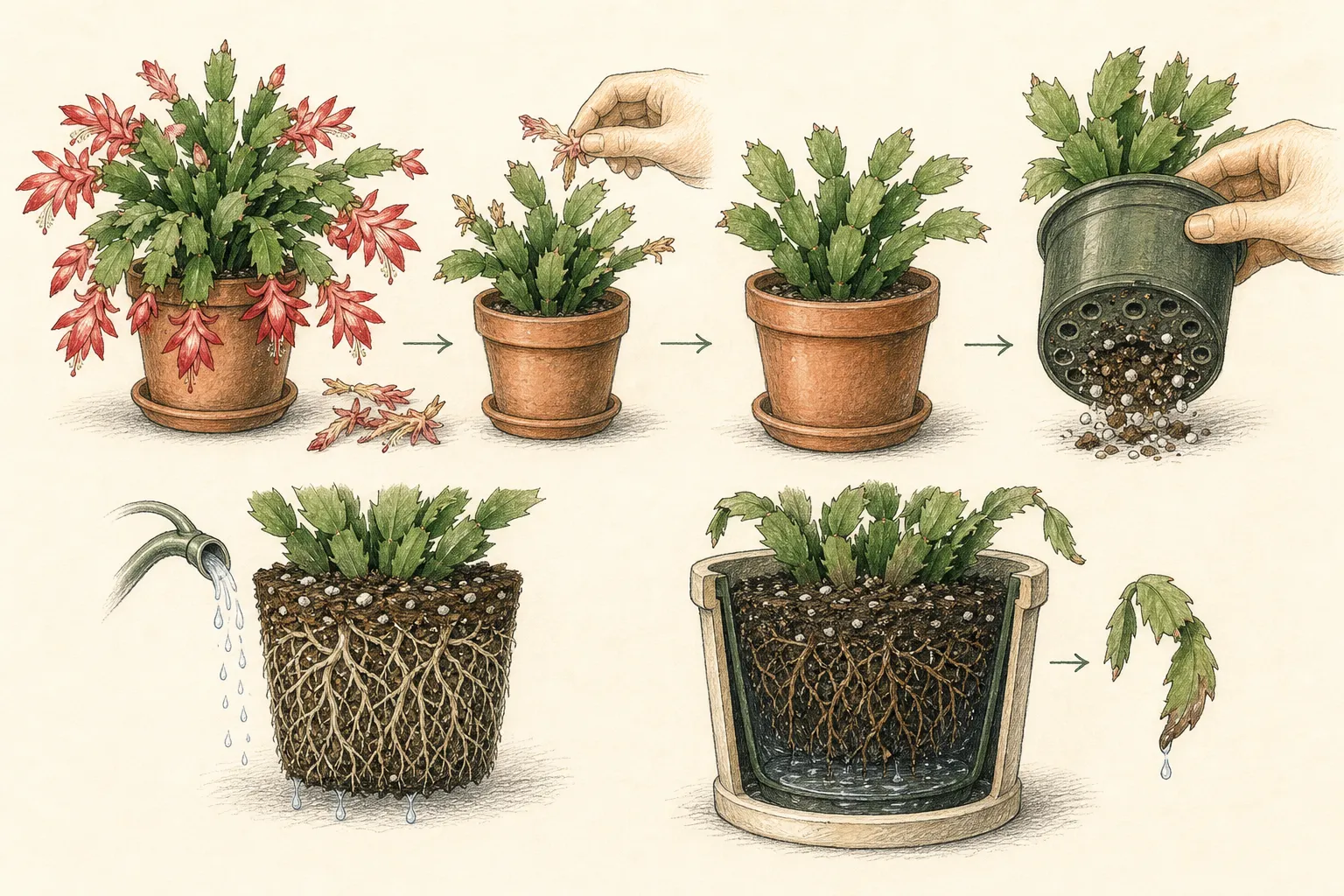
Wait until growth is restarting before making the bigger change. A post-bloom inspection may tell you what is wrong, yet the best moment to repot is usually when the plant is ready to extend new segments, not when it has just finished an energy-expensive flowering cycle. That sequence keeps the short drier rest intact, then lets the refreshed root zone support active growth instead of forcing the plant to recover from bloom and root disturbance at the same time.
Restart growth on purpose in spring and summer
New segment growth tells you the plant has finished its short recovery and is ready for more regular care. At that point return to a steadier watering rhythm, still allowing the mix to dry partially between waterings but no longer deliberately holding back. Active growth is also the season for light feeding according to the product label, because holiday cactus stores far less water and nutrient reserve than a thick desert cactus would. Its branching and bud count improve when spring and summer growth is healthy rather than sparse.
Shape the plant while the branching response still has time to mature before autumn bud set. Iowa State and Illinois both note that pinching or pruning after flowering and into early summer can encourage fuller plants. Removing one or two terminal segments from selected stems is usually enough. This is not topiary work. The point is to create more finished stem tips for the next flowering cycle, not to shear every stem to one line and delay the plant's return to strong growth.
If you summer the plant outdoors, make the move because the light is better, not because the calendar says every houseplant belongs outside. Holiday cacti can thicken and color up in bright shade once frost danger has passed, but they scorch if moved abruptly into hot sun. Acclimate them gradually, keep rain from turning a decorative cachepot into a water reservoir, and bring them back in before autumn nights slide into cold that the plant cannot use safely.
Set up autumn bud initiation before the calendar slips
Rebloom is decided well after the spring recovery is over. Holiday cactus needs either a cool-night regime or a true short-day regime long enough to trigger buds on mature stem tips. The commonly cited window is about six weeks of long uninterrupted nights, and Illinois Extension gives a practical indoor range of roughly 55 to 65 degrees Fahrenheit at night for bud set. This is why a plant can look perfectly healthy through summer and still produce little in winter if the autumn conditions never change.
There are two reliable home routes. One is to give the plant bright days with naturally cool nights in the mid-50s to low-60s Fahrenheit once late summer growth is finished. The other is to keep the plant in a slightly warmer room but supply at least 12 to 14 hours of uninterrupted darkness every night for several weeks. The word uninterrupted matters. Porch lights, a late-night lamp, and a television in the same room can undo the short-day signal even when the plant is otherwise well grown.
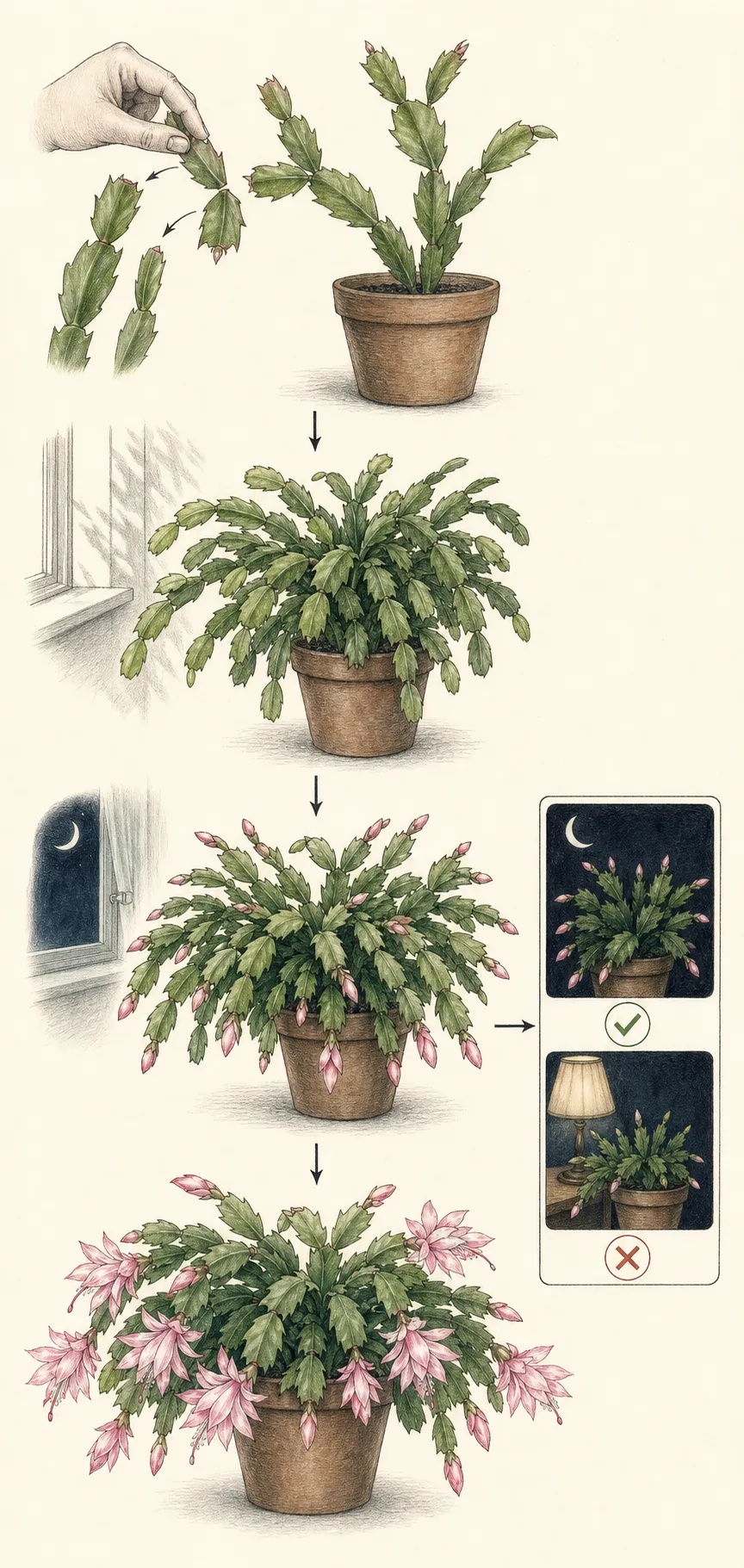
Keep the plant stable once buds appear. Do not answer the first tiny buds by moving the pot constantly, increasing fertilizer, or letting the mix swing from dry to saturated. Bud drop is often the result of abrupt environmental change layered onto a plant that had finally begun the right cycle. The simplest successful routine is a mature, branched plant in bright light, an explicit autumn bud-setting phase, then even moisture and ordinary indoor stability while buds enlarge.
Solve the common post-bloom failures by reading segments and roots
Wrinkled segments do not always mean underwatering, and that mistake ruins many holiday cacti after bloom. If the root ball has gone hard and dry, a thorough watering followed by free drainage is correct. If the pot is still heavy, the mix smells sour, or the base of the stems has softened, more water only extends a root problem the plant is already showing on its segments. Read the root zone and the weight of the container before reaching for the watering can.
A plant that stays green but makes very few flowers usually missed the branching or bud-setting phase, not the winter feeding phase. Late summer pinching, warm autumn nights, interrupted darkness, and low autumn light each reduce bloom potential even when the plant never collapses. That is why the best time to solve poor flowering is not at the first disappointing bloom season but months earlier, when the plant can still be branched, lighted, and cooled correctly.
Reddened or purplish segments, stalled growth, and bleaching along the edges usually point to excessive sun or temperature stress rather than a mysterious nutrient deficiency. Outdoors that can mean too much direct exposure. Indoors it can mean cold glass at night, a heater during the day, or a south-facing window without the filtered light the plant tolerates best. Change the station before layering on extra feed, because the problem is often placement rather than fertility.
Keep a rebloom ledger instead of chasing memory
A holiday cactus does not need a complicated spreadsheet, but it benefits from a simple annual record. Note when flowers ended, when you eased watering, when new growth resumed, whether you pinched the tips, whether the plant spent summer outdoors, and when the cool-night or short-day period began. The next season's buds then become evidence, not a surprise. You can see whether the plant needed a fuller summer, an earlier autumn cue, or less disturbance once buds formed.
Record the actual conditions rather than the intention. A note that says "dark treatment started September 20" is less useful than one that says "moved from family room to spare room, door closed at dusk, lights off all night." Likewise, "watered less" is weaker than "watered after top mix dried and pot felt light." Specific observations make it possible to repeat what worked and identify what changed in a season when the plant disappointed you.
That modest ledger turns after-bloom care into a complete cycle instead of a string of isolated fixes. Holiday cacti are long-lived houseplants when their care matches their annual rhythm: a slight recovery after bloom, active branching in spring and summer, explicit bud-setting cues in autumn, and stable moisture during flowering. When those stages are linked, the plant becomes easier each year because the gardener is working from evidence rather than seasonal guesswork.
Use new growth as the handoff point
The useful post-bloom milestone is not a date but the appearance of firm new segments. Until then, keep the plant cool enough to rest, maintain modest moisture, and avoid repotting merely because flowering has ended. Once active growth is clear, resume restrained feeding and provide bright indirect light so new segments develop compactly.
If repotting is needed, choose a container only slightly larger than the root mass and a porous mix that drains while retaining some moisture. Holiday cacti often flower well when mildly pot-bound; a large volume of wet mix increases root risk without improving the display. Keep orientation stable after buds form, because abrupt changes in light, temperature, or moisture can contribute to bud drop.
Treat the next cycle as a sequence: recovery, active growth, late-summer maturation, then autumn night and temperature cues. A monthly note on segment firmness, irrigation interval, and room conditions is more useful than reacting to every dropped segment.
During summer outdoors, use bright shade and shelter from heavy rain, slugs, and abrupt heat. Acclimate the plant in stages rather than moving it directly from indoor light to sun. Bring it back before cold conditions exceed the tolerance of the species and before autumn bud treatment needs a controlled schedule. Inspect the pot first so outdoor pests do not follow it inside.
Steps
- Level
- moderate
- Time
- One short post-bloom reset, then seasonal checks through the next bud cycle
- Tools
- A pot with working drainage, Clean fingertips or small snips for spent flowers, Weather notes or a simple care log, Optional bright shaded outdoor spot for summer
- Materials
- Holiday cactus in a draining pot, Fresh airy potting mix only if inspection shows repotting is needed, A balanced houseplant fertilizer for active growth if you already use one
- 1Finish the bloom cleanly
Twist off spent flowers and any soft developing fruit, but leave sound green segments in place. Move the plant out of any hot display position and into bright filtered light with ordinary room air.
- 2Reduce water slightly, not radically
Let the upper mix dry a bit farther between waterings until new growth begins, then water thoroughly and let all surplus drain away. Do not leave the pot standing in runoff.
- 3Inspect the setup during the rest period
Lift the inner pot, confirm clear drainage holes, check whether the mix rewets evenly, and note whether the root ball is still vigorous or trapped in exhausted soggy media. Use that inspection to decide whether repotting is needed later, not to rush into a larger container immediately.
- 4Resume active growth care deliberately
When new segments appear, return to steadier watering and, if you already feed houseplants, resume light label-directed feeding during active growth. Pinch selected stem tips from after bloom into early summer if the plant needs more branching.
- 5Use summer light without scorching the plant
Keep the holiday cactus in bright indoor light or acclimate it gradually to bright outdoor shade after frost. Protect it from hard direct sun and from rainwater collecting around the pot.
- 6Create an explicit autumn bud-setting phase
After summer growth hardens, give the plant either cool nights roughly in the 55 to 65 degree Fahrenheit range or at least 12 to 14 hours of uninterrupted darkness nightly for about six weeks. Keep bright days and do not prune late.
- 7Stabilize the plant once buds form
Keep moisture even, avoid sudden moves between hot and cold positions, and record what actually worked. Once buds are visible, stop experimenting with location, feeding, and irrigation intervals all at once. Check the mix before watering, protect the plant from heater blasts and cold glass, and remove failed buds without disturbing healthy segment joints. The goal is not only this season's flowers but a repeatable cycle for the same plant next year.
Sources
- How to identify and care for holiday cacti and get them to rebloom. Illinois Extension. Source record · Accessed 2026-08-19.
- Holiday cacti. University of Minnesota Extension. Source record · Accessed 2026-08-19.
- All About Holiday Cacti. Iowa State University Extension and Outreach. Source record · Accessed 2026-08-19.
- 18. Plants Grown in Containers. NC State Extension. Source record · Accessed 2026-08-19.