Gardens · spring rock garden design
Design a Spring Rock Garden Around Drainage and Plant Scale
Set stones as one geological gesture, build draining planting pockets, and choose compact spring plants that will not erase the structure.
Published Last updated
In this guide
Choose a site where water can leave
Use an open position with useful sun and no roof runoff. A decorative mound in a wet hollow remains wet. Schedule the work when construction has settled and spring planting can root before winter wet. Confirm the choice by inspecting water exit, stone stability, crown dryness, mature plant spread and the direction of strata. The safe finish is reached when stones remain visually primary while compact plants occupy distinct draining pockets.
Map underground services, tree roots and frost pockets. Rockwork should not block drainage or access.
Observe the slope after heavy rain before construction. The outlet matters more than surface grit. In this case, success means stones remain visually primary while compact plants occupy distinct draining pockets. Let the next inspection test whether stones remain visually primary while compact plants occupy distinct draining pockets; the workday shows only the starting condition.
Drainage begins with landform. A natural slope or terrace lets water leave below the root zone, while a flat clay pocket bordered by stones can become a basin. Observe runoff during heavy rain and snowmelt before construction. Colorado State advises keeping a rock garden small enough to maintain because weeds establish in every open pocket. Mark a stable working path and keep water away from foundations. If the site cannot provide an outlet, use a raised trough or another planting type that gives trapped water a visible outlet.
A south-facing slope can be hotter and drier in summer than its regional climate suggests, while a north-facing pocket may hold snow and moisture longer. Map those microclimates separately and assign plants only after both summer heat and winter wet have been considered.
Set a geological direction
Choose compatible local or responsibly sourced stone in varied sizes. One material creates coherence.
Align visible strata and tilt stones into the slope. Random upright teeth look unstable. Check water exits, stone stability, crown dryness, mature spread, and visible strata direction throughout the rockwork. Use stable lawfully sourced stone, open runoff, and slow-spreading plants.
Bury substantial stones partly into grade and support them securely. Surface placement shifts and looks artificial. The finished work must allow stones remain visually primary while compact plants occupy distinct draining pockets. Weather and new growth can clarify water exit, stone stability, crown dryness, mature plant spread and the direction of strata during a measured pause.
Recheck set a geological direction after the first settling rain or growth flush. Changes in water exit, stone stability, crown dryness, mature plant spread and the direction of strata reveal whether the correction is holding or the original site constraint is still active.
Use one geological stone type and follow its grain or bedding direction so the arrangement reads as an outcrop. Colorado State recommends burying roughly one-third of substantial rocks, but stability and local engineering conditions control the actual placement. Set the largest anchors first on a compacted base and test them from the maintenance route. Source stone lawfully from suppliers that respect protected and culturally important material. Smaller pieces can retain soil or continue the line, yet a pile of unrelated fragments will obscure both plant scale and safe footing.
Large stone creates a handling hazard before it creates a garden. Estimate weights, keep hands out of pinch points, and use equipment or trained help when a rock cannot be controlled safely by hand. Check underground utilities before excavation and keep boulders away from unstable retaining edges. Final stability must not depend on a small wedge that can wash out. Planting pockets are shaped around securely seated stones; the stone must remain stable before plants and soil are added.
Make drainage a continuous section
Build a stable draining base where the native site requires it. Build every pocket with a continuous outlet below the root zone. Separate seasonal timing from cosmetic urgency. The useful window is when construction has settled and spring planting can root before winter wet.
Fill between stones with a soil-grit-organic mix adjusted to plant needs. One recipe is not universal. Compare that setting with water exit, stone stability, crown dryness, mature plant spread and the direction of strata.
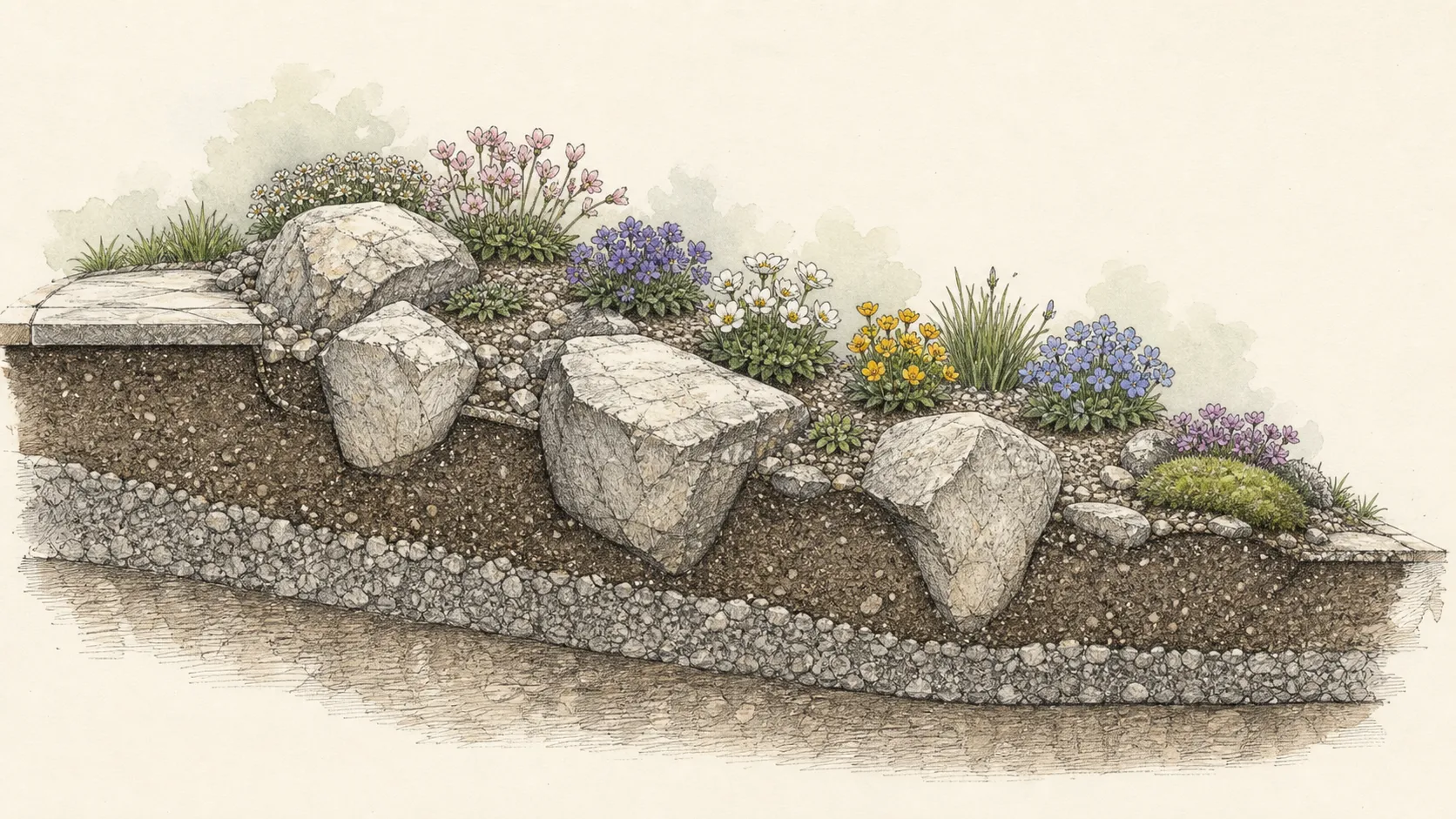
Keep crowns above persistent wet and preserve runoff paths. Gravel topdressing cannot rescue blocked subsoil. Stop once stones remain visually primary while compact plants occupy distinct draining pockets.
Every planting pocket needs a continuous water exit. Build the coarse stable base first, then place a soil, grit, and organic fraction suited to the selected plant. One alpine may need lean mineral conditions while another accepts more humus; neither benefits when fine particles wash down and seal the outlet. Pour water into each empty pocket and watch where it travels. A gravel topdressing reduces splash and keeps necks dry, but it cannot correct a perched layer or a closed basin below.
Think of each pocket as a section: plant crown at the top, root medium below, a coarse stable path for drainage, and a real outlet downslope. Fine mix should not sift indefinitely into voids, so choose graded mineral components and settle them before planting. A pocket beside a wall may receive roof runoff even when the surface appears dry. Test again during actual rain and after leaf fall. If water exits through another plant's crown, alter the channel before installing either plant.
Choose plants by final scale
Select compact true alpines or small rock-garden perennials with documented spread. A dwarf label still requires a verified mature width. Choose every plant by mature width, crown habit, exposure, and drainage, not by a vague dwarf label. Keep stable stone, legal sourcing, open runoff, and slow plant spread as fixed constraints.
Match pH, moisture, sun and winter wet tolerance to each pocket. Adjacent crevices can differ. Record water exit, stone stability, crown dryness, mature plant spread and the direction of strata before the work begins.
Repeat a few forms and leave open mineral surface. Instant fullness erases stones within a season. Account for slope, geology, rainfall, soil pH, winter wet and summer heat define the rock garden.
Read nursery labels for mature width, crown habit, pH, light, summer heat, and winter moisture. Rock-garden plants are not automatically tiny or drought tolerant. Choose slow-spreading mats and cushions whose final outlines leave stone visible. A creeping phlox-type mat can occupy a lower edge, compact saxifrage-type cushions repeat in separated crevices, and small iris- or pulsatilla-type accents require deeper pockets. Replace every example when local climate or soil disagrees; the functional scale matters more than the name.
Check invasive status as well as size. A compact nursery plant can still spread by abundant seed into gravel and adjacent natural areas, creating maintenance that the small rock garden cannot contain.
Use one worked planting grammar
Place a low Phlox-subulata-like mat only where its outer shoots can spill and its crown stays drained. Confirm regional fit. A creeping mat belongs at a pocket edge where shoots can drape while its crown stays on drained soil. Repeat compact cushions farther upslope and leave mineral space between groups so stone remains the dominant structure.
Repeat saxifrage-like cushions in separate crevices and use small iris or pulsatilla-like accents sparingly. Keep species needs compatible. Use water exit, stone stability, crown dryness, mature plant spread and the direction of strata to decide whether the task is corrective, preventive, or unnecessary. That distinction controls timing and scale.
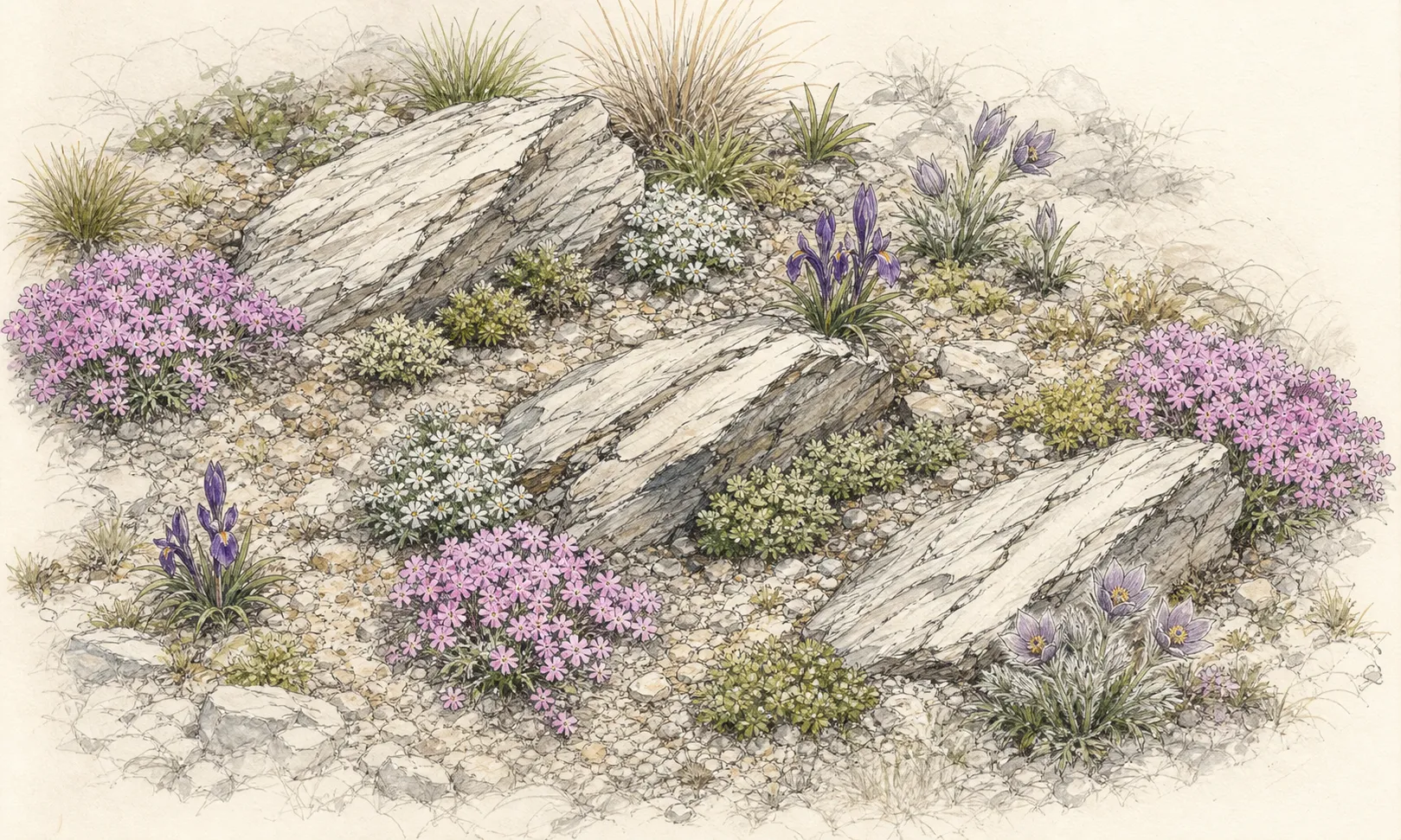
Reserve north faces for plants that accept cooler exposure. Pair shade tolerance with a freely draining pocket. Use cooler stone faces only for plants whose light and summer-temperature needs fit them. Shade cannot compensate for a sealed pocket; every root zone still needs an unobstructed route for excess water.
Before closing use one worked planting grammar, inspect the soil surface, crown or framework from the maintenance route. The result should still allow stones remain visually primary while compact plants occupy distinct draining pockets, with unstable boulders, protected stone sources, blocked runoff and fast-spreading plants are excluded treated as the stopping boundary.
For a worked spring composition, set three anchor stones in one direction and reserve one firm foothold. Place the mat at the outer lower edge, two or three cushion groups higher among open grit, and a few deeper-rooted vertical accents in the largest pockets. Use a north-facing stone only for a plant that accepts cooler exposure and the slower drying there. The empty mineral field is intentional. It separates crowns, displays stone, and gives seedlings and weeds nowhere to hide.
A practical layout could reserve the lower sunny edge for one slow phlox-like mat, place three small saxifrage-type cushions in separate high crevices, and use two deeper pockets for iris- or pulsatilla-type accents. That is six planting groups around three anchors, not a prescription for those taxa. In a humid summer climate, replace heat-sensitive alpines with compact rock-garden perennials documented locally. In alkaline stone, exclude acid-demanding plants unless an independent trough provides a genuinely different root medium.
Plant without loosening the structure
Water pots, set them in place and judge mature spread before removal. Stone should remain accessible.
Tease only congested roots, firm planting mix around them and topdress carefully. Keep gravel out of rosettes.
Use small tools and protect adjacent crowns. Repeated stepping compacts pockets. Include water exit, stone stability, crown dryness, mature plant spread and the direction of strata.
Install plants without levering against settled stone. Slide roots into prepared pockets at nursery depth, keeping crowns and necks above persistent wet. Firm with fingers or a narrow tool and water each pocket gently so the mix settles without washing downhill. Check the drainage exit again after watering. Leave structural and drainage joints open. Mark small dormant plants and keep hoses on the planned path, because one dragged line can dislodge a cushion or loosen a freshly set edge.
Small roots dry rapidly during installation, especially against sun-warmed stone. Keep plants shaded and in their pots until each pocket is ready, then tease only circling outer roots and transfer the intact core. A narrow spout directs water without eroding the surface. After settling, replenish displaced grit beside the crown while keeping the crown uncovered. Check that labels will not funnel water into the neck or loosen in frost. If a pocket cannot accept the full root system at correct depth, enlarge it without moving the anchor stone or choose a smaller plant; trimming roots to fit undermines establishment.
Maintain openness through the year
Remove tree leaves that mat over tiny crowns while retaining appropriate shelter elsewhere. Inspect after storms. Track water exit, stone stability, crown dryness, mature plant spread and the direction of strata.
Trim spreading plants after flowering when species guidance allows. Stop them before they cover drainage gaps.
Record winter losses and summer scorch by pocket. Replace a mismatch with a better plant, not more amendments.
Maintenance protects openness. Hand weed before roots enter cushions, remove tree seedlings while small, and clear wet leaves from crowns in autumn. Inspect rock movement and blocked outlets after freeze-thaw, intense rain, and snowmelt. Trim a mat only when it covers another crown or the foothold. Diagnose a failed plant by pocket temperature, moisture, pH, and root depth before replacement. Colorado State notes that many rock-garden plants need low to moderate water, but each label and local season determines the interval.
Water new plants at the pocket, not across the entire rock face, until roots establish. Thereafter, use species response and moisture below the gravel to set intervals. Winter covers are rarely neutral: a solid cover can trap heat and condensation, while open wind protection may help a specific plant. Apply protection only when a source recommends it for that taxon. Keep a simple map because a dormant cushion can be mistaken for an empty crevice during spring weeding.
Keep a small reserve of matching grit for erosion repairs. Refill only material washed from a sound pocket; recurring loss means the runoff path or stone placement needs correction.
Keep a pocket-by-pocket record of plant name, root medium, exposure, and water exit. After winter, note heaving, crown softness, and stone movement; after summer, note scorch, dormancy, and spread. A plant lost only on north faces suggests a different cause from one lost in every sealed pocket. Replace a failed taxon with another only after the pocket has passed a drainage test and the stone remains stable. This record lets the rock structure stay constant while plant choices improve, which is essential because repeated reconstruction damages roots, drainage layers, and safe footing.
Design ideas
- Style
- restrained naturalistic rock garden
- Space
- small sunny slope or raised bed
- Climate
- The worked plan assumes a temperate garden with winter wet risk, an open sunny slope, stable local stone and access to free-draining mineral material. Alpine needs vary widely; confirm each named plant’s moisture, pH, summer heat and winter protection before using the arrangement. The plan suits an open temperate slope where winter wet is a larger threat than drought. Recheck plant hardiness, summer heat, pH, and moisture for the actual region, and obtain stone through a lawful local supplier.
- 1Anchor-stone trio
Set three large stones with the same visible strata direction, burying them securely and leaving one practical maintenance foothold. Follow the natural bedding plane of one stone type and bury each large rock deeply enough to be immovable. Keep one flat foothold outside planting pockets so later weeding does not loosen the structure.
- 2Draining section
Connect every planting pocket to a real water exit through the slope or raised structure, then adjust the medium for each plant. Test each pocket with water before planting. A free-draining mineral mix cannot help if the pocket has no outlet, so connect low points to the slope and keep fine soil from sealing the exit.
- 3Low mat role
Use one restrained creeping-phlox-like plant at an outer edge where the crown remains on soil and shoots may drape. Position a restrained mat at the lower edge and leave its crown on soil, not under gravel. Trim only shoots that cover neighboring cushions or close the maintenance foothold.
- 4Cushion role
Repeat two or three compact saxifrage-like cushions in separate crevices with sufficient open gravel for mature form. Repeat cushions in odd, separated groups with enough bare grit to show their mature outlines. Colorado State guidance cautions against overplanting because slow spread and accessible weeds are part of the design.
- 5Vertical accents
Add a few small iris- or pulsatilla-like plants where their root depth, pH and seasonal moisture fit the pocket. Place deeper-rooted accents only where the pocket provides their full root run. Check each iris or pulsatilla substitute for local hardiness, moisture, and pH, and match the root mix to each taxon.
- 6Cool-face option
Reserve the north side of a stone for a documented cool-tolerant alpine while maintaining sharp drainage. The north face can reduce afternoon heat, but it may also stay wet longer after snowmelt. Pair that microclimate with a plant documented for both the cooler exposure and the pocket's drainage.
- 7Open mineral field
Keep visible gravel between groups and remove seedlings that erase the intended scale or block crown ventilation. Visible gravel is functional mulch and negative space. Remove woody seedlings and aggressive volunteers early, hand weed close to crowns, and keep fallen leaves from holding winter moisture against cushions.
- 8Seasonal audit
Inspect stability, runoff, spread and crown condition after winter wet and summer heat before replacing failed plants. After freeze-thaw and heavy rain, check rock movement and the water exits before assessing plants. Replace a failure only after identifying whether heat, winter wet, pH, or an undersized pocket caused it.
Related reading
Sources
- Create a Rock Garden with Alpines. Royal Horticultural Society. Source record · Accessed 2026-08-30.
- How to Grow Alpines. Royal Horticultural Society. Source record · Accessed 2026-08-30.
- Rock Gardens: Plants. Royal Horticultural Society. Source record · Accessed 2026-08-30.
- Rock Garden Plants. Colorado State University Extension. Source record · Accessed 2026-08-30.
- Selection and Culture of Landscape Plants in Utah. Utah State University Extension. Source record · Accessed 2026-08-30.