Winter Heath
Erica carnea
A field guide to Erica carnea: identify the fine evergreen mat and urn-shaped winter flowers, then use drainage, sun and light post-bloom trimming to keep it dense.
Published Last updated
At a glance
- Light
- Full sun; light afternoon shade can help where summers are hot
- Water
- Regular during establishment, then moderate with excellent drainage
- Soil
- Free-draining sandy, loamy or gritty soil; more lime-tolerant than many heathers but impaired by waterlogging
- Hardiness
- Zones 5–7
- Bloom
- Winter into early spring, varying by cultivar and climate
- Height
- 6–12 in for many cultivars · 15–30 cm
In this guide
Overview
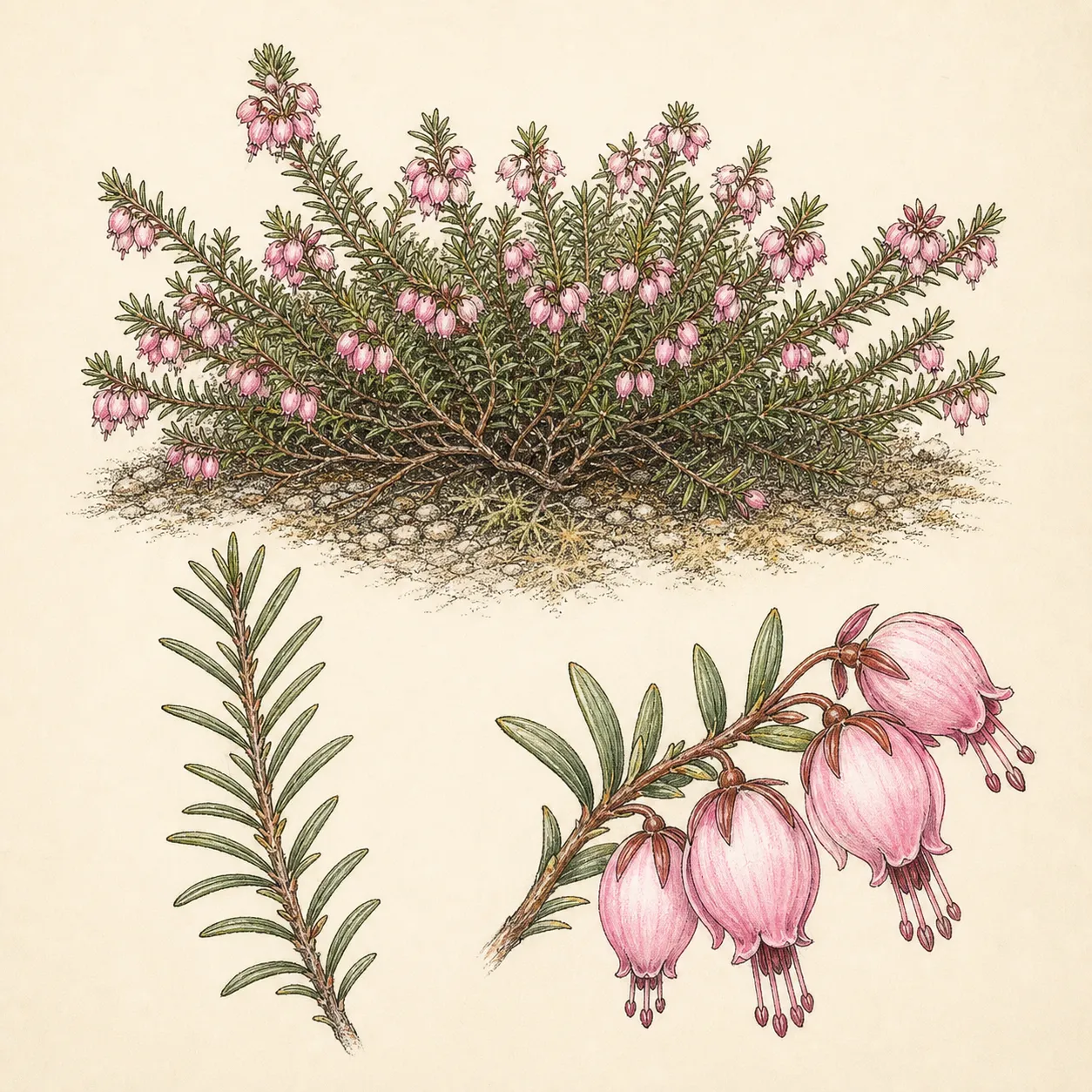
Winter heath is a miniature evergreen shrub that brings color close to the ground while much of the garden is dormant. Fine woody stems spread outward into a dense mat, carrying narrow needle-like leaves and short clusters of small hanging flowers. Depending on cultivar and climate, white, pink or purple bloom can begin in winter and continue toward early spring.
The plant is Erica carnea, not a generic label for every heather. Its narrow leaves occur in whorls, and the flowers are urn-shaped with anthers extending beyond the corolla. Calluna and other Erica species can look similar at a distance but differ in leaf arrangement, soil tolerance, flowering season and pruning response. Keep the full botanical and cultivar name when designing a sequence.
Cultivar dimensions vary substantially. RHS describes 'Carnea' as a spreading shrub around 15 centimetres high with a potential spread of 0.5–1 metre, while NC State gives a broader species-scale height range. A nursery plant in a small pot therefore represents a future mat, not a bedding dot. Plan from the named selection's documented width.
Sun and drainage shape both survival and appearance. An open sunny position supports dense growth and strong flower color. Waterlogged soil can damage roots, and a deep wet clay pocket beneath a surface dressing of grit does not provide genuine drainage. Place winter heath on a naturally draining slope, raised rock-garden area or suitable container where excess water can leave the complete root zone.
Unlike many acid-demanding heathers, Erica carnea tolerates a broader soil reaction. RHS specifically identifies it among ericas capable of growing in neutral and somewhat alkaline soils, though free drainage remains essential. This tolerance is not a guarantee for every chalky or compacted site; observe local performance and avoid turning a soil exception into permission for saturation.
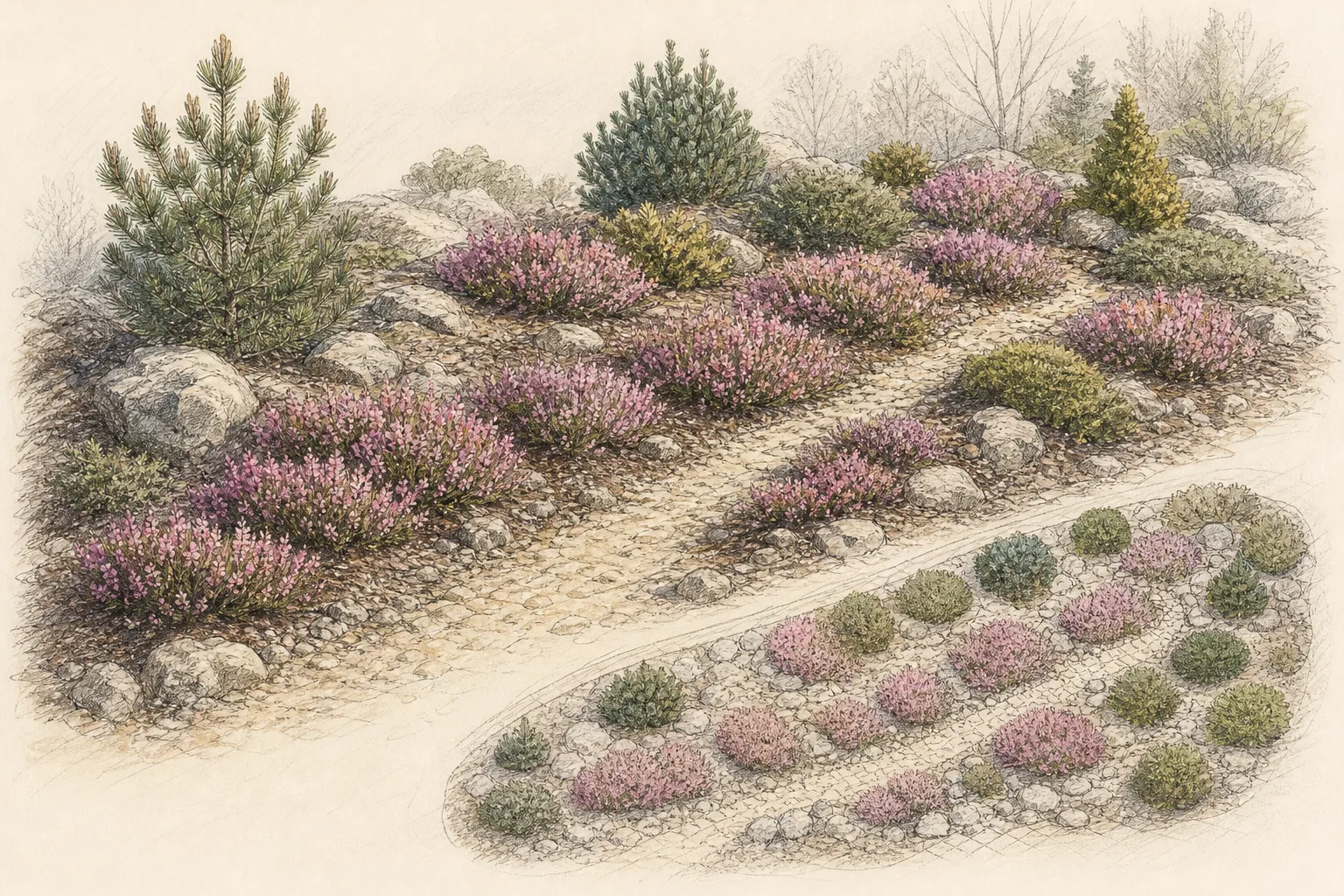
Use it as a repeated low drift where winter flowers can be seen from a path or window. Dark dwarf conifers, pale stone, fine grasses and early bulbs provide contrasting scale. Repeat one or two cultivar colors in irregular linked groups, leaving enough room for mature mats to meet gently without burying neighboring crowns or blocking access for post-bloom trimming.
Pruning is light and timely. Trim just after flowering to remove spent spikes and encourage branching while retaining leafy green growth. NC State warns that heather may not regenerate readily from old bare wood. An overgrown plant is therefore better managed through modest annual editing and good light than by a severe rescue cut into leafless stems.
- Family
- Ericaceae
- Range
- Central and east-central Europe, especially mountain regions including the Alps
- Soil pH
- 5–7.5
- Spread
- 1–3 ft, cultivar dependent · 30–90 cm
Planting & careHow to grow winter heath
Missouri Botanical Garden lists 'Springwood Pink' for Zones 5–7, while RHS hardiness ratings use UK conditions and are not a direct USDA-zone conversion. NC State notes that cool summers suit the species and that southern heat can be challenging. Select a cultivar proven locally, confirm its mature spread and flowering window, and use afternoon shade only where heat warrants it without sacrificing the open light needed for compact growth.
- 1Confirm species and cultivar
Retain the Erica carnea cultivar name, flower color, bloom period and documented mature spread. Do not substitute an acid-demanding heather solely because the pots look alike.
- 2Choose a visible winter position
Use an open sunny site beside a path, entry or winter view. In regions with hot summers, allow locally appropriate afternoon protection while preserving enough light for dense growth.
- 3Prove drainage through the profile
Inspect the wider slope and soil after rain. Build a genuinely raised or freely draining root zone where necessary; surface grit cannot correct a sealed wet layer below.
- 4Lay out mature drifts
Mark each cultivar's expected width and arrange linked irregular groups rather than evenly spaced dots. Preserve stepping access and room for adjacent dwarf shrubs, rocks and bulbs.
- 5Set the root ball at grade
Plant at the same depth as the nursery container, tease only clearly congested outer roots, backfill with compatible soil and keep the woody crown exposed above mulch.
- 6Establish with attentive moisture
Water deeply after planting and check small root balls regularly until roots spread. Let excess water drain; frequent surface sprinkling can leave the original root ball dry while the surrounding soil looks damp.
- 7Trim after flowering
Once the display finishes, shorten spent flowering growth lightly into leafy stems to maintain a dense mound. Leave old bare wood intact rather than expecting a hard cut to regenerate.
Pruning winter heath
Trim winter heath immediately after flowering, while the transition from spent flower spike to leafy green stem remains easy to see. Use clean shears to shorten the flowering growth and lightly level wayward shoots, retaining green foliage on every cut stem. This modest annual pass encourages branching and keeps neighboring mats legible. Avoid cutting into old leafless wood because Erica may not produce replacement shoots there. A plant made open by shade, saturation or unsuitable heat will not become dense through harder pruning; correct the site condition first. Remove dead stems individually at their origin and clean debris trapped in the crown without pulling live prostrate branches loose. Stop before the plant becomes a clipped geometric pad—the natural irregular mat is part of its winter value.
Seasonal care
Spring
Enjoy the late portion of bloom, then trim spent spikes lightly into leafy growth. Check winter drainage, reset exposed roots and water new plants while their small root balls establish.
Summer
Monitor heat and root-zone moisture, especially in containers or southern exposures. Preserve open light, prevent surrounding perennials from smothering the mat and keep irrigation from creating persistent saturation.
Autumn
Plant where regional conditions allow enough establishment time, renew a thin crown-clear surface mulch or grit layer and remove fallen leaves that hold wetness inside the fine stems.
Winter
View flowers from paths without walking over brittle low stems. Check drainage during thaw, brush away only crushing debris and avoid heavy mulch over the evergreen crown.
Safety and garden spread
The retained horticultural sources do not establish Erica carnea as edible or identify a specific human or pet toxicity. Treat all parts as ornamental, prevent ingestion, and seek poison-control or veterinary advice after a suspected exposure.
Common problems
Open, leggy growth
- Look for
- Long sparse stems, reduced flowering and gaps opening on the shaded side of the mat.
- Action
- Increase useful light by editing neighbors, trim only into leafy growth after flowering and replace plants where the site remains too shaded.
Root decline in wet soil
- Look for
- Sections browning from the crown, weak growth and soil that remains saturated after surrounding ground has drained.
- Action
- Stop routine watering, inspect the complete drainage profile and seek diagnosis. Rebuild the area as a genuinely raised draining site before replacement.
Brown center after hard pruning
- Look for
- Bare woody stems that fail to break after cuts were made below the leafy shell.
- Action
- Wait for the normal growth window to confirm viability, remove only dead stems and avoid further hard cutting. Replace severely bare plants and adopt light annual post-bloom trimming.
Summer stress
- Look for
- Dull foliage, edge dieback or weak recovery in a hot reflected site, especially near the warm edge of adaptation.
- Action
- Check root moisture and drainage separately, provide locally appropriate afternoon protection and use a more heat-adapted groundcover if the regional climate remains unsuitable.
Mats swallowing small neighbors
- Look for
- Cultivar spread closing over bulbs, rocks, edging or the crown of another dwarf plant.
- Action
- Edit the youngest leafy outer shoots after flowering and relocate vulnerable neighbors during their proper season. Base future spacing on mature cultivar width.
Sources
- Winter Heath — Erica carnea. North Carolina Extension Gardener Plant Toolbox. Source record · Accessed 2026-08-30.
- Erica carnea L.. Royal Botanic Gardens, Kew. Source record · Accessed 2026-08-30.
- How to Grow Erica. Royal Horticultural Society. Source record · Accessed 2026-08-30.
- Erica carnea 'Carnea'. Royal Horticultural Society. Source record · Accessed 2026-08-30.
- Erica carnea 'Springwood Pink'. Missouri Botanical Garden Plant Finder. Source record · Accessed 2026-08-30.