Weigela
Weigela florida
Identify species weigela by its arching deciduous habit and pink funnel-shaped flowers, then site and prune it without sacrificing the next old-wood bloom.
Published Last updated
At a glance
- Light
- Full sun to partial shade
- Water
- Moderate; even moisture during establishment
- Soil
- Moist but well-drained; adaptable to clay, loam, or sand
- Hardiness
- Zones 4–8
- Bloom
- Late spring, sometimes with scattered rebloom
- Height
- 6–10 ft · 180–300 cm
In this guide
Overview
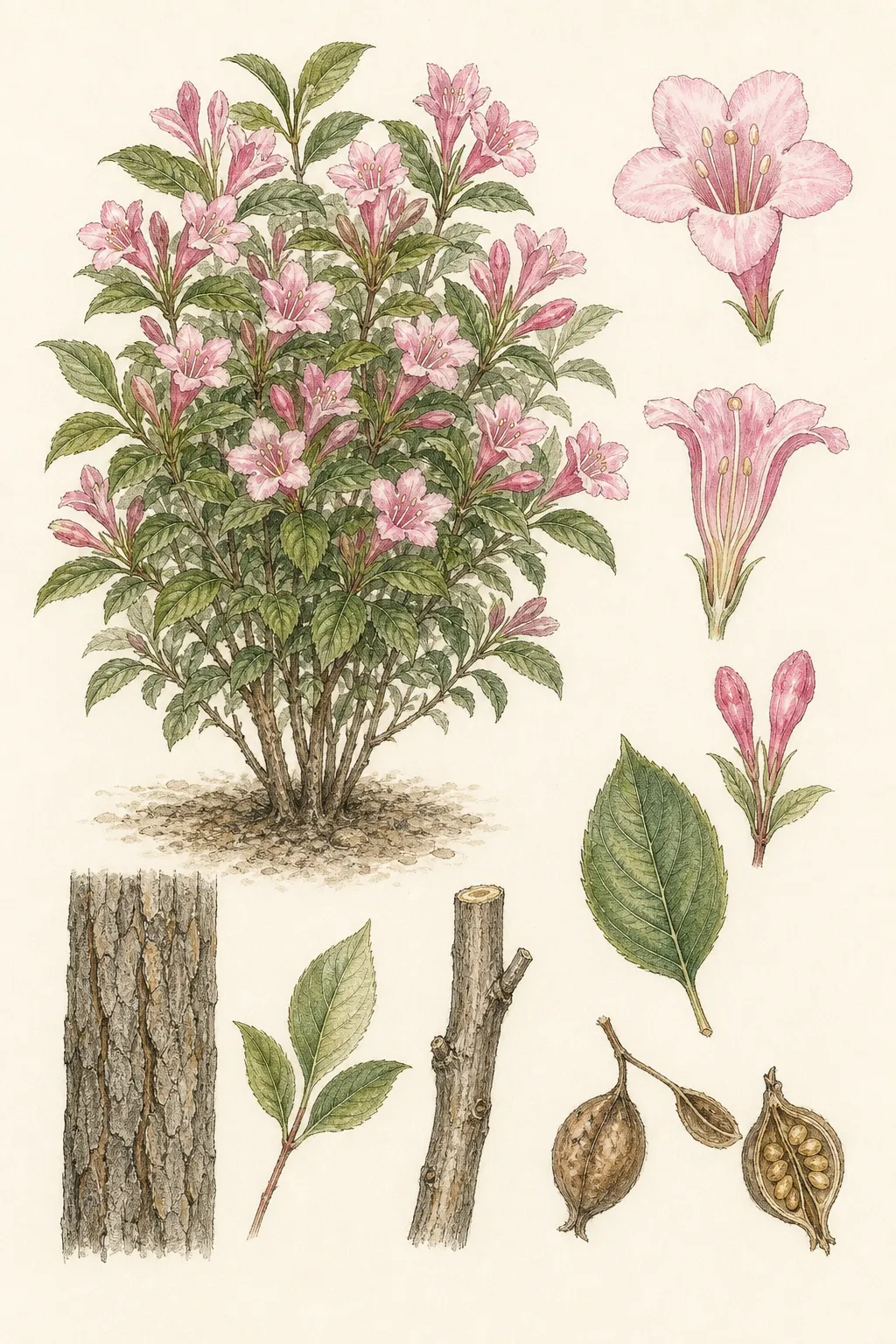
Species weigela is a dense, rounded deciduous shrub whose coarse branches arch as they mature. Opposite ovate leaves have serrated margins, while pink to rose funnel-shaped flowers appear in clusters after the leaves open. The hairs arranged in two lines on young shoots and the ring-like stipular scars at the nodes provide useful confirmation outside the flowering period.
An unselected Weigela florida can reach 6–10 ft high and 9–12 ft wide. Dwarf, purple-leaved, variegated, and compact cultivars may occupy a fraction of that space, so a cultivar name is part of the identity rather than a decorative label. Reserve enough room for the selected plant’s arching outline instead of relying on annual shearing beside windows or paths.
Full sun produces the densest flowers and strongest foliage color; light or dappled shade is tolerated, with fewer blooms likely as shade deepens. The shrub accepts clay, loam, or sand when the root zone drains, and it performs best with moist but not waterlogged soil. Excess fertilizer is unnecessary where growth and leaf color are already normal.
Plant container-grown stock with the first structural roots and root flare at finished grade. Tease or correct circling roots, backfill with the site soil, water the root ball and surrounding soil thoroughly, and keep a shallow mulch layer clear of the basal stems. During establishment, test moisture inside the original root ball because it can dry while the adjacent bed still feels damp.
The main spring display is carried on shoots made the previous season. After flowering, remove selected old canes at the base and shorten a misplaced arch to a healthy outward lateral; this opens the framework without turning it into a clipped shell. Repeated tip shearing creates dense outer twigs and removes much of the flowering wood.
A sparse repeat bloom may appear in summer, but it should not delay the main pruning window. Winter dieback can occur near the cold edge of the range, so wait for spring growth to show what is alive before cutting questionable tips. Institutional sources do not identify the species as edible, and ornamental parts should not be sampled.
- Family
- Caprifoliaceae
- Range
- Southern Russian Far East, northern and eastern China, Korea, and Kyushu, Japan
- Soil pH
- 5.5–8
- Spread
- 9–12 ft · 2.7–3.6 m
Planting & careHow to grow weigela
The species is generally grown in USDA zones 4–8, but named cultivars vary greatly in mature size, foliage color, and repeat bloom. Use the cultivar label for spacing and check local guidance where winter dieback, extreme heat, or salt exposure is a concern.
- 1Confirm the exact selection
Record the cultivar name and its documented mature dimensions. Use the species allowance of 6–10 ft high by 9–12 ft wide only for unselected Weigela florida, not for dwarf or narrow cultivars.
- 2Choose light for flowers
Prefer full sun where the species is heat-appropriate; light or dappled shade is acceptable when some reduction in flower density and foliage color is understood. Avoid deep shade.
- 3Check drainage at root depth
Inspect the site after rain and reject a pocket that remains waterlogged. Weigela accepts several soil textures, but the planting area must drain while retaining enough moisture for establishment.
- 4Set the root flare at grade
Remove excess potting mix above the first structural roots, correct circling roots, and place the flare level with finished soil. Backfill with site soil and keep mulch clear of every basal stem.
- 5Wet the original root ball
Water thoroughly after planting, then probe both the nursery root ball and surrounding soil through the first growing seasons. Rewater when the occupied root zone is beginning to dry, not by a fixed calendar.
- 6Leave access after bloom
Keep lower companions and hardscape outside the mature branch sweep so old canes can be reached at their base immediately after flowering without crushing neighboring plants.
Pruning weigela
Prune immediately after the main late-spring bloom because Weigela florida flowers chiefly on the previous season’s wood. Remove dead stems and selected old canes at the base, and shorten a misplaced arch to a healthy outward lateral. Avoid routine shearing and broad winter reduction, both of which remove flower-bearing shoots and spoil the fountain-like habit.
Seasonal care
Spring
Watch leaf-out for winter-killed tips, but postpone ordinary shaping until the spring flower display has finished. Refresh shallow mulch while keeping the flare and basal canes exposed.
Summer
Make renewal and shaping cuts as soon as the main bloom ends. Check newly planted root balls during dry weather; established shrubs need supplemental water when the root zone, not just the surface, is dry.
Autumn
Stop nitrogen feeding and late pruning so new shoots can harden. Clear fallen diseased leaves if a confirmed leaf problem occurred, and water recent plantings during prolonged dry spells before freeze-up.
Winter
Use the leafless framework to note broken, rubbing, or aging canes for the post-bloom session. Remove storm-broken wood when necessary, but retain sound one-year shoots carrying the coming flower buds.
Safety and garden spread
The retained institutional profiles do not flag Weigela florida as poisonous, but they are not an edibility assessment. Do not ingest ornamental plant material, and supervise children and animals around any garden plant.
Common problems
Sparse flowering
- Look for
- Healthy leaves with few spring flower clusters, especially after winter pruning or where only the outer edge receives useful sun.
- Action
- Check the previous pruning date and actual light before adding fertilizer. Move routine cuts to immediately after bloom and reduce shade where that can be done without root damage.
Twiggy sheared shell
- Look for
- Many short branch ends crowd the outside while the interior carries dead twigs and little flowering growth.
- Action
- After bloom, stop tip shearing and remove selected old canes at ground level over successive seasons. Retain vigorous basal replacements and the natural arching outline.
Winter dieback
- Look for
- Tips or whole canes fail to leaf out after a cold winter while lower buds or neighboring stems begin growth normally.
- Action
- Wait until live growth defines the boundary, then cut dead wood back to healthy tissue. Recheck cultivar hardiness and exposure if the same pattern recurs.
Distorted or sticky shoots
- Look for
- Young leaves curl or discolor, shoot tips stall, or sticky residue and scale-like bumps appear on stems or leaf undersides.
- Action
- Inspect closely to identify aphids, scale, or another cause before treatment. Remove a limited badly affected tip if useful and follow local Extension guidance and any product label.
Plant details
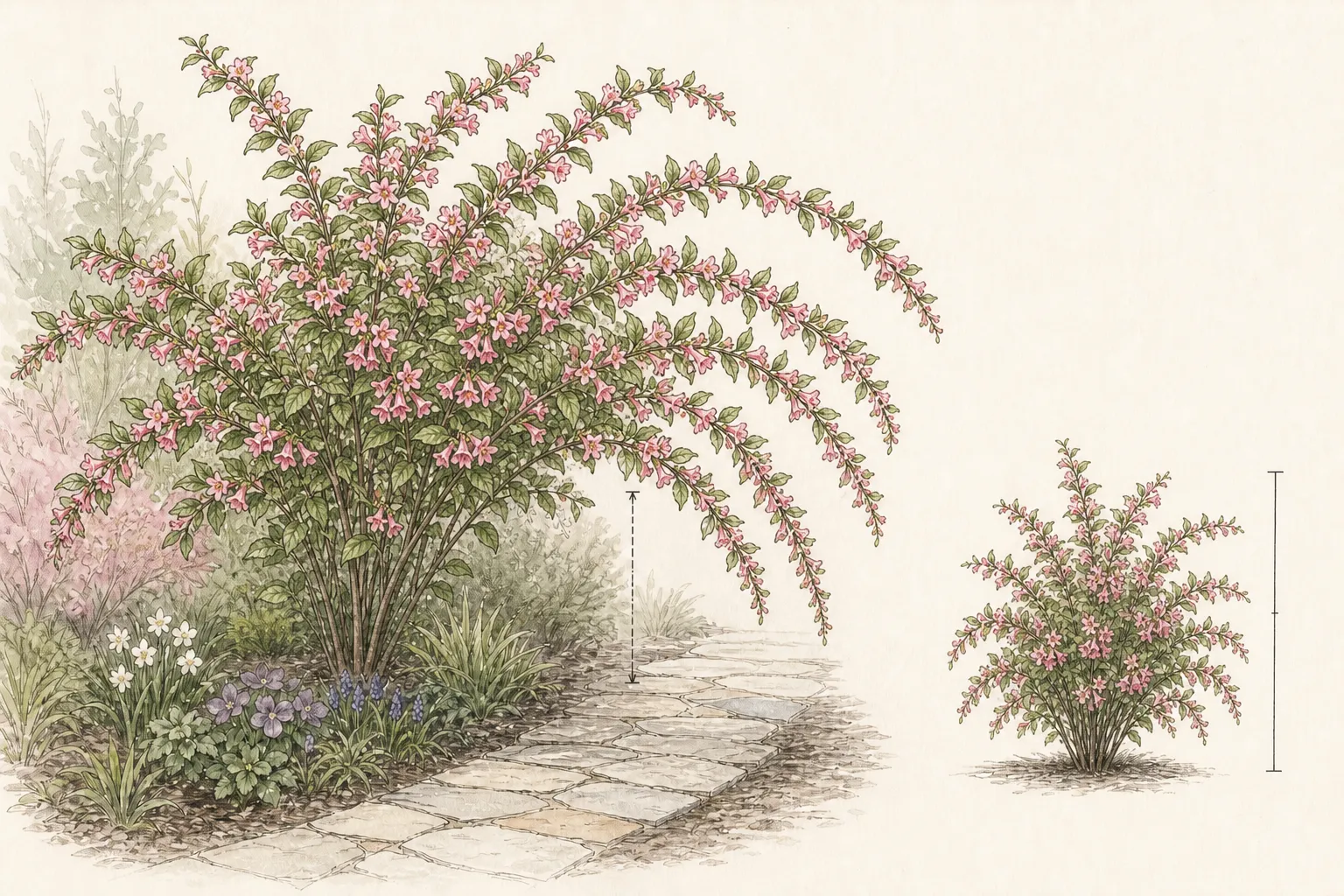
Border spacing study showing a leafy arching weigela with pink tubular flowers beside a path and at mature scale
Sources
- Weigela florida. North Carolina State Extension. Source record · Accessed 2026-08-30.
- Weigela florida. Royal Horticultural Society. Source record · Accessed 2026-08-30.
- Weigela florida (Bunge) A.DC.. Royal Botanic Gardens, Kew. Source record · Accessed 2026-08-30.