Virginia Bluebells
Mertensia virginica
A spring woodland ephemeral with purple-pink buds, nodding blue bells, smooth blue-green leaves, and a normal early-summer disappearance.
Published Last updated
At a glance
- Light
- Partial to full shade under deciduous trees
- Water
- Even moisture through spring growth; protect dormant roots from severe drought
- Soil
- Rich, humus-heavy, moist but well-drained woodland or floodplain soil
- Hardiness
- Zones 3–9
- Bloom
- Early to mid-spring
- Height
- 1.5–2 ft · 45–60 cm
In this guide
Overview
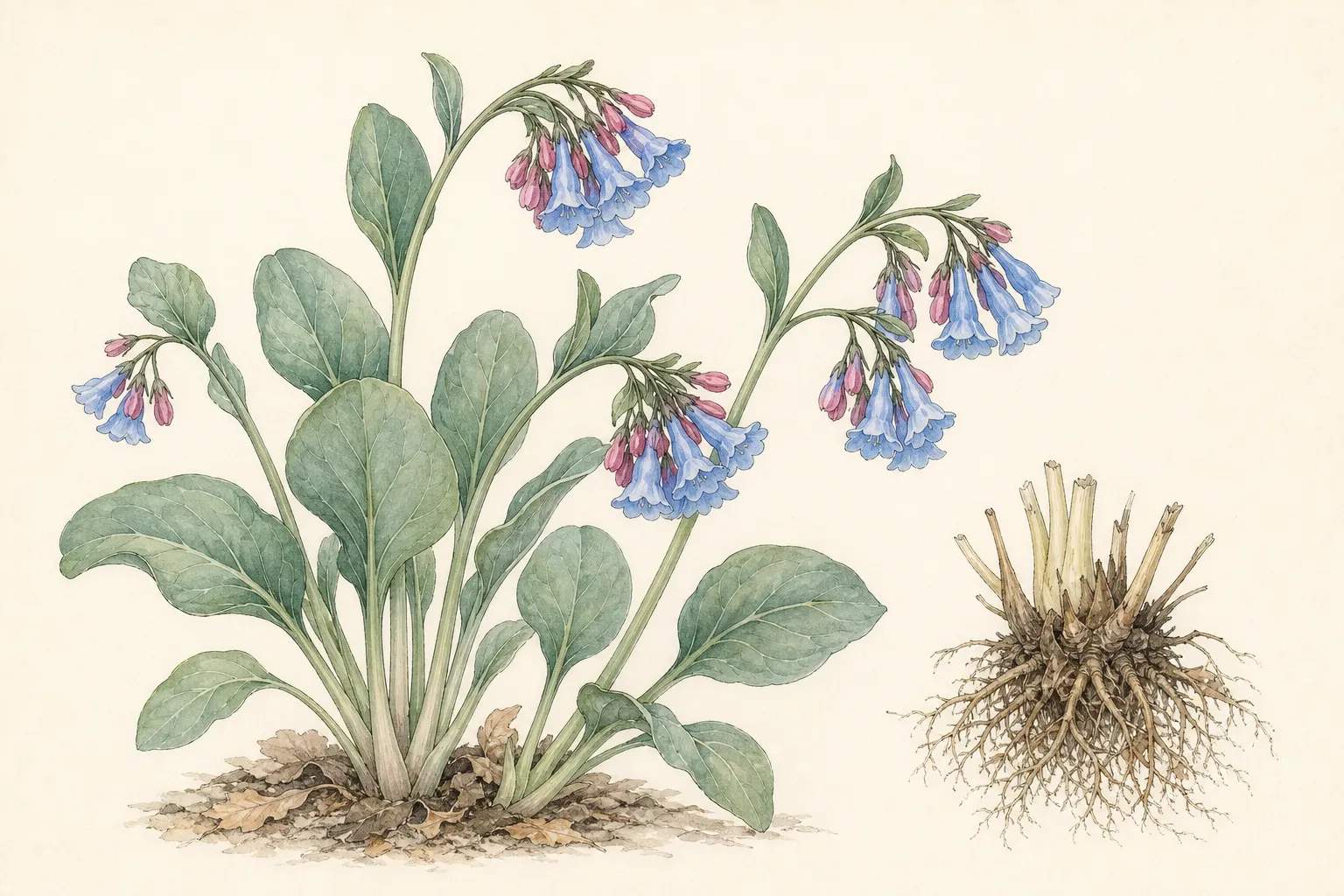
Mertensia virginica is a spring-ephemeral herbaceous perennial. Deep-purple shoots quickly turn green, then loose terminal clusters of purplish-pink buds open into slightly fragrant nodding blue bells. The alternate leaves are smooth, oval to oblong, and blue- to gray-green, with the largest leaves near the base of the fragile, nearly hollow stems.
The visible clump reaches about 1.5–2 ft high and 1–1.5 ft wide. Flowering lasts roughly three weeks in spring, followed by four-lobed fruits, yellowing foliage, and complete dieback by early to midsummer. That disappearance is the normal storage cycle, not evidence that a healthy crown has died.
Choose part to full shade beneath deciduous trees, where useful light reaches the soil before the canopy closes. Rich humus, even spring moisture, and drainage resemble its floodplain-forest habitat. Dense evergreen shade and compacted dry soil are poor substitutes, and established tree roots can outcompete a new bluebell planting even where the light looks suitable.
Potted plants can be set 10–18 in apart in autumn or after the last spring frost. Plant at the nursery depth, settle soil around the crown, and never let purchased bare roots dry while waiting. Virginia bluebells develop a long taproot, so established clumps are best left undisturbed; if movement is necessary, do it during dormancy and preserve as much root as possible.
Plants self-seed and can form dense colonies where moisture and leaf litter leave suitable germination sites. Young seedlings may take several years to flower. Mark the patch before foliage vanishes so summer planting, hoeing, or bulb work does not cut through dormant crowns and roots.
There is no pruning season. Let every green leaf remain until it yellows and releases naturally, then remove collapsed material gently without digging. Use hostas, ferns, Solomon’s seal, or other later-emerging shade plants to occupy the summer opening while leaving the spring crowns accessible.
- Family
- Boraginaceae
- Range
- Eastern Canada to the north-central and eastern United States
- Soil pH
- 6.8–7.2
- Spread
- 1–1.5 ft · 30–45 cm
Planting & careHow to grow virginia bluebells
The species is generally grown in USDA zones 3–9. Emergence, flowering, and dormancy shift with local spring temperatures; in Wisconsin bloom is usually mid-April to mid-May, while warmer regions can be earlier. Penn State gives near-neutral pH 6.8–7.2 for rain-garden use, and regional sources describe broader soil adaptation.
- 1Map the dormant-season gap
Choose a deciduous woodland position and plan later-emerging companions before planting. Leave the future bluebell crowns free from summer digging and from dense evergreen groundcover.
- 2Confirm humus and spring moisture
Use rich, humus-heavy soil that stays evenly moist during emergence, flowering, and seed set but still drains. Check competition from established tree roots as well as the soil surface.
- 3Plant at the original depth
Set potted plants 10–18 in apart in autumn or after the last spring frost, keeping the crown at its nursery grade. Plant dormant roots immediately and protect them from drying before backfill.
- 4Water through the leafy phase
Soak the planting and maintain even moisture while leaves are active. Continue to protect first-year dormant roots from severe drought without keeping a poorly drained site saturated.
- 5Mark every crown
Place a durable marker at the colony edge before early-summer dieback. The empty-looking soil still contains long-lived crowns and taproots that are easily damaged by later planting.
- 6Leave foliage to finish
Allow leaves to yellow and collapse on their own after seed set. Remove dead material by hand at the surface and avoid cultivating through the dormant patch.
Pruning virginia bluebells
Virginia bluebells require no pruning. Leave all foliage until it has yellowed and died naturally after seed set, then lift the loose dead material without cutting or digging into the crown. Avoid routine division because established plants develop a long taproot; move a plant only when necessary and while dormant, preserving as much root as possible.
Seasonal care
Spring
Watch for purple shoots before raking or hoeing, keep the soil evenly moist, and weed by hand around the fragile hollow stems. Let pink buds, blue flowers, and seed development complete without cutting foliage.
Summer
Allow yellowing leaves to die back, remove only material that releases easily, and keep the dormant colony marked. Avoid planting or cultivating in the apparent gap; protect new plantings from severe drought.
Autumn
Plant potted or dormant stock at its original depth while roots are protected from drying. Top-dress the broader bed with leaf mold without burying the marked crowns under a dense wet layer.
Winter
The plant remains below ground. Keep markers in place, avoid soil disturbance and compaction, and check that runoff has not scoured or buried the dormant colony.
Safety and garden spread
The retained institutional profiles do not flag Mertensia virginica as poisonous, but this profile does not treat it as food or medicine. Do not ingest unidentified or ornamental plant material, and use normal garden hygiene.
Common problems
Normal summer disappearance
- Look for
- After spring bloom and seed set, the entire clump yellows, collapses, and leaves bare-looking soil by early or midsummer.
- Action
- Treat this as expected dormancy when the sequence was gradual and seasonally normal. Mark the crown, stop cutting, and wait for the following spring before judging survival.
Failure to return in spring
- Look for
- A marked crown produces no shoots after neighboring bluebells and local spring ephemerals are already growing.
- Action
- Review summer digging, drought, planting depth, and winter runoff before disturbing the site. Wait for the local emergence window, then inspect cautiously around the marker rather than excavating the whole taproot.
Ragged low foliage
- Look for
- Irregular holes or scraped surfaces appear on low spring leaves, often with slugs or snails active after dark in damp litter.
- Action
- Confirm the feeder, reduce dense hiding material directly against the crown, and use a targeted locally appropriate control only if damage threatens the brief leafy period.
Sparse flowering
- Look for
- Mature clumps make leaves but few flower clusters, or only the spring-lit edge blooms well.
- Action
- Compare early-season light, spring moisture, and tree-root competition. Seedlings can take several years to bloom, so confirm plant age before changing the site.
Plant details
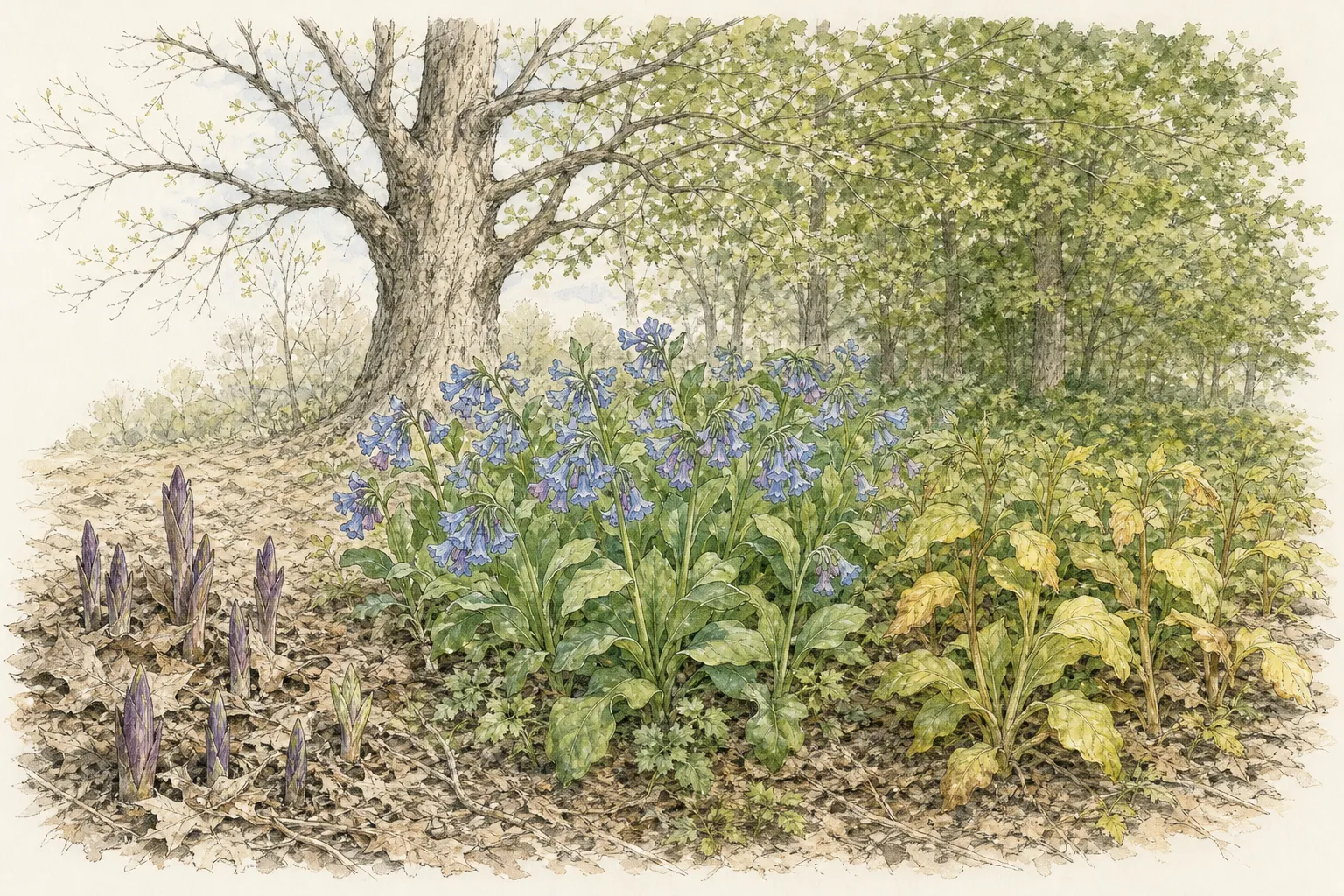
Deciduous woodland floor showing Virginia bluebells emerging purple, flowering blue, and yellowing before summer dormancy
Sources
- Mertensia virginica. North Carolina State Extension. Source record · Accessed 2026-08-30.
- Virginia Bluebells, Mertensia virginica. University of Wisconsin–Madison Extension. Source record · Accessed 2026-08-30.
- Rain Garden Plants: Virginia Bluebells. Penn State Extension. Source record · Accessed 2026-08-30.
- Mertensia virginica (L.) Pers. ex Link. Royal Botanic Gardens, Kew. Source record · Accessed 2026-08-30.