Toad Lily
Tricyrtis hirta
A practical species profile of Tricyrtis hirta, with identification, garden placement, soil and seasonal care guidance.
Published Last updated
At a glance
- Light
- Partial to full shade
- Water
- Consistent moisture without waterlogging
- Soil
- Humus-rich, moist, well-drained soil
- Hardiness
- Zones 4–8
- Bloom
- Late summer to autumn
- Height
- 2–3 ft · 60–90 cm
In this guide
Overview
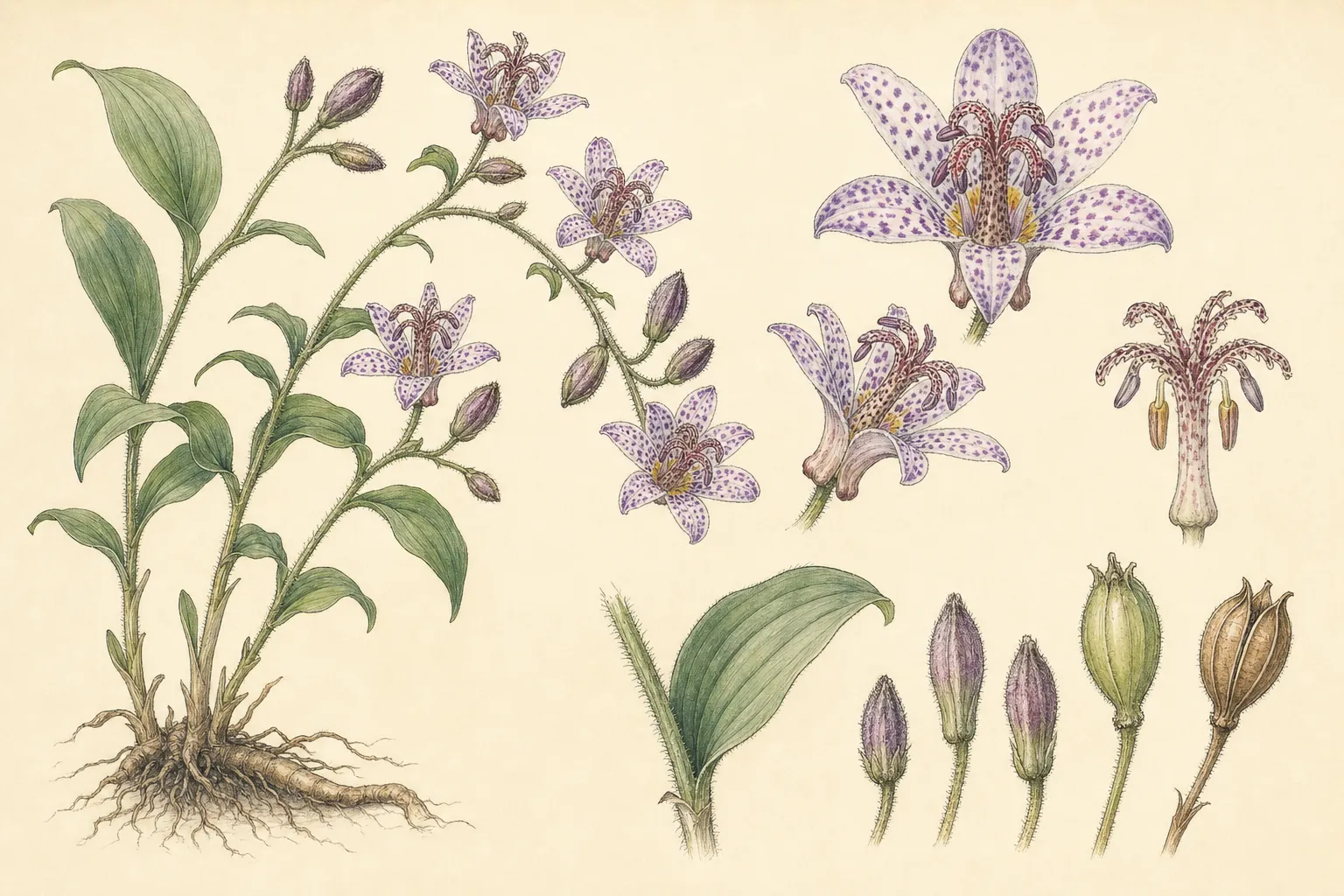
Toad lily is a deciduous herbaceous perennial with slow, creeping rhizomes. Hairy upright to arching stems carry alternate leaves and small white-to-lavender flowers densely spotted with purple. The flowers open in the upper leaf axils from late summer into autumn, so the plant is best placed close to a shaded path where their detail can be seen rather than buried at the back of a coarse groundcover.
The species forms a clump about 18–23 inches across rather than a woody framework. Named cultivars change foliage markings, flower color, and height, but all require room for intact summer stems and late flowers. Stems lost to routine hedge trimming cannot be replaced in time for the same autumn display.
Partial to full shade, shelter, and humus-rich soil that stays moist while draining well reproduce the important features of its native stream-bank and shaded-cliff habitat. Dry soil checks growth and flowering; saturated soil threatens the crown and rhizomes. Apply water at the base so the root zone is supplied while foliage remains dry.
New shoots expand in spring and summer, flowers arrive late, and the above-ground stems die for winter. This is not a shrub that blooms on old wood. Remove old stems as they collapse at the end of the season, or in early spring before fresh shoots are tall enough to be damaged.
Propagation can be by seed, stem cuttings, or division. The rhizomes spread slowly, so a widening clump is normal; sudden aggressive shoots from elsewhere should be identified before being attributed to toad lily. Divide only when there is a horticultural reason and keep replanted pieces from drying during re-establishment.
Rabbits may eat leaves and buds. NC State also identifies anthracnose and an aphid-spread Tricyrtis floral virus: orange leaf spots fit the former, while flowers that become mottled and then entirely purple fit the virus. Those patterns call for diagnosis, not generic fertilizer or pruning.
- Family
- Liliaceae
- Range
- Japan
- Soil pH
- 5.5–7.5
- Spread
- 1–2 ft · 30–60 cm
Planting & careHow to grow toad lily
Tricyrtis hirta comes from shaded cliffs and stream banks on the Japanese islands of Honshu, Shikoku, and Kyushu. It performs best where summer soil stays cool and moist without becoming waterlogged and where stems are sheltered. In colder parts of its range, young seed-grown plants may need first-winter protection; in hot regions, dependable shade and moisture matter more than a broad hardiness-zone label.
- 1Confirm Tricyrtis hirta
Keep the species and cultivar label because Tricyrtis selections vary in stem height, leaf markings, and flower pattern. Reserve about 18–23 inches of clump width and a viewing position close enough for the small axillary flowers to be appreciated.
- 2Choose sheltered shade
Use full or partial shade away from drying wind. Avoid a dense neighboring canopy at ground level that hides the flowers or competes strongly for the steady moisture this woodland perennial needs.
- 3Prepare moist, draining soil
Work with humus-rich soil that holds useful moisture but releases excess rain. Check both the planting hole and the surrounding bed; an isolated amended pocket cannot compensate for a dry tree-root zone or a saturated low spot.
- 4Set the herbaceous crown
Place the container root mass at the depth it was growing, with the crown and stem bases at the soil surface rather than buried. Spread any visible sound rhizomes without snapping them and settle the soil gently around the root system.
- 5Establish even moisture
Water the root zone after planting and monitor it through dry weather so the soil does not repeatedly dry out. Direct irrigation to the base and keep mulch off the crown, which supports moisture retention without leaving leaves chronically wet.
- 6Protect the late-season display
Mark the clump and leave emerging stems intact through summer. Add discreet support only if the site remains exposed enough for stems to lodge, and record autumn flowering before deciding whether shade, moisture, or cultivar placement needs adjustment.
Pruning toad lily
Toad lily has no flowering branches to thin. Keep the season's herbaceous stems intact while they carry leaves, buds, and late-summer to autumn flowers. RHS guidance is to cut the old stems back as the plant dies down for winter; cleanup may also be completed before new spring shoots rise. Remove anthracnose-affected material separately after diagnosis, and avoid cutting healthy summer stems merely to shorten the clump because their upper leaf axils hold the coming flowers.
Seasonal care
Spring
Clear any remaining dead stems before new shoots lengthen, taking care not to damage the crown. Divide only an established clump that needs it, reset pieces promptly, and restore even moisture. Watch young shoots for rabbit or slug feeding.
Summer
Keep the sheltered root zone moist without waterlogging and irrigate at soil level. Preserve the stems that will carry autumn flowers. Photograph orange leaf spots, unusual flower mottling, or aphid activity before removing tissue or choosing a control.
Autumn
Enjoy and record the axillary flowers, noting whether the clump receives enough light to bloom without drying. After frost or natural senescence, cut collapsed stems at the base; retain a marker so the dormant crown is not disturbed.
Winter
The top growth is dormant. Check that winter water drains away from the crown and that mulch has not covered it. In colder districts, maintain the locally appropriate protection for young plants without creating a wet, sealed layer.
Safety and garden spread
The retained NC State and RHS profiles do not identify Tricyrtis hirta as a poisonous plant. That absence is not food or pet-safety approval; grow it as an ornamental, prevent routine ingestion, and seek poison-control or veterinary advice after a concerning exposure.
Common problems
Few late-season flowers
- Look for
- Healthy leaves but few buds, summer stems cut short, a clump hidden in very dark competition, or repeated drought before the expected bloom period.
- Action
- Restore consistent moisture, preserve full-length summer stems, and compare the cultivar's bloom time with the site's autumn season. Move only if the plant cannot receive useful shade-filtered light and moisture together.
Anthracnose-like leaf spots
- Look for
- Small orange spots developing on leaves rather than uniform edge browning from a dry root zone.
- Action
- Keep foliage dry by watering at the base, improve spacing without exposing the plant to drying sun, and seek a local diagnosis if spotting spreads. Remove diagnosed diseased material and use controls only when current regional guidance supports them.
Tricyrtis floral virus concern
- Look for
- Flowers becoming mottled and then completely purple, particularly where aphids are present.
- Action
- Isolate the concern from normal cultivar spotting, avoid propagating the plant, and obtain a plant-health diagnosis. Manage aphids and infected material only according to current local recommendations; pruning unrelated stems will not cure a systemic virus.
Rabbits or slugs remove buds and leaves
- Look for
- Clipped young growth, missing buds, or irregular chewing on tender shaded foliage and stems.
- Action
- Confirm the animal from the damage pattern, then protect new shoots with a locally suitable barrier or other evidence-based method. Replace lost moisture and foliage care, but do not apply an undiagnosed pesticide to a plant whose damage is from browsing.
Plant details
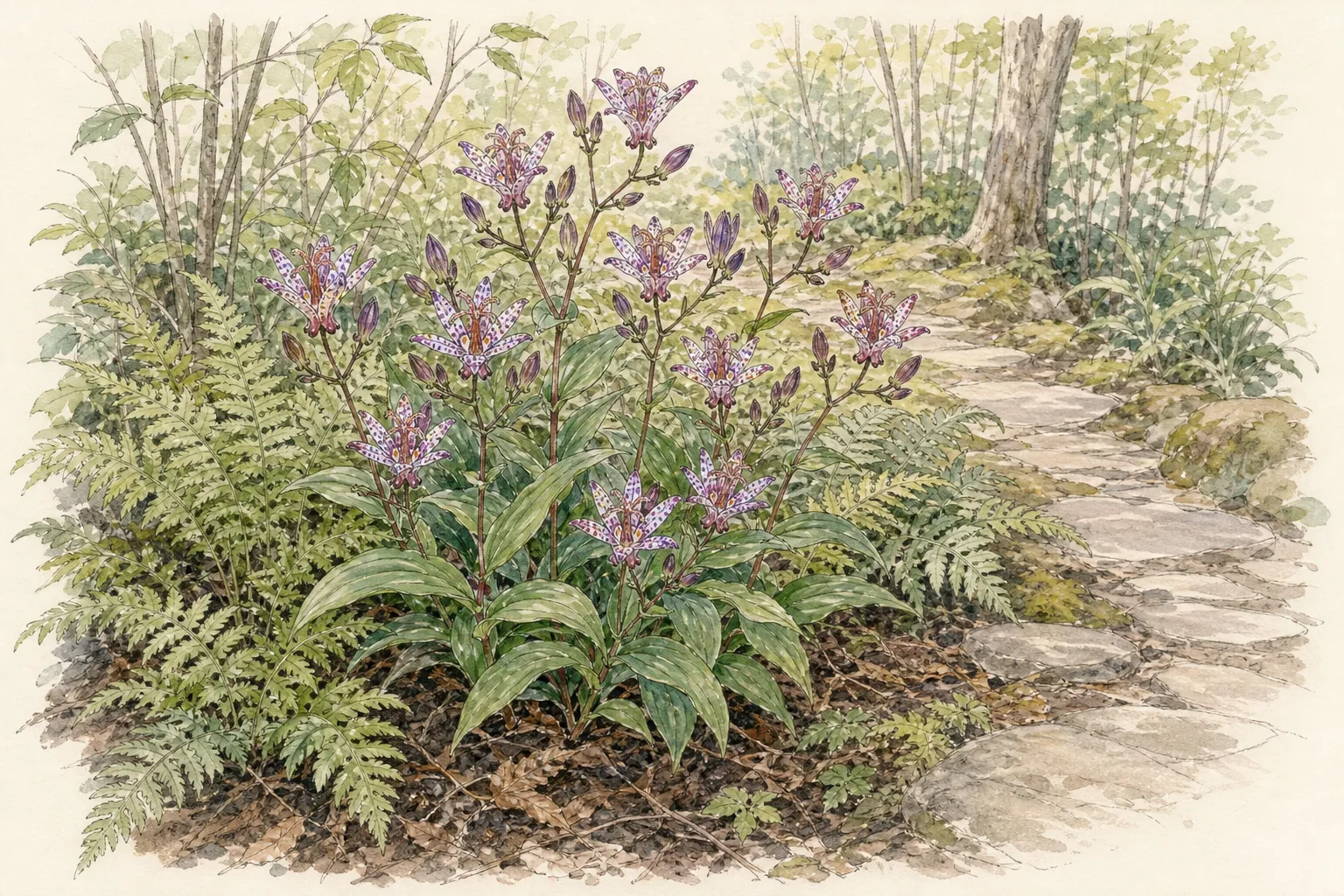
Garden placement study showing mature Toad Lily in an ornamental planting
Sources
- Tricyrtis hirta. North Carolina Extension Gardener Plant Toolbox. Source record · Accessed 2026-08-30.
- Tricyrtis hirta. Royal Horticultural Society. Source record · Accessed 2026-08-30.
- Tricyrtis hirta (Thunb.) Hook.. Royal Botanic Gardens, Kew. Source record · Accessed 2026-08-30.