Strawberry Tree
Arbutus unedo
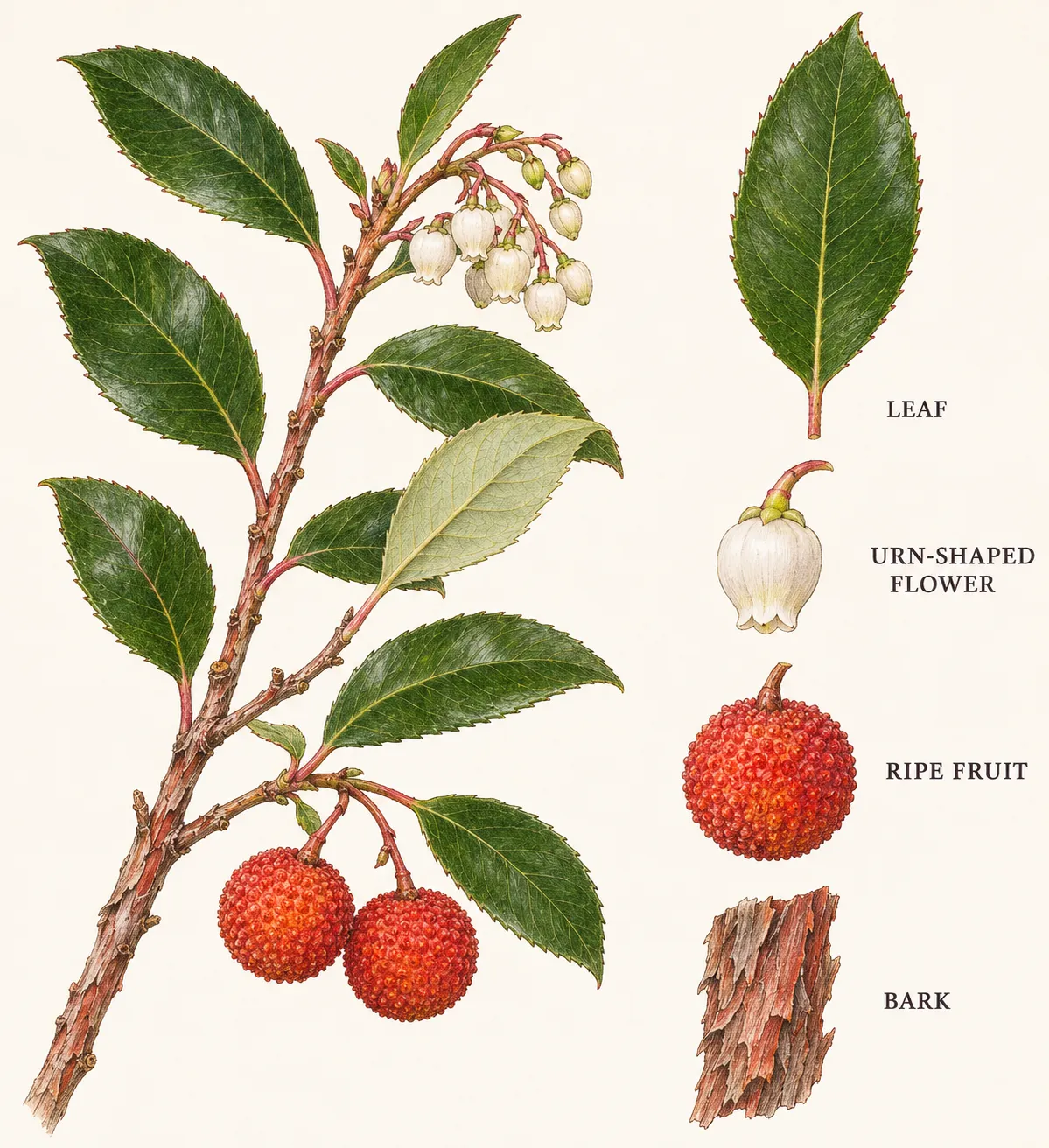
An evergreen shrub or small tree with serrated glossy leaves, white urn-shaped flowers and rough red fruit that can share the branches in autumn.
Published Last updated
At a glance
- Light
- Full sun; light partial shade can suit, with shelter from cold drying wind
- Water
- Regular root-ball checks during establishment; drought tolerant once established, with water during severe prolonged drought
- Soil
- Well-drained loam, sand or suitable clay; tolerates a range of fertility and some lime
- Hardiness
- Zones 7–10
- Bloom
- Autumn into winter; timing varies by climate, with older fruit ripening alongside new flowers
- Height
- Often 13–26 ft; larger specimens occur · Often 4–8 m; larger specimens occur
In this guide
Overview
Strawberry tree offers a late-season combination that few evergreen trees provide: new pale flowers can hang beside rough red fruits produced from the previous year's flowering. Arbutus unedo suits a sunny, sheltered position with freely draining soil and enough room for a broad shrub or small tree. Choose it for the year-round leafy framework as well as the autumn detail; a heavy crop or an exact flowering date is never assured.
The leaves are simple and alternate along the twig, with a leathery surface, a pointed tip and finely toothed edges. Oregon State describes blades about 5–10 cm long, glossy dark green above and paler beneath, attached by short reddish stalks. These features help distinguish the plant from a holly with sharply spined leaves and from other evergreen shrubs that also carry red fruit.
The small flowers are rounded urns with a narrow opening, white or sometimes pink-tinged, gathered in hanging clusters. Oregon State records flowers about 6 mm long and clusters around 5 cm long. The round fruits are much larger, about 1.5–2 cm across, with a densely rough surface and orange-to-red coloring as they ripen. They resemble strawberries in color and texture, but they are spherical tree fruits, not the pointed fruits of a cultivated Fragaria strawberry plant.
The overlapping display spans two flowering seasons. RHS explicitly describes the red fruits ripening from the previous year's flowers while new flowers open. Oregon State records that overlap in western Oregon, although its broader description also includes winter or early-spring flowering. Expect local timing to vary. A branch bearing flowers and green developing fruit in one season can look quite different when those fruits color the following autumn.
Plan for the full species to become substantial. RHS gives an eventual height and spread of 4–8 m, roughly 13–26 ft, over 10–20 years. NC State describes many plants around 15 ft tall, with larger specimens reaching 35 ft; Oregon State also records a wide range. A young specimen in a pot is not evidence that the mature canopy will fit beside a narrow doorway.
A useful garden position is a broad sunny bed beside a seating area, where the branch detail is visible but falling fruit lands mainly on soil. NC State warns that fruit drop can be messy on hard surfaces. Keep the eventual canopy and trunk clear of a frequently used path, and leave access for watering while the tree establishes. The rough red-brown bark becomes another feature as the framework develops.
For a smaller site, investigate a named selection and its eventual dimensions. Oregon State describes 'Compacta' at around 1.8 m after ten years, but about 3 m at maturity and potentially 3.6 m with time. NC State also lists 'Compacta' and the dwarf 'Elfin King'. A compact label changes the scale; it does not make the plant permanently miniature. Ask the nursery for the expected height, spread and habit of the exact stock offered.
Full sun is the clearest starting point for a sheltered UK garden. NC State allows partial shade, and the South Australian plant selector lists sun or part shade, but the site still needs to release excess water. RHS favors shelter from cold drying winds and warns that young plants are more frost tender. Both NC State and Oregon State report difficulties in humid climates, so summer humidity and drainage deserve attention alongside a winter hardiness zone.
Although it belongs to the heather family, strawberry tree is more tolerant of lime than an assumption of strictly acid-loving culture would suggest. RHS allows acid, neutral and alkaline soil, and South Australia's botanical guidance includes lime tolerance. The displayed pH 6–8 represents NC State's neutral-soil category, not the full limits of the species: NC State also lists acidic soil, and Oregon State favors acid to neutral conditions. Test a questionable site before changing its chemistry; a numerical target cannot compensate for persistent saturation.
Drought tolerance develops after establishment. Oregon State describes little summer irrigation being needed for established plants in its regional conditions, while the University of Washington's advice notes that severe recent Pacific Northwest droughts can still cause damage if supplemental water is absent. Check a newly planted nursery ball separately from adjacent soil, and continue watering through dry weather while roots establish. A mature tree and a newly installed container plant have very different reserves.
The fruit is primarily an ornamental feature in this garden profile. NC State and Oregon State describe fully ripe fruit as edible; the RHS description acknowledges food use but its caution panel labels fruit ornamental and not for eating. That mixed guidance should not be simplified into either a poisonous-fruit claim or a blanket permission to taste any red fruit. Identify the species carefully and keep children and pets from casual tasting.
Regional suitability can outweigh the attraction of autumn fruit. The Botanic Gardens of South Australia identifies the species as potentially invasive and advises keeping it away from conservation areas and coastal reserves. That is a geographically specific warning, not a statement that every garden population is invasive. In that region, select a locally appropriate alternative where the planting could affect natural vegetation.
Buy sound container-grown stock with a manageable, intact root ball and choose its permanent position carefully. Have the nursery show you the roots before purchase, following Maryland's general tree-selection advice. Reject severe circling, a buried trunk base or a plant loose in its pot instead of treating a heavily compromised specimen as a bargain. Root-ball planting gives you a clear starting point for establishing the woody framework.
RHS recommends seed propagation or semi-ripe cuttings in late summer. Seed is a route to species plants; a correctly labelled nursery selection or vegetatively propagated plant is the more predictable choice for a specific compact habit or flower color. Propagation is separate from routine maintenance: a well-placed specimen needs little cutting simply to remain attractive.
- Family
- Ericaceae
- Range
- Western and southern Europe, including southwestern Ireland, and the Mediterranean region
- Soil pH
- 6–8
- Spread
- Allow 13–26 ft for the full species · Allow 4–8 m for the full species
Planting & careHow to grow strawberry tree
NC State lists USDA zones 7a–10b; the displayed 7–10 range follows that guidance. Oregon State gives zone (6)7, while RHS assigns H5 under UK conditions. These ratings describe different systems and do not guarantee survival in an exposed garden. RHS notes that young plants are more frost tender than mature specimens. November is a good time to assess flowers, fruit and space in a suitable mild garden; spring establishment is the safer default near the cold edge. In South Australia, follow the separate regional caution about planting near natural areas.
- 1Choose the permanent position and suitable season
Confirm Arbutus unedo and the cultivar, then reserve its mature width clear of doors and busy paving. Check drainage after rain and choose shelter from cold drying wind. Maryland favors spring planting for broadleaf evergreens; use spring particularly near the cold edge. In mild regions, other workable planting windows require suitable soil and reliable establishment watering.
- 2Inspect the nursery ball and find the collar
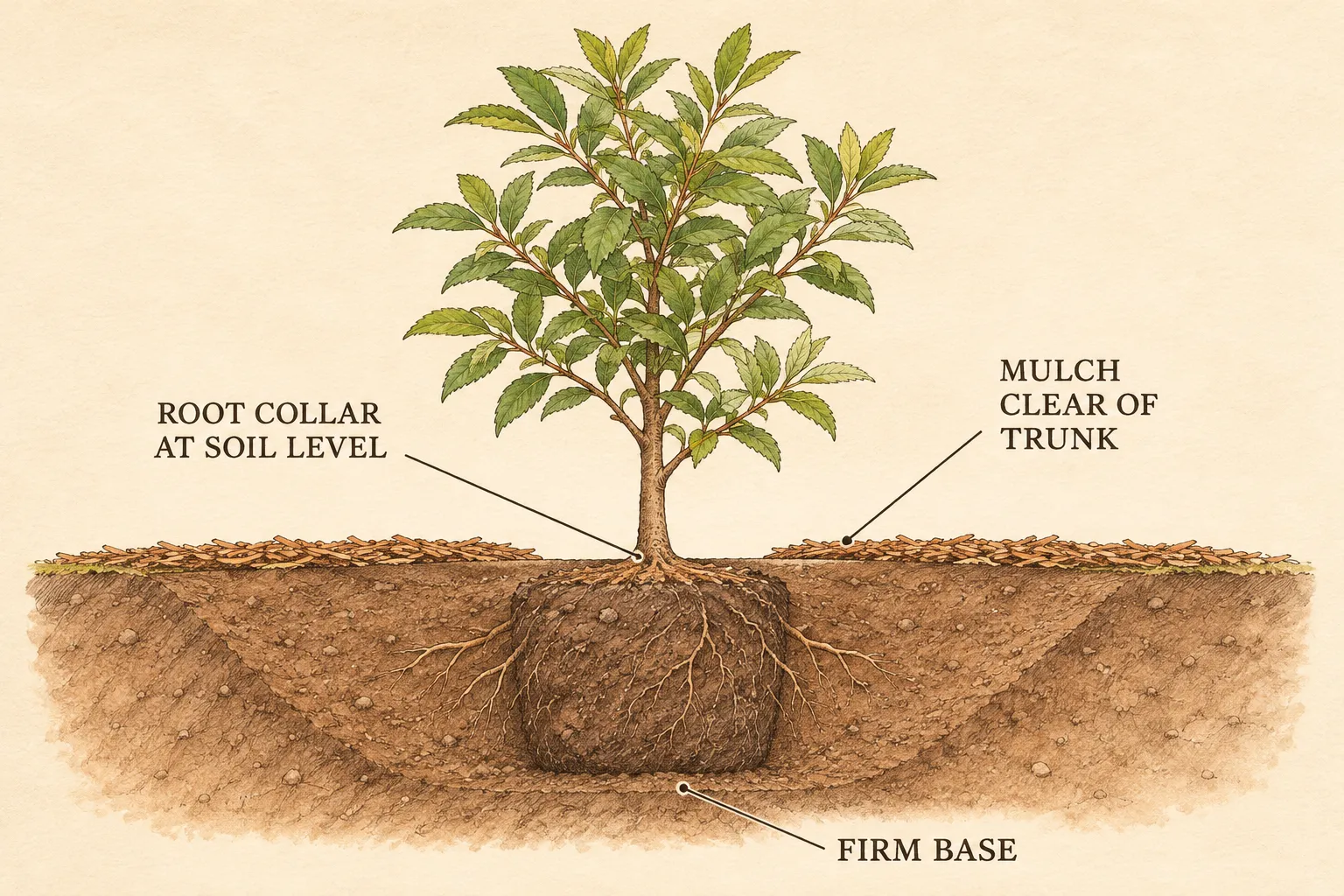
Water a dry root ball before planting. Remove the container while supporting the ball, and locate where the upper structural roots emerge from the trunk. Gently clear excess loose medium above that point. Keep the main ball cohesive. Obtain nursery help for serious root defects; small accessible circling roots can be loosened or corrected before setting the plant.
- 3Dig broad, with a firm base
Following Maryland's tree-planting method, make the hole at least twice the root-ball width and no deeper than the ball measured from its true root collar. Leave firm soil beneath it to resist settlement. Set the collar at the surrounding finished soil level, and check orientation before backfilling. The nursery pot's old surface is not the reference if the collar was buried.
- 4Return soil and settle it around the roots
Backfill with the excavated soil and use water and gentle hand pressure to settle it around the intact ball. Keep the trunk base exposed at grade. Spread organic mulch around the root area, leaving a clear gap beside the trunk. A rich compost-filled pocket or a deep mound over the collar changes the root environment and is unnecessary in suitable soil.
- 5Water for establishment and check stability
Feel the original root ball as well as adjacent soil beneath the mulch. Water when it is drying several inches down, allowing surplus to drain. Continue checks through the first growing seasons and prolonged dry spells. Stake only if the tree cannot remain upright and stable, using a flexible arrangement that allows some trunk movement. Check ties and remove support when it is no longer needed.
Pruning strawberry tree
Keep pruning light and selective. RHS assigns strawberry tree to minimal-pruning group 1, and the University of Washington's Miller Library recommends spring pruning after the main risk of frost has passed. Remove dead, damaged or badly placed branches while preserving the natural framework. Choose between a multi-stemmed shrub and a more open tree form early, so large corrective cuts are less likely later. Oregon State notes that tree-trained plants can be more sensitive to winter injury, which matters near the cold edge. Repeated topping or shearing to fit an undersized site sacrifices the branch outline and can remove flowers and developing fruit. A tree that persistently blocks access usually needs a space decision, not an indefinitely tighter haircut. Semi-ripe cuttings in late summer are a propagation option; they are not a reason to strip useful growth from a specimen that already fits.
Seasonal care
Spring
Plant container-grown stock when the ground is workable and local conditions favor evergreen establishment. Check the collar after watering and settling. Make only necessary selective pruning after frost risk has eased, retaining the framework and developing fruit. Refresh mulch clear of the trunk and check the original root ball during drying weather.
Summer
Water young trees according to moisture in the nursery ball and surrounding soil. Established plants tolerate drought, but prolonged severe heat and dryness still justify inspection and supplemental water. Check foliage and stems if growth declines. Take semi-ripe cuttings in late summer only when propagation is intended and suitable material is available.
Autumn
Look for new urn-shaped flowers and coloring fruit from the preceding year's bloom. Assess mature spread before buying a plant on the strength of its fruit display. Clear fallen fruit from frequently used paving. Plant only where the local season and soil support establishment; November interest is not a requirement to plant just before winter.
Winter
Retain the evergreen canopy and protect vulnerable young plants from severe cold and drying exposure according to local conditions. Check container drainage and moisture if stock is still awaiting a permanent home. Record exposed-side damage and reassess it in spring. A mature sheltered tree's performance does not guarantee that a newly planted specimen has the same resilience.
Safety and garden spread
Regional invasive risk
The Botanic Gardens of South Australia warns that Arbutus unedo is potentially invasive and advises against planting it near conservation areas or coastal reserves. Check local suitability before planting there; this regional caution is not a worldwide classification.
Reported region: South Australia, especially near conservation areas and coastal reserves
Common problems
Decline where soil stays saturated
- Look for
- Weak growth, yellowing or dieback accompanies persistent wetness around the root ball.
- Action
- Check runoff, drainage and planting depth before adding water or fertilizer. NC State lists root rot and Phytophthora among possible problems, but foliage alone cannot identify a pathogen. Correct obvious water accumulation and seek a root assessment if decline continues.
Brown leaves after cold or drying wind
- Look for
- Damage is concentrated on exposed foliage after severe weather, particularly on a young tree.
- Action
- Review shelter and the moisture of the root ball. RHS notes greater frost tenderness in young plants. Give a movable container suitable protection and reassess damaged growth once spring development clarifies what remains alive. Treat the hardiness rating as regional guidance, not proof against injury.
Sparse fruit despite flowering
- Look for
- Flowers are present but few fruits develop or remain to ripen the following year.
- Action
- Allow for the long fruit-development cycle and weather-dependent cropping noted by NC State. The University of Washington describes the plant as self-fertile, with fruiting potentially improved by more than one tree. Preserve flowering branches and suitable growing conditions; a second tree is not a guaranteed cure or a reason to overcrowd a small bed.
Leaf spots, insects or continuing dieback
- Look for
- Discrete leaf lesions, unusual deposits, visible insects or progressive branch decline appear beyond ordinary weather damage.
- Action
- Inspect both leaf surfaces and stems. RHS lists leaf spot and aphids; NC State lists other possible pests and diseases. Obtain identification before treatment, and retain a photograph or sample showing the progression. A single spot does not establish a need for pesticide.
Fruit litter on a path
- Look for
- Ripe fruit falls onto paving beneath the expanding canopy.
- Action
- Collect fallen fruit regularly from used surfaces. When selecting a site, allow the canopy to extend mainly over soil or a bed, where the display creates less maintenance. Pruning a mature crown hard every autumn to prevent litter also removes the feature for which the tree was planted.
A compact selection outgrows its space
- Look for
- The plant labelled 'Compacta' continues to widen and eventually interferes with access or neighboring plants.
- Action
- Compare the actual plant with its mature dimensions, not its ten-year estimate. Oregon State records eventual sizes around 3 m and sometimes larger. Use light selective pruning where appropriate, but reconsider the arrangement if permanent room is inadequate.
Sources
- Arbutus unedo | strawberry tree. Royal Horticultural Society. Source record · Accessed 2026-11-02.
- Arbutus unedo. NC State Extension Gardener Plant Toolbox. Source record · Accessed 2026-11-02.
- Arbutus unedo. Oregon State University. Source record · Accessed 2026-11-02.
- Arbutus unedo — Irish Strawberry Tree. Botanic Gardens of South Australia. Source record · Accessed 2026-11-02.
- Planting a Tree or Shrub. University of Maryland Extension. Source record · Accessed 2026-11-02.
- Plant Answer Line: Arbutus unedo. University of Washington Elisabeth C. Miller Library. Source record · Accessed 2026-11-02.