Slender Deutzia
Deutzia gracilis
A compact Japanese deciduous shrub with opposite serrated leaves and small white spring flowers on old wood, best renewed immediately after bloom.
Published Last updated
At a glance
- Light
- Full sun to partial shade
- Water
- Moderate; moist during establishment
- Soil
- Moist, well-drained clay, loam, or sand; pH adaptable
- Hardiness
- Zones 5–8
- Bloom
- Spring to early summer, on the previous season’s wood
- Height
- 2–5 ft · 60–150 cm
In this guide
Overview
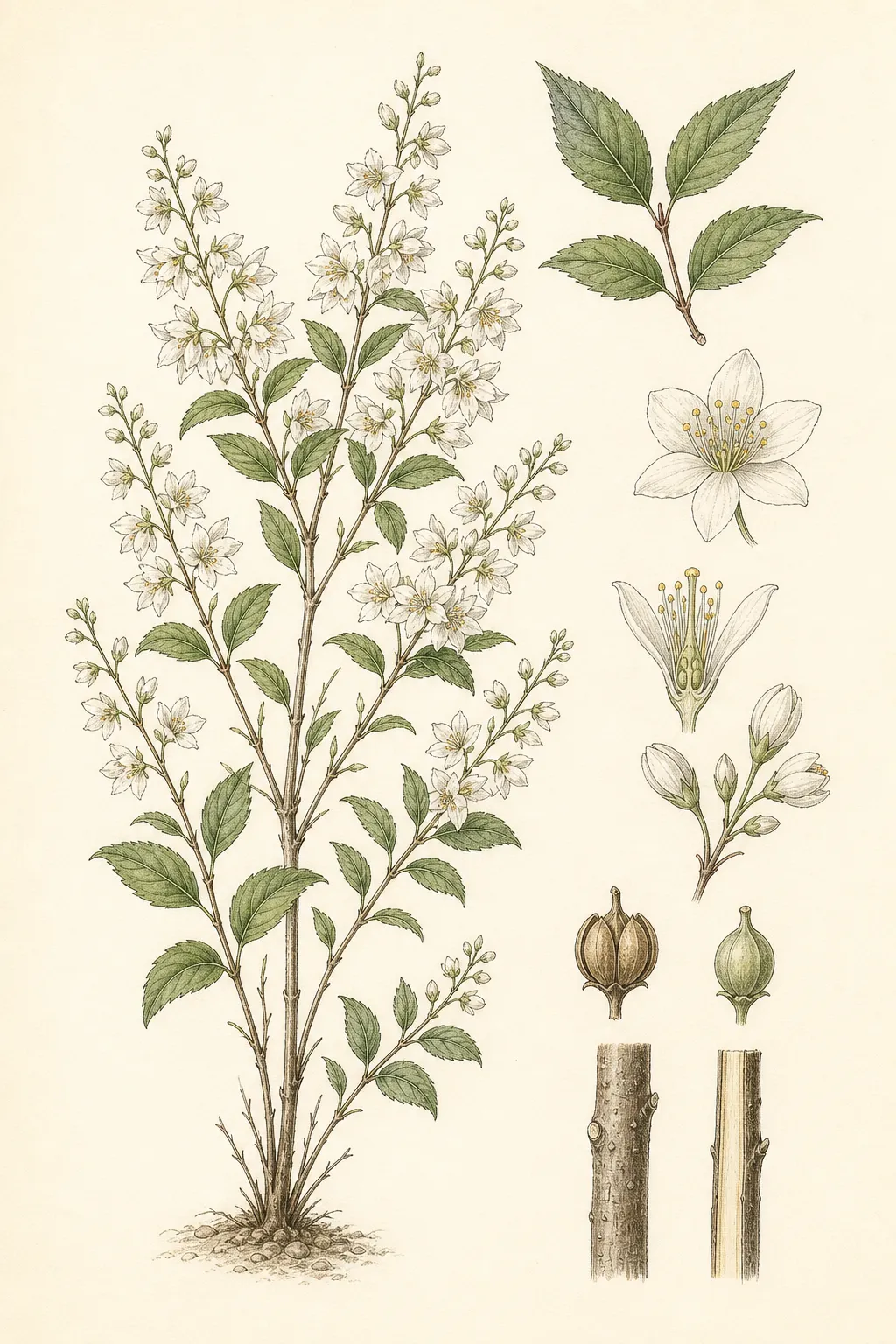
Deutzia gracilis is a rounded deciduous shrub with fine, broadly spreading to arching brown stems. Its opposite leaves are ovate to lance-shaped, serrated, and hairy on both surfaces. Small fragrant white flowers are bell- to star-shaped and carried in upright clusters; the later brown, half-rounded capsules are much less conspicuous.
The species commonly reaches 2–5 ft high and 3–4 ft wide, while selections such as ‘Nikko’ can make a much lower mound. It fits a low shrub border, open woodland edge, bank, or informal repetition where the tips can arch freely. Check a named cultivar’s dimensions before using the species size beside a window or walk.
Flowering is heaviest in full sun, but partial shade is tolerated and afternoon shade can reduce bleaching in very hot conditions. The shrub accepts clay, loam, or sand across a broad pH range when the soil remains moist yet drains. Saturated soil and a rich isolated planting pocket are unnecessary and can weaken establishment.
Set container stock with the root flare at finished grade, loosen circling roots, and water the original root ball and surrounding soil together. A shallow mulch layer can limit drying, but keep mulch off the cluster of basal stems so decay and new cane growth remain visible.
The white spring flowers form on the previous season’s wood. Make renewal cuts immediately after flowering: remove dead or failing canes at ground level and shorten an intrusive arch to a healthy lateral. Hedge shears erase the loose form and leave a crowded surface of short shoots.
Late frost can injure developing buds and flowers, and intense summer sun can bleach foliage. Aphids and leaf miners are occasional rather than defining problems. A branch that dies repeatedly should prompt inspection of planting depth, drainage, and the stem base before pesticide use.
- Family
- Hydrangeaceae
- Range
- Central and southern Japan
- Soil pH
- 5–8
- Spread
- 3–4 ft · 90–120 cm
Planting & careHow to grow slender deutzia
The species is generally grown in USDA zones 5–8. Flowering dates shift with climate, late spring frost can damage buds or flowers, and compact cultivars may be substantially shorter than the 2–5 ft species range.
- 1Distinguish species from cultivar
Use 2–5 ft high by 3–4 ft wide for the species, then replace those figures with the documented size of a named compact selection. Leave access to the basal canes after flowering.
- 2Balance sun and heat
Choose full sun for maximum bloom or partial shade where summers are hot enough to bleach leaves. Avoid a frost pocket that regularly catches the shrub as spring buds open.
- 3Confirm moist drainage
Check the intended root zone after rain. It should retain useful moisture without leaving the root ball in standing water; correct the site rather than creating a small amended sump.
- 4Plant the woody base at grade
Find the first structural roots, set that flare at finished soil level, and spread or correct circling container roots. Backfill with site soil and keep mulch away from the basal stems.
- 5Water through the first season
Soak the planted root ball, then recheck moisture below the mulch during dry intervals. Established slender deutzia tolerates some drought, but new roots need even moisture while extending into the bed.
- 6Preserve the arching outline
Place paths and neighboring crowns beyond the mature spread. Plan to thin old canes after bloom instead of forcing the shrub into a narrow clipped box.
Pruning slender deutzia
Deutzia gracilis flowers on old wood, so prune immediately after the spring display. Remove dead, damaged, or selected aging canes at ground level and shorten a wayward arch to a healthy lateral. Preserve the loose rounded fountain; winter or pre-bloom shearing removes flower buds and creates a twiggy shell.
Seasonal care
Spring
Protect swelling buds from an exposed late-frost pocket where practical and let the shrub complete its white flower display before shaping. Remove only clearly broken or dead wood beforehand.
Summer
Thin old canes as soon as flowering ends, then allow replacement shoots to mature for next spring. Check new plants during dry periods and note any sun bleaching before changing fertility.
Autumn
Let current shoots harden without late fertilizer or shearing. Clear confirmed diseased leaf debris and maintain mulch clearance around the many-stemmed base.
Winter
Inspect the leafless shrub for snow breakage and dead canes, but reserve ordinary renewal for after bloom. Keep piled snow, salt, and traffic from crushing the fine outer stems.
Safety and garden spread
The retained institutional profiles do not flag Deutzia gracilis as poisonous, but they are not an edibility assessment. Do not ingest ornamental plant material, and use normal garden hygiene.
Common problems
Few spring flowers
- Look for
- The shrub leafs out normally but flowers only on the sunniest side or follows a winter haircut with little bloom.
- Action
- Check light and pruning date first. Move routine cuts to the immediate post-bloom period and allow the new summer shoots to remain for the following spring.
Bleached foliage
- Look for
- Leaves turn pale or nearly white on the hottest, brightest exposure while shaded foliage remains greener.
- Action
- Confirm heat and light exposure rather than treating it as a nutrient deficiency. Provide afternoon shade in hot climates and maintain even establishment moisture.
Bud or flower frost injury
- Look for
- New tips or open flower clusters brown suddenly after a late freeze while protected interior growth remains sound.
- Action
- Wait for regrowth to reveal living tissue, then remove only dead tips after the normal bloom window. Reconsider an exposed frost pocket if injury repeats.
Aphids, leaf miners, or leaf spots
- Look for
- Curled sticky tips, winding mines within leaves, or discrete lesions that increase rather than isolated cosmetic marks.
- Action
- Identify the organism or disorder before acting; these problems are usually occasional. Remove limited damaged material where useful and follow local Extension guidance and product labels if control is warranted.
Plant details
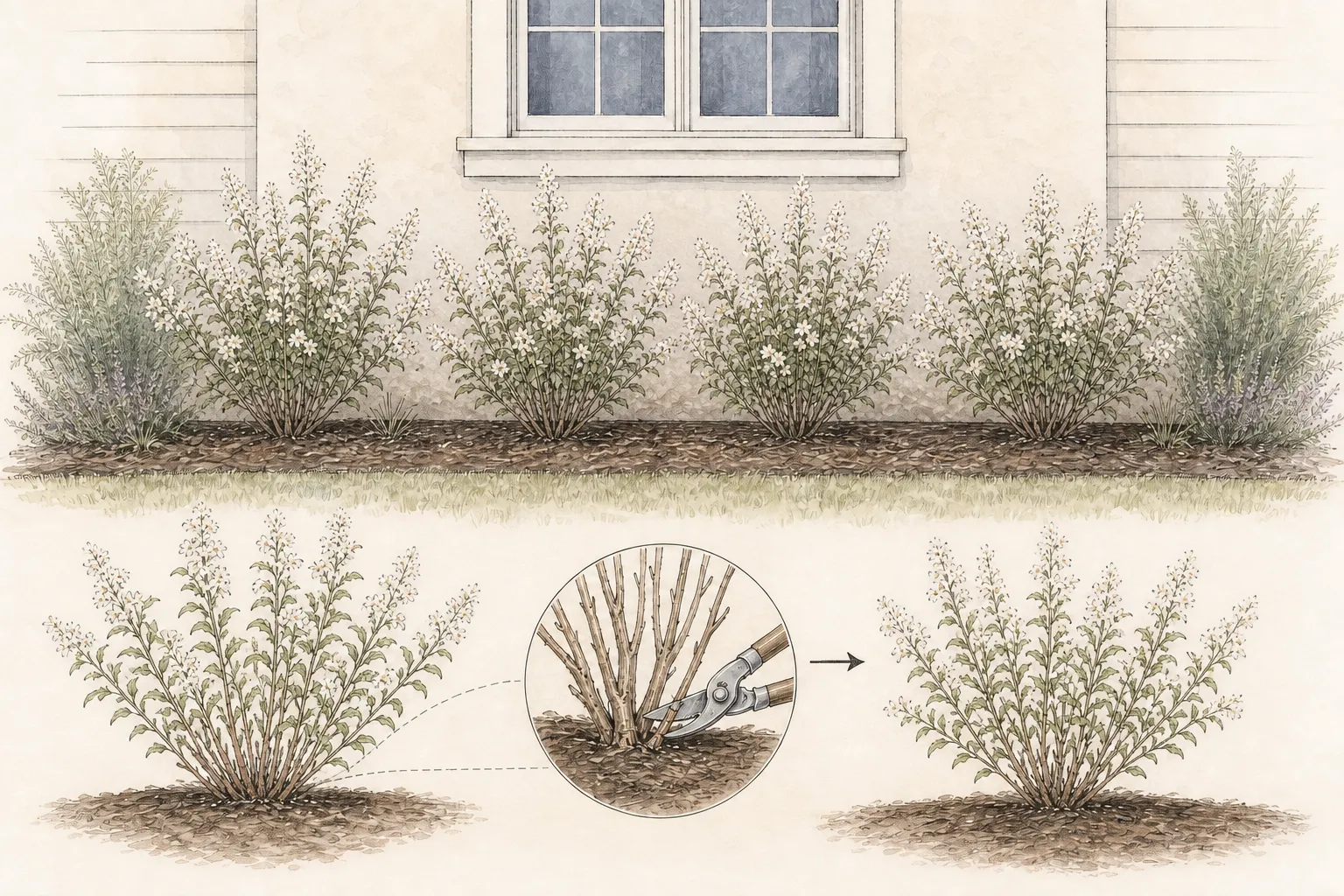
Repeated low shrubs beneath a window with an inset showing old canes removed at ground level after flowering
Sources
- Deutzia gracilis. North Carolina State Extension. Source record · Accessed 2026-08-30.
- Deutzia gracilis. Royal Horticultural Society. Source record · Accessed 2026-08-30.
- Deutzia gracilis Siebold & Zucc.. Royal Botanic Gardens, Kew. Source record · Accessed 2026-08-30.