Siberian Iris
Iris sibirica
A source-checked guide to Siberian iris: narrow rhizomes, grassy fans, moisture needs, 1–2 in planting depth, division, and safe handling.
Published Last updated
At a glance
- Light
- Full sun to partial shade
- Water
- Evenly moist in spring and through bloom
- Soil
- Moist, fertile, well-drained soil
- Hardiness
- Zones 3–8
- Bloom
- Late spring to early summer
- Height
- 2–4 ft · 60–120 cm
In this guide
Overview
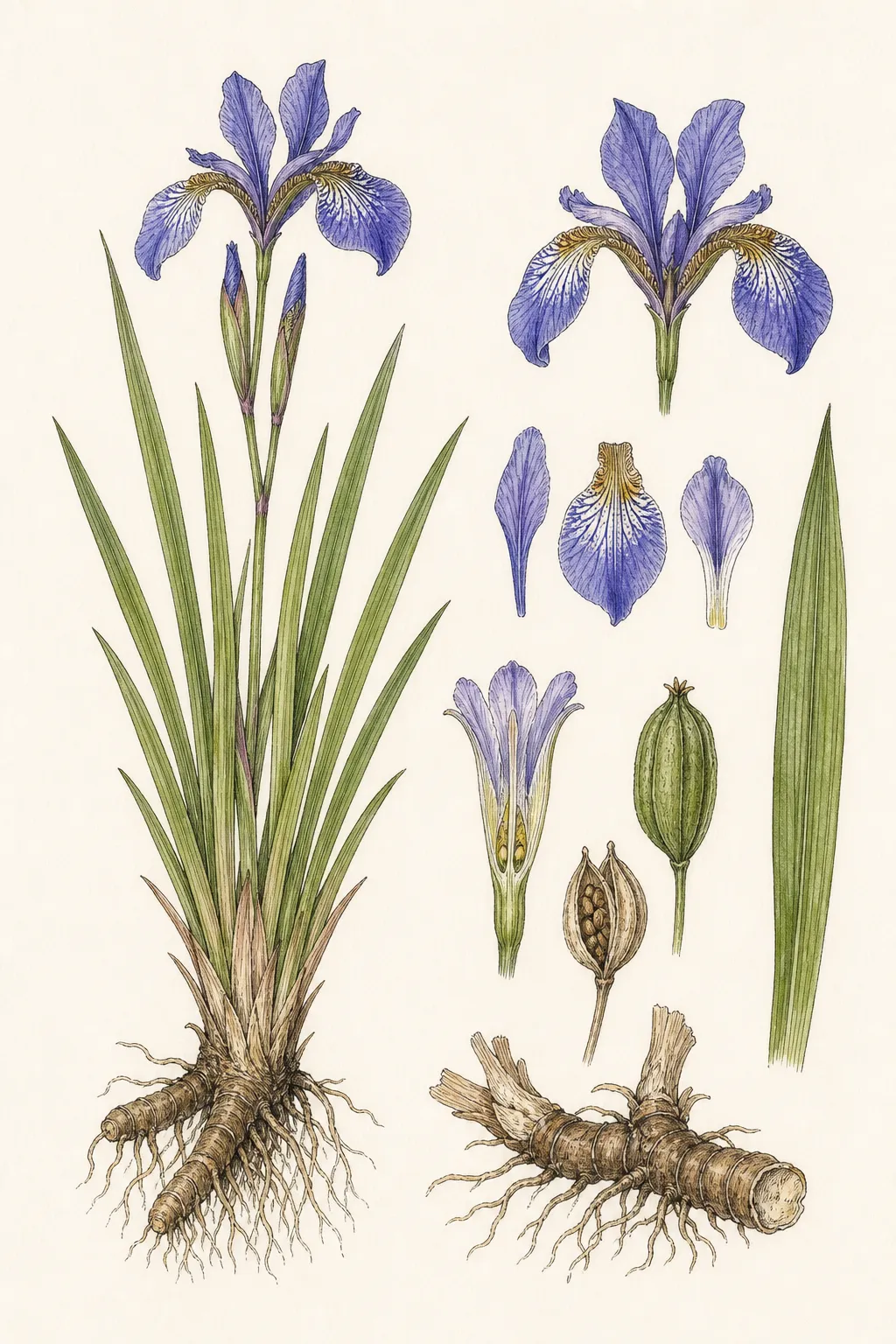
Siberian iris is a deciduous, rhizomatous perennial with narrow blue-green leaves arranged in upright, vase-shaped fans. Its beardless flowers have three upright standards and three flaring falls, usually in blue or violet in the species; named garden selections can differ in color and height. The slender underground rhizome distinguishes it from thick-rhizomed bearded irises.
Flowering stems rise 2–4 ft above a foliage clump that can reach roughly 2.5–3 ft across. Use repeated fans beside a moist border, stream edge, or rain-garden shoulder, leaving enough room to lift a congested clump later. The foliage remains ornamental after the late-spring to early-summer bloom and should not be cut while it is still green.
Best flowering comes in full sun with evenly moist, fertile, organically rich soil. Partial shade is useful in hot regions, but too much shade reduces flowers and can make the foliage lean. Established clumps tolerate a dry interval better than new divisions, yet prolonged drought or chronically saturated soil both reduce performance.
Bare rhizome divisions are planted with 1–2 in of soil over them, not exposed at the surface like bearded iris. Each division should retain at least two sound fans, and its roots must stay moist while it is out of the ground. Spring suits colder-winter regions; fall planting gives roots a head start in milder climates.
Dense clumps commonly flower less after several years. Lift them when the center thins or flower count falls, shorten the leaves to 6–8 in for handling, separate healthy outer rhizomes, and replant promptly at the same 1–2 in cover. Division is corrective maintenance, not an annual pruning task.
Remove finished flower stems unless seed pods are wanted, then let the leaves photosynthesize until they yellow in autumn. Rhizomes are not edible, and NC State records both digestive effects from ingestion and skin irritation from sap, so gloves and careful cleanup belong in the division routine.
- Family
- Iridaceae
- Range
- Central Europe to Mongolia
- Soil pH
- 5.5–7
- Spread
- 2.5–3 ft · 75–90 cm
Planting & careHow to grow siberian iris
In hot southeastern climates, afternoon shade can prevent stress, while winters warmer than the species' normal range may reduce bloom. Use local extension advice for planting season and heat exposure.
- 1Reserve the mature footprint
Allow flower stems up to 4 ft high and about 2.5–3 ft for a mature clump. Leave a reachable edge so an aging crown can be lifted without trampling neighboring plants.
- 2Match sun and spring moisture
Choose full sun in cool climates or light afternoon protection in hot regions. The soil should remain evenly moist from spring growth through several weeks after flowering without staying anaerobic.
- 3Cover the rhizome by 1–2 inches
Spread the roots in a broad hole and set a bare division so 1–2 in of soil covers the rhizome. Keep roots damp throughout the job, firm soil gently, and water immediately.
- 4Keep new divisions evenly moist
Check below the mulch and water before the root zone dries during the first six to eight weeks. Once established, continue irrigation through long dry periods but do not leave the crown in stagnant water.
- 5Mulch beside, not onto, the fans
Use a light organic layer to conserve moisture while leaving the bases of the leaf fans visible. Pull mulch back if it settles into the crown or prevents inspection for soft tissue.
- 6Plan division from flower count
After bloom, compare flower number and center vigor with previous years. Divide only when crowding or a weakening center is evident, and retain healthy outer fans rather than the exhausted middle.
Pruning siberian iris
Remove flower stems after bloom unless the pods are wanted. Keep green leaves through the growing season, cut yellowed foliage in autumn or before spring growth, and shorten leaves to 6–8 in only when handling divisions.
Seasonal care
Spring
Clear last year's brown leaves before fresh fans lengthen, maintain even moisture as growth accelerates, and apply compost around rather than over the rhizomes.
Summer
Remove finished flower stems, continue watering through dry spells so the foliage stays functional, and decide after bloom whether a crowded clump needs division.
Autumn
Plant or reset divisions early enough to root before freezing weather, keep them moist for six to eight weeks, and remove foliage only after it yellows.
Winter
The rhizomes are dormant below ground. Check that winter water is not stagnating over the crown and keep heavy mulch or piled debris out of the leaf-fan bases.
Safety and garden spread
Common problems
Sparse flowering
- Look for
- The plant makes foliage but few flower stems, or bloom is limited to the brightest edge.
- Action
- Compare actual seasonal light, crown age, pruning time, moisture, and nitrogen input with this profile. Correct the evidenced mismatch and allow a full cycle before moving the plant.
Congested or open-centered crown
- Look for
- New growth is packed around the edge while the center weakens, or neighboring plants merge into the crown.
- Action
- Thin or divide at the season given in the care guidance. Keep vigorous outer sections, reset them at the original depth, and restore mature spacing.
Bacterial soft rot
- Look for
- A fan loosens at the base, and rhizome tissue becomes soft, discolored, or foul-smelling.
- Action
- Stop overhead or excess watering, isolate affected material, and seek an extension diagnosis before cutting. Disinfect tools between plants and do not replant soft tissue.
Slug or snail damage
- Look for
- Irregular holes and rasped edges appear on tender new fans, often with slime trails nearby.
- Action
- Confirm the pest after dark, remove damp hiding places without drying the root zone, and use a locally appropriate targeted control only if damage is material.
Plant details
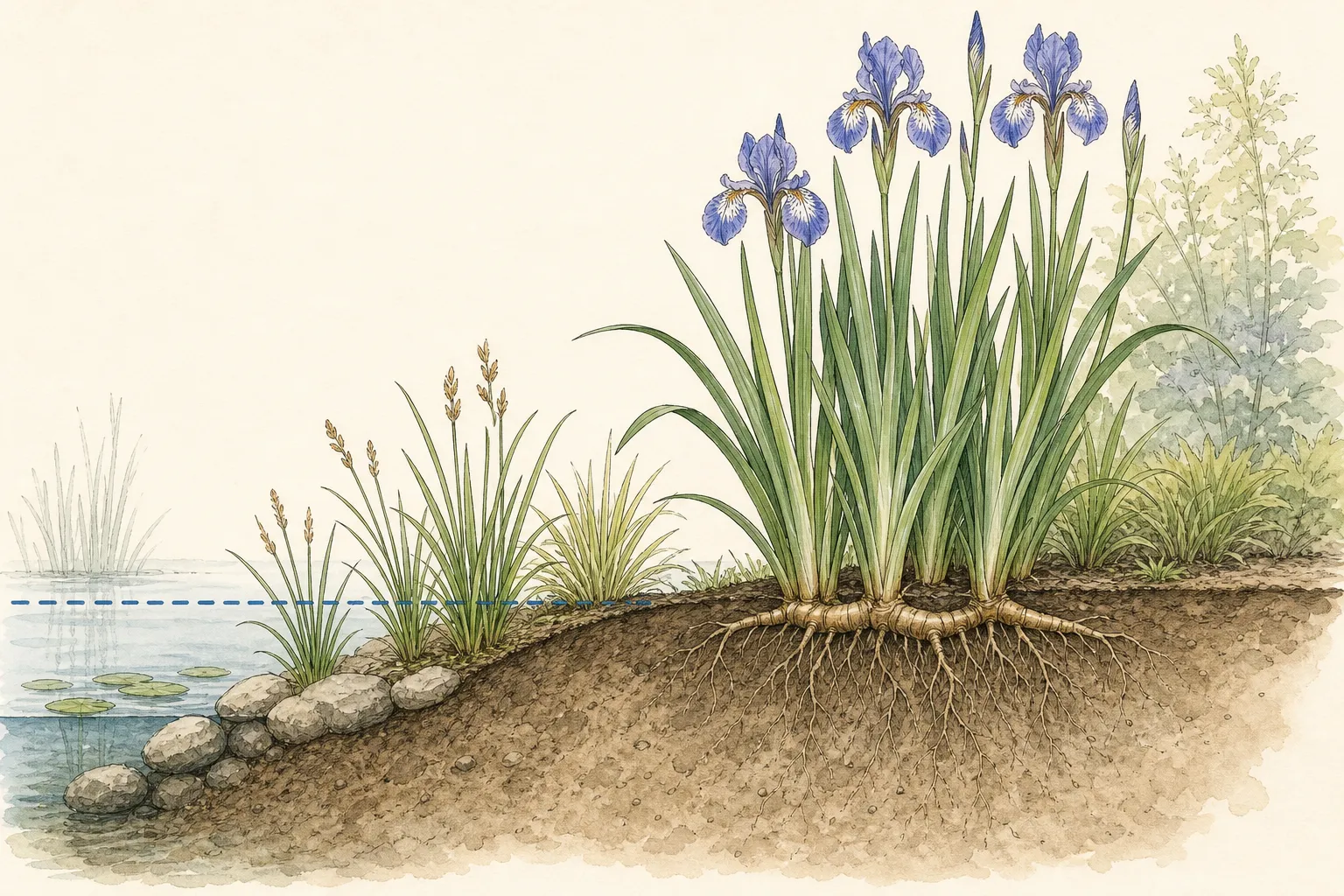
Garden study showing the placement and growth habit of Siberian Iris
Sources
- Siberian Iris cultivation profile. NC State Extension. Source record · Accessed 2026-08-30.
- How to grow border and Siberian irises. Royal Horticultural Society. Source record · Accessed 2026-08-30.
- Iris sibirica taxonomy and native range. Royal Botanic Gardens, Kew. Source record · Accessed 2026-08-30.