Showy Stonecrop
Hylotelephium spectabile
A clump-forming succulent perennial with flat pink late-summer flower heads, strongest in full sun and lean, sharply drained soil.
Published Last updated
At a glance
- Light
- Full sun
- Water
- Low; water established plants only after the soil has dried
- Soil
- Lean to average, sharply drained neutral to alkaline soil
- Hardiness
- Zones 4–9
- Bloom
- Late summer to autumn
- Height
- 1–2 ft · 30–60 cm
In this guide
Overview
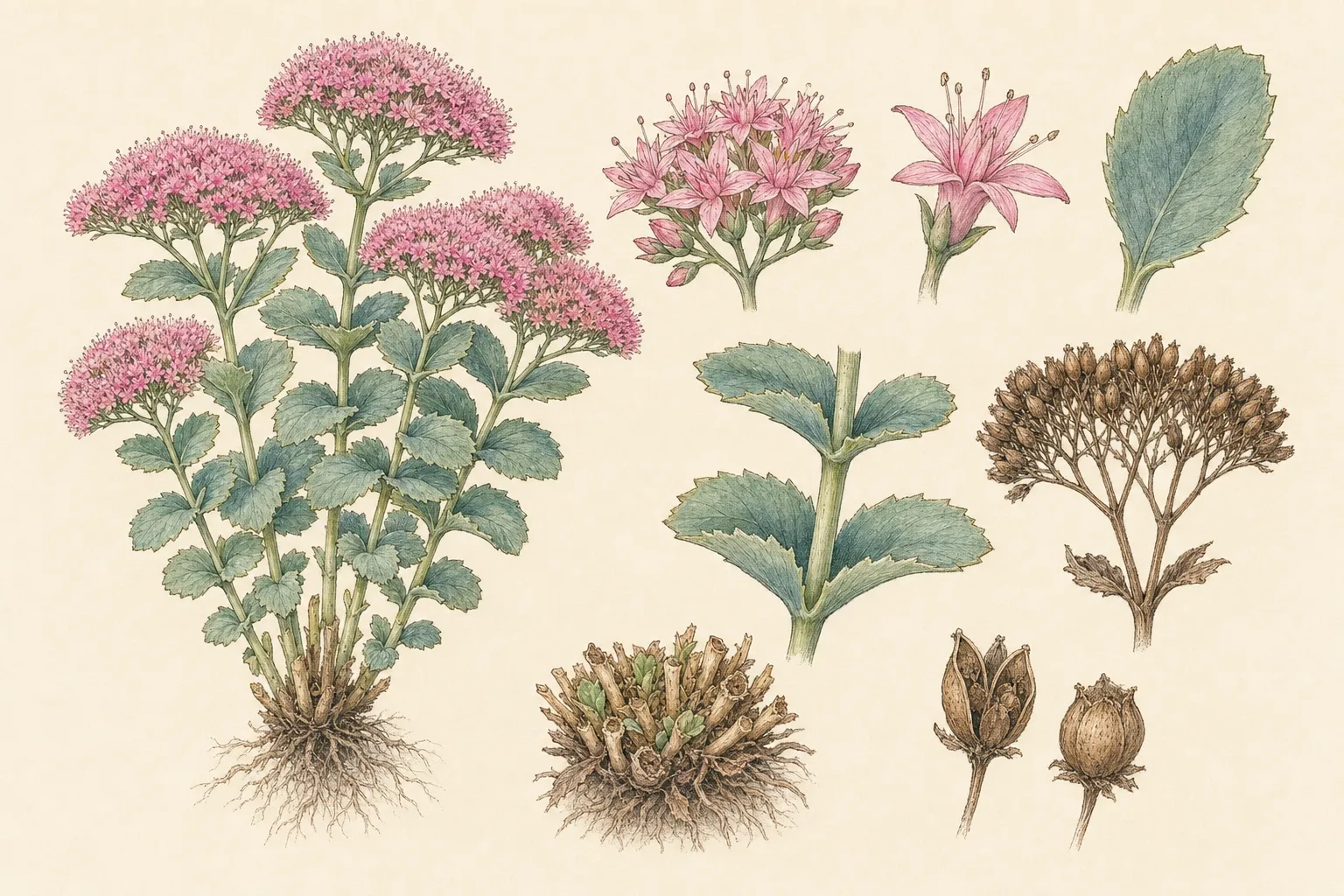
Hylotelephium spectabile is a clump-forming herbaceous succulent, formerly sold as Sedum spectabile. Thick upright stems carry fleshy blue-green leaves and broad, flat clusters of small pink star-shaped flowers from late summer into autumn.
The flower heads darken to reddish brown and can remain standing after the shoots die back. Place the plant near a path, gravel garden or sunny border front where both the pollinator-rich flowers and dry winter silhouettes can be seen.
Its water-storing leaves do not make wet soil safe. Full sun, modest fertility and rapid drainage keep the stems compact; shade, rich feeding and frequent irrigation produce soft growth that opens at the center or rots at the crown.
The top growth dies to the ground each winter and returns from a perennial crown. It has no woody branch framework, and its annual stems can be pinched only while young or cut to the base after they finish.
- Family
- Crassulaceae
- Range
- Southwestern Primorye, northern and east-central China, and Korea
- Soil pH
- 6–8
- Spread
- 1–2 ft · 30–60 cm
Planting & careHow to grow showy stonecrop
Guidance fits temperate gardens in USDA zones 4–9. Winter survival depends less on heavy protection than on a crown that remains well drained through cold, wet weather.
- 1Choose a dry, sunny position
Allow a clump roughly 1–2 feet high and wide in full sun, clear of taller neighbors that would shade or lean over its succulent stems.
- 2Test drainage before planting
Use gravelly, sandy or otherwise well-drained ground; do not place the crown in a hollow that stays wet after rain.
- 3Keep the crown at soil level
Set the herbaceous crown at its nursery depth and leave the bases of the fleshy stems exposed rather than burying them under soil or mulch.
- 4Water sparingly after establishment
Water the new root ball, then let the soil dry between later irrigations; established plants tolerate drought better than repeated saturation.
- 5Avoid rich amendments
Backfill with the site soil and skip routine high-nitrogen feeding, which encourages weak, floppy stems rather than improving the succulent clump.
Pruning showy stonecrop
For a compact clump, pinch or shorten young stems in early spring; a late-May cut by up to half can also reduce splaying but delays bloom. After flowering, either cut the spent annual stems to the crown or leave sound seed heads for winter, then remove them before new shoots emerge.
Seasonal care
Spring
Clear old stems before new shoots expand, divide the crown if needed, and pinch young growth only when a shorter, later-flowering clump is the goal.
Summer
Let the soil drain between waterings and inspect succulent stems for splaying, aphids, mealybugs or slug damage without feeding soft growth.
Autumn
Watch flat pink flower heads deepen to brown, then decide whether to leave the dry stems for winter structure or cut them to the crown.
Winter
Keep the dormant crown free of wet leaf litter and standing water; remove any remaining dry stems before spring shoots appear.
Safety and garden spread
Common problems
Open or floppy clump
- Look for
- Soft stems spreading away from a hollow center before flowers mature.
- Action
- Increase sun, reduce irrigation and fertility, and use an early-season pinch next year if the cultivar still needs a more compact habit.
Crown or root rot
- Look for
- Soft dark stem bases, collapsing shoots or a crown that fails after wet weather.
- Action
- Stop irrigation, clear wet debris and improve drainage; remove irrecoverably soft tissue and replace the plant only in a drier position.
Sap-feeding insects
- Look for
- Clusters of aphids, cottony mealybugs, sticky residue or distorted young leaves.
- Action
- Confirm the insect, remove small colonies physically where practical and use a locally recommended control only if damage continues.
Slug or snail feeding
- Look for
- Irregular holes and scraped areas on low leaves, often with slime trails.
- Action
- Reduce damp shelter around the crown, inspect after dark and use regionally appropriate management only after confirming slugs or snails.
Plant details
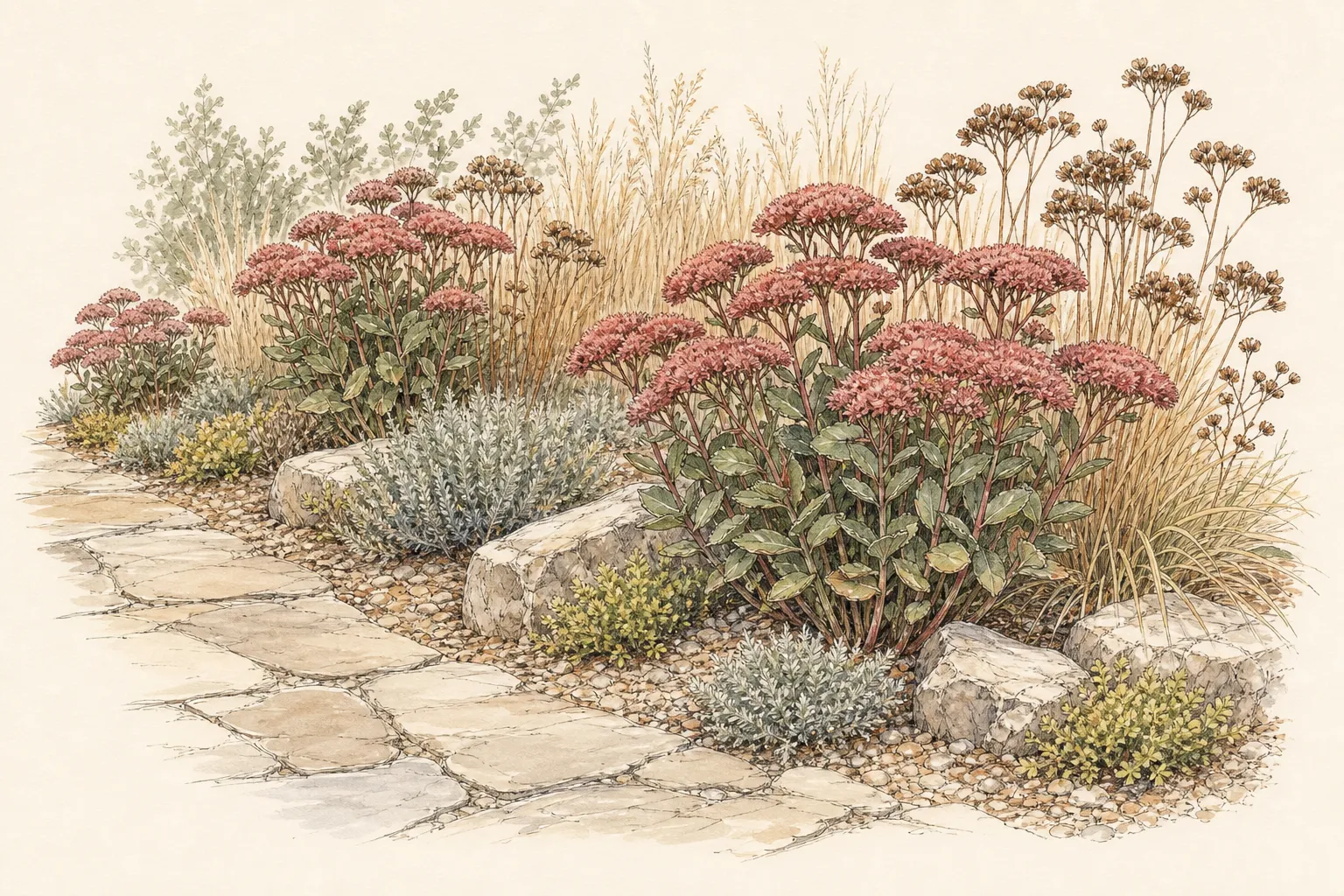
Garden placement study showing mature Showy Stonecrop in an ornamental planting
Sources
- Showy Stonecrop cultivation profile. North Carolina Extension Gardener Plant Toolbox. Source record · Accessed 2026-08-20.
- Hylotelephium spectabile plant profile. Royal Horticultural Society. Source record · Accessed 2026-08-30.
- Hylotelephium spectabile taxonomy and distribution. Royal Botanic Gardens, Kew. Source record · Accessed 2026-08-30.
- CliniTox: Sedum species. University of Zurich. Source record · Accessed 2026-08-30.