Russian Sage
Salvia yangii
A Central Asian deciduous subshrub with silver aromatic stems and a long haze of blue flowers, built for full sun, lean soil, and dry summers after establishment.
Published Last updated
At a glance
- Light
- Full sun
- Water
- Low once established
- Soil
- Lean, sharply drained soil
- Hardiness
- Zones 4–9
- Bloom
- Midsummer to autumn
- Height
- 2–4 ft · 60–120 cm
In this guide
Overview
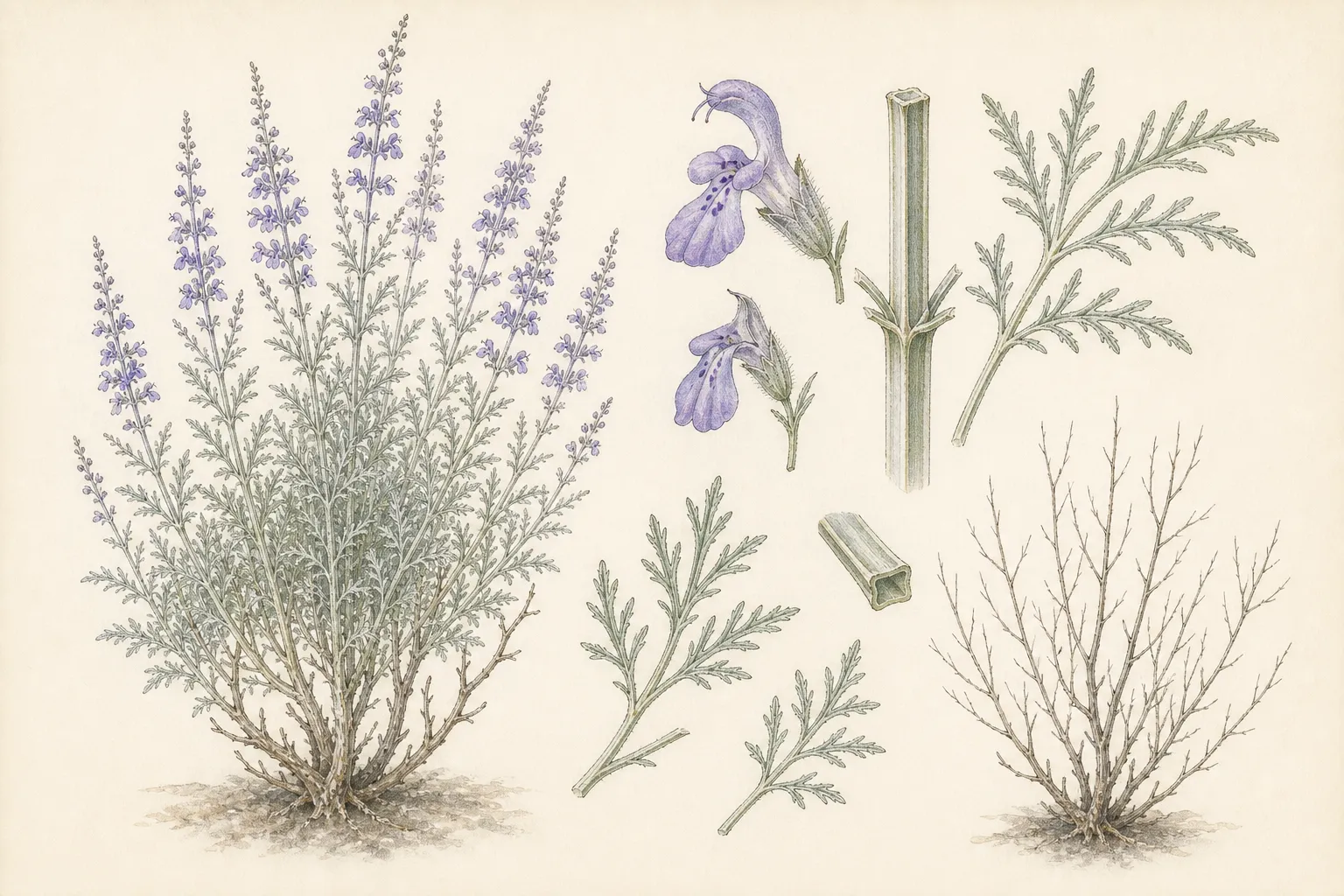
Salvia yangii, formerly Perovskia atriplicifolia, is a woody-based deciduous subshrub from Afghanistan through western China. Square silver-white stems carry aromatic, divided gray-green leaves, and long panicles of small violet-blue flowers create an airy haze from midsummer into autumn.
Species plants commonly reach 3–4 ft, while named selections range from about 2 ft to a similar 4 ft height and width. Mass them in a hot gravel garden or sunny border where the open outline can overlap sturdy neighbors without falling into a path. The cultivar label controls the final spacing decision.
Full sun is essential for strong stems and abundant flowers. Use poor to moderately fertile, sharply drained soil; shade and rich wet ground produce weak growth, while winter saturation can rot the woody base. Soil pH is less important than air reaching the roots after rain.
Plant container-grown material at the same depth it occupied in the pot. Water regularly through the first growing season while a deep root system develops, then reduce irrigation. An established plant tolerates drought well, but a newly planted root ball can still dry before roots reach the surrounding soil.
Leave the old stems standing through winter. In early spring, before vigorous new growth, cut them down to about 12 in to prevent a tall, bare woody base and to renew flowering shoots. This is a once-a-year renewal cut, not repeated summer shearing.
The accepted Salvia name does not turn Russian sage into the culinary herb Salvia officinalis. Treat it as an ornamental. The retained sources do not flag a specific poisoning hazard, but they also do not establish food use, dose, or safety.
- Family
- Lamiaceae
- Range
- Central Asia
- Soil pH
- 6–8
- Spread
- 2–4 ft · 60–120 cm
Planting & careHow to grow russian sage
Salvia yangii is the accepted name for the plant long sold as Perovskia atriplicifolia. Species plants and cultivars range from compact to roughly 4 ft, and winter survival depends strongly on drainage. Keep the nursery label, especially where a compact selection or a wet-winter microclimate changes the expected outline.
- 1Match space to the exact selection
Allow roughly 2–4 ft of height and width, using the cultivar label to narrow that range. Keep enough access to make the annual spring cut without stepping into neighboring crowns.
- 2Test sun and winter drainage
Choose an open site with at least six hours of direct sun and watch where water sits after heavy rain. Dense, persistently wet ground is unsuitable because winter aeration is central to survival.
- 3Keep the woody base at pot depth
Set the top of the container root ball level with the surrounding soil, spread loosened outer roots into a wider hole, and backfill without burying the lowest stems. Water once to settle the soil.
- 4Establish roots, then reduce water
Water regularly during the first growing season whenever the original root ball begins to dry. Once established growth fills out, irrigate only during extended drought and let the soil drain fully between waterings.
- 5Keep the base dry and visible
Use no mulch or only a thin, free-draining layer away from the stem cluster. Do not heap organic material over the woody base, where trapped moisture hides decay.
- 6Leave stems for the first winter
Do not cut a newly planted Russian sage in autumn. Leave the stems to mark and protect the base, then assess winter survival and make the renewal cut in early spring.
Pruning russian sage
Leave the flowered stems intact through winter. In early spring before new shoots expand, cut the old stems to about 12 in above the soil; the RHS also classifies the species for a hard early-spring cut. Remove stems that are clearly dead at the base, but wait for spring bud movement before judging borderline wood. Do not repeat the hard cut during summer bloom.
Seasonal care
Spring
Before vigorous new growth, cut last year’s stems to about 12 in and clear debris from the woody base. Check drainage after thaw and add little or no fertilizer; rich growth is more likely to lean.
Summer
Water first-year plants when the root ball dries below the surface; established plants need water only through extended drought. Keep the plant in full sun and let the long flower panicles develop without shearing.
Autumn
Leave faded flower stems standing and stop routine irrigation as growth slows, while preventing a newly planted root ball from entering winter bone-dry. Remove leaves or mulch that collect against the base.
Winter
Keep the dormant base out of standing water and leave the old stems uncut. Inspect after freeze-thaw cycles for heaving or saturated soil, postponing the annual cut until early spring.
Safety and garden spread
The retained institutional profiles do not identify a specific human poisoning hazard. Russian sage is ornamental Salvia yangii, not culinary sage; do not use its leaves or flowers as food without an authoritative food-safety source.
Common problems
Floppy, open growth
- Look for
- Stems lean and the center opens, especially on a young plant or in shade and fertile soil.
- Action
- Increase light, stop unnecessary feeding, and use discreet support while the plant establishes. Compare the habit with the cultivar label before changing spacing.
Root or base rot
- Look for
- Stems wilt in wet soil, the woody base darkens or softens, or sections fail after a saturated winter.
- Action
- Stop irrigation, expose the base, and correct drainage. Remove irrecoverable material and confirm the diagnosis locally before replanting in a dry, aerated site.
Few flowers in shade
- Look for
- Long pale stems carry sparse bloom while the brightest side of the plant flowers more freely.
- Action
- Move a young plant to full sun during a suitable planting window or reduce safe overhead shade. Do not try to replace missing light with fertilizer.
Unexpected wilt or leaf disease
- Look for
- Powdery growth, one-sided wilt, or spreading discoloration develops despite correct sun and drainage.
- Action
- Isolate the symptom pattern, remove badly affected debris, and ask a local diagnostic service to distinguish powdery mildew, vascular wilt, or root disease before using a labeled control.
Plant details
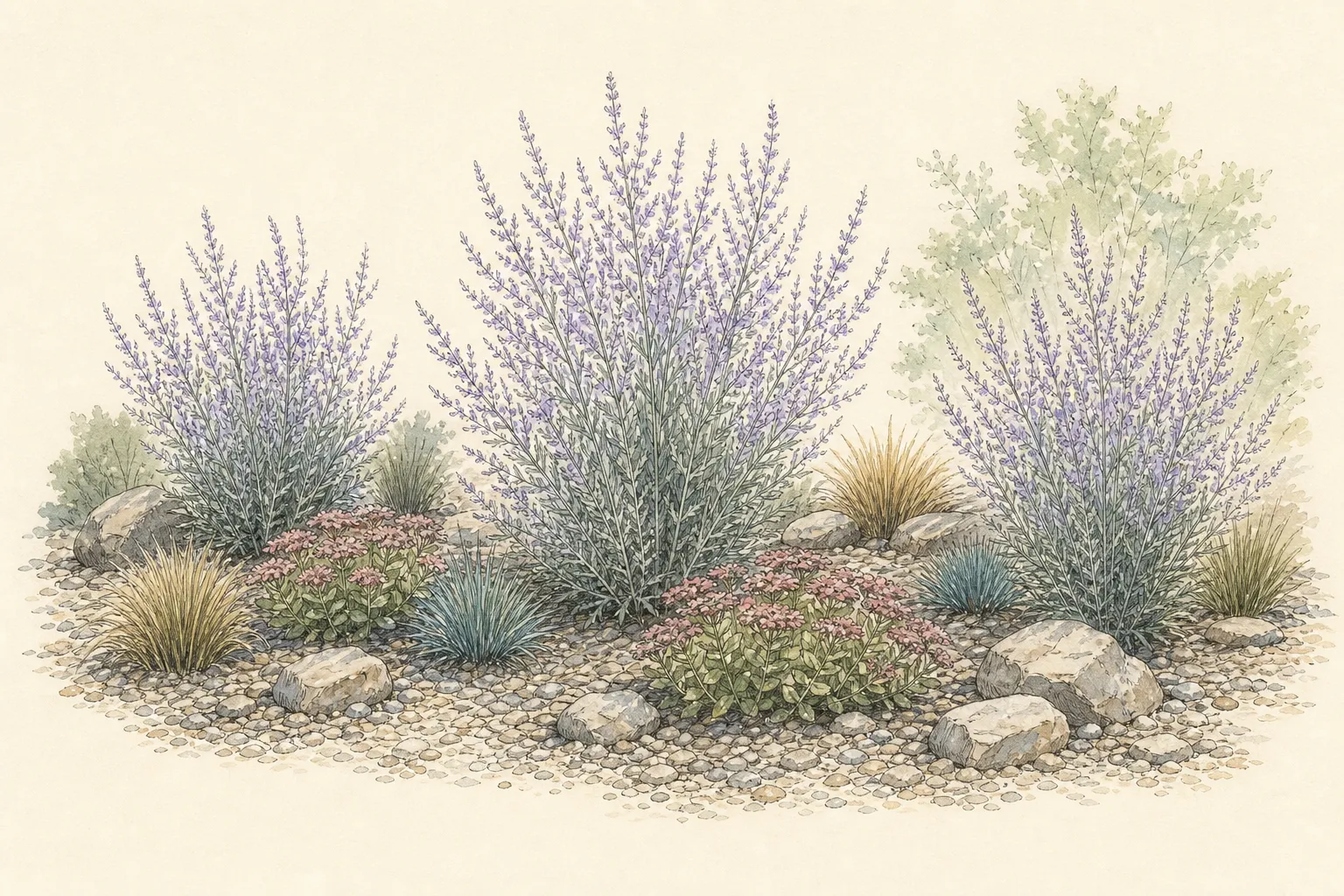
Garden placement study showing mature Russian Sage in an ornamental planting
Sources
- Russian sage, Salvia yangii (Perovskia atriplicifolia). University of Wisconsin Extension. Source record · Accessed 2026-08-30.
- Salvia yangii (Pe). Royal Horticultural Society. Source record · Accessed 2026-08-30.
- Salvia yangii B.T.Drew. Royal Botanic Gardens, Kew. Source record · Accessed 2026-08-30.