Red-Hot Poker
Kniphofia uvaria
Grow species red-hot poker in full sun and sharply drained soil, protect its rhizomatous crown from winter wet, and prune its leaf fan correctly.
Published Last updated
At a glance
- Light
- Full sun
- Water
- Moderate during growth, lower after establishment
- Soil
- Rich to average, sharply drained soil
- Hardiness
- Zones 5–9
- Bloom
- Late spring through summer
- Height
- 3–4 ft · 90–120 cm
In this guide
Overview
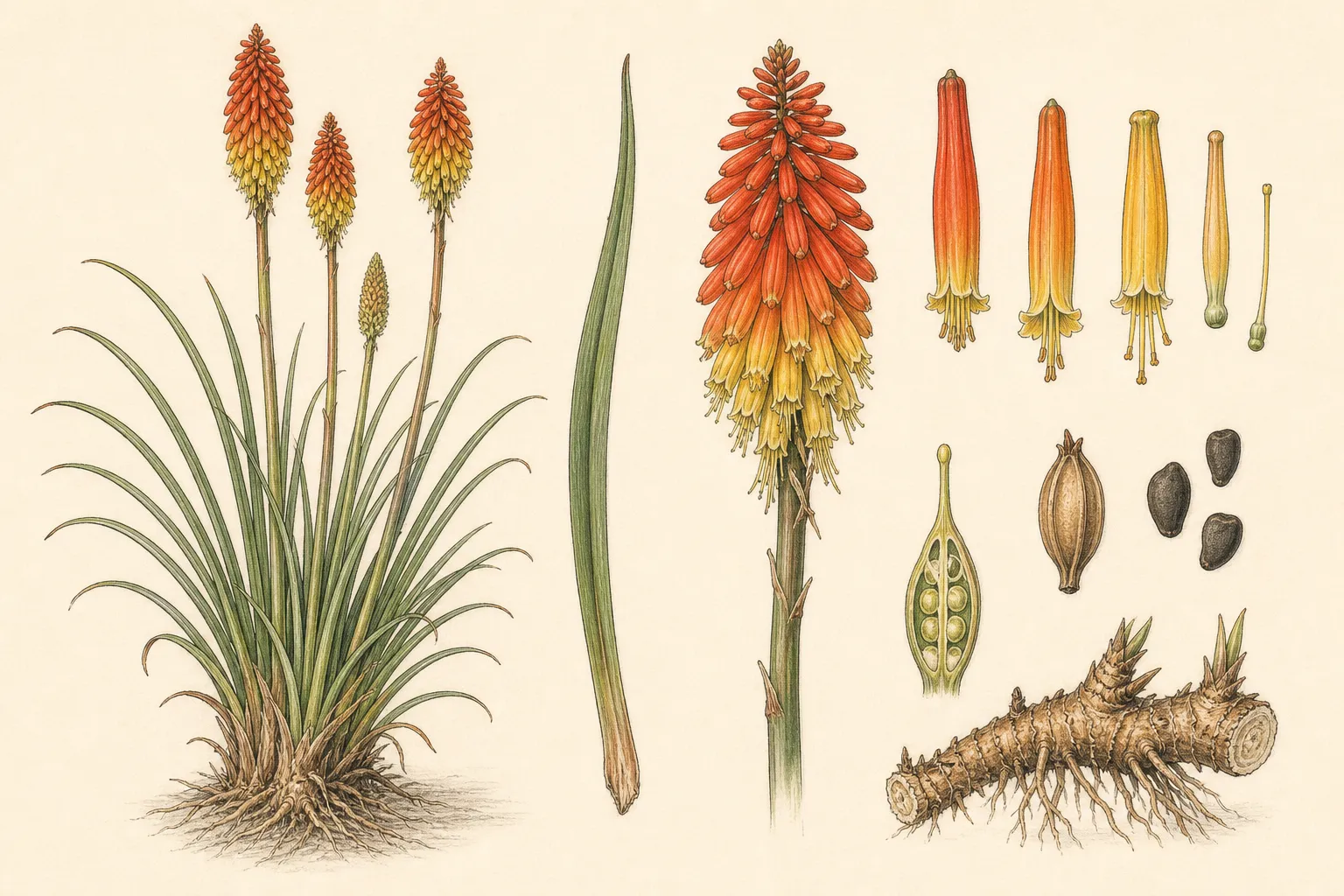
Kniphofia uvaria is a clump-forming rhizomatous perennial with a basal fan of coarse, blue-green strap leaves. Bare scapes carry dense racemes of pendent tubular flowers; red buds mature through orange to yellow, creating the familiar two-toned torch. Many plants sold as red-hot poker are hybrids, so use the full botanical label when species identity matters.
The leaf clump is roughly 2 ft tall, while successive flower scapes commonly reach 3–4 ft; allow about 2–3 ft of width. Position the spikes as a clear vertical accent and leave open air around the basal fan. A wind-sheltered site reduces scape damage without sacrificing the full sun needed for sturdy growth.
Average to humus-rich sandy or loamy soil is suitable only when it drains quickly. The crown is especially vulnerable in cold, wet winter soil, and NC State identifies root rot as the principal cultural failure. Water regularly during first-season growth, then let established soil begin to dry before watering again.
Set a container plant at its existing grade and spread the roots into the surrounding soil. Keep mulch outside the center of the leaf fan so rain and meltwater cannot collect over the crown. A raised, broadly amended bed may help heavy ground, but an isolated amended hole can act as a sump and is not a drainage solution.
The rhizomatous clump can spread and also reproduce from seed, yet established plants respond poorly to needless disturbance. Remove spent spikes promptly when seed is not wanted. If congestion reduces bloom, take offsets from the edge rather than dismantling the entire crown.
In cold climates, local guidance may call for gathering leaves over the crown and applying root-zone mulch before winter. Remove that protection as growth resumes. Cut weather-damaged foliage to about 3 inches in early spring, but retain sound semi-evergreen leaves in mild climates rather than imposing the same hard cut everywhere.
- Family
- Asphodelaceae
- Range
- Southwestern and southern Cape Provinces of South Africa
- Soil pH
- 5.5–8
- Spread
- 2–3 ft · 60–90 cm
Planting & careHow to grow red-hot poker
Kew records this species as introduced in several mild regions, including California, Oregon, and Washington. Because it can spread by seed or rhizomes, check local status before planting and deadhead where escape is a concern.
- 1Reserve the mature footprint
Reserve about 2–3 ft for the leaf fan and up to 4 ft for flower scapes. Choose a position protected from strong wind and far enough from paths that coarse leaves will not flop across them.
- 2Prove winter drainage
Use full sun and observe the site after prolonged rain, not only in summer. Reject a position where water lingers around the crown or where heavy soil remains saturated during freeze-thaw cycles.
- 3Set the crown at container grade
Place the root ball so the center of the leaf fan remains at the surrounding soil level. Loosen circling roots, backfill with site soil, water to settle it, and leave the crown visibly free of mulch.
- 4Water growth without filling the crown
Keep the root zone evenly moist through the first growing season, directing water to soil outside the fan. Established plants need less supplemental water, especially as temperatures fall.
- 5Keep the leaf-fan center open
Pull soil, mulch, and fallen leaves away from the crown. In a cold region, place winter mulch around the root zone and use tied foliage only as locally recommended, never as a wet plug inside the fan.
- 6Disturb the rhizomes only when needed
After flowering, assess whether crowding actually reduced scapes. If division is justified, sever vigorous offsets at the perimeter and replant them promptly instead of breaking apart the whole established clump.
Pruning red-hot poker
Cut spent flower scapes at the base. Retain green leaves through the growing season; in early spring remove weather-damaged foliage or cut a winter-browned fan to about 3 in before new leaves lengthen.
Seasonal care
Spring
Remove winter mulch and tied-leaf protection promptly, cut browned foliage before fresh tips lengthen, and check the crown for soft tissue after thaw.
Summer
Water new plants during dry spells, deadhead each spent torch before seed develops, and monitor wind exposure if loaded scapes begin to lean.
Autumn
Leave sound green leaves in place. In cold regions, prepare the crown protection recommended locally only after growth slows, keeping the root zone drained rather than wet.
Winter
Inspect after freeze-thaw and heavy rain for water trapped in the fan. Maintain root-zone protection without packing mulch into the crown or sealing wet foliage around it.
Safety and garden spread
The retained institutional profiles do not identify a poisoning hazard. The coarse leaf edges can still abrade skin, so gloves are useful when tying or cutting the fan.
Common problems
Winter crown or root rot
- Look for
- The fan loosens, the crown turns soft, or whole sections fail after cold saturated weather.
- Action
- Remove material holding moisture against the crown, stop irrigation, and obtain a local diagnosis. Correct drainage before replacing the plant; a fungicide cannot repair a waterlogged site.
Foliage without many scapes
- Look for
- A mature fan remains leafy but produces fewer flower spikes than in earlier seasons.
- Action
- Check actual sun, excess nitrogen, and rhizome congestion. Divide only if the crown is demonstrably crowded; otherwise correct the site condition and reassess after a full season.
Thrips damage
- Look for
- Flowers or young leaves develop silvery scars, distortion, or tiny dark specks while the crown remains firm.
- Action
- Confirm thrips with magnification or an extension diagnosis before treating. Remove spent infested flowers and use only a locally labeled control if damage warrants it.
Wind-bent flower scapes
- Look for
- Tall flower stems crease or fall after wind while the basal leaves remain healthy.
- Action
- Move future divisions to a sheltered full-sun position and use discreet support before forecast storms. Do not shear the leaf fan or overfeed in an attempt to stiffen the scapes.
Plant details
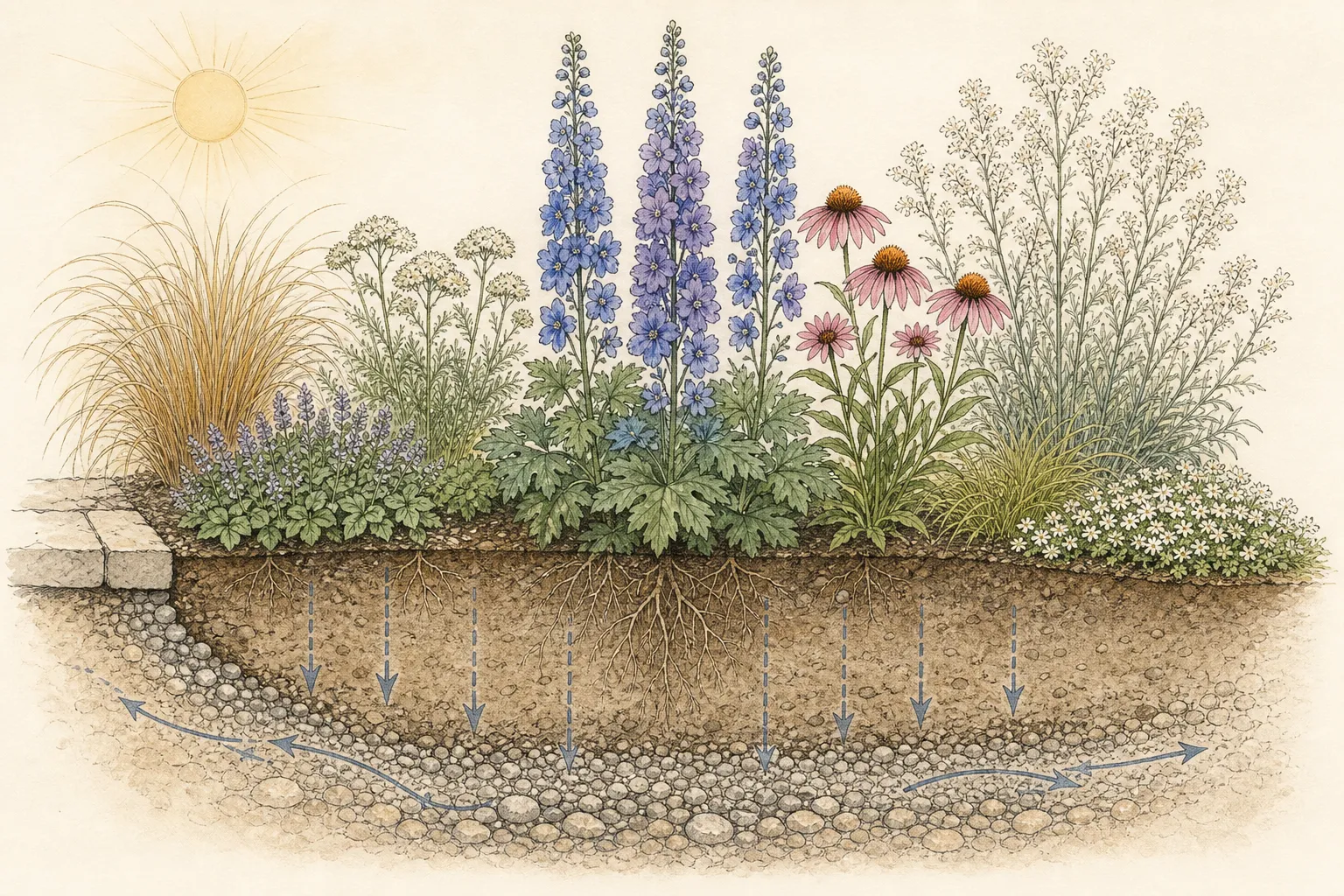
Garden study showing the placement and growth habit of Red-Hot Poker
Sources
- Red-Hot Poker cultivation profile. NC State Extension. Source record · Accessed 2026-08-30.
- Dry-sun perennial profile for Kniphofia uvaria. Missouri Botanical Garden. Source record · Accessed 2026-08-30.
- Kniphofia uvaria taxonomy and native range. Royal Botanic Gardens, Kew. Source record · Accessed 2026-08-30.